

Author: David, Shenchao TechFlow
Apple, the world’s most valuable technology company by market capitalization, has just handed over its CEO position to someone with almost no public profile.
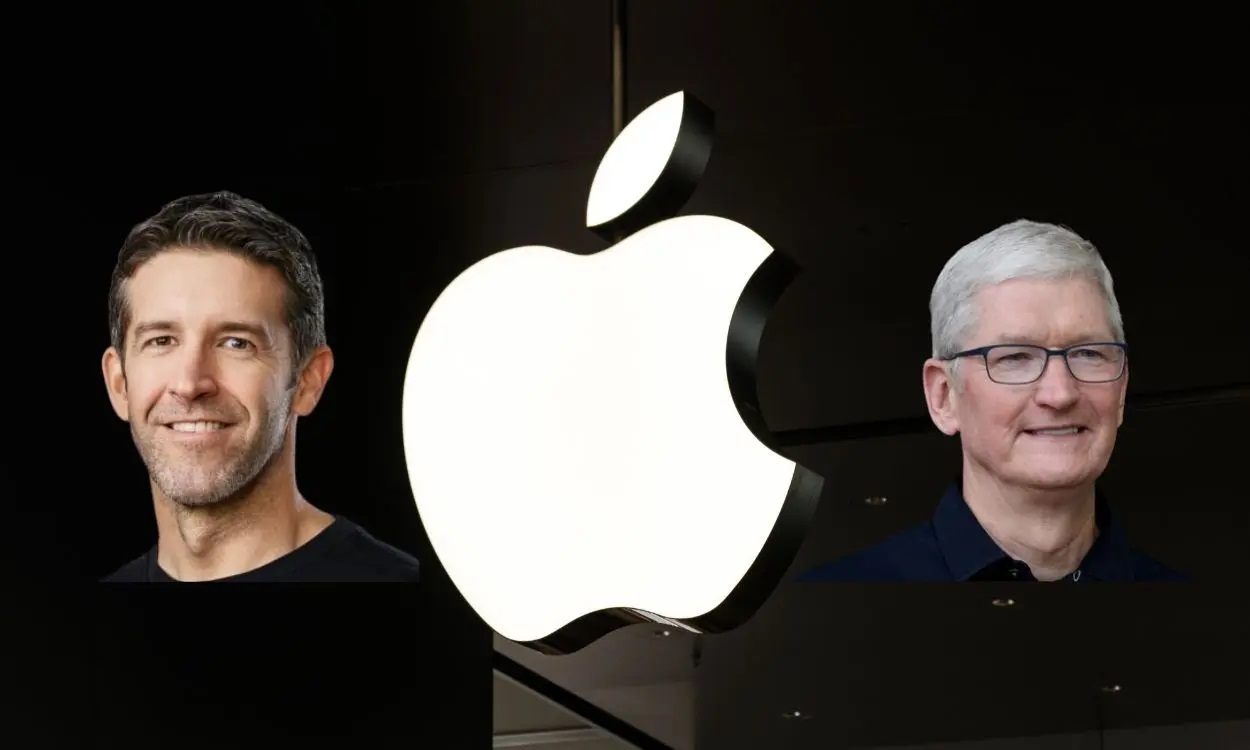
On April 20, Apple announced that Tim Cook will step down as CEO on September 1 and assume the role of Executive Chairman. His successor, John Ternus, aged 51, has been with Apple for 25 years and previously held the title of Senior Vice President of Hardware Engineering.
After the announcement, Apple's stock dipped slightly by less than 1% in after-hours trading. The market's response was calm, perhaps because many had already anticipated it.
Over the past year, Ternus has appeared more frequently at Apple’s product launches. Last year, when the iPhone 17 was released, he was the one greeting the first customers outside the London flagship store.
According to Bloomberg reporter Mark Gurman, Apple’s PR team has been deliberately shifting the spotlight toward this person since last year.
But if you don’t follow Apple’s hardware launches closely, you’ve likely never seen him. He has no social media accounts, rarely gives interviews, and when asked about succession rumors, he simply said five words:
I like my current job.
Apple’s CEOs who have left their mark—Jobs was a fusion of product intuition and marketing genius, while Cook is an expert in supply chain and operations. Their styles are vastly different, but they share one common trait:
Neither of them is an engineer.
But Ternus is. He graduated in mechanical engineering and has been working with parts, molds, and production lines since day one of his career. Before joining Apple, he worked at a little-known company developing VR headsets that still haven't become mainstream today.
And at the time he took over Apple, the company’s greatest concern may have had nothing to do with hardware.
Low-key hardware engineer
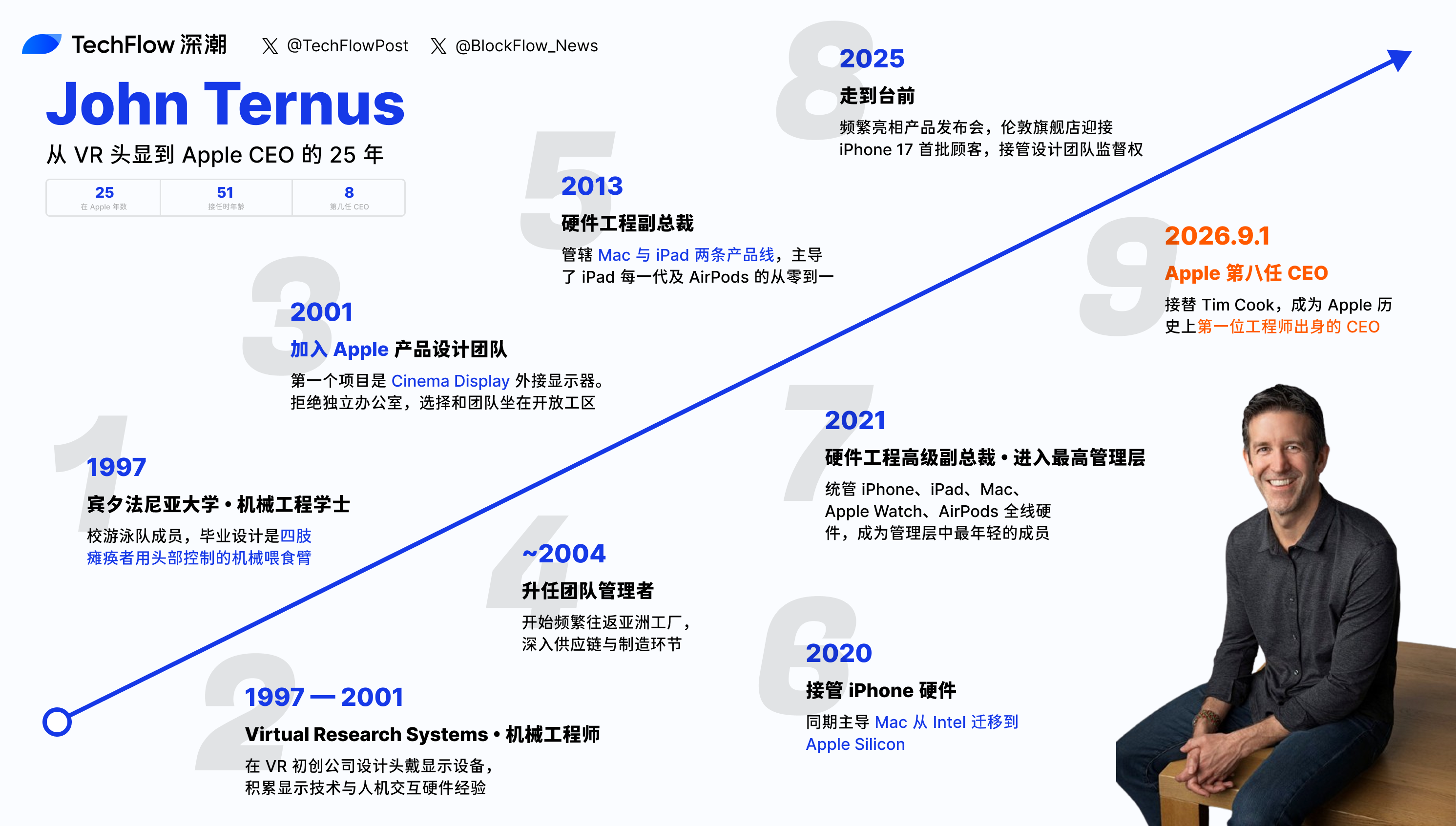
In 1997, Ternus graduated from the Department of Mechanical Engineering at the University of Pennsylvania. He was a member of the university's swim team and won championships in the 50-meter freestyle and 200-meter individual medley.
Public records show that his graduation project was a mechanical feeding arm that allows individuals with quadriplegia to control the arm using head movements to complete eating.
After graduation, he joined a company called Virtual Research Systems as a mechanical engineer working on VR headsets.
In 1997, the VR industry was more than two decades away from Meta investing tens of billions into the metaverse, and even further from Apple launching its own Vision Pro. The company ultimately achieved little, but Ternus spent four years there every day working with display technologies and hardware for human-computer interaction.
In 2001, he joined Apple’s product design team.
That year, Jobs had just pulled the company back from the brink of death, the iPod had not yet been released, and the iPhone was still six years away. Ternus’s first project was designing the Cinema Display, Apple’s line of external monitors at the time.
According to the New York Times, Steve Siefert, Ternus’s first supervisor at Apple, recalled that after Ternus was promoted to management, he was assigned to a new floor with the option of an individual office, but he chose to stay in the open workspace with his team.
When Siefert retired, he left his office to him, but he declined again.
Starting with the display, Ternus worked his way up. According to Apple’s official records, he was involved in the initial development of the iPad and every subsequent generation, and led the hardware engineering of AirPods. In 2013, he was promoted to Vice President of Hardware Engineering, and in 2021, he succeeded his predecessor as Senior Vice President of Hardware Engineering, officially joining Apple’s top management.
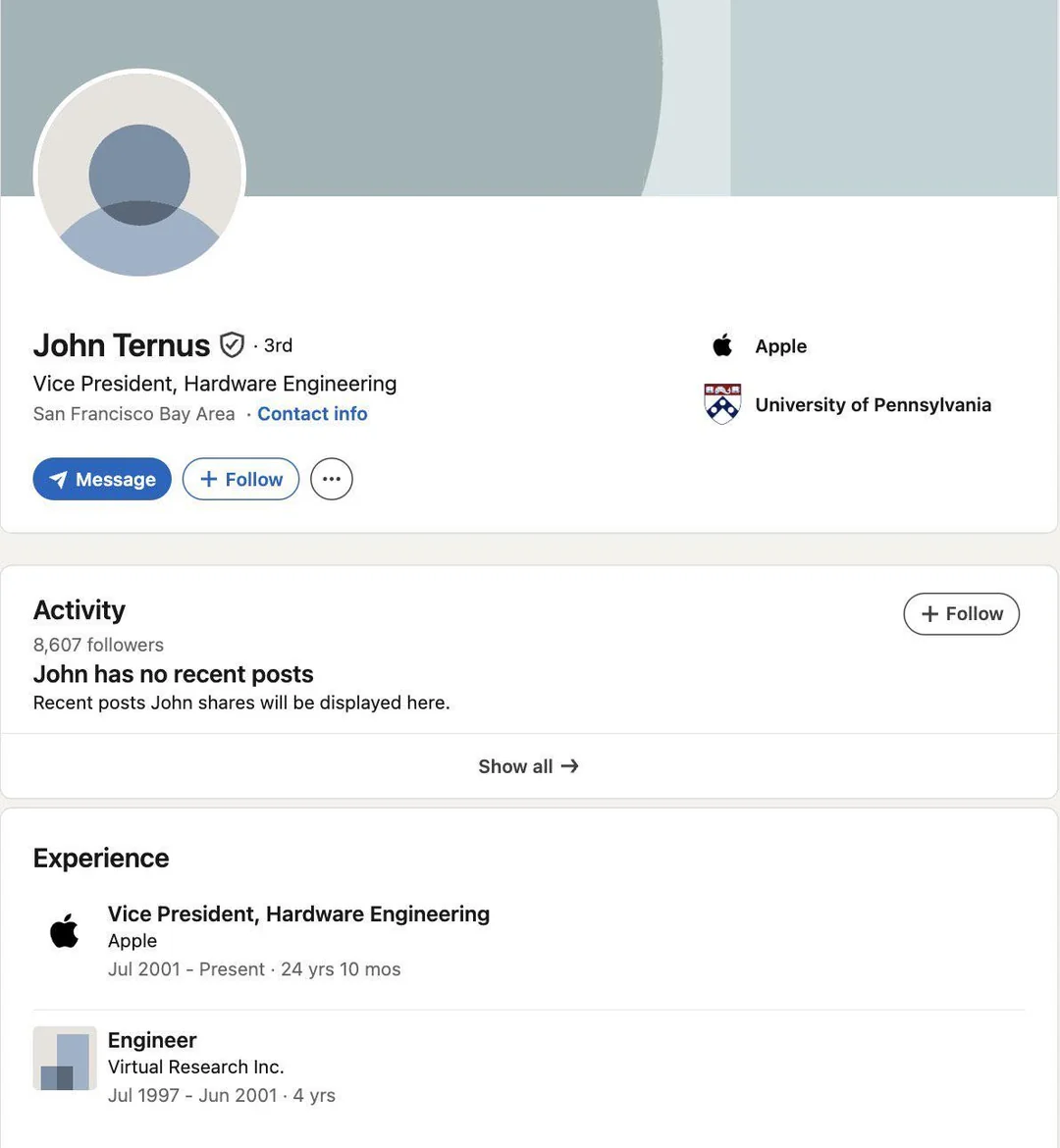
I checked his LinkedIn and found that Ternus is astonishingly low-key—he doesn’t even have a profile picture or any posts. Perhaps until today, he hadn’t cared much about maintaining a public image, preferring instead to focus on hardware.
Internally, he also led a highly impactful initiative: transitioning the Mac product line from Intel chips to Apple’s custom-designed chips.
In 2024, he returned to his alma mater, the University of Pennsylvania, to deliver a speech to the engineering graduates, saying something that, in today’s context, I believe is well worth reflecting on.
Always assume you are as smart as anyone else in the room, but never assume you know more than they do.
This sounds like humility, but for someone about to take over the world’s largest tech company, it’s more akin to an engineer’s survival instinct—you can’t know everything, but you must know who does.
But the company he now leads left him an inheritance far more complex than just an office.
After Cook
Cook served as CEO of Apple for nearly 15 years, leaving a record that would be legendary at any company.
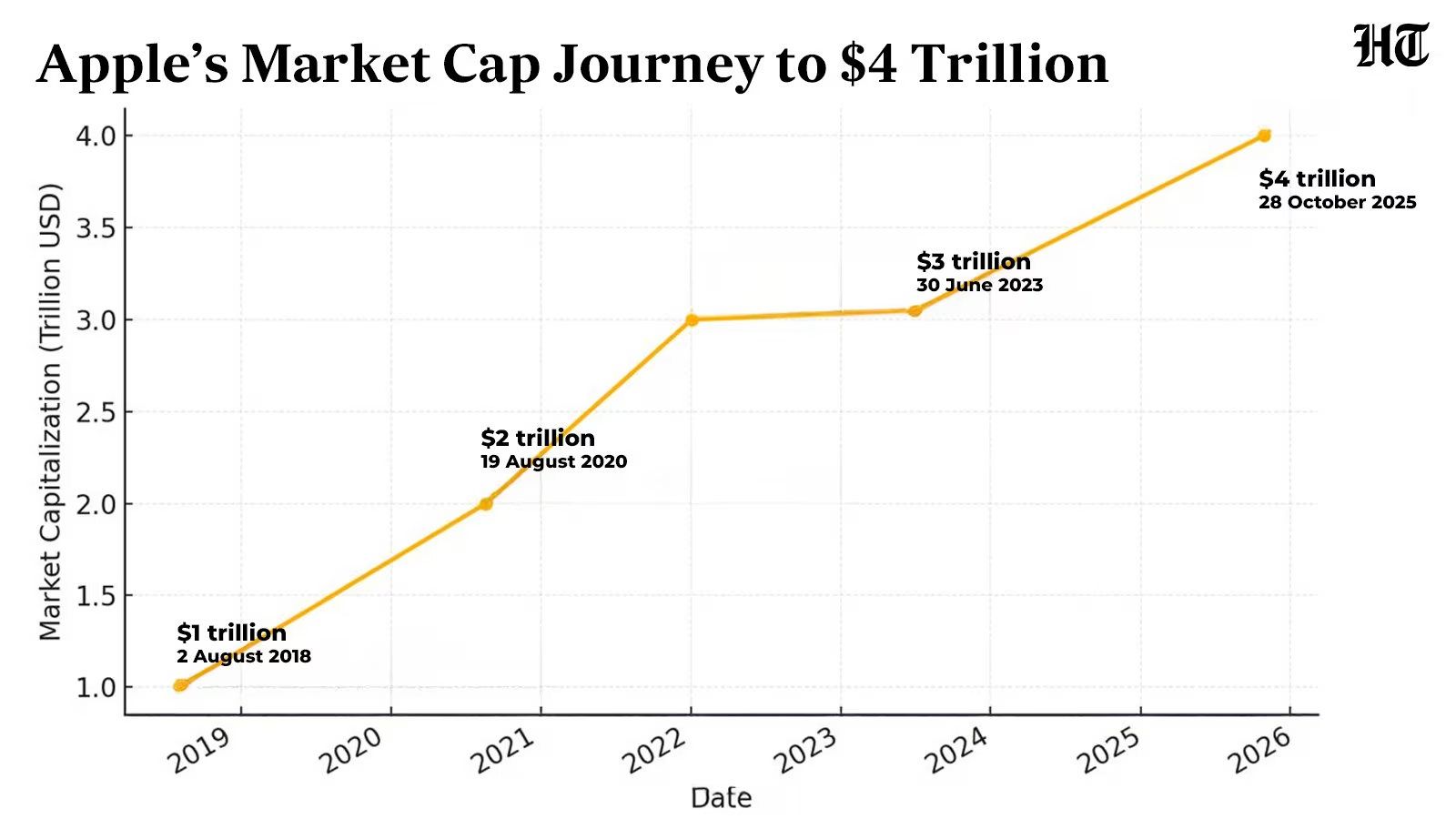
According to CNBC, when he took over the company from Jobs in 2011, Apple’s market capitalization was approximately $350 billion. Today, that figure is $4 trillion—more than ten times higher.
According to Apple’s most recent fiscal year data, the company’s annual revenue exceeded $400 billion, nearly four times what it was when he took over. He also built Apple’s services business—including revenue from the App Store, iCloud, and Apple Music—into a business generating over $100 billion in annual revenue.
A CEO with an operations background turned a product-driven company into the world’s most profitable machine. The author believes that, on this basis alone, Cook has proven the prophecy that "Apple would fail without Jobs" to be wrong.
But he also left some questions unanswered.
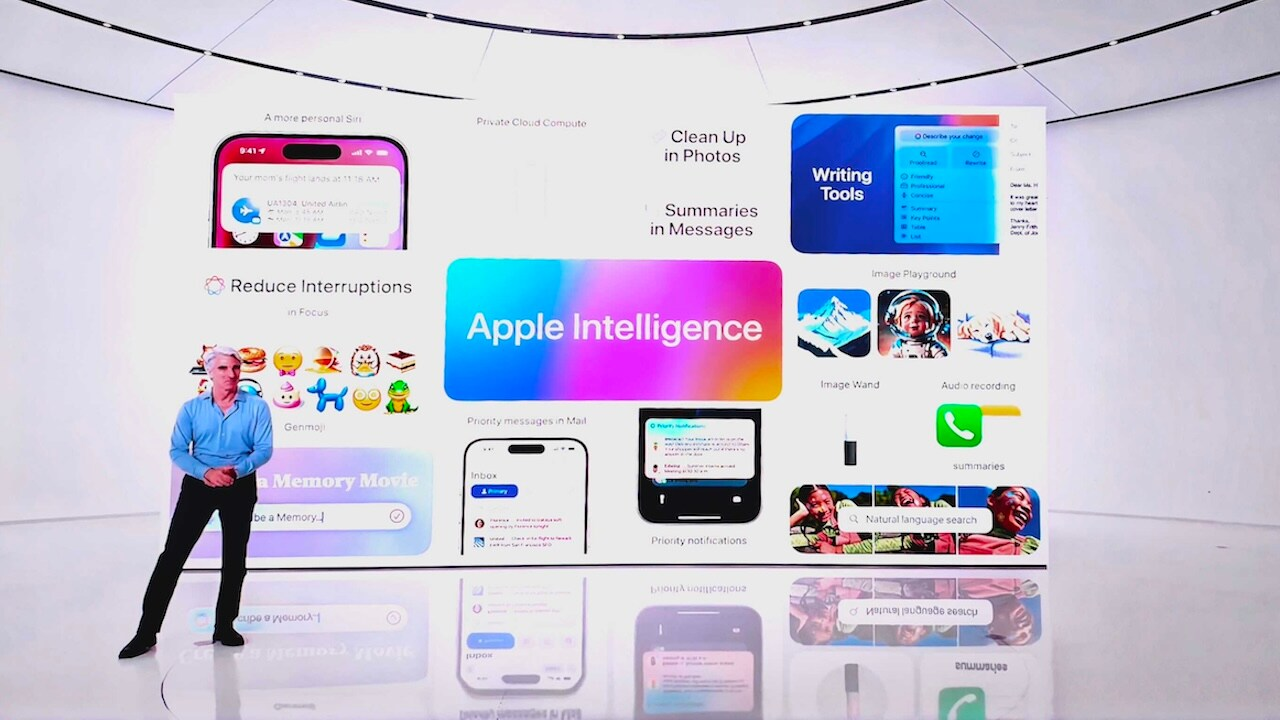
In 2024, Apple prominently launched Apple Intelligence, its official response to the AI wave. The initial marketing focus was on a brand-new, smarter Siri voice assistant.
But this promise has never been fulfilled. Siri has been mocked for years in the AI race—users can’t even rely on it to set an alarm, while competitors’ AI assistants can now write code, conduct research, and help manage schedules.
In January 2026, Apple made a highly telling decision.
According to CNBC, the company announced a multi-year partnership with Google, using Google’s Gemini large model as the foundational technology for Apple’s next-generation Siri. Multiple media outlets previously reported that Apple pays approximately $1 billion annually for this arrangement.
Previously, Apple also tested technologies from OpenAI and Anthropic, but ultimately chose Google. A company known for "doing everything in-house" has opted to pay external partners for its AI needs.
More awkwardly, this external support plan is also being delayed.
The new Siri powered by Gemini was originally scheduled to launch on iOS 18.4, but some features may now be delayed until September this year alongside iOS 19. Apple has been making promises about its core AI features since 2024, yet none have been delivered yet.
Cook also made another less successful big bet: the Vision Pro. This mixed-reality headset, priced at thousands of dollars, received a lukewarm response after its 2024 launch. Consumers were unwilling to pay such a high price for a device weighing over a pound that they must wear on their face.
What Cook failed to accomplish in this category has now fallen into the hands of someone who understands this hardware even better. But the issues with VR headsets can be solved gradually; Ternus faces two more urgent matters.
On June 8, Apple will host its annual developer conference, WWDC, widely expected to be the stage for the official debut of the new Siri powered by Gemini. This represents Apple’s most important public exam in the AI arena, and the one submitting the答卷 will be an engineer who has spent a lifetime building hardware.
In September, the same month Ternus officially became CEO, Apple plans to release its first-ever foldable iPhone, potentially priced above $2,000.
According to Bloomberg, the mass production of this product has been delayed due to supply chain constraints, and initial shipment volumes are likely to be limited.
A software exam and a hardware exam are both putting pressure on the new CEO.
Fear the “soft” but not the hard?
Apple handed both exams to someone with 25 years of hardware experience, so you don’t need to worry too much about the hardware exam.
The delay in mass production of the foldable iPhone is due to supply chain issues, and Ternus has been shuttling between factories and production lines in Asia since 2004—it’s the battlefield he knows best.
Apple’s choice of him over someone with a financial or software background sends a clear signal: the board believes that, over the coming years, the physical form of Apple’s products will remain its core competitive advantage.
But the other exam paper is different.
AI is currently Apple's biggest weakness and is becoming a survival-level issue. The harshest lesson in the tech industry over the past few years has been that the impact of AI on software companies has far exceeded everyone's expectations.
Apple is not currently on the list of potential replacements, as it primarily sells hardware. However, the issue is that if the AI experience on iPhones is always significantly worse than on Android, consumers will eventually vote with their feet.
And the new successor, Ternus, has no experience whatsoever related to software or AI. He is the type of person who can take the magnetic mounting solution for an iPhone screen from concept to mass production—not the type who can decide how Siri should interpret a sentence.
All the products he oversaw at Apple—iPad, AirPods, Mac, and the transition to Apple Silicon—were victories defined by hardware. Whether the software was user-friendly was never a question he needed to answer.
After September 1, this issue is his responsibility.
Apple's arrangement shows that the company is also aware of this risk. After Ternus took office, hardware engineering was entrusted to Johny Srouji, a veteran who had worked on chips at Apple for nearly 20 years, with his title upgraded to Chief Hardware Officer.
Cook will remain as Executive Chairman, continuing to oversee global policy and government relations. Ternus will be freed from day-to-day hardware matters, allowing him to focus his efforts on AI and overall strategy.
The CEO needs to address the direction: What role does AI play in Apple’s products? Is it merely an auxiliary feature, like a camera, or does the hardware become a vessel for AI instead?
Cook did not answer this question, or if he did, the market did not accept his response. Apple's stock price has barely risen this year, while Google's has increased by over 20% during the same period.
Cook's departure at a critical moment in Apple's transition to AI naturally raises questions.
This issue has now been passed to Ternus—a leader within Apple known as "the executive closest to the product"—who suddenly must grapple with a problem far removed from the product.
However, the author is not pessimistic about this candidate.
Engineers have an underappreciated advantage: they’re accustomed to admitting what they don’t know and then finding someone who does. In an era where CEOs compete to perform “I understand AI better than AI,” someone willing to say, “I don’t know, but I know who does,” may actually move more steadily.
Of course, the market and consumers won't give him much time to verify this hypothesis.