




It is April 2026. Lenny Rachitsky sits in front of a podcast microphone, momentarily stunned as Amol Avasare, Anthropic’s Head of Growth, recites the numbers.
Fourteen months ago, Anthropic’s annual recurring revenue (ARR) had just surpassed $1 billion—that was early 2025. Today, one year and two months later, that figure has surged to $19 billion. Atlassian and Palantir, after nearly two decades of operation, have ARR stuck in the $4–5 billion range. Anthropic is effectively generating a new Palantir every few months.
This growth feels almost unreal to everyone sitting inside the company.
While Amol was still a regular user tinkering with Claude, he sighed as he watched this intelligent but commercially clumsy AI. He was certain that these geeks had no proper growth team. Drawing on instincts honed from his own past entrepreneurial ventures, he sent an email to Mike Krieger, the product lead at the time—yes, the very same man who casually co-founded Instagram.
The email didn’t include any pleasantries—it basically said, “Your product is impressive, but you have no growth strategy; we need to talk.”
Mike replied. Amol became the only product manager to break into the fastest-growing company through cold emails, later rising to the top of growth.
Before we continue the story, let’s list three counterintuitive insights Amol brought to the table.
Smart growth is deliberately creating precise friction to filter and deeply understand your users.
• Traditional micro-level A/B testing is largely ineffective in the face of AI's exponential surge—either bet on those assets that could potentially grow 1,000-fold, or do nothing at all.
• If the project development time is less than two weeks, do not assign a product manager; instead, have engineers take responsibility for the outcomes.
The success disasters that trap you
Amol’s previous experience driving 70% growth at other companies hardly applied here. He spent most of his day cleaning up what internally were called “successful disasters”—the new model became so popular that traffic instantly overwhelmed the servers or completely flooded existing user pathways.
All the indicators on the screen are green, soaring toward the top right, but the entire team’s nerves are stretched to the breaking point.
In this context, the traditional workplace triangle is beginning to break down. With tools like Claude Code, engineers’ productivity has directly doubled or tripled. Previously, one product manager coordinated with five engineers; now, those five engineers produce code equivalent to that of fifteen.
The PM was overwhelmed by the volume of deliveries and couldn’t keep up. Amol’s solution was straightforward, even a bit blunt—engineers took on the role of PM themselves, handling stakeholder alignment and even arguing with legal teams on their own, for a task that would normally take less than two weeks of engineering work.
If machines can now take over tasks like writing documentation and running data analysis, what will human product managers rely on to survive?
Amol’s strategy is to stop standardizing skills and instead seek out crossover points—look for the unusual combinations of experiences in your own background. Amol has founded businesses, worked in investment banking, and nearly entered sales; ultimately, he combined all of these to drive business growth. In an era where large models can write copy for you, only those with unconventional, cross-disciplinary approaches will avoid being easily replaced by algorithms.
Growth hacking taken over by large models
Human reaction speeds can no longer keep up with the momentum brought by technology.
They launched a project called CASH (Claude Accelerates Sustainable Hypergrowth), which essentially lets Claude take over growth experiments on its own.
The system automatically identifies opportunities, formulates hypotheses, modifies copy and UI code, deploys tests, and finally presents the data results on the table. Amol calculated that this system’s success rate is already on par with that of a junior product manager with three years of experience. As long as brand boundaries are defined, it becomes an tireless machine.
Even writing documents and running data analysis are being handled by machines—what are humans doing?
Amol has handed over all expense reports and meeting room bookings to AI. Even more interestingly, every week he has Claude scan Ami Vora’s public articles and internal Slack messages. Then he asks the AI: Based on your understanding of Ami and what I’ve accomplished this week, how do you think she would respond?
He’s using a large model to thoroughly understand his boss’s temperament. It sounds a bit absurd, but it works incredibly well.
The head that was kicked to pieces
Amol is not the type of Silicon Valley elite who has had an easy, uninterrupted path.
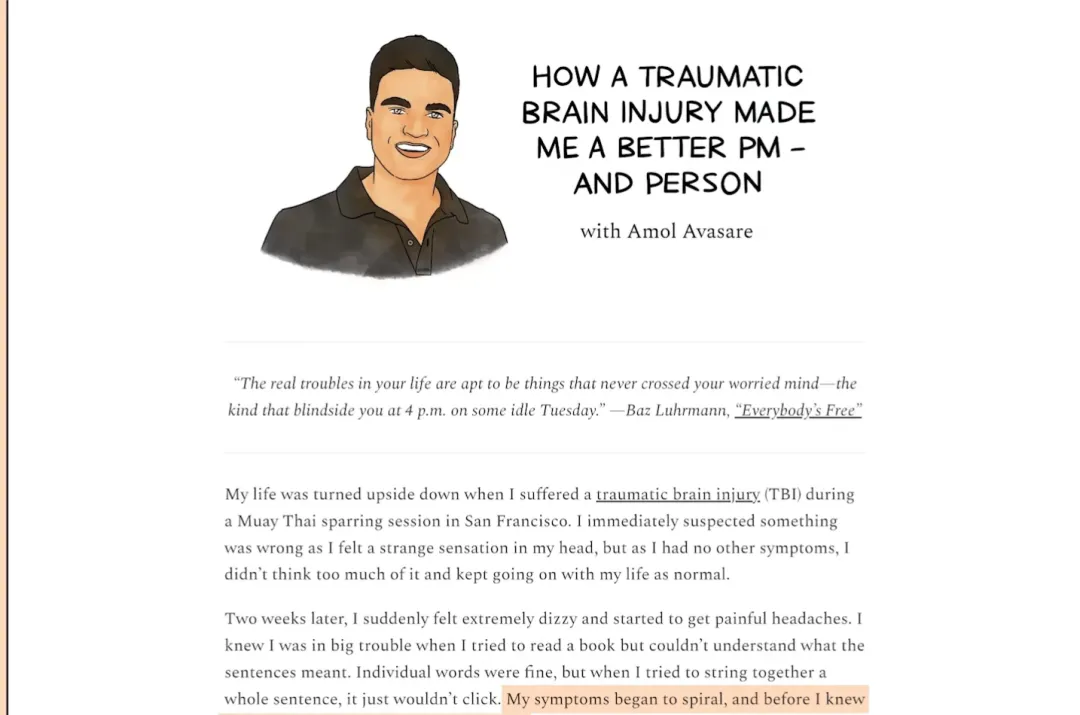
In 2022, during a routine mixed martial arts (MMA) training session, Amol received a solid kick to the head.
Life came to an abrupt stop.
For nine full months, he was unable to work. In the early months, his wife took care of everything for him—except for bathing and using the bathroom. Listening to just 20 seconds of music made him nauseous and vomit; even glancing at a screen sent him into a spinning dizziness. It took him half a year to relearn how to walk like a normal person. At one point, he even discussed with his wife how they would live if he were permanently disabled.
Rehabilitation from brain injury is an extremely grueling process. But it was precisely those days spent teetering on the edge of despair that gave him an extraordinary sense of calm.
Later, he joined Anthropic, and faced with growth curves and work noise that could induce nervous exhaustion, he found he was no longer easily anxious. Someone who had once lost even basic survival skills couldn’t be frightened by a few wildly fluctuating data charts.
Having lost everything, he became obsessed with constraints. Like Anthropic in its early days, which was broke, without Meta’s cash or OpenAI’s first-mover advantage, it had no choice but to bet everything on B2B and code generation. The path they were forced to take due to lack of funds and resources ultimately saved them from meaningless cash-burning battles with big tech giants.
Your Off-Track Recovery Guide
Finally, here are a few clarifying tips for professionals feeling overwhelmed by the AI era.
Learn to keep some money on the table.
Never try to squeeze out the last drop of profit. Sacrificing user experience or compromising security for a few percentage points in conversion rate is extremely short-sighted. By choosing to forgo immediate monetization opportunities in favor of security principles, this restraint—pushing money away—has become Anthropic’s strongest survival barrier today.
Force power off.
Even though the company brings in tens of millions of dollars daily and countdowns for new model releases are everywhere, Amol forcibly unplugs his device in the morning and afternoon to spend ten minutes alone in the office’s meditation area.
The world doesn’t need your ten minutes to change, but you need those ten minutes to confirm that you’re still alive.
After all, even the wildest exponential growth can't withstand a sudden rupture of a fragile blood vessel in your mind.