





Recently, Anthropic released a study that precisely maps which jobs current AI is replacing. The most affected groups are surprising: they are older, more educated, and earn significantly more (47% above average). Moreover, they are nearly four times as likely to hold a graduate degree compared to those not yet impacted by AI.
However, research shows that AI is far from reaching its theoretical capability limits, and its current practical coverage represents only a small fraction of possible use cases. Specifically, while certain tasks are theoretically feasible for AI implementation, they have not yet been scaled in practice, primarily due to multiple barriers including functional limitations of the models, regulatory constraints, barriers to adapting specialized software, and mandatory human verification requirements.
Notably, the company that published this research is the same one that sells the well-known large model, Claude. A company selling AI released data most detrimental to its own interests. Anthropic could have downplayed these findings for commercial reasons, but it chose to disclose them anyway.
The 10 highest-risk professions have been revealed—which jobs lie on the edge?
Before presenting the research findings, Anthropic first noted, “Currently, evidence on AI’s impact on employment remains limited. Our goal is to establish a framework for measuring how AI affects employment and to update this analysis regularly in the future. While this approach cannot capture all the ways AI may reshape the labor market, by building a foundation before significant impacts emerge, we aim to enable more reliable identification of economic disruptions as they occur, rather than attributing them retroactively. AI’s effects may ultimately become very clear—but this framework is especially valuable when impacts are still uncertain, helping to identify the most vulnerable jobs before substitution actually occurs.”
Their reasoning is straightforward. Anthropic developed a new metric called "observed exposure," which doesn't focus on what an AI could theoretically do, but rather on what it is actually doing in real-world professional settings. Currently, this metric is measured using millions of real-world Claude conversations from enterprise users. If you spent four years and $200,000 earning a degree to enter a white-collar profession, the company behind Claude has just confirmed: your job’s exposure level may be higher than that of the bartender who poured your graduation drink.
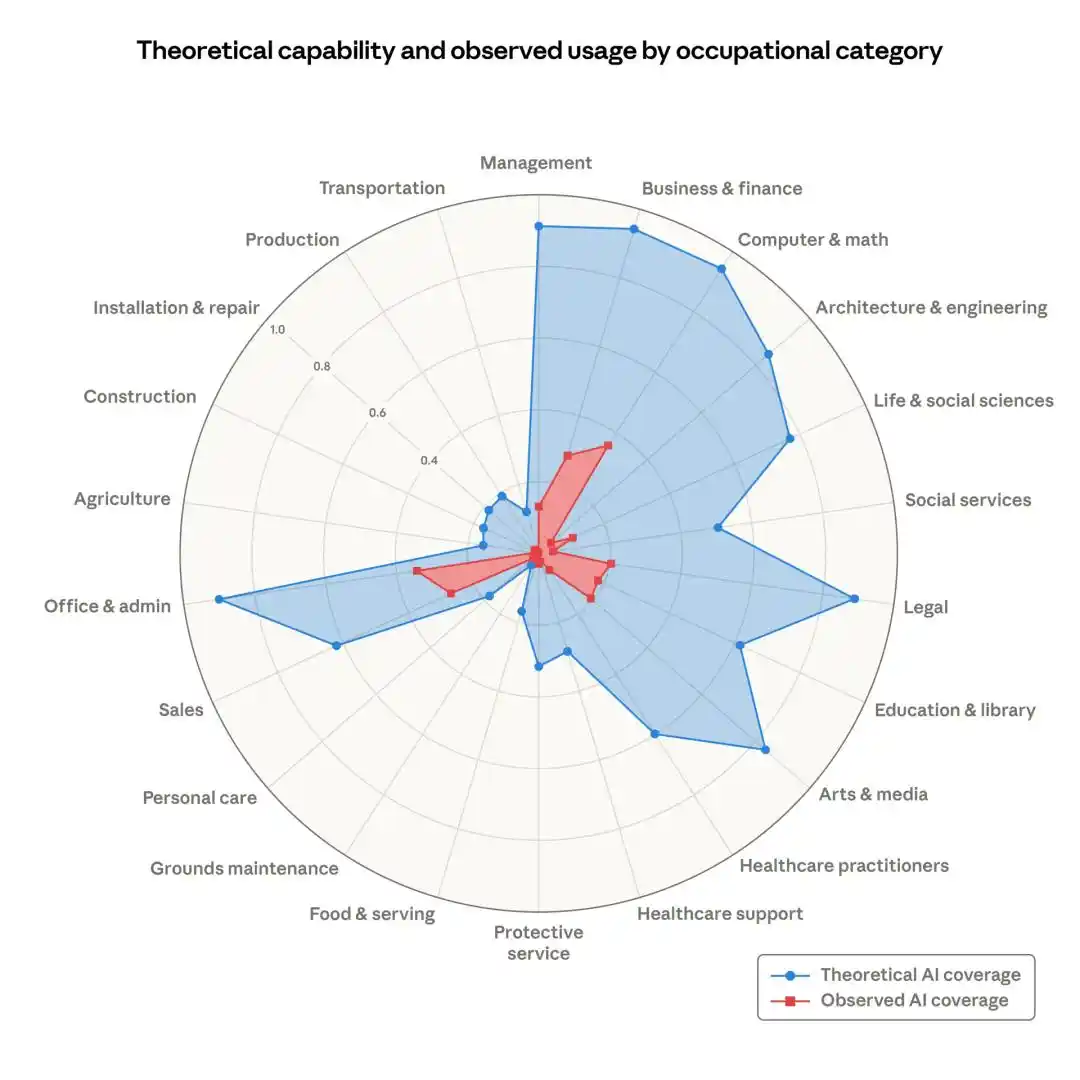
For example, in computer and mathematics-related roles, the theoretical task adaptation rate for large models is 94%, but current real-world coverage is only 33%; in office and administrative roles, the theoretical capability is 90%, while actual usage stands at 40%. The gap between what AI “can do” and what it “is currently doing” remains substantial. Researchers also clearly identify what will happen next: as capabilities improve and applications deepen, real-world usage will gradually catch up to theoretical potential.
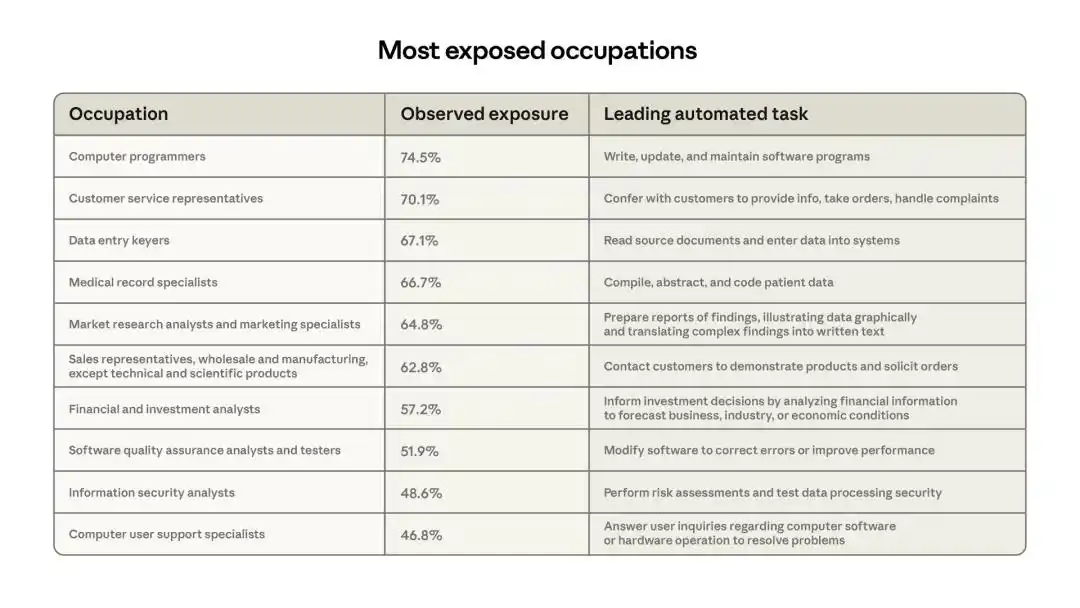
Data shows that among the top ten occupations with the highest actual AI exposure, programmers rank first with a task coverage rate of 74.5%, reflecting the frequent use of AI in code development; customer service representatives rank second at 70.1%, due to high-frequency use of official API interfaces; and data entry clerks rank third with a 67% coverage rate, as their workflow is highly automated.
Looking further down, medical records specialists account for 66.7%; market research analysts and marketing specialists for 64.8%; wholesale and manufacturing sales representatives (excluding technical and scientific products) for 62.8%; financial and investment analysts for 57.2%; software quality assurance analysts and testers for 51.9%; information security analysts for 48.6%; and computer user support specialists for 46.8%.
None of these are predictions—they are real instances of job replacement currently occurring on AI platforms.
Additionally, the technology that is reshaping white-collar professions has had almost no impact on about one-third of the workforce. Among the tail end of occupations, 30% of workers have zero exposure to AI, as their tasks occur too infrequently in the statistical sample to meet the测算 threshold, resulting in an AI task coverage rate of zero. Typical roles include chefs, motorcycle mechanics, lifeguards, bartenders, dishwashers, and locker room attendants. Meanwhile, many jobs remain well beyond the current capabilities of AI, including manual agricultural tasks such as tree trimming and farm machinery operation, as well as legal practice work like court representation.
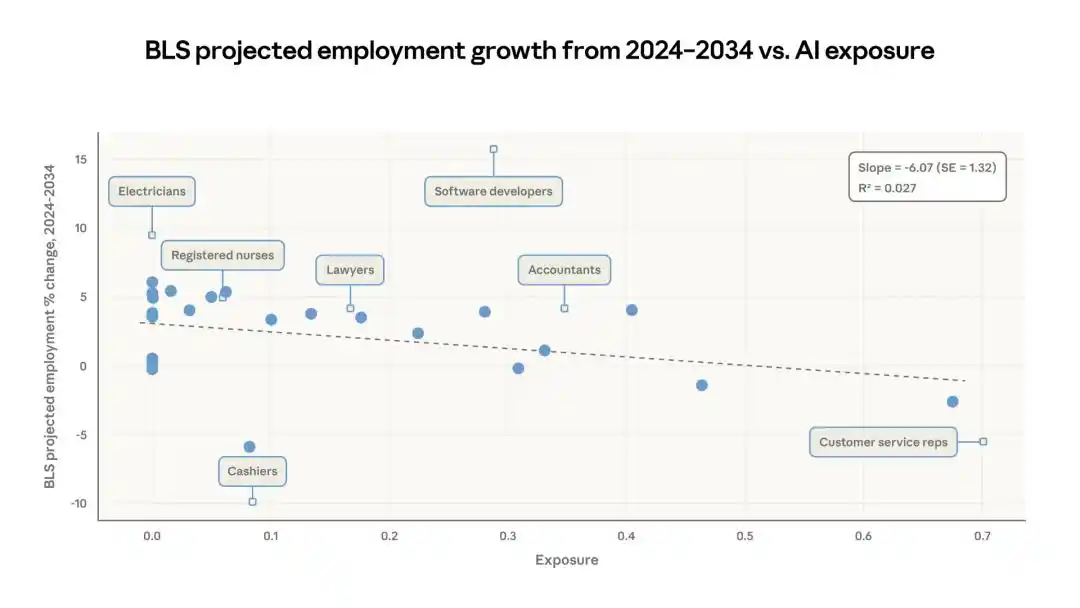
The divide is no longer “high-skill vs. low-skill,” but “whether or not a job is covered by AI.” Conducting an occupation-level regression analysis weighted by current employment levels, the results show: the higher the actual exposure to AI, the weaker the projected job growth. For every 10-percentage-point increase in task coverage, the BLS job growth forecast decreases by 0.6 percentage points. This weak correlation confirms the consistency of this metric with professional labor market analysis data; notably, this relationship cannot be observed using only traditional theoretical skill coefficients (β).
Higher educational attainment, yet easier to become unemployed.
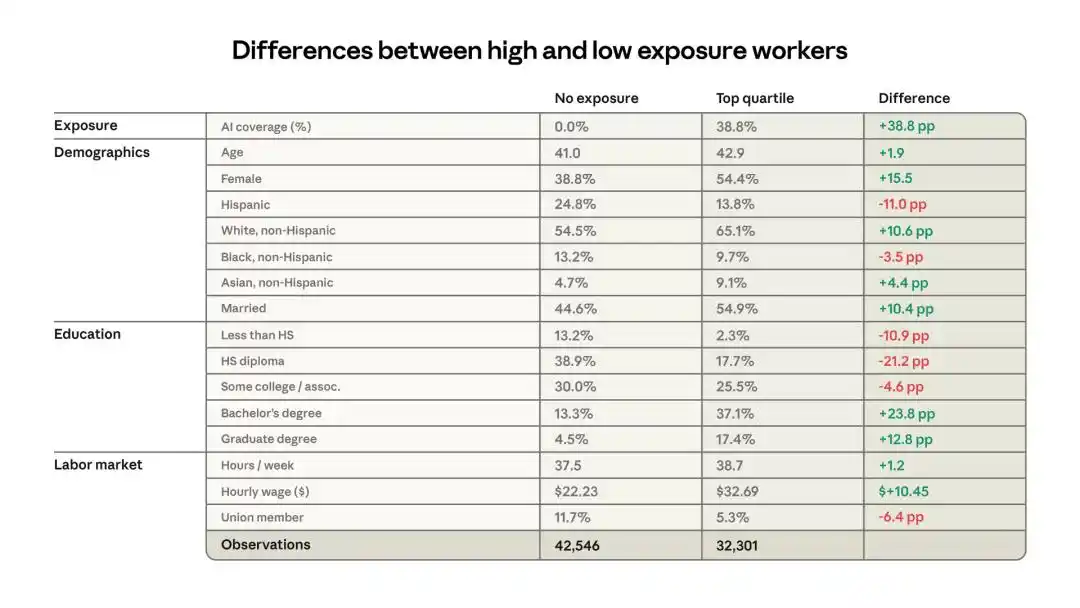
What is truly concerning are the findings at the demographic level. Comparing the profiles of practitioners in the top 25% most exposed group with those in the 30% zero-exposure group reveals significant differences: the highly exposed group has 16 percentage points more women, 11 percentage points more white individuals, and nearly double the proportion of Asian individuals.
Moreover, the group with the highest AI exposure has an average income 47% higher than the group with the lowest exposure, and a generally higher level of education. Among those with zero exposure, only 4.5% hold a graduate degree, compared to 17.4% in the high-exposure group—a nearly fourfold difference.
Stress testing shows that if employees in the top 10% of highest-exposure roles were laid off en masse, the unemployment rate among the top quarter of highest-exposure groups would surge from 3% to 43%, while the overall unemployment rate would rise from 4% to 13%.
And these individuals are precisely the people who were once thought to be “protected by education.” One netizen commented, “To be honest, this is surprising, but it makes sense—they likely possess skills that can be easily transferred to rapidly evolving tech fields.”
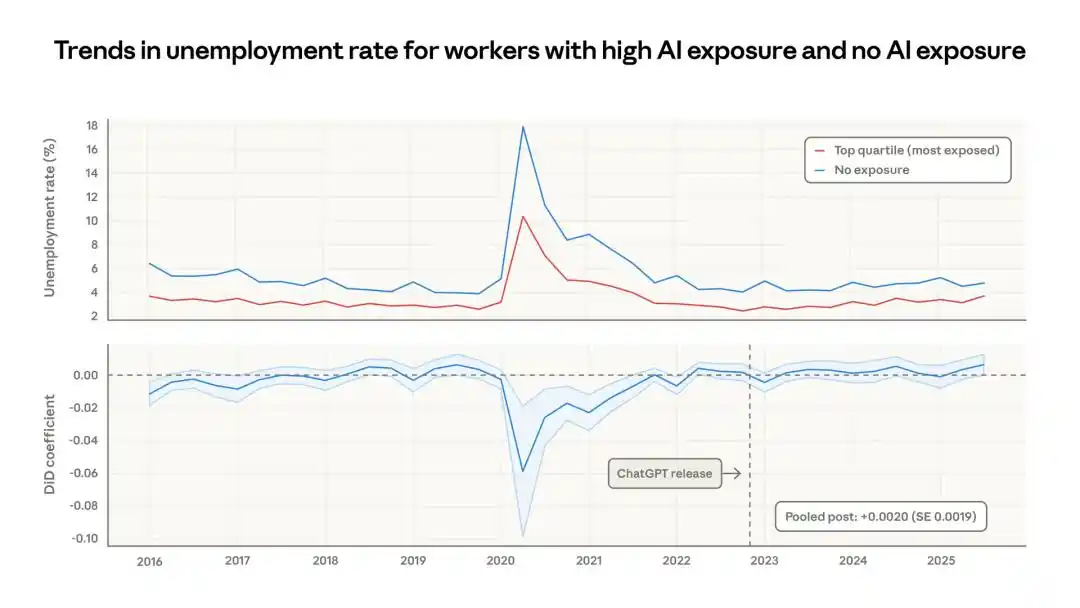
Young workers are particularly noteworthy; Brynjolfsson et al. report that employment in highly exposed occupations among individuals aged 22 to 25 declined by 6% to 16%. The study attributes the reduction in employment primarily to slower hiring by firms, rather than increases in quits or layoffs.
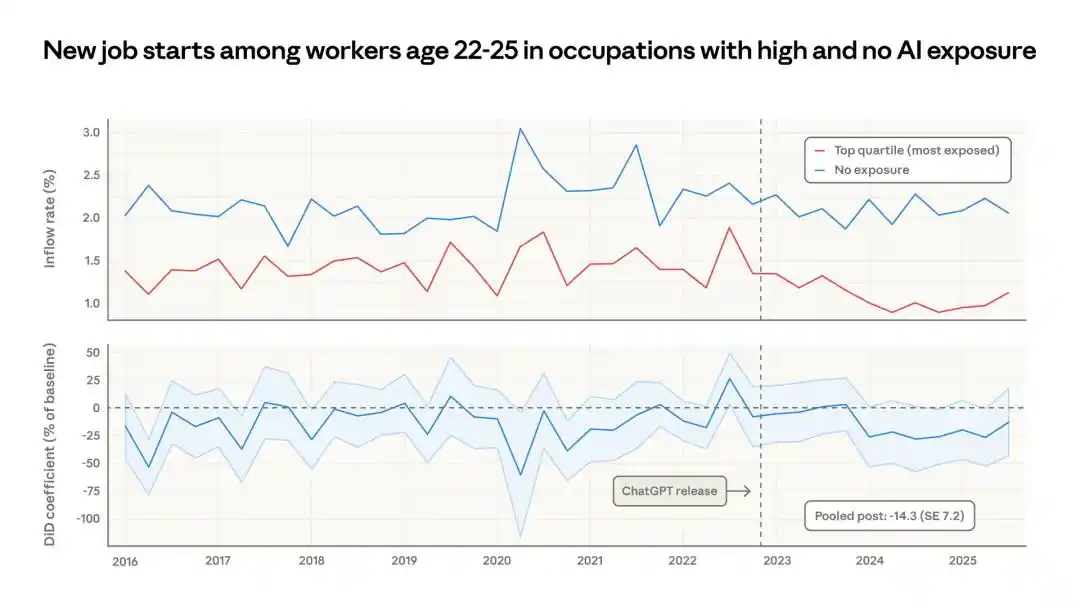
In addition, Anthropic’s researchers found that, after removing the unusual volatility period from 2020 to 2021, hiring trends for young workers in 2024 showed a clear divergence between the two job categories: companies’ willingness to hire youth for high-AI-exposure roles declined significantly. The monthly new hire rate for low-exposure occupations remained stable at 2%, while the proportion of new hires in high-exposure roles dropped by approximately 0.5 percentage points. Overall estimates indicate that since the widespread adoption of ChatGPT, the youth hiring rate in high-exposure occupations has declined by 14% compared to 2022—a result that is marginally statistically significant; no similar contraction in hiring was observed among workers aged 25 and older.
Entry-level positions are never just “jobs”—they are training grounds: junior analysts grow into senior analysts here, and junior lawyers learn how to build arguments here. If this layer disappears, where will future senior professionals come from? This question currently has no answer.
Meanwhile, some netizens have remarked, “If AI replaces all knowledge workers and technical professionals, then when the current training data of models becomes outdated, who will produce the next generation of training materials? Who will create the vast amount of searchable content online—the very core raw material that AI models rely on for generation? Furthermore, when the vast majority of AI’s primary user base faces unemployment, who will continue to bear the enormous computational costs that fund AI’s operation and iteration?”
Reference link: https://www.anthropic.com/research/labor-market-impacts
This article is from the WeChat public account "AI Frontline," compiled by Hua Wei.