





Original Author: New Intelligence
The "value" of your job is being drained by AI. A new report from Anthropic reveals a counterintuitive truth: the more complex a task is—measured by years of education required—the faster AI accelerates its automation. More alarming than being directly replaced is "deskilling"—AI takes away the joy of thinking, leaving you with only menial tasks. However, the data also points to a clear path forward: those who master human-AI collaboration can increase their chances of success by tenfold. In this era of abundant computing power, this is a survival guide you must understand.
Anthropic just released the "Economic Index Report" on its official website yesterday.
The report focuses not only on what people are doing with AI, but more importantly, on the extent to which AI is genuinely replacing human thinking.
This time, they introduced a new set of dimensions called "Economic Primitives," attempting to quantify the complexity of tasks, the required level of education, and the degree of AI autonomy.
The future of work reflected by the data is far more complex than the simplistic "job loss theory" or the "utopian theory."
The harder the task, the faster AI can complete it.
In our traditional understanding, machines are typically good at repetitive and simple tasks, but they appear clumsy in areas requiring advanced knowledge.
But Anthropic's data presents an entirely opposite conclusion: the more complex the task, the more astonishing the "acceleration" brought by AI.
The report shows that for tasks requiring only a high school level of understanding, Claude can increase work speed by 9 times;
Once the task difficulty increases to the level requiring a college degree, this acceleration multiplier surges directly to 12 times.
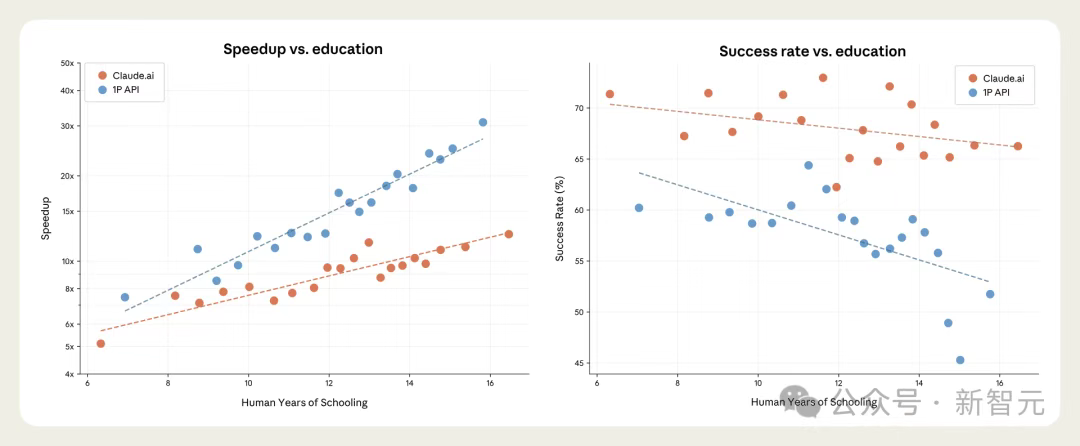
This means that white-collar elite jobs, which previously required humans to think intensively for hours, are precisely the areas where AI is currently achieving the highest efficiency gains.
Even if we take into account the failure rate of AI occasionally generating hallucinations, the conclusion remains unchanged: the significant efficiency gains AI brings to complex tasks are sufficient to offset the costs of correcting its errors.
This explains why today's programmers and financial analysts are more reliant on Claude than data entry clerks—because in these high-intelligence-density fields, AI demonstrates the strongest leverage effect.
19 Hours: The "New Moore's Law" of Human-Machine Collaboration
The most shocking data in this report is the test of AI's "durability" (task horizons, measured by 50% success rate).
Common benchmarks such as METR (Model Evaluation & Threat Research) suggest that current state-of-the-art models (e.g., Claude Sonnet 4.5) have a success rate below 50% when handling tasks that would take a human approximately 2 hours to complete.
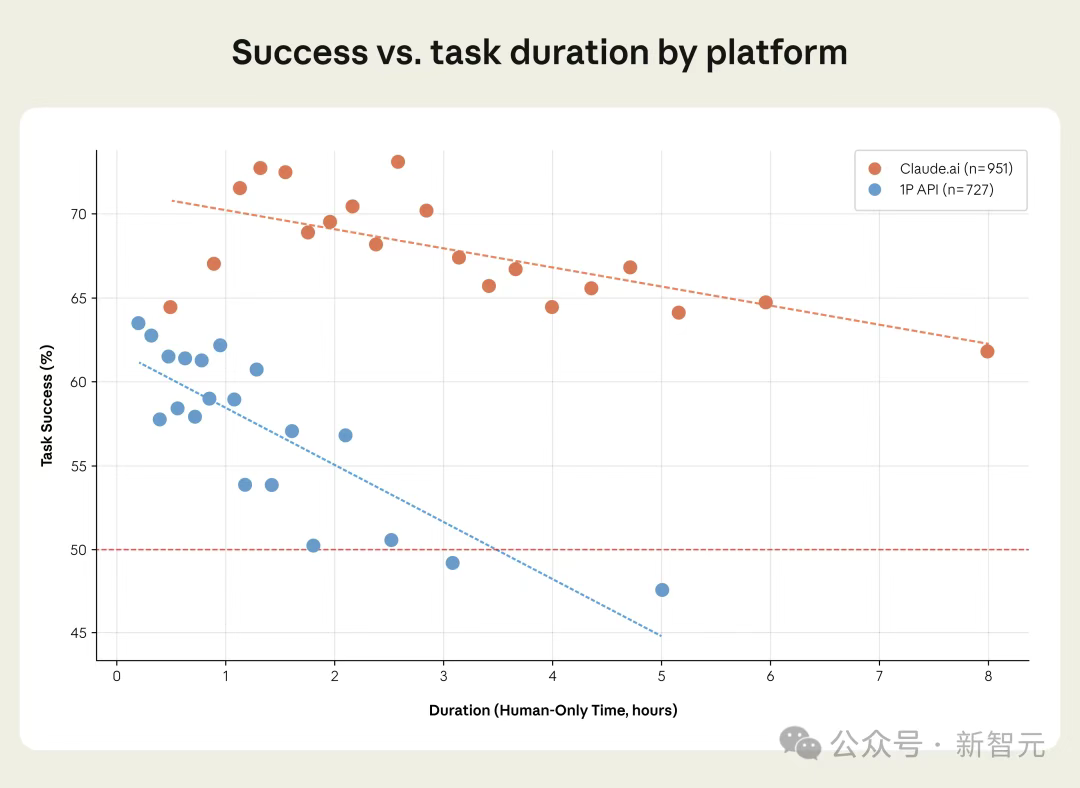
However, in actual user data from Anthropic, this time boundary is significantly extended.
In commercial scenarios involving API calls, Claude can maintain a winning rate of over 50% in tasks requiring 3.5 hours of work.
In the Claude.ai chat interface, this number was surprisingly extended to 19 hours.
Why is there such a huge gap? The secret lies in the involvement of "people."
Benchmarking is like an AI facing an exam paper alone, while in reality, users break down a large and complex project into countless small steps, continuously adjusting the AI's course through iterative feedback loops.
This human-AI collaborative workflow increased the upper limit of task duration (measured by a 50% success rate) from 2 hours to approximately 19 hours, achieving nearly a tenfold improvement.
This might be the true face of future work:It's not that AI completes everything independently, but rather that humans have learned how to harness it to run a marathon.
Folding on the world map: the poor learn knowledge, the rich produce.
If we broaden our perspective to a global scale, we can see a clear and slightly ironic "adoption curve."
In developed countries with higher per capita GDP, AI has already been deeply integrated into productivity and personal life.
People use it to write code, create reports, and even plan travel itineraries.
However, in countries with lower GDP per capita, Claude's primary role is that of a "teacher," with a significant portion of its usage focused on coursework and educational tutoring.
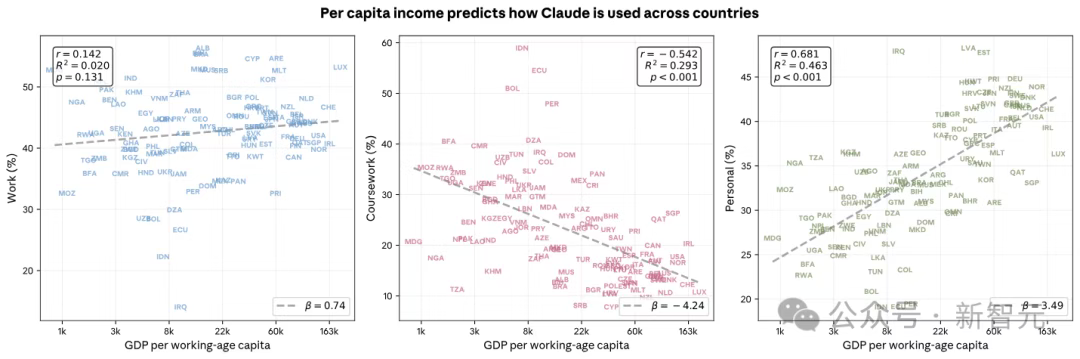
Besides the wealth gap, this is more a reflection of a technological generation gap.
Anthropic mentioned that they are collaborating with the Rwandan government to help people move beyond the basic "learning" stage and into broader application layers.
Because if no intervention is applied,AI is likely to become a new barrier: people in wealthy regions use it to exponentially amplify their productivity, while those in underdeveloped areas are still using it to catch up on basic knowledge.
Workplace Anxiety: The Ghost of "Deskilling"
The most controversial and also the most cautionary part of the report is the discussion on "deskilling."
The data indicates that the average educational background required for tasks currently covered by Claude is 14.4 years (equivalent to an associate degree), which is significantly higher than the 13.2 years required on average for overall economic activities.
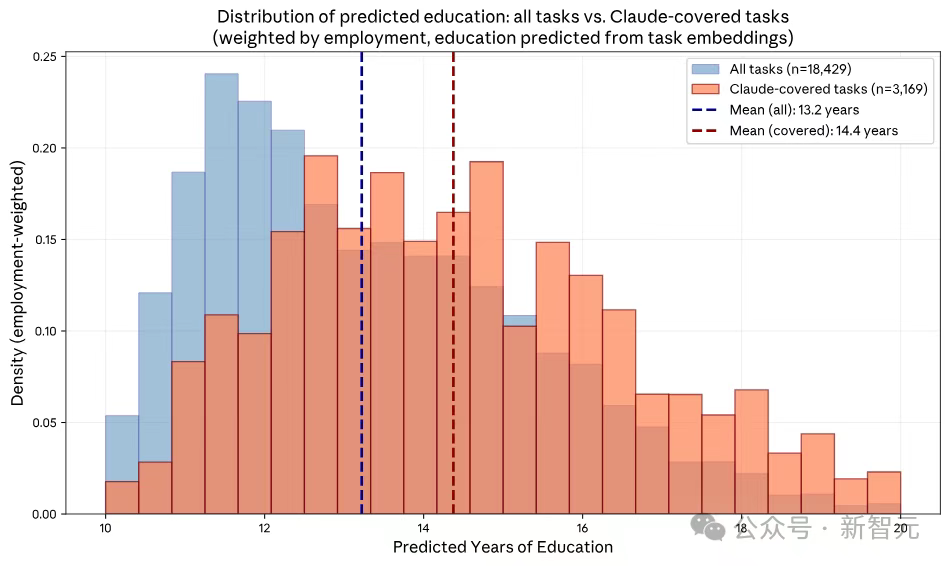
AI is systematically eliminating the "high-intelligence" aspects of work.
This could be catastrophic for technical writers or travel agency agents.
AI takes over the tasks that require "brainpower," such as analyzing industry trends and planning complex itineraries, leaving humans with only trivial jobs like sketching drafts or collecting invoices.
Your job is still there, but the "value" of the work has been drained away.
Of course, there are also beneficiaries.
For example, real estate managers—once AI handles tedious administrative tasks like bookkeeping and contract reconciliation—they can focus their efforts on client negotiations and stakeholder management, which require high emotional intelligence. This, in turn, represents a form of "upskilling."
Anthropic cautiously stated that this is merely a projection based on the current situation, not a certain prediction.
But the warning it sounds is real.
If your core competitiveness is merely handling complex information, then you are right at the eye of the storm.
Return to the "Golden Age" of Productivity?
Finally, let's return to the macro perspective.
Anthropic revised their forecast for U.S. labor productivity.
After excluding potential AI errors and failures, they expect AI to contribute 1.0% to 1.2% annual productivity growth over the next decade.
This appears to be one-third less than the previous optimistic estimate of 1.8 percent, but by no means should this 1 percentage point be underestimated.
This would be sufficient to bring the U.S. productivity growth rate back to the levels seen during the internet boom at the end of the 1990s.
Moreover, this is based solely on the model capabilities as of November 2025. With the introduction of Claude Opus 4.5 and the gradual dominance of the "enhancement mode" (where users no longer attempt to outsource all their work to AI, but instead collaborate with AI more intelligently), there is still significant room for this number to grow.
Conclusion
Going through the entire report, what's most striking isn't necessarily how powerful AI has become, but rather how quickly humans have adapted.
We are undergoing a transition from "passive automation" to "active reinforcement."
In this transformation, AI acts like a mirror—it takes over tasks that require higher education but can be accomplished through logical reasoning, thereby forcing us to seek out values that cannot be quantified by algorithms.
In this era of abundant computing power, the most scarce human ability is no longer finding answers, but defining the questions.
Reference materials:
The link you provided is in Chinese (zh_CN) and needs to be translated into English (en_US). However, the link itself is already in English and points to a page on the Anthropic website discussing "Economic Index Primitives." If you want the content of that page translated from Chinese to English, I can help with that.
The provided link appears to be a placeholder or a non-existent page, as it does not lead to a valid report or content. However, if you'd like, I can help you translate the text from Chinese to English if you provide the actual content you'd like translated. Let me know how I can assist!