


Author: Claude, Shenchao TechFlow
DeepChao Summary: Anthropic launched a two-pronged initiative this week: on April 4, it cut off subscription access for 135,000 OpenClaw instances, and on April 8, it launched its cloud-based Agent hosting service, Managed Agents.
Together, these two moves reveal a shift from selling model APIs to selling AI agent infrastructure. Anthropic, whose ARR has just surpassed $30 billion, is using pricing power and platform lock-in to redefine the rules of the AI agent game.
Anthropic completed two actions within a week; together, their intent is clear almost without needing interpretation.
On April 4, Anthropic officially revoked the ability of Claude Pro and Max subscribers to use their credits through third-party agent frameworks such as OpenClaw, forcing 135,000 active instances to switch overnight to pay-as-you-go or API-based pricing. Four days later, on April 8, Anthropic released the public beta of Claude Managed Agents, offering a complete cloud-hosted infrastructure including sandbox execution, state management, and multi-agent coordination.
Closing one door while opening another. The open-source community’s anger is understandable, but from a business perspective, these two moves serve the same goal: Anthropic is no longer content to be just a model provider—it aims to become the infrastructure platform for the Agent era.
Banning OpenClaw, the $20 all-you-can-eat ends
The popularity of OpenClaw speaks for itself.
Previously, some users ran Agents using Claude’s $20 monthly subscription credit, but the issue lay in the economics: a single heavy user could consume computing costs of $1,000 to $5,000 per day, clearly placing a significant burden on Anthropic.
According to VentureBeat, Boris Cherny, head of Anthropic Claude Code, announced this change on X, stating that the subscription plans were "never designed for usage patterns of third-party tools," and the company needs to "prioritize serving customers who use our own products and APIs."
The timeline makes this matter more nuanced.
In January, Anthropic filed an opposition to the Clawdbot trademark. On February 14, Steinberger announced his departure to OpenAI, where Sam Altman publicly welcomed him. On February 20, Anthropic updated its terms of service to explicitly prohibit the use of OAuth tokens for third-party tools. On April 3, Semafor reported that Anthropic is building its own competitor to OpenClaw, with Chief Business Officer Paul Smith acknowledging that customers "have been asking us to do this." On April 4, full enforcement began.
Steinberger’s response was blunt: “Copy the popular open-source features into your own closed tool, then lock out open source.” He and investor Dave Morin attempted to negotiate with Anthropic but managed to secure at most a one-week delay.
Anthropic offers two transition measures: a one-time credit equal to the monthly subscription price, and up to a 30% discount on pre-purchased usage packs. However, for heavy users, switching from a fixed monthly fee to pay-as-you-go pricing could increase costs by up to 50 times.
Managed Agents: From Selling Models to Selling Runtime
In the same week that OpenClaw was banned, Anthropic introduced its own alternative.
On April 8, Claude Managed Agents entered public beta. According to Anthropic’s engineering blog, the design of this service draws inspiration from operating system abstraction principles: splitting the Agent into three independently replaceable components—session (conversation log), harness (invocation loop), and sandbox (code execution environment)—decoupled so that a failure in any one component does not affect the others.
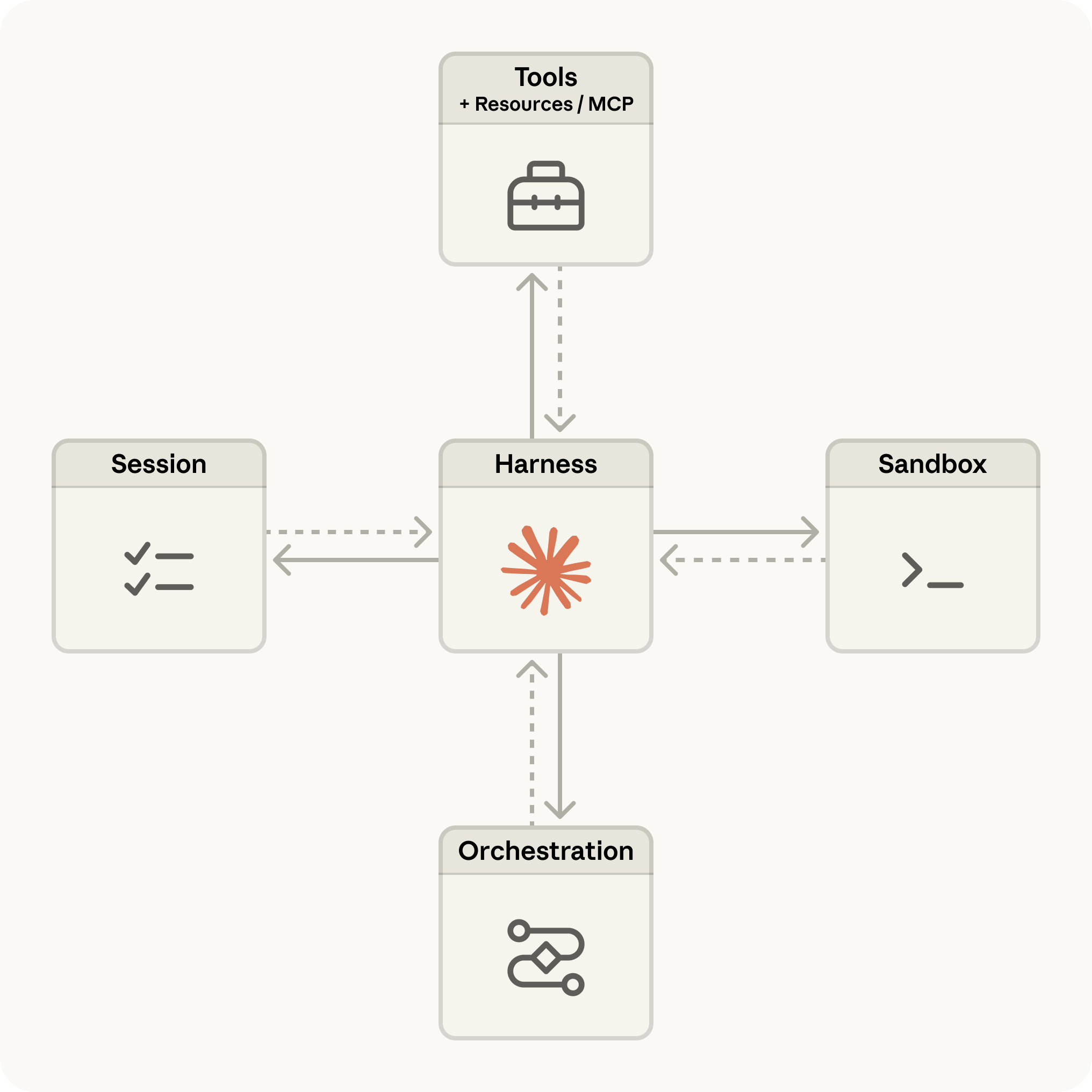
The engineering blog explains in detail why this architecture is necessary. In earlier versions, all components were placed in a single container, turning it into a "pet." When it went down, the entire session was lost, and debugging could not access user data.
After decoupling, containers became "cattle"—if one fails, simply replace it with a new one, and harness resumes from the session log to continue execution.
Regarding pricing, Managed Agents charge an additional $0.08 per session hour (billed in milliseconds) on top of the standard API token fee, with no charges for idle waiting time. Web searches triggered by the Agent are charged at $10 per thousand searches.
According to SiliconANGLE, companies such as Notion, Rakuten, Asana, and Sentry have become early adopters. Asana has integrated Agent into its project management workflow to create an "AI teammate" that can automatically claim tasks and draft deliverables; Sentry has paired its existing debugging Agent with a Claude-powered patch generation Agent, reducing the process from bug detection to pull request submission from months to weeks.
Two features are currently in research preview: first, Agents can initiate sub-Agents when handling complex tasks; second, Agents have self-assessment capabilities, allowing Claude to iterate independently until it meets success criteria defined by developers.
The Platform Economics Behind Two-Step Moves
When viewed side by side, the business logic is very clear.
Anthropic's ARR has just surpassed $3 billion. According to The Information, this figure more than triples from approximately $900 million at the end of 2025, with over 1,000 enterprise customers spending more than $1 million annually.
Claude Code alone generated over $2.5 billion in annualized revenue. At this scale, sustaining 135,000 OpenClaw instances consuming thousands of dollars' worth of compute power at a $20 monthly fee is unsustainable.
However, cost control alone does not explain the timing of the Managed Agents launch.
Angela Jiang, Head of Product at Anthropic, said in an interview that there is still a gap between the capabilities of the company’s models and real-world enterprise use cases, and that Managed Agents aims to enable enterprises to deploy teams of Claude Agents to handle actual workloads.
This is a classic platform lock-in strategy. Once an enterprise’s agents run on Anthropic’s hosted infrastructure, data pipelines, monitoring configurations, and permission systems become embedded in daily workflows, causing migration costs to rise sharply.
For a company valued at $380 billion that is considering an IPO, this stickiness is far more valuable than mere API call fees.
Previously, multiple analysts and social media influencers have expressed the view that "the real battlefield for AI lies in the orchestration layer." Whoever controls the routing and composition logic of agents can make the underlying models interchangeable.
OpenClaw now supports switching between multiple models, including Claude, GPT-4o, and Gemini. After 135,000 users were forced to leave the flat-rate plan, some may turn to local models or other providers.
In February this year, Google took a similar action by banning third-party tools from using OAuth authentication with the Gemini CLI. Taken together, these developments show that the AI industry is shifting from "model competition" to "platform competition."
The unlimited subscription model is ending across the industry; pay-as-you-go and infrastructure bundling will become the new norm.