





Original | Odaily Planet Daily (@OdailyChina)
Author | Azuma (@azuma_eth)

The pre-IPO stock token market has just undergone a severe震荡. The epicenter of this earthquake came from two announcements by Anthropic and OpenAI, two major AI giants.
Anthropic and OpenAI have successively stated that they do not recognize it.
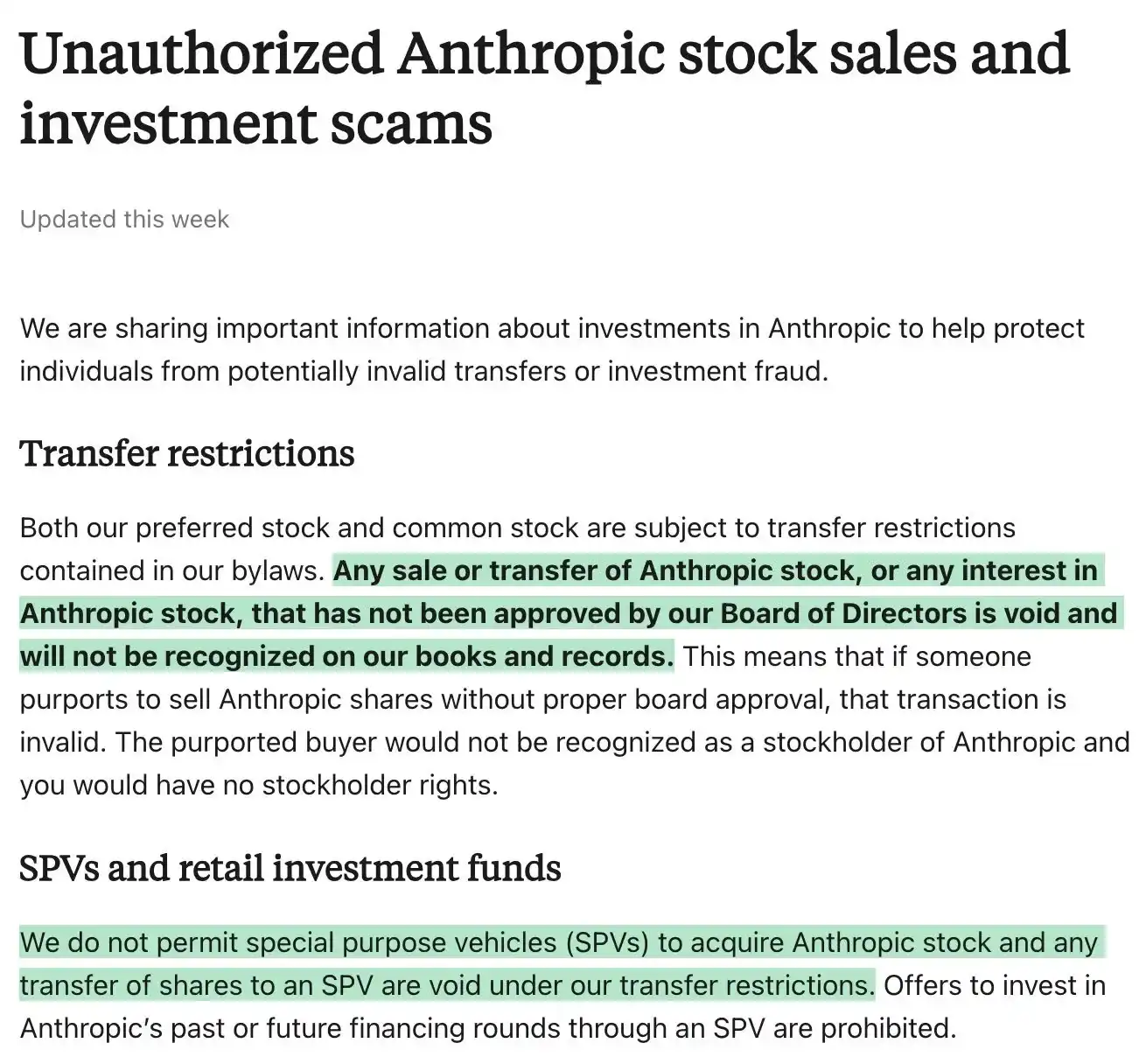
Today, Anthropic updated its official statement released in February of this year, "Regarding Unauthorized Sales of Anthropic Stock and Investment Scams".
Anthropic explicitly states in the article: "Any sale or transfer of Anthropic stock, or any disposition of rights in Anthropic stock, without the approval of our board of directors, shall be void (note the wording is 'void') and will not be recognized on the company’s books and records. This means that if someone sells Anthropic stock without board approval, the transaction will be deemed invalid. The so-called buyer will not be recognized as a shareholder of Anthropic and will not be entitled to any shareholder rights."
Shortly after Anthropic’s update, OpenAI also issued a statement saying: “All equity is subject to transfer restrictions. No shares may be transferred, directly or indirectly, without the company’s written consent. Any sale without consent is both unauthorized and invalid.”
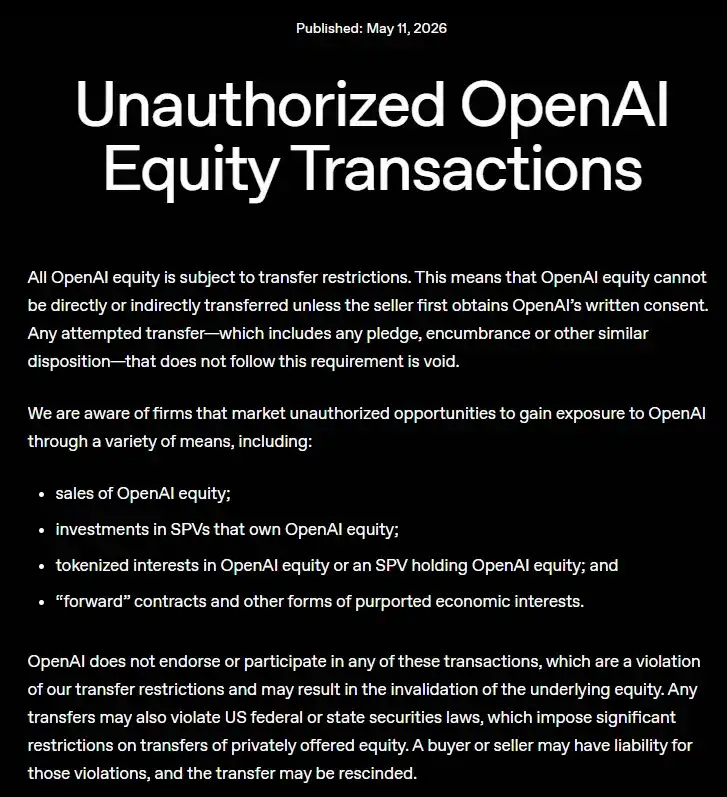
In their announcements, both Anthropic and OpenAI explained that the company's preferred and common shares are subject to transfer restrictions set forth in the charter, and therefore all share transfers require board approval.
Anthropic also specifically emphasizes that the company does not permit “special purpose vehicles” (SPVs) to acquire Anthropic shares, and any transfer of shares to an SPV violates the company’s transfer restrictions... Some investment funds claim to offer indirect access to Anthropic stock, but these funds are likely attempting to circumvent transfer restrictions. Therefore, any third party claiming to sell Anthropic shares to the public—whether through direct sales, forward contracts, stock tokens, or other mechanisms—may be engaging in fraud or offering investments that are worthless due to Anthropic’s transfer restrictions.
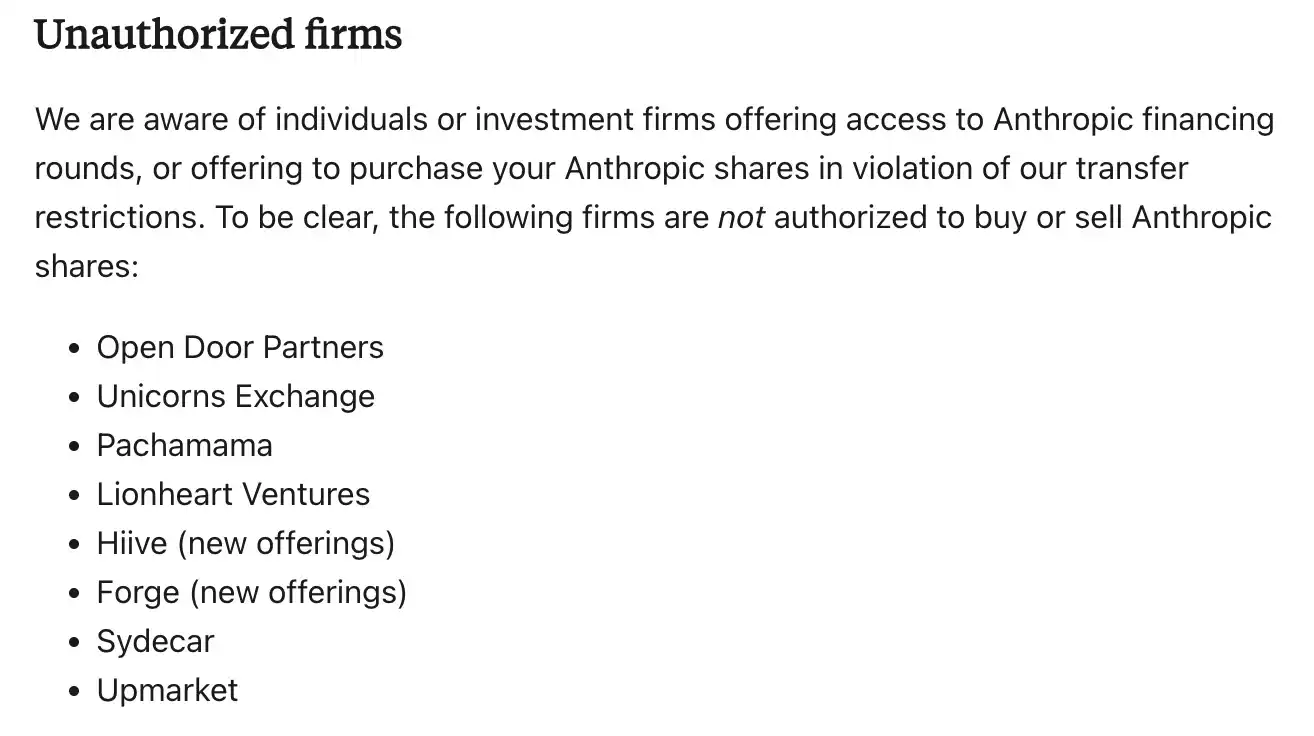
- Odaily note: The figure shows the unauthorized equity transfer platform named by Anthropic.
What is SPV?
To understand why this update has had such a significant impact on the pre-market stock token market, first understand what an SPV is.
In traditional pre-market stock trading, direct transfer of original shares is extremely difficult, restricted not only by the company’s articles of incorporation but also by complex legal procedures. In this context, SPVs emerged as a solution.
An SPV is a legal entity created specifically for a particular transaction or investment purpose, and can be understood as a "shell company established solely to hold a specific asset"—multiple investors can indirectly hold shares in a company or certain assets by contributing funds to the same SPV, thereby achieving centralized ownership, lowering entry barriers, and optimizing legal and tax structures. SPVs are especially common in pre-market stock trading. Since many prominent companies are often unwilling to directly bring on a large number of small shareholders, institutions typically establish an SPV first, which then makes a unified investment in the target company.
For example, what is marketed as “early participation in Anthropic or OpenAI equity offerings” essentially involves investors first contributing funds to a specific SPV, which then collectively purchases unlisted equity in Anthropic.
Currently, most pre-market stock token platforms (such as Prestock) use an SPV structure.
- The platform or its partners will register an SPV in a specific jurisdiction, and the sole purpose of this SPV will be to purchase Anthropic’s original shares on the secondary market (typically from employees or early investors);
- The platform will then issue derivative tokens (such as ANTHROPIC or OPENAI) on-chain, which are legally defined as "claims to the economic returns of that SPV";
- Theoretically, the token is pegged 1:1 to the original shares, meaning that for every token issued, the offline SPV should hold the corresponding share of stock.
But the issue now is that Anthropic and OpenAI have clearly stated that they do not recognize unauthorized stock transfers. This means that if an SPV transfers shares without board approval (which is virtually impossible), those shares held by the SPV may be considered invalid by Anthropic and OpenAI—if the shares held by the SPV are invalid, then the “economic benefits” represented by the on-chain tokens lose their value.
The "Russian nesting doll" risk of SPV
A major reason Anthropic and OpenAI are so opposed to SPVs is that the excessive financialization of SPVs has begun to emerge, as their pre-market stock tokens have been heavily speculated upon (Anthropic’s pre-market valuation once surged to $1.4 trillion, far exceeding its valuation from the previous funding round).
Among these, the most concerning issue is the "Russian doll" problem with SPVs—many investors who purchase pre-IPO stock tokens believe they are buying shares in the company, when in fact they only hold a claim on the economic returns of a particular SPV. Even more striking, many of these SPVs do not directly hold Anthropic’s original shares but instead layer two or three additional SPVs beneath them.
This "nested" structure is actually very dangerous.
- Legal transparency issue: Each additional layer obscures the authenticity of the underlying assets. Investors struggle to verify whether the underlying SPV has received board approval for the transfer.
- Management fee exploitation: Each layer of the SPV charges management fees, performance fees, and dividends, severely diluting the investor’s actual returns through multiple layers of deductions.
- Zero-risk: If any layer of equity transfer is deemed "invalid" by Anthropic, the entire value chain will collapse instantly.
Both Anthropic and OpenAI clearly have no interest in seeing this happen, whether for reputational or investor protection reasons.
Pre-market stock tokens plummet, while contracts remain relatively stable.
Immediately after the announcements from Anthropic and OpenAI, the market responded.
On PreStocks, ANTHROPIC plunged sharply, dropping as low as $1,000 at one point, and was trading at $1,082 as of 12:00, down 20.62% on the day; OPENAI was trading at $1,440, down 26.82% on the day.
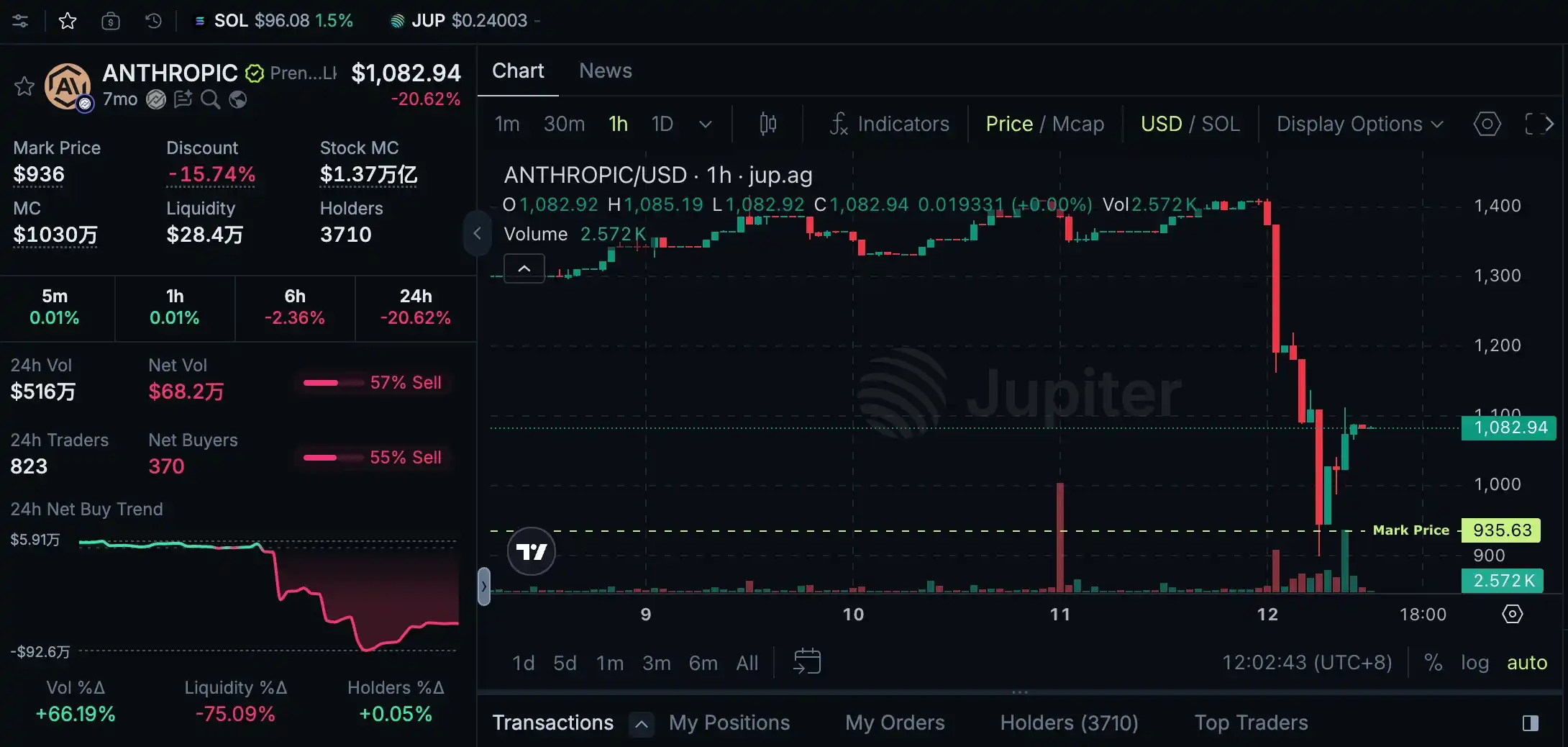
Investor panic is easily understandable: since Anthropic and OpenAI have explicitly stated they do not recognize unauthorized holdings, the "rights" behind these tokens risk becoming worthless, exposing holders to significant ownership verification risks and legal costs.
Interestingly, while pre-market stock tokens are under pressure, another type of pre-market stock trading product has remained relatively stable—pre-market contracts that rely entirely on market-based two-sided betting. This is because these products do not hold any actual shares; the restrictions on Anthropic and OpenAI have no impact on them. They are merely “two-sided bets” on future IPO prices, driven solely by price negotiations between buyers and sellers.
Future outlook prediction
In response to Anthropic and OpenAI's refusal to acknowledge, the industry has seen two sharply contrasting viewpoints.
Some believe the logic behind pre-market coin and stock trading has died. If leading giants like Anthropic and OpenAI are leading the charge to ban SPVs, other major players may follow suit. With equity backing under threat, the value of so-called pre-market stock tokens is questionable.
But others, including Rivet founder Nick Abouzeid, argue that this is nothing to be alarmed about—trading pre-market stock tokens on unofficial channels has always been a gamble, and buyers should have accepted from day one that the company may not recognize these tokens—you’re simply lacking direct investment opportunities, and obtaining them through alternative channels always carries some risk.
In summary, as the pre-market stock token premium continues to expand and market sentiment grows increasingly euphoric, the statements from Anthropic and OpenAI have undoubtedly dampened the entire sector.
Over the past few months, an increasing number of investors have begun viewing pre-market stock tokens as a low-barrier way to participate in the growth of top AI companies, with some AI-related pre-market stock tokens seeing valuations that have clearly detached from reality and even experienced wild speculation far exceeding their previous funding rounds. Against this backdrop, the public clarifications from Anthropic and OpenAI can be seen as an effort to redefine boundaries for this rapidly evolving new market.
For speculators, this is a lesson in risk; but for the long-term development of the industry, the market may also need such a moment of "de-bubbling."