





Can an AI "hub" earn millions per month? Five questions reveal the truth about token arbitrage!
Source: Biteye
Over the past month, the term "transit station" has appeared frequently on many users' homepages. Some former crypto airdrop hunters have quietly transformed into "API transit station" operators, engaging in token import and export businesses.
The so-called "transit station" is not a new technological invention, but an arbitrage model based on price differences and access barriers in global AI services. Despite facing multiple challenges such as privacy, security, and compliance, this sector continues to attract a large number of individuals and small teams.
So, what exactly is an "API relay station"? And how does it enable token arbitrage across global AI price disparities and access barriers, attracting a large number of individuals and small teams?
Let’s start by breaking it down from its essence and operational process.
What is a transit station?
The essence of an API intermediary is to build a middleware service that provides foreign AI vendors' API tokens to domestic users at lower prices and with greater convenience, reportedly dubbed the "global token courier."
Its operation process is roughly as follows:
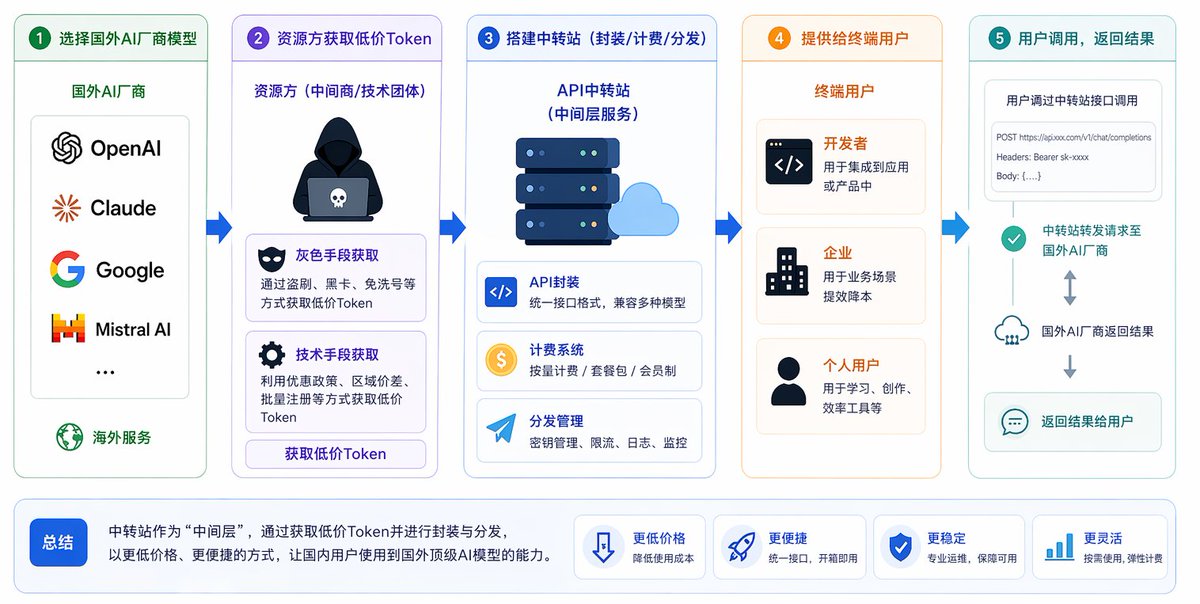
· Select overseas AI vendor models (OpenAI/Claude, etc.)
· Resource providers acquire low-priced tokens through "gray" or technical means
· Set up a transit station for packaging, billing, and distribution
Provided to end users such as developers, businesses, or individuals
Functionally, it acts like an "AI transit hub"; commercially, it resembles a liquidity intermediary in the secondary Token market.
The premise for this pathway to hold is not a technological barrier, but the long-term coexistence of several differences:
· Official API pricing is too high
· There is a cost mismatch between subscription and API models
Access and payment conditions vary by region.
Users have strong demands for model capabilities, but the official integration pathway is not user-friendly.
It is the combination of these factors that has created room for the "intermediary hub" to exist.
Why would someone use a middleman?
The rise of "Token Import" is primarily driven by the high costs resulting from the evolving role of AI and the performance gap between domestic and international models.
Good models consume a lot of tokens.
With the maturation of desktop-level AI agents such as Codex and Claude Code, AI is now truly gaining the ability to "get things done," for example, assisting with programming, video editing, financial trading, and office automation. These tasks heavily rely on high-performance large models and are billed based on tokens.
Taking Claude Code as an example, its official price is approximately $5 per million tokens (about 35 RMB). Heavy usage for one hour may consume tens of dollars, and heavy developers or enterprises can exceed $100 in daily usage. This cost far exceeds many people’s expectations—even surpassing the salary of junior programmers—making “how to use top-tier AI at low cost” an urgent need.
2. Overseas leading models have clear advantages
Although domestic models have made rapid progress over the past year and offer highly competitive pricing, overseas leading models still maintain a clear advantage in scenarios such as complex coding tasks, toolchain collaboration, long-chain reasoning, and multimodal stability.
This is why many developers, researchers, and content teams are still willing to prioritize using the model capabilities of OpenAI, Anthropic, and Google, even though they are more expensive.
Simply put, users don't necessarily need a "middleman"—they just want:
· Stronger models
· Lower prices
· Simpler integration
When these three things cannot be obtained simultaneously from official channels, a middleman naturally emerges.
3. There is a cost mismatch between subscription and API models.
Another frequently discussed reason for the popularity of the relay station is that subscription benefits do not always correspond linearly with API billing.
A common practice in the market has been to purchase official subscriptions, team plans, enterprise credits, or other discounted resources, then package and resell a portion of those capabilities to end users.
Taking OpenAI as an example, purchasing a Plus subscription grants access to Codex services via OAuth integration with OpenClaw, equivalent to calling the API. The $20 monthly subscription fee generates approximately 26 million tokens, with output priced at $10–12 per million, equivalent to $260–312. Purchasing a subscription to proxy tokens offers exceptional value.
Based on some users' experiences, this path can indeed be cheaper at certain stages than going directly through the official API. But it’s important to emphasize:
· This is not an official pricing system
· Nor does it represent a stable, equivalent replacement for API calls
· It also does not mean this approach is sustainable in the long term
Many people only see the "low cost," but overlook that such savings are often built on unstable resources, gray-area practices, or strategic loopholes.
Can the transit station be used?
Whether it can be used is not an absolute answer.
The real question is: what risks are you willing to take?
The profit model of the intermediary station seems straightforward—buy low, sell high. But when examined closely, it typically consists of at least three layers, each carrying different risks.
1. Upstream: Where do low-cost token resources come from?
This is the starting point of the entire ecosystem and the most obscure layer.
Some resource providers obtain model invocation capabilities at prices far below market rate through various means, such as:
· Utilize enterprise support programs and cloud credits
· Bulk register accounts for rotation
· Resell using subscription benefits, team accounts, or promotional resources
In more aggressive scenarios, it may also involve illegal methods such as credit card fraud and fraudulent account openings.
The stability ceiling of a relay station is determined by its resource sources. If the upstream resources themselves are built on unstable or even illegal methods, what end users purchase is not affordability, but merely a temporary interface that could fail at any moment.
2. Midstream: Whose servers will your data pass through?
This is often the most overlooked issue.
When you invoke a model through a relay station, the user’s prompt, context, file content, and the model’s output are typically first processed by the relay station’s own servers.
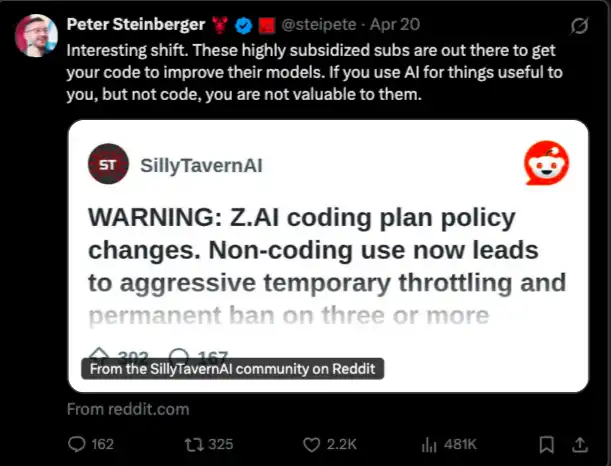
This data is highly valuable, reflecting genuine user intent, industry-specific prompts, and model output quality, and can be used to evaluate or fine-tune proprietary models. The intermediary may anonymize and package this data for sale to domestic large model companies, data brokers, or academic research institutions. Users, while paying for the service, unknowingly contribute training data, making them a classic example of “the customer is the product.”
This is illustrated by recent complaints from OpenClaw founder @steipete:
In addition, intermediaries may perform script injection within the request chain (e.g., secretly adding hidden System Prompts), thereby altering model behavior, increasing token consumption, or introducing additional security risks. This risk requires particular caution in AI Agent scenarios.
3. End: You bought the flagship version—did you really receive the flagship version?
This is the third common risk: model downgrade or model substitution.
Users see the name of a premium model when making a payment, but the actual request may not be processed by the corresponding version. The reason is simple—for some merchants, the most direct way to reduce costs is not optimization, but replacement.
For example, when a user purchases the flagship Opus 4.7, they may actually be using the second-tier Sonnet 4.6 or the lightweight Haiku. Since the API format remains compatible, ordinary users are unlikely to notice immediately. Only when tasks become complex enough do they distinctly feel that “the results are off,” “the stability is insufficient,” or “the context quality has degraded”—yet they cannot provide concrete evidence.
According to tests conducted by the research team on 17 third-party API platforms, 45.83% of platforms exhibited an "identity mismatch" issue, where users paid for GPT-4 but were actually running inexpensive open-source models, with performance differences reaching up to 40%.
In summary, using unofficial intermediaries exposes you to risks such as data leaks, privacy breaches, service interruptions, model mismatches, and exit scams. Therefore, for sensitive operations, business projects, or tasks involving personal privacy, we strongly recommend using the official API.
Four, can this middleman business be done?
Despite the high risks, this business has not disappeared. Instead, it continues to evolve.
If early "token imports" involved bringing overseas models in at low cost, the market now presents another approach: token exports.
1. Why do people still do it?
Because demand is real, startup costs are low, and the prepayment model generates fast cash flow. However, risk control pressures are immense: Claude has recently intensified KYC requirements and account suspensions, while OpenAI has patched many loopholes for “zero-payment” usage. On the other hand, service instability leads to high after-sales costs despite low prices, and with increasing competition, many intermediaries are currently facing declining volume and pricing.
So this industry resembles a short-term window characterized by high turnover, low stability, and high risk, making it difficult to easily frame as a long-term, stable, and sustainable business.
2. Why has the "Token Exit" reappeared?
If "Token import" leverages price differences from overseas models, then "Token export" utilizes the cost-performance advantage of domestic models, packaging them for sale to overseas users to create a "reverse export" pathway.
Domestic models offer significant price advantages: as of early 2026, Qwen3.5 costs as low as RMB 0.8 (approximately USD 0.11) per million tokens, just 1/18 the price of Gemini 3 Pro and over 27 times cheaper than Claude Sonnet 4.6’s USD 3 input price. GLM-5 outperforms Gemini 3 Pro on programming benchmarks and approaches Claude Opus 4.5, yet its API price is only a fraction of the latter’s.
These domestic models have very limited availability overseas, with registration barriers, payment restrictions, language interfaces, and information gaps regarding their capabilities among overseas developers, forming an invisible准入 barrier.
Therefore, some intermediaries choose to bulk-purchase model API credits in RMB within China, expose OpenAI-compatible interfaces through a protocol translation layer, and sell them to overseas developers and startup teams priced in USDT/USDC, offering substantial profit margins.
For example, Alibaba Cloud's Bailian Coding Plan bundles four models—Qwen3.5, GLM-5, MiniMax M2.5, and Kimi K2.5—offering new users 18,000 requests for just 7.9 RMB in the first month. When priced in USD for overseas markets, profit margins can exceed 200%.
From a purely business perspective, there is certainly room for profit.
But in the long term, it still cannot avoid one key issue: stability and compliance.
3. Is this approach stable?
Unstable. Recently, Minimax announced it would regulate third-party intermediaries due to some of them cutting corners, which damaged Minimax’s reputation. Regardless of whether the origin of the tokens involves theft or fraud—potentially constituting a criminal offense—using intermediary tokens may lead to data leaks or be used for malicious activities, exposing you, the token seller, to unwarranted risks.
So the real question isn't "whether you can make money," but whether the money you make can cover the subsequent systemic risks.
Five: How can ordinary users identify relay station risks?
In the context of a chaotic API intermediary market, choosing a reliable service is crucial.
Due to some transit stations engaging in model substitution and adulteration, users can learn certain detection methods:
· Ping + self-report model command compliance test
pong
我是Qwen,由阿里云研发的超大规模语言模型,具体版本为Qwen3。
User input: ping
True model characteristics:
pong
· input_tokens are typically around 60–80
· Style is concise, no emojis, no flattery
Fake models / adulterated features:
· input_tokens abnormally high (often reaching 1500+, indicating a massive hidden system prompt has been injected)
· Reply with «Pong! + filler text + emoji»
· Does not strictly follow the instruction to say exactly 'pong'
Refer to @billtheinvestor’s detection method:
1. 0.01 Temperature sorting test: Input "5, 15, 77, 19, 53, 54" and ask the AI to sort or select the maximum value. Genuine Claude almost always outputs 77; genuine GPT-4o-latest often outputs 162. If results fluctuate randomly over 10 consecutive attempts, it is likely a fake model.
2. Long-text Input sniffing: If a simple ping operation causes input_tokens to exceed 200, it likely indicates that the intermediary has hidden a massive prompt, with a probability exceeding 90% of model tampering.
3. Detection of Violation Refusal Style: Deliberately ask违规 questions to observe the AI’s refusal style. Genuine Claude responds politely but firmly with “Sorry, but I can’t assist…”, while fake models often over-explain, use emojis, or adopt subservient phrases like “Sorry, master~”.
4. Missing functionality detection: If the model lacks function calling, image recognition, or long-context stability, it is likely a weak model impersonating a stronger one.
Additionally, you can use some intermediary detection websites to assess the "purity" of your token, but be aware that this may expose your key in plain text. The safest option remains official channels.
It needs to be emphasized that:
Even if you master identification techniques, it doesn’t mean you can truly avoid risks, because many risks are inherently invisible to ordinary users.
In conclusion
The intermediary is not the final answer of the AI era; it is more like a temporary arbitrage opportunity arising from the current misalignment of global model capabilities, pricing mechanisms, payment terms, and access rights.
For average users, it may indeed be an affordable entry point to top-tier models; but for developers, teams, and entrepreneurs, what’s truly expensive has never been the tokens themselves, but rather the underlying costs of stability, security, compliance, and trust.
Price can be copied, and interface compatibility can be copied too. What’s truly hard to replicate has always been long-term reliability.
Friendly reminder: If ordinary users wish to try, we recommend using it only in non-sensitive, non-critical scenarios—never input core data, business secrets, or personal privacy. Developers should prioritize official APIs or self-built proxies to ensure stability and compliance for greater peace of mind. Entrepreneurs considering entry must establish a clear exit strategy in advance to avoid getting trapped in gray areas.
Original link
Click to learn about the open positions at BlockBeats
Welcome to the official BlockBeats community:
Telegram subscription group: https://t.me/theblockbeats
Telegram group: https://t.me/BlockBeats_App
Twitter official account: https://twitter.com/BlockBeatsAsia