





Author: Hu Shixin, Deep Web · Tencent News Xiaoman Studio
Editor: Ye Jinyan
On March 3, Jack Ma, along with Cainiao, Wu Yongming, Shao Xiaofeng, Jiang Fan, and Ant Group’s Jing Xian Dong and Han Xinyi—core executives from Alibaba and Ant Group—unusually gathered at Yun Gu School in Hangzhou. This first meeting of the new year focused primarily on the opportunities and challenges brought by AI, sending a strong strategic signal to the public that both companies are going “All in AI.”
Ironically, in the early hours after the high-level panel concluded, Lin Jinyang, the group’s youngest P10 and the technical lead who propelled Alibaba’s Qwen to the pinnacle of global open-source AI, suddenly posted on social platform X: “me stepping down. bye my beloved qwen.” — a message that ignited the global AI community.
Overnight, Alibaba's Qwen lost its "captain."
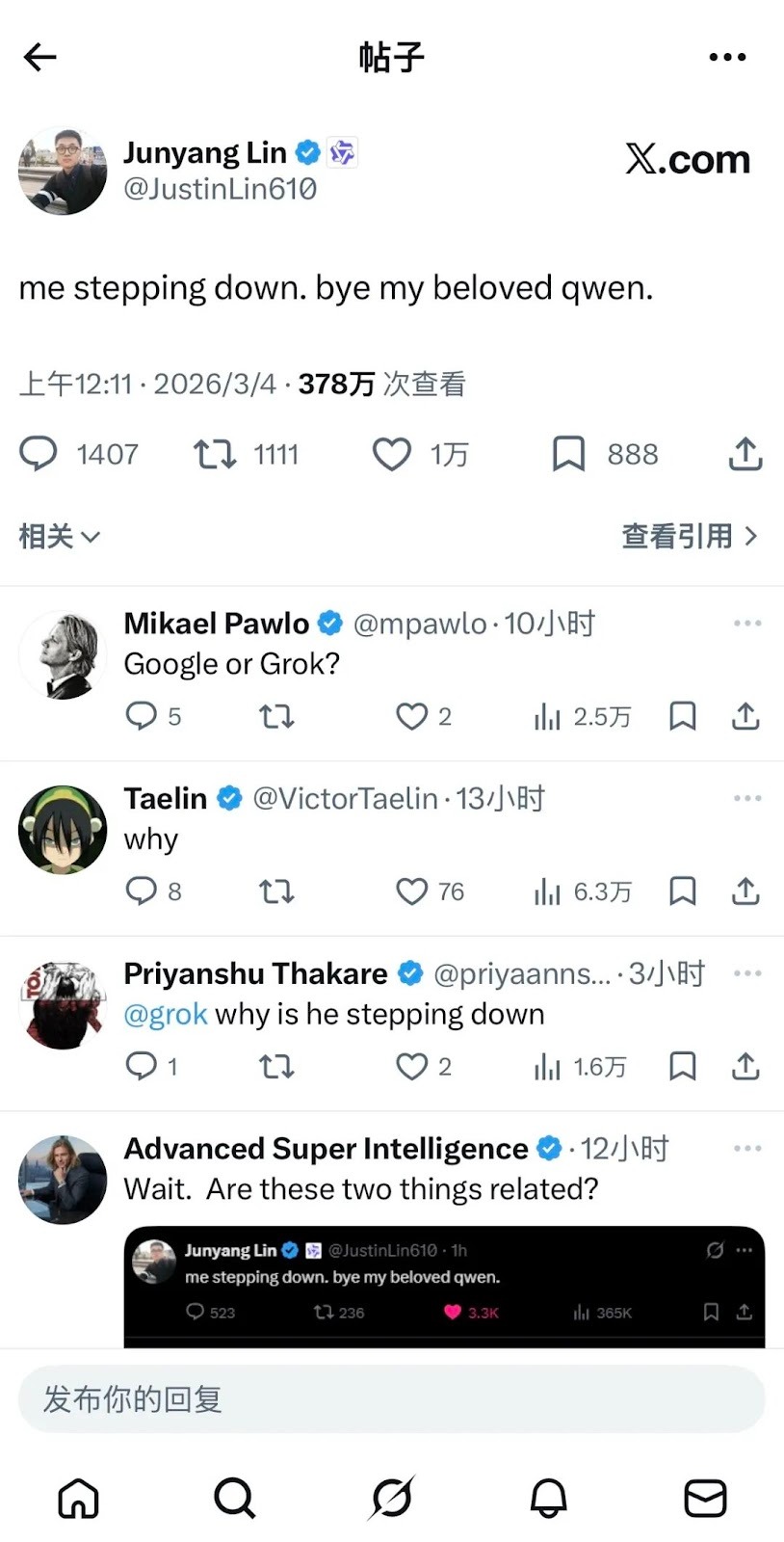
(Lin Junyang X Latest Updates)
Lin Junyang's departure was not voluntary?
Based on information from multiple sources, we have reconstructed the key events of this resignation incident.
On the evening of March 2, Lin Junyang led the release of four small-sized open-source Qwen3.5 models, which immediately drew global attention in the tech community; Elon Musk commented on their “impressive intelligence density,” and Lin Junyang himself shared and thanked the comment. On the same day, Alibaba officially unified its B2B and B2C large model brands under “Qwen,” establishing it as the group’s core AI brand.
According to reports from LatePost and Phoenix Tech, on the afternoon of March 3, Lin Junyang left the meeting due to internal disagreements and submitted his resignation to Alibaba; upon the news being shared, some members of the Qwen team were moved to tears on the spot.
On the evening of March 3, Lin Junyang shared the song "Toasting Myself" on his WeChat Moments.
On the morning of March 4, Lin Junyang publicly announced his resignation on X, and as of 16:00 today, the post has received over 10,000 likes and more than 1,400 comments. Numerous industry developers have left messages thanking him and the Qwen team for their contributions to the open-source community, and official accounts from AI companies such as MiniMax have also appeared in the comments to express their recognition.
On the morning of March 4, Yu Bowen, head of Qwen's post-training, and Li Kaixin, core contributor to Qwen3.5/VL/Coder, announced their departure.
On the afternoon of March 4, Lin Junyang posted on his Moments: "Sorry everyone, I won't be responding to messages or calls today—I really need to rest. Brothers of Qwen, keep going as planned, everything will be fine."
It is worth noting that Chen Cheng, a core contributor to the Qwen team, bluntly commented while sharing Lin Junyang’s post: “I’m truly heartbroken; I know leaving wasn’t your choice. Just last night, we jointly released the Qwen3.5 small model—I can’t imagine what Qwen would be like without you.”
This comment also accelerated the spread of the claim that the departure was involuntary within the industry; as of now, Alibaba has not issued any public statement regarding this personnel change. A source close to Alibaba believes that Lin Junyang’s resignation was not voluntary, and that his rapid posting of the departure update on X was likely due to losing emotional control at the time.
Why did you leave?
Lin Junyang's sudden resignation has caused a major stir in the industry, sparking widespread speculation. At its core, this is the culmination of long-standing tensions within Alibaba, stemming from conflicts between its organizational structure, technical direction, business goals, and talent landscape.
The trigger may stem from a restructuring of the team’s architecture. According to LatePost, Tongyi Lab plans to dismantle the vertically integrated R&D model of the Qwen team, splitting the previously end-to-end team covering pre-training, post-training, multimodal development, and infrastructure setup into several independent, horizontally divided modules, all directly overseen by Tongyi Lab. As a result, Lin Jinyang’s managerial authority and scope of responsibilities will be narrowed.
Behind the structural reorganization was a fundamental conflict between Lin Junyang and Alibaba’s senior leadership regarding the philosophy of large model development. Lin Junyang believed that the core competitive advantage in large model development stems from deep collaboration across end-to-end teams, and that fragmented, assembly-line workflows severely erode R&D efficiency and innovation potential—his team had already built a proprietary infrastructure system. The decision to dismantle and disperse the lab directly contradicted his assessment of the technological trajectory of large models.
More difficult to reconcile than technical roadmap disagreements is the deeper conflict between the open-source approach and the group’s commercial objectives. Under Lin Junyang’s leadership, Qwen rose to the top of global open-source large model rankings through a comprehensive open-source strategy, becoming a benchmark for Chinese large models going global. However, Alibaba’s core evaluation of Qwen has shifted from building technical influence to achieving commercial deployment.
However, there has always been skepticism within the company regarding the revenue efficiency of the open-source model. It is reported that some executives described the Qwen-3.5 unveiled on Chinese New Year’s Eve as an unfinished “prototype.” Coupled with the C-end Qwen app’s 3-billion-yuan subsidy failing to meet expectations and B-end AI cloud services facing intense competition, the misalignment between technological ideals and business goals has become increasingly difficult to reconcile.
Behind this shift, the restructuring of talent at Tongyi Lab has also led to a dilution of core decision-making power. Since 2025, Alibaba has consistently brought in top global AI talent; after IEEE Fellow Xu Zhuhong transferred to Tongyi Lab, his responsibilities overlapped significantly with Qwen’s roadmap. In early 2026, former DeepMind senior researcher Zhou Hao joined the lab, reporting directly to the lab head, and will take over responsibilities previously held by the departed post-training lead, Yu Wenbo.
The lab shifted from a single-core model led by Lin Junyang to a “multiple strong players in parallel” structure, compounded by the successive departure of the core founding team behind Qwen, triggering this industry-shaking wave of resignations.
Who can replace Lin Junyang?
The reason this resignation triggered a chain reaction within Alibaba and the global open-source community is due to Lin Junyang’s pivotal industry position within the Qwen team, Alibaba’s AI ecosystem, and the global open-source large model landscape.
As a rare tech leader in China’s AI industry who grew up entirely domestically, Lin Jinyang, born in 1993, holds a cross-disciplinary background with a bachelor’s degree in computer science and a master’s degree in linguistics and applied linguistics from Peking University, giving him a unique advantage in large language model development.
After graduating with a master’s degree in 2019, he chose not to study abroad but instead joined Alibaba’s Damo Academy directly, starting as a senior algorithm engineer. In six years, he was promoted four levels, becoming Alibaba’s youngest P10 technical expert at age 32, standing alongside other leading tech figures such as Tang Jie from Zhipu AI, Yang Zhilin from Moonshot AI, and Yao Shunyu from Tencent—all of whom hold PhDs from overseas—and earning recognition as one of China’s “Four Great Foundation Model Pioneers” in the industry.
When Lin Junyang took over as the technical lead of Qwen at the end of 2022, the domestic large model field was just emerging, and Alibaba’s large model strategy had not yet established clear differentiating advantages. Under his leadership, Qwen launched a comprehensive open-source strategy, creating a family of models covering parameter sizes from 0.8B to 72B. The trillion-parameter flagship model, Qwen3-Max, released in 2025, outperformed leading international models of the same period in multiple authoritative benchmarks such as GPQA.
As of January 2026, the Qwen series of models has surpassed 200,000 derivative models and 1 billion downloads on Hugging Face, the world’s largest AI open-source community, maintaining its position as the number one open-source large model globally. According to Stanford University’s 2025 Artificial Intelligence Index Report, the performance gap between top AI models in China and the United States has narrowed to 0.3%, with Qwen’s core models ranking third globally in contribution.
After Lin Junyang turned and left, the outside world had two questions.
- Who will replace Lin Junyang? According to insiders, due to the sudden nature of the event, there is currently no one who can fully replace Lin Junyang; his previously managed full-stack responsibilities will be distributed across multiple parallel teams following the team restructuring.
- Where will Lin Junyang go? A long-time industry observer of Alibaba says he is most likely to start his own venture, or possibly join a leading team in embodied AI or world models; the chance of him staying is very small.
For Alibaba AI, the primary risk posed by this personnel change is the cascading threat of core team attrition and diminished morale. According to Phoenix Tech, Alibaba’s senior leadership is still in communication with Lin Junyang to retain him.
Within just three months, key early founding team members, including the technical lead, post-training lead, and code lead, have successively left, which will not only directly impact the pace of future Qwen model iterations but may also trigger further talent attrition.
Lin Junyang's departure marks a pivotal moment in Alibaba's AI strategy shift. This signifies that Alibaba's large models will move away from the phase centered on establishing technical benchmarks and building a global open-source ecosystem, and fully transition into a new cycle focused on commercialization and practical application.
Facing Alibaba are disruptions in R&D momentum due to core team departures, fluctuations in trust within the global open-source ecosystem, and intensifying industry competition from rivals like ByteDance and Tencent—these ripple effects from the personnel upheaval will directly test the resilience of Alibaba’s All-in-AI strategy.