



Author: Amelia, DeniseI Biteye Content Team
Just after the Lantern Festival, the Qwen team experienced a major leadership shakeup: Technical lead Lin Junyang departed, along with three other key members: Yu Bowen, head of Qwen post-training; Hui Binyuan, head of Qwen Code; and Li Kaixin, core contributor to Qwen3.5, VL, and Coder.
This is not an ordinary departure of a technical lead, but a systemic conflict over organizational structure, resource allocation, and open-source strategy. Biteye seeks to reconstruct the full picture of this personnel upheaval and probe a more fundamental question: In the age of AI, how should big tech companies accommodate technological ideals?
I. A Night of Blood Loss: Core Team Members Depart En Masse
Less than 24 hours after the Qwen3.5 small model, recently liked and praised by Musk for its “incredible intelligence density,” was released, Lin Junyang, head of Alibaba’s Tongyi Qianwen technology, posted a brief farewell on X at midnight:
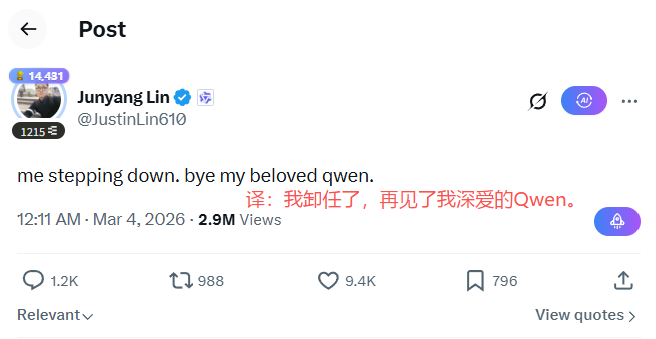
As of publication, this post has received over 11,000 likes and over 4.5 million views, with the comments section filled with heartbreak.
Lin Jinyang, Alibaba’s youngest P10-level tech expert at age 32, has passed away.
Lin Junyang's resume is a typical example of China's new generation of AI technical talent.
Cross-disciplinary background: Born in 1993, he earned his bachelor’s degree in computer science from Peking University, but chose linguistics for his master’s. Perhaps due to this unconventional path compared to AI elites, he possesses an exceptional intuition for multimodal and semantic understanding.
Alibaba Leap: Joined DAMO Academy in 2019 and led the development of OFA and Chinese CLIP.
Leading Qwen: Appointed head of Qwen in 2022, promoted in 2025 to P10 at Alibaba, the youngest in company history at age 32.
Three others followed him in leaving. Yu Bowen, lead of Qwen’s post-training team, also resigned simultaneously. Hours later, Hui Binyuan, lead of Qwen Code, posted “me too” and changed his profile to “former Qwen”.
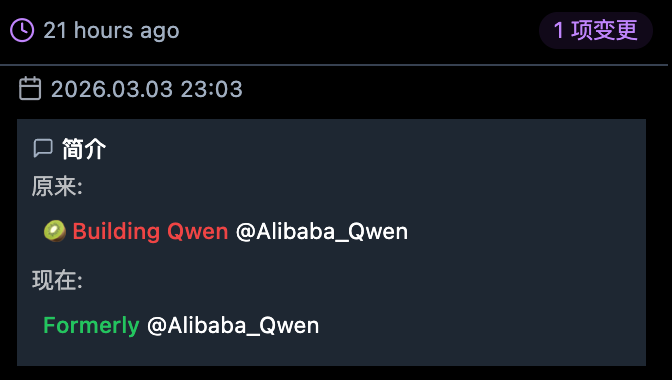
Several hours later, Kaixin Li, a core contributor to Qwen3.5, VL, and Coder, also posted about leaving and changed her Twitter profile to "Pre Qwen".
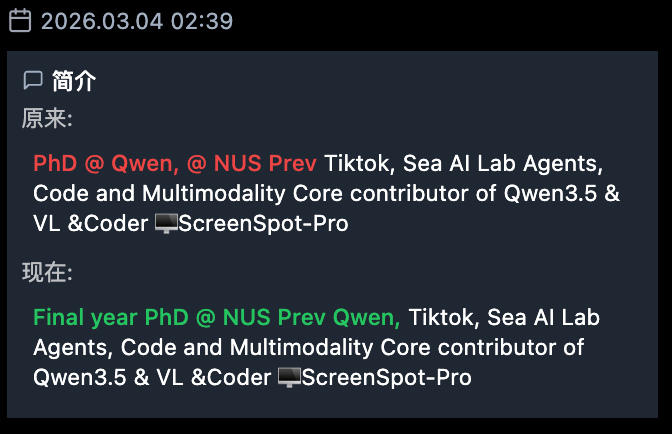
The star team that once created a model with over 1 billion downloads worldwide and more than 200,000 derivative models, consistently ranking as the top open-source large model, appears to be disintegrating at a visible pace.
II. The Dilemma of Cause: The Struggle Between Individuals and Tech Giants in the AI Era
A tweet by Qwen team member @cherry_cc12 revealed just the tip of the iceberg. As details from internal meetings gradually surfaced, we pieced together the full picture of this mass departure.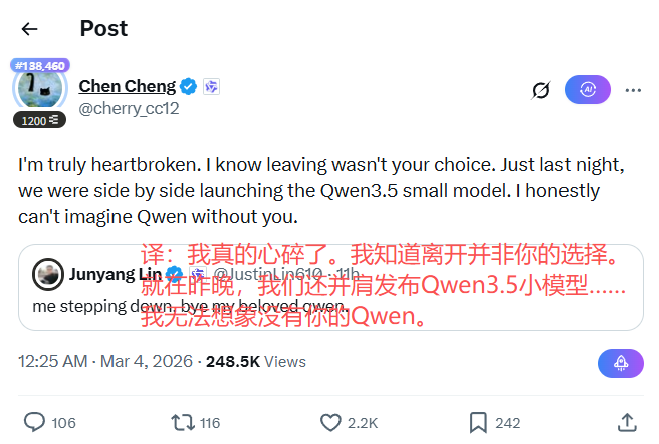
2.1 The Organization's Dilemma: From Special Forces to Assembly Line
The editor guesses that the original Qwen Lab was likely a elite tech squad, with each member a specialist and multi-skilled soldier. Lin Junyang acted like a reinforced company commander, leading the team into battle. However, rumors suggest that the Qwen team plans to split into separate horizontal teams focused on distinct areas such as pre-training, post-training, text, and multimodal.
This is actually a typical approach used by traditional internet companies. I assume Alibaba thought like this: Early on, the Qwen Lab was an internal incubated project, but after a year, things have changed—I’m ready to scale up the application of this incubated project. How can we improve efficiency? By breaking down each step into SOPs and enhancing efficiency at every stage, the overall efficiency will improve.
This idea is definitely outdated—if you take a look at how much of a splash one person made with OpenClaw, you’ll see that the way games are played in the AI era has truly changed.
2.2 Resource Constraints: Is It There or Not?
On one hand, “Qwen is the most important thing for the group”; on the other, Wu Ma says, “Resources are scarce—no one can be satisfied.” This contradictory stance is just like a manager who keeps making promises but never delivers. What does it mean to say “Qwen is the top priority”? What does it mean to claim “the China CEO has done everything possible”? And what does it mean to blame resource constraints on “issues in the information transmission process”?
Who are you trying to fool? There are only two possibilities here.
First, senior leadership doesn't really prioritize Qwen; investing in Qwen is merely due to AI FOMO.
Second: The upper management is divided into two factions; one values it, while the other does not, and those who don’t value it begin to create various obstacles.
In short, some senior executives only pay lip service to prioritization. As a result, even product lines labeled as top priority cannot secure basic resource support.
2.3 The博弈 Between Individuals and the Platform: Who Can Rise Above the Organization?
The most heartbreaking part of the entire leaked information was the HR’s statement: “If we can’t elevate them to a pedestal, the company cannot accept irrational demands to retain them at any cost.”
Is that true? AI companies are already fighting tooth and nail for talent: In 2024, Zhou Chang, the former technical visionary behind Qwen, left to start his own company, then quietly joined ByteDance’s Seed team, where ByteDance offered a “sky-high” package: a level 4-2 role plus a seven- to eight-figure annual salary. In 2025, Meta offered a staggering $200 million compensation package to poach Pang Ruoming from Apple—complete with substantial stock grants and milestone-based incentives tied directly to technical breakthroughs. Doesn’t this HR team do competitor research?
Are you wrong? This sentence seems to embody China's thousands-of-years-old philosophy of conduct: the individual cannot supersede the organization.
2.4 Political Struggle: Whose side are you on?
Internally, they say “political factors were never considered at all,” yet also say “we need to consider where to place zhouhao for maximum efficiency.” This is intriguing—it seems to carry an unspoken implication that zhouhao must be included in this organization, with the only question being where to place him.
Anyone who has watched palace intrigue dramas knows that it’s not about who can get things done—it’s about who obeys. A harsh职场truth: for most professional managers, whether someone can actually solve problems is just as important as whether they pose a threat to one’s position. In a startup, jump as high as you can; in a big company, your superior’s sense of security may matter more than your ability.
Think about it, really think about it.
2.5 Mismatch Between Open Source and Commercial
A deeper tension arises from the misalignment between open-source and commercial pathways. Qwen has built substantial reputation within the global open-source community—its download numbers, derivative models, and international recognition are all significant.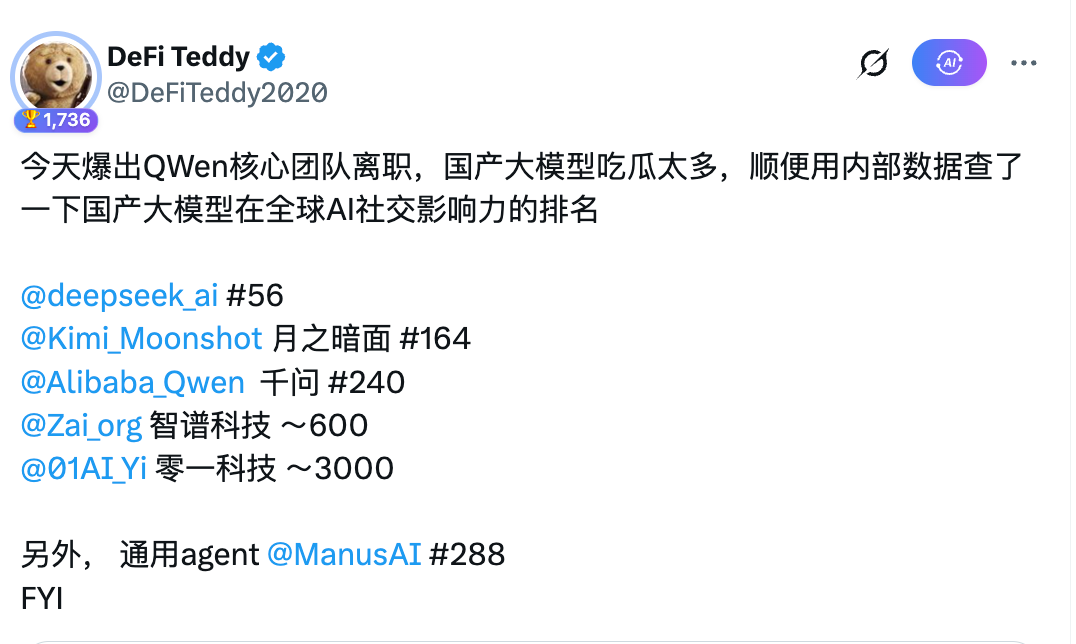
But open source doesn't bring users or revenue. Now that Qwen has grown large, the group will naturally ask: I've invested so much—aren't you going to deliver some return?
III. Reflection: The AI Dilemma of Big Tech
Actually, this kind of thing happening at Alibaba doesn't surprise me at all. Haven't you seen "Don't Stop the Annual Meeting"? It was based on Alibaba as its prototype. There's a classic line in it: "If you can't solve the problem, solve the person who raised it."
Alibaba's logic should be: No matter who is missing, Qwen still runs just fine.
The statement, "What we're doing is huge; over a hundred people definitely aren't enough—we need to expand," no longer seems like Alibaba doesn't understand AI—it's as if AI no longer understands Alibaba. Even Web3 next door is laughing.
The internet era empowers individuals through platforms, pursuing standardized, process-driven, and replicable organizational structures. Individuals rely on platforms, and platforms define the rules.
The AI era is evolving into one where super individuals gain stronger bargaining power, even reversing the definition of platforms. AI innovation thrives through the "special forces model" of small teams, high density, and rapid iteration.
When big companies try to manage creativity in the AI era using organizational logic from the internet age, conflict is almost inevitable. Behind the organizational chaos lies a collective uncertainty about how to manage geniuses.
When HR asked employees, "What do you think your worth is?", those who can truly shape the future have already voted with their feet.