






Yesterday, Alibaba internally announced a series of adjustments to its AI team, with Li Fei-Fei appointed as the new CTO of Alibaba Cloud.
This Li Fei-Fei is not the Stanford-trained AI matriarch, but rather the Vice President of Alibaba Group and the head of Alibaba Cloud/DAMO Academy’s database business. If today’s protagonist were the one from Stanford, this article would be about the latest achievements from World Lab.
Just kidding—back to Alibaba’s recent restructuring, the key personnel change is that Zhou Jingren, former CTO of Alibaba Cloud, has stepped down and been succeeded by Li Feifei. Meanwhile, Wu Zeming will focus solely on his role as CTO of Alibaba Group, and Lei Yanqun has taken over as CEO of Taobao Flash Purchase.
At first glance, Zhou Jingren appears to have been demoted, but a closer look at this internal memo reveals that Alibaba has made a three-branch-style reorganization of its overall AI strategy.
First, Tongyi Lab has been upgraded to the Tongyi Large Model Division, fully overseen by Zhou Jingren. This means that the large model R&D division has been given even higher priority within Alibaba. Although Zhou Jingren has stepped down from his CTO role, the core importance of his model business has been further solidified.
In addition, Alibaba has established a Technology Committee at the group level, with Wu Yongming serving as chair, and members including Zhou Jingren, Wu Zeming, and Li Feifei.
Among them, Zhou Jingren serves as Chief AI Architect on the Technical Committee, Li Feifei is responsible for Alibaba Cloud technology and AI cloud infrastructure development, and Wu Zeming oversees the group’s business technology platform and AI inference platform construction. Undoubtedly, this represents a "separation of powers" structural shift in Alibaba’s AI business.
Since last year, Alibaba has been active on its AI business front: first, the Qwen app made a comeback, directly competing with DouBao and Yuanbao in the Spring Festival red packet battle. Then, Lin Junyang, a key figure behind the Qwen model, left the company, forcing Alibaba to issue an internal memo and hold a senior executive meeting to address internal concerns.
Less than a month ago, Alibaba officially established the Alibaba Token Hub (ATH), a dedicated business unit directly overseen by Wu Yongming, with its core mission summarized as “create tokens, deliver tokens, apply tokens.” ATH encompasses Tongyi Lab, the MaaS business line, the Qwen Business Unit, the Wukong Business Unit, and the AI Innovation Business Unit.
Next up is today’s “separation of powers,” but after multiple rounds of ups and downs in business and personnel, it appears to be a somewhat delayed restructuring of authority.
01
At the foundation of ambitions in the AI era still lies the model.
A few weeks ago, Letter AI wrote in the article "Tongyi Did Not Become 'Alibaba's Seed':"
Tongyi Lab has not been elevated independently to a status similar to a “group-level research hub,” like Seed, but has instead been integrated into an AI business system centered around Token, becoming part of the ATH Business Group.
Several weeks later, Alibaba has taken further steps to strengthen and focus on its model business.
If we look solely at Zhou Jingren’s departure as CTO, this is indeed a shift in responsibilities. However, when combined with Alibaba’s establishment of the Technology Committee and the creation of the Tongyi Large Model Division, it becomes clear that Tongyi is moving toward a model similar to ByteDance’s Seed team, and Zhou Jingren’s recent personnel change positions him more similarly to Wu Yonghui, the lead of Seed Team 1 within ByteDance’s structure.
A brief overview of Zhou Jingren’s career: He graduated from the University of Science and Technology of China and earned a Ph.D. in Computer Science from Columbia University in 2004. He then worked as a Research Partner at Microsoft. In 2015, he joined Alibaba, initially serving as Chief Scientist of Alibaba Cloud, later transitioning to search, recommendation, and advertising, followed by a role at Ant Group. He subsequently returned to Alibaba Cloud as CTO and also served as Deputy Director of the DAMO Academy.
Within Alibaba’s technical hierarchy, Zhou Jingren is a cross-cloud, cross-algorithm, and cross-business leader. He once led iDST, the Institute of Data Science and Technology—the predecessor to the Damo Academy—and later took charge of the Tongyi Lab. By the end of 2025, he became an Alibaba partner, widely seen as recognition from management for his role in maintaining Qwen’s leading position over the past year.
In addition, as CTO of Alibaba Cloud, Zhou Jingren delivered impressive results during his tenure. By September last year, Tongyi had open-sourced over 300 models, achieving more than 600 million global downloads, over 170,000 derivative models, and onboarding more than one million customers. During the same period, the daily model invocation volume on the Bailian platform increased 15-fold year-over-year.
Therefore, another explanation seems more reasonable: after the upheaval surrounding Lin Junyang's departure and the Qwen team's reorganization, Alibaba now wants Zhou Jingren to firmly focus on the model line.
His internal title is Chief AI Architect of the Technical Committee, and Tongyi Lab has been upgraded to the Tongyi Large Model Division, which he continues to lead. Although he no longer holds the title of CTO, he has become Alibaba’s de facto lead for models.
Looking at Li Feifei, Alibaba has not appointed the Stanford AI pioneer this time, but rather Li Feifei, who has long worked within Alibaba’s ecosystem on databases and cloud infrastructure.
He is a vice president of Alibaba Group and previously served as head of the Alibaba Cloud Database Product Division and director of the DAMO Academy's Database and Storage Laboratory.
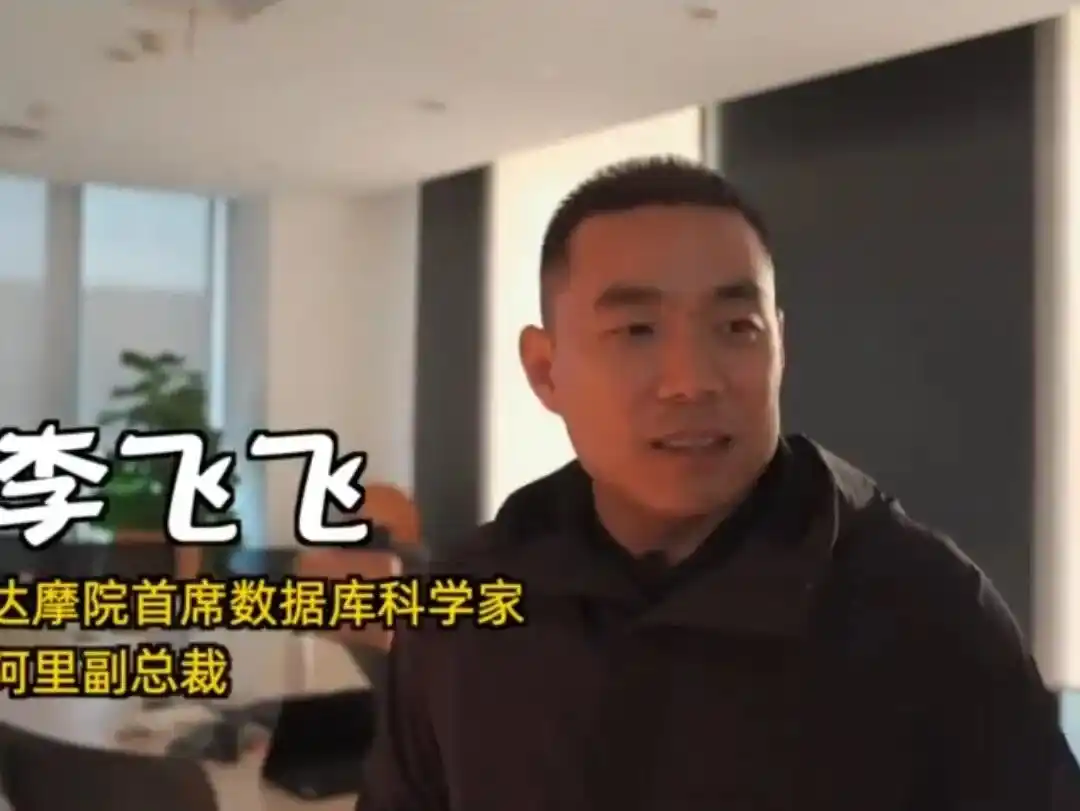
However, one thing the two Li Feifeis have in common is their strong academic backgrounds.
Public records show that Li Fei-Fei was admitted to Tsinghua University’s Department of Electrical Engineering in 1997 through a direct admission program from Tsinghua High School, later pursued advanced studies at Nanyang Technological University in Singapore and Boston University, taught at U.S. universities until becoming a tenured full professor, and subsequently joined the Alibaba ecosystem.
His research focuses on database systems, big data management, systems analysis, and cloud data management security. He was later elected as an ACM Fellow, IEEE Fellow, CCF Fellow, and other honors.
In other words, Li Fei-Fei is not a typical “AI storyteller,” but rather a quintessential infrastructure engineer. In his role as CTO of Alibaba Cloud, he will be responsible for driving the advancement of AI cloud infrastructure, enhancing end-to-end efficiency across AI cloud services and model-side resources including training, storage, databases, scheduling, and inference.
In other words, although Li Fei-Fei has taken over from Zhou Jingren, the two still appear to maintain a collaborative business relationship.
Finally, let’s turn our attention to Wu Zeming, who joined Taobao in 2004 as a core member in building Alibaba’s e-commerce technical architecture. He has held key roles including President of the New Retail Technology Group, CTO of Local Life Services, CTO of Alibaba Group, and Deputy Director of the DAMO Academy—clearly, he is a technology executive who rose through the ranks from hands-on technical positions.
Therefore, the significance of this technical committee list is straightforward: on one hand, Alibaba’s technological infrastructure and AI business aim to strengthen collaboration, but this collaboration has evolved into a three-way synergy among Alibaba Cloud, Tongyi, and the group.
The three individuals each have distinct responsibilities: Zhou Jingren is in charge of defining the upper limits of model capabilities; Li Feifei focuses on enhancing the efficiency and cost structure of the foundational infrastructure and further implementing it within cloud services; Wu Zeming strengthens the technological foundation at the group level while coordinating the integration of AI with other business units.
The head of the Technical Committee is Wu Yongming, CEO of Alibaba. After going through a period of restructuring within the model team and enthusiastically establishing ATH, this CEO has finally found the bandwidth to clarify the responsibilities and authority within Alibaba’s AI division.
It remains unclear whether this is an active embrace of the future or a passive adjustment driven by circumstances.
02
Is the butterfly effect of Lin Junyang's departure still continuing?
Over the past few weeks, all of Alibaba's structural adjustments in its AI business have inevitably drawn comparisons to the departure of Lin Junyang, formerly in charge of the Qwen large model.
For a long time, Lin Junyang, a post-95s, was regarded as Alibaba’s young-generation leader in model development, compared to Zhou Jingren, who was born in 1976.
At the AGI NEXT forum, led by Tsinghua University at the beginning of the year, Lin Junyang represented Alibaba and Qwen in a panel discussion with Tang Jie, Yang Zhilin, and Yao Shunyu, the chief scientist of Tencent’s CEO, who was then receiving significant attention in the industry.
However, what makes Lin Junyang most representative is not just his youth or the label of “star researcher,” but the strong reputation he has built within the industry for Qwen’s open-source technical approach—a growth model centered on a model foundation, an open-source community, and academic influence.
The problem lies precisely here. After Lin Junyang left, Alibaba’s senior leadership quickly convened an internal meeting, with Wu Yongming, Jiang Fang, and Zhou Jingren present to explain the organizational changes; the greatest source of anxiety within the team was not just the loss of key personnel, but whether Qwen should continue iterating on its foundational model or instead deepen its focus on serving Qwen’s consumer-facing products and Alibaba Cloud’s commercialization efforts.
Lin Junyang's departure somewhat ignited internal discussions at Alibaba regarding this issue. Previously, the Qwen App was said to believe that the Qwen model team lacked sufficient support, while the Qwen team was reportedly constrained by outdated infrastructure, preventing it from keeping pace with other industry competitors.
And when ATH was established, the problem became even more complex as Tongyi Lab, the MaaS business line, Qianwen Division, Wukong Division, and the AI Innovation Division were all folded into a larger framework.
As a component of ATH, Tongyi Lab’s long-term objectives will inevitably be influenced by external factors if it takes on too many "empowerment business" directions and demands.
So, when signals emerged during the internal meeting following Lin Junyang’s departure—that “Qwen is the most important initiative for the group, and expanding talent will inevitably involve structural changes”—it became clear that the management burden and pressure on the Qwen team could no longer be shoulderered part-time by Zhou Jingren in his role as CTO.
During Alibaba’s most recent earnings call, when asked about Alibaba’s AI priorities, Wu Yongming stated that building the most intelligent model is unquestionably Alibaba’s top AI priority.
To some extent, as long as Alibaba wants to focus on developing foundational models, Zhou Jingren must become the undisputed leader in large models.
In particular, Alibaba’s newly released Qwen3.6 model appears to signal a “closed-source first” approach: core capabilities (such as Qwen3.6-Plus) are not open-sourced and are only accessible via paid API calls; all three new models are released as closed-source, directly enabling commercial monetization. At the same time, smaller models will remain open-sourced in the future, establishing a dual-track strategy of “flagship closed-source, edge open-source,” fundamentally shifting from an open-source-driven model to one prioritizing revenue.
Industry analysis also shows that after becoming a business unit, the Tongyi Business Unit is expected to have greater autonomy and decision-making power in setting job levels and compensation, making it more attractive in recruiting and developing talent, and better able to attract outstanding young scientists in the industry.
These changes in business and management levels require full commitment from team leaders.
On the other hand, over the past two months, Alibaba's stock has retraced approximately 30%–40% from its recent high, declining by 3%–9% on multiple occasions following the release of its last earnings report, significantly underperforming other tech stocks.
Market debate centers on AI investment: Although cloud and AI revenues grew by over 30% year-over-year, large-scale computing costs and subsidies have pressured profits, leading outsiders to question the company’s commercialization pace of “high investment, slow returns.”
ByteDance, which previously poached Zhou Chang and a series of Alibaba AI talent, has recently seen its valuation surge to a record high of over $600 billion. This growth is primarily driven by the explosion of its AI business, particularly the Doubao large model, with the recently released Seedance 2.0 video model attracting significant attention within the industry.
Under this context, further strengthening and clarifying the status of the model R&D department is undoubtedly key to Alibaba’s AI business making a comeback in the ATH era.
Today, in addition to this personnel adjustment, there is another noteworthy AI-related development potentially linked to Alibaba.
On Tuesday evening, a mysterious video generation model codenamed "HappyHorse-1.0" debuted at the top of the renowned AI evaluation platform Artificial Analysis, sparking widespread discussion within the AI community.
There is currently a speculation that the team behind HappyHorse comes from Alibaba’s Taotian Future Life Lab, led by Zhang Di, formerly the head of Kuaishou’s Keling project.
If the message is true, the AI technological strength within Alibaba's vast infrastructure remains among the best in China, and extends far beyond just the Tongyi Lab.
However, within the broader framework of ATH, how to further promote resource collaboration and effectively leverage the group’s R&D resources, while balancing and integrating the objectives of the base model teams, is a question left for the newly established Alibaba Technology Committee to consider.
This article is from the WeChat public account "Letter List" (ID: wujicaijing), authored by Li Zhaofeng.