



At this stage, the only reason he wants to hire someone is because he feels lonely.Author: Jia Yang
Source: DeepTech
Over the past year, the concept of a "one-person company" has gained momentum on both sides of the Pacific.
In China, OPC (One Person Company) has become a hot topic at the National Two Sessions, with Beijing, Shanghai, Shenzhen, and other cities competing to designate land for parks and distribute computing power vouchers, aiming to turn the concept of “one person plus an AI agent equals a company” into a replicable entrepreneurial model.
Across the ocean, OpenAI’s Sam Altman predicted on a podcast in 2024 that AI would give rise to billion-dollar companies run by a single person, revealing that he and a group of tech CEOs were betting on which year this would happen. Dario Amodei of Anthropic went further, directly stating at the 2025 developer conference that such a company is very likely to emerge in 2026.
So far, the OPC craze has sparked some interesting developments, but most people may never have imagined that someone could turn a one-person company into a business generating $1 billion in annual revenue. Some calculations suggest that to truly reach the "$1 billion" threshold, an individual would need to achieve at least $100 million in annual recurring revenue, multiplied by a reasonable valuation multiple. Most analyses conclude: theoretically possible, but extremely difficult in the short term.
Then Matthew Gallagher appeared.
On April 2, 2026, New York Times reporter Erin Griffith reported on Gallagher’s telemedicine startup, Medvi. The company launched in September 2024, generated $401 million in sales for the full year of 2025, and aims for $1.8 billion in revenue in 2026; it is reported to currently earn over $3 million per day. The company has only two full-time employees: Gallagher himself and his younger brother Elliot, whom he later hired. The New York Times stated that it has verified Medvi’s financial data.

Image | Matthew Gallagher (Source: Medvi)
Altman wrote in an email to The New York Times that it appeared he had won a bet with his tech industry CEO friends, and he “would really like to meet the person who did this.”
Strictly speaking, Medvi is not a “one-person company.” Gallagher hired his brother and several freelance contractors. But even counting them, having only two full-time employees at a company with annual revenue approaching $1.8 billion is virtually unprecedented in the business world. For comparison, publicly traded competitor Hims & Hers Health has over 2,400 employees and generated approximately $2.4 billion in annual revenue in 2025, with a net profit margin of 5.5%. Medvi’s net profit margin is 16.2%, translating to $65 million in net profit. Two people, achieving a profit margin three times higher than their publicly traded peer.
Gallagher is 41 years old and had a turbulent childhood, living at motels and in his car at one point. After moving to Cincinnati at age 12, he received a laptop from his uncle and taught himself programming; his first project was a fan page for "Weird Al" Yankovic.
He once sold candles and samurai swords on eBay, sold his self-built website hosting business for $6,000 at age 18, briefly attended college without graduating, tried his luck in Hollywood, and eventually returned to coding. In 2016, he founded Watch Gang, a subscription-based e-commerce watch business, hiring 60 people; it had a fan base but never turned a profit. This experience left him deeply skeptical about hiring employees.
After the release of ChatGPT at the end of 2022, Gallagher began intensely researching AI tools. Two years later, he met Jiten Chhabra, co-founder of the Atlanta-based healthcare startup CareValidate. CareValidate provides an “telemedicine-as-a-service” infrastructure: companies wishing to sell prescription medications can integrate with its technology platform and network of online physicians, where licensed doctors issue prescriptions, pharmacies dispense the drugs, and logistics handle delivery—CareValidate charges a software service fee. Another similar platform, OpenLoop Health, offers the same service.
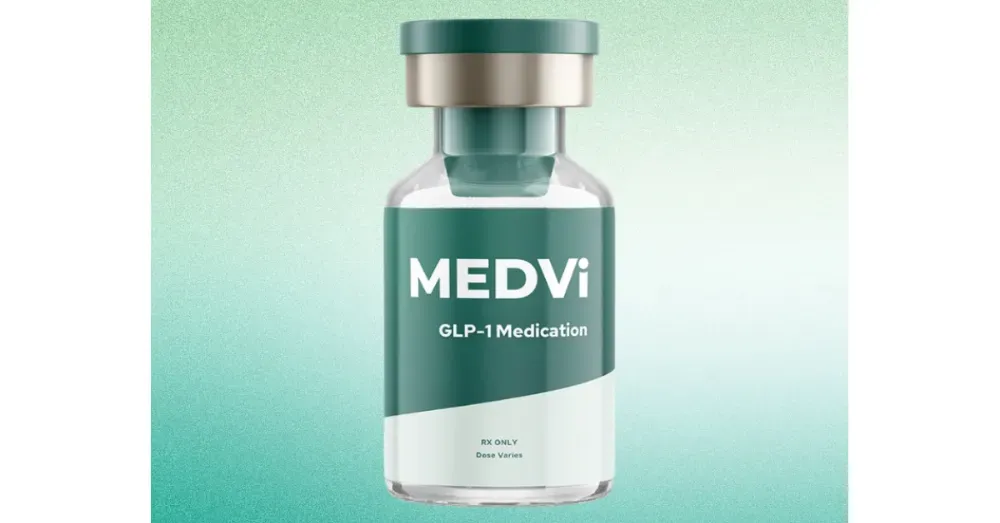
Gallagher saw a clearly defined division of labor: he used AI to handle branding, marketing, the website, customer service, and data analysis, while leaving all professional licensure-dependent tasks—such as medical compliance, prescription issuance, and drug dispensing—to CareValidate and OpenLoop. He chose to enter the market through GLP-1 weight-loss medications, the hottest category in the 2024 U.S. consumer healthcare market, where demand for semaglutide and tirzepatide far outstrips supply. A large number of consumers are willing to obtain compounded versions of GLP-1 medications online to avoid the inconvenience of in-person visits.
(Source: Medvi)
He used ChatGPT, Claude, and Grok to write code and website copy, Midjourney and Runway to generate advertising images and videos, ElevenLabs’ voice tools for customer service calls, and built a suite of custom AI agents to connect various software systems. The entire launch process took two months with a total investment of $20,000.
In September 2024, Medvi launched. It acquired 300 customers in its first month, 1,000 in the second, and growth surged thereafter. GLP-1 started at $179 per month, roughly in line with competitors. By the end of 2025, Medvi had accumulated 250,000 customers and generated $401 million in annual revenue. Chhabra of CareValidate told The New York Times that he initially assumed Gallagher had a team behind him—only to be told, “No.” OpenLoop’s CEO Jon Lensing said that Gallagher, in turn, began teaching their company how to use AI.
However, the process was not without challenges. Medvi’s AI customer service chatbot sometimes fabricated drug prices, and Gallagher chose to honor the incorrect quotes to fulfill customer orders. The bot also experienced “hallucinations,” telling customers that Medvi sold hair loss medication—even though the company didn’t offer it at the time. When customers insisted on speaking to a human, the chatbot would forward calls to Gallagher’s personal phone, resulting in over 1,000 customer service calls. On another occasion, after making a minor change to a website feature and going hiking, the site crashed, and no orders came in for an entire hour. With no one else able to fix the issue, Gallagher had to run all the way down from the mountain, losing approximately 200 potential customers.
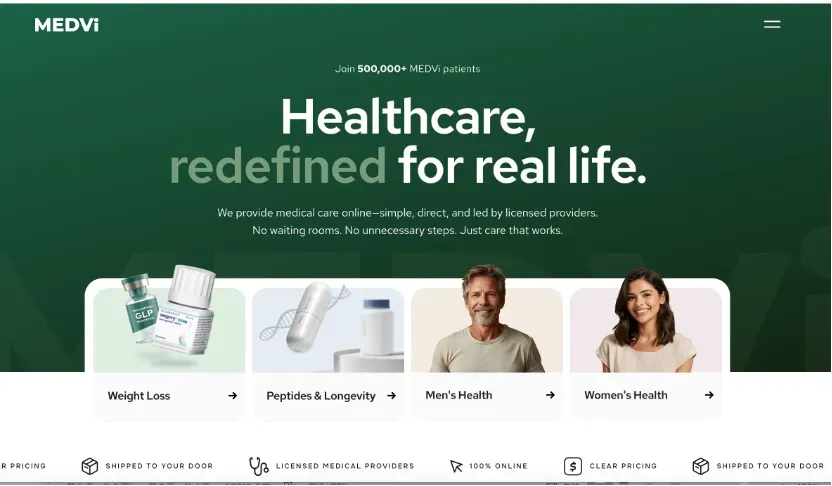
The early website also featured many unorthodox methods. Medvi initially used AI-generated model photos and weight-loss before-and-after images sourced from the internet, with faces altered using AI. The site displayed rotating logos of Bloomberg and The New York Times, giving the impression of media coverage and endorsement, when in fact they had only run advertisements on those platforms. Gallagher later replaced some of the materials with photos of real customers, but as of the report, Medvi’s homepage still included some AI-generated images.
(Source: Medvi)
Changing a few photos is a minor issue; the bigger concern is regulatory compliance.
In March 2026, the U.S. Food and Drug Administration (FDA) issued warning letters to more than 70 telemedicine companies, including Medvi, citing the sale of compounded GLP-1 drugs that had not been approved by the FDA or evaluated for safety and efficacy. While Medvi’s business model itself does not prescribe medications—the prescribing authority rests with licensed physicians at OpenLoop—the three-party separation of “platform-doctor-pharmacy” still exists in a regulatory gray area.
Nevertheless, Gallagher is expanding rapidly. In February 2026, Medvi launched its men’s health product line, including ED (erectile dysfunction) medications, acquiring 50,000 customers in its first month and is projected to surpass the scale of its GLP-1 business within four months. In March, it introduced a healthy meal delivery service, with women’s health, hair growth, and skincare products also in development. He considered acquiring other health product companies but ultimately concluded that building from scratch would be faster.
Kobie Fuller, an investor at venture firm Upfront Ventures, once advised Gallagher not to raise funding. Gallagher took that advice, and to this day, Medvi has accepted no external investment. Fuller told The New York Times that Gallagher is able to achieve this because he possesses two key skills: an understanding of marketing and the ability to expertly leverage cutting-edge AI tools. “This is an extreme case, but I don’t think it’s the last.”
However, Medvi’s case also reveals the fragility of this ultra-minimalist model: when the AI customer service makes a mistake, there’s no one to cover for it; when the website goes down, no engineers are on call; and when regulations tighten, a one-person company struggles to simultaneously manage compliance, public relations, and business continuity. Gallagher himself admits that he works all day except when sleeping, showering, or spending time with his children—even using an AI clone of his voice to make personal appointments, so he can devote more time to the company.
On social media, many have pointed out that Medvi is essentially an extremely efficient intermediary—it doesn’t develop drugs, hire doctors, or operate pharmacies; instead, it uses AI to push marketing and customer acquisition efficiency to the limit, while outsourcing the actual medical services. This assessment is largely accurate, but it does not negate its business achievements. Much of the value creation in traditional industries has always occurred in the areas of connection and distribution, and AI simply enables one person to accomplish this entire function.
Gallagher told The New York Times that Medvi has generated cumulative profits of $70 million to $80 million so far. Given his background, these figures mean more to him than just business. “This is the first time I’m no longer in survival mode,” he said. He set aside $1 million to establish a foundation, donating it to a cat rescue organization in Los Angeles, and plans to next fund nonprofit organizations that support homeless youth.
He said he had no plans to hire more people, as he couldn’t see how it would benefit the company. After a pause, he added: “At this stage, the only reason he’d want to hire someone is because he’s lonely.”
Reference materials:
1. https://www.nytimes.com/2026/04/02/technology/ai-billion-dollar-company-medvi.html