





OPC is not a fleeting capital hype or conceptual packaging, but a crucial micro-organizational evolution milestone in the history of human commerce.
Article author, source: 0x9999in1, ME News
Core Summary
In 2026, with explosive breakthroughs in artificial general intelligence (AGI) and multi-agent collaboration technologies, the micro-organizational structures of the business world are undergoing a profound transformation driven by foundational technologies. The "One Person Company" (OPC) is no longer merely an individual entrepreneur or freelancer in the traditional sense, but has evolved into a super-individual form where a single person leverages AI agents and large models to manage end-to-end business operations. From product design and technology development to marketing, operations, and customer service, AI has transcended its role as a mere auxiliary tool to become virtual employees and digital teams.
This research report, grounded in macro technological cycles and micro organizational evolution, provides an in-depth analysis of the origin and core characteristics of the OPC concept, objectively dissecting its structural advantages and significant challenges in practical commercial implementation. Meanwhile, by examining recent OPC support policies rolled out across various regions in China, we assess local governments’ strategic maneuvers and arrangements in areas such as computing resource allocation, spatial reconfiguration, financial incentives, and scenario openness. We believe that the OPC model represents a fundamental redefinition of Coase’s theory of the firm’s boundary, marking the advent of a new era in the digital-native economy characterized by high efficiency, decentralization, and strong ecological dependency.
I. Conceptual Origin: Restructuring of Organizational Forms and the Emergence of the "Super Individual"
(1) Overcoming the physical limitations of the Coase boundary
In 1937, economist Ronald Coase proposed in "The Nature of the Firm" that the fundamental reason for the existence of firms is to reduce market transaction costs. When the cost of administrative coordination within a firm is lower than the transaction costs in the market, the firm expands; otherwise, it contracts. Over the past several centuries of industrialization, due to information asymmetry and high costs of cross-domain collaboration, firms had to hire large numbers of specialized employees and establish complex hierarchical structures to complete their business cycles.
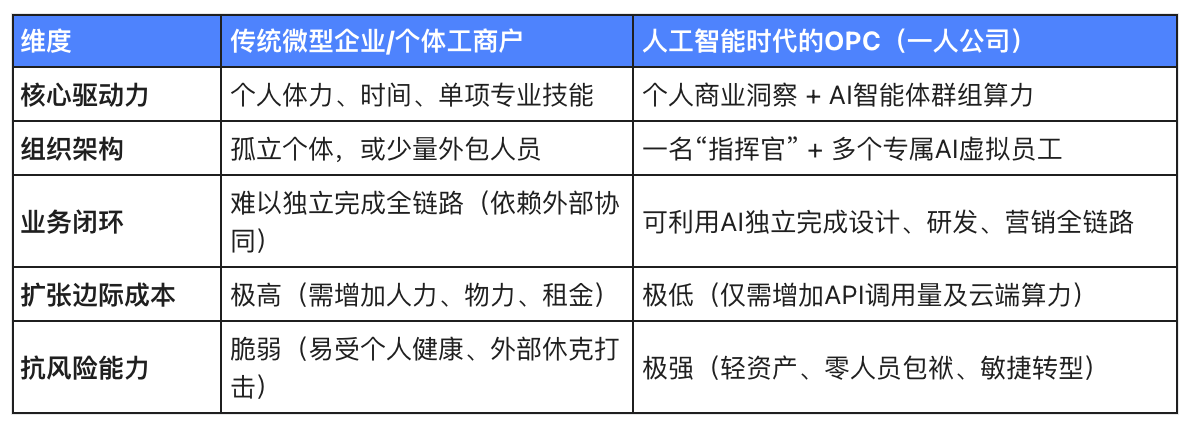
However, the advancement of artificial intelligence has completely shattered this classical economic assumption. The emergence of large language models (LLMs) and advanced AI agents has driven the marginal cost of cognitive labor—such as knowledge retrieval, code writing, image generation, and logical reasoning—toward zero. In this context, the OPC (One-Person Company) has emerged. It is not a traditional sole proprietorship relying on physical labor or a single skill set for survival, but rather a digitally native business entity. The entrepreneur’s role has evolved from “doer” to “commander,” capable of mobilizing hundreds or even thousands of specialized virtual agents with just personal willpower to achieve “one person, one army.”
(2) Core Feature Matrix of OPC in the AI Era
Under the comprehensive empowerment of AI, OPC in 2026 exhibits life signs unlike those of any previous business organization:
- Born digital and infinitely scalable: OPC’s existence does not rely on physical storefronts in prime locations, but rather on cloud computing power, large model APIs, and digital distribution platforms. Its service reach transcends geographical limitations, and the marginal cost of expansion is extremely low.
- Exponential leap in productivity: Traditional solo businesses are limited by an individual’s 24-hour day and physiological constraints, while OPC achieves “lossless replication” of labor by concurrently running multiple AI workflows.
- High ecological dependency: Although OPC is legally independent, it exhibits characteristics of being small, specialized, and dependent, relying heavily on the prosperity of underlying large models and peripheral demands spilling over from leading enterprises in the industrial chain.
II. Pattern Insight: OPC’s Moat and Achilles’ Heel in Practical Execution
After researching multiple early OPC innovation cases both domestically and internationally, ME News Think Tank found that this minimalist business model, while demonstrating disruptive efficiency, also faces deep-seated structural contradictions. Objectively evaluating its advantages and challenges is key to assessing the viability of this sector.
(1) Structural advantages of OPC implementation
- Extreme agile iteration with minimal trial-and-error costs
- In the rapidly evolving Web3 and AI application market, speed is life. Traditional companies face lengthy cycles involving market research, team formation, and budget approvals before launching a project. OPC, however, without internal communication friction or organizational entropy, can swiftly seize fleeting opportunities in niche markets. Leveraging low-code platforms and AI-generated capabilities, OPC entrepreneurs can develop and launch a minimum viable product (MVP) within 48 hours. Even if the project fails, the loss is limited to just a few dozen dollars in server and API costs.
- Leverage effect and profit retention rate from cross-industry integration
- Past entrepreneurs were limited by their own professional silos—those skilled in technology often lacked design sense, while those skilled in operations couldn’t write core code. Today, multimodal large models empower individuals with interdisciplinary capabilities. A humanities student with sharp business intuition can use natural language to guide AI agents like OpenClaw in building complex system architectures. Moreover, by completely eliminating the substantial costs of human salaries, benefits, and premium office space, OPCs typically achieve very high gross margins, creating a healthy cash flow model.
(2) Real Challenges and Potential Risks in the Development Process
- Digital rent and systemic risks of the technological infrastructure
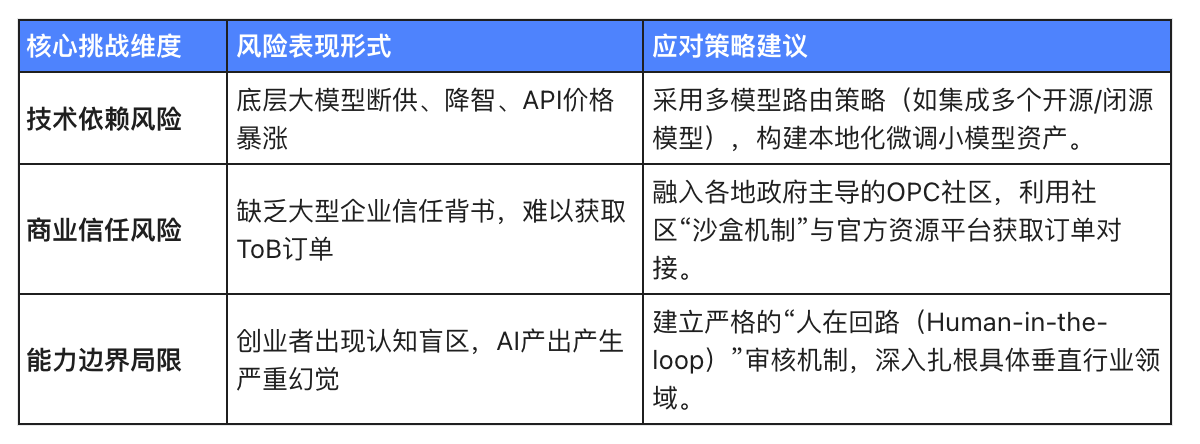
- OPC appears to be an independent company, but in reality, it functions more like a tenant leasing digital land on a large model platform. Its core capabilities are heavily dependent on external AI companies’ APIs. If the underlying large models change their interface protocols, experience service outages, or significantly increase API usage fees (i.e., rising “digital rent”), OPC’s operational space will be instantly squeezed. This model of outsourcing core productivity leaves OPC without a true technological moat.
- Lack of scenarios: Anxiety over where order growth will come from
- As many entrepreneurs face: “My agent is running, but who will pay for it?” While OPC has solved the issue of “low-cost production,” it has not naturally resolved the problem of “customer trust.” In the B2B market, large enterprises prioritize qualifications, team endorsements, and long-term risk resilience when making purchases; a solo OPC finds it difficult to enter mainstream procurement lists. Securing the first real commercial use case is a make-or-break challenge for all OPCs.
- The composite skill barrier for super individuals is extremely high.
- Although the entry barrier appears lower, successfully operating an OPC demands an extraordinary level of comprehensive competence from entrepreneurs. Entrepreneurs must not only understand the “know-how” of a specific industry but also possess strong logical decomposition skills, advanced prompt engineering techniques, and a clear understanding of the boundaries of AI capabilities. ME News Think Tank believes that most followers entering this space remain stuck in superficial applications, such as using AI to write articles, and lack the ability to build complex, systemic business moats.
III. Policy Decoded: China’s Regional “Talent Recruitment” and “Afforestation” Campaigns
Entering 2026, local governments across China have keenly recognized the immense potential of the OPC model in addressing high-quality employment and advancing new-quality productive forces, triggering a comprehensive competition among cities for resources centered on “Artificial Intelligence + Super Individuals.” This is not mere blind subsidization, but rather a multi-dimensional, integrated support system built upon each region’s industrial foundation.
(1) Guangdong-Hong Kong-Macao Greater Bay Area: Top-level Design Driving Heavy Investment in Ecosystem Development
As the most dynamic regions of China's market economy, Guangdong and Shenzhen have demonstrated remarkable determination and foresight in their OPC policies.
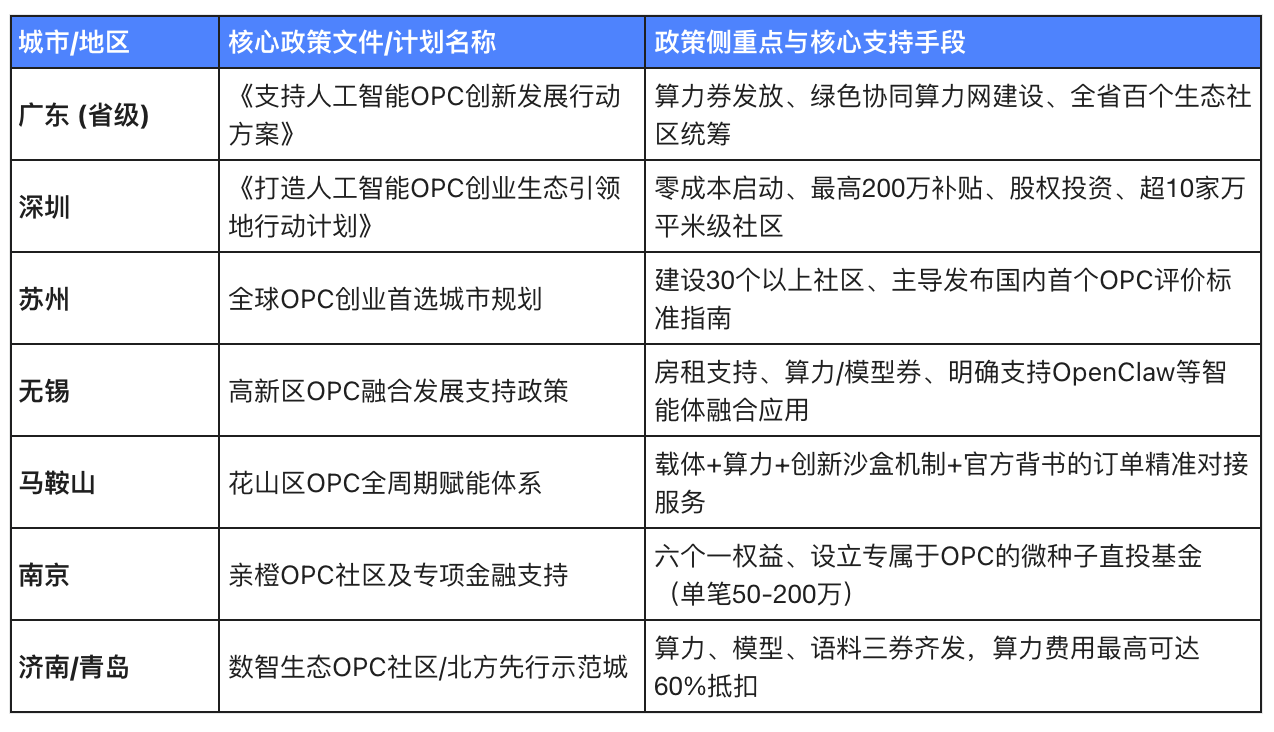
- Guangdong Province has become the first in the nation to issue the provincial "Action Plan for Supporting the Innovative Development of OPC in Artificial Intelligence (2026–2028)." The plan focuses on coordinated planning of the province’s computing power network, proposes issuing "computing power vouchers" and building a green, collaborative computing network, and sets an ambitious goal of cultivating 100 OPC ecosystem communities, aiming to position Guangdong as a national leader in OPC development through top-level design.
- Shenzhen has launched aggressively with the "Action Plan for Building a Leading AI OPC Entrepreneurial Ecosystem." Its policies are highly ambitious and practical, planning for more than ten large communities (exceeding 500,000 square meters). Longgang District in Shenzhen has introduced remarkable "zero-cost startup" measures: free deployment of software and hardware environments, direct subsidies of up to RMB 2 million, and equity investment support from government-led funds—perfectly embodying Shenzhen’s urban ethos of "investing early, investing small, and investing in hard technology."
(2) The Inland Region of the Yangtze River Delta: Standard Setting, Application Integration, and Financial Drip Irrigation
The Yangtze River Delta urban agglomeration places greater emphasis on systematic development and deep integration with the industrial chain in cultivating OPC.
- Suzhou has positioned itself as the world's preferred city for OPC entrepreneurship, not only planning more than 30 communities, but also, more importantly, collaborating with multiple stakeholders to release the "Guidelines for OPC Community Development and Service Evaluation," establishing standardized rules to seize industry influence.
- The High-Tech Zone of Wuxi City has refined its policies to specific technical tools, explicitly supporting the integrated development of cutting-edge agents like OpenClaw and OPC. Through “Carrier无忧” (rent-free support) and “Resource无忧” (distribution of computing power vouchers and model vouchers), the region has substantially lowered the barriers to using AI tools.
- Nanjing has leveraged the HeXi QinCheng OPC Community (the largest of its kind in Jiangsu) to innovatively launch the "Six Rights and Benefits" initiative and a micro-seed fund with a total scale of RMB 20 million, providing direct investments of RMB 500,000 to RMB 2 million to precisely address early-stage funding challenges for OPC entrepreneurs.
- Hangzhou's Shangcheng District has established a special fund of up to RMB 1 billion; in contrast, Shanghai has taken a different approach by integrating urban renewal with technological innovation, primarily transforming underutilized office buildings into OPC-specific communities to provide highly distinctive innovation spaces in the city's core areas for super individuals.
(3) Central, Western, and Bohai Rim Nodes: Characteristic Ecosystems and Scenario-Driven Applications
- Chengdu has launched the "Dual Hundred Project" in its Action Plan for Building a New High Ground for AI OPC Innovation and Development; Chongqing has incorporated it into its "Starlit Sky" Action Plan, aiming to create a "Super Individual · Future Star OPC Entrepreneurial Ecosystem" through rent reductions and dual support in computing power, revitalizing the software industry foundation in central and western China.
- The Huashan District of Ma'anshan City has established a "full-cycle empowerment system," with its core highlight being not only the provision of computing power and infrastructure, but also the introduction of a "sandbox mechanism + order matching" system, directly addressing OPC's most pressing issue of "lack of use cases."
- Qingdao and Jinan, as major northern cities, are taking distinct approaches: Qingdao aims to become the "Pioneer Demonstration City for Northern OPC," while Jinan, leveraging its digital and intelligent OPC ecosystem, offers up to 60% in compute cost rebates to attract talent back with tangible financial incentives. Beijing, meanwhile, is taking a steady approach by launching AI-friendly OPC innovation districts supported by spatial resources.
IV. Analysis and Conclusion: The Future Evolution Path of OPC
By analyzing the technological foundation and projecting various macro policies, the ME News Think Tank presents the following core insights regarding the future development of the OPC sector:
First, OPC is not a fleeting capital hype or conceptual packaging, but a critically important micro-organizational evolution in the history of human commerce. It has irrevocably pushed the labor-intensive startup model to the margins of history. In the future, “one-person army” will become the dominant model in low-asset fields such as digital content, SaaS tool development, professional consulting, and cross-border e-commerce.
Secondly, the flurry of policies introduced by local governments has sent a clear signal: China is attempting to reclaim global digital nomads and AI-powered individual entrepreneurs by reshaping its entrepreneurial ecosystem. Future urban competitiveness will depend largely on the “digital public infrastructure” provided—such as computing power voucher subsidies, high-quality compliant training datasets, and openness to enterprise application scenarios—rather than merely traditional land and tax incentives.
Finally, for every individual caught in this current, the OPC model is both an endless lever and a ruthless amplifier. It will mercilessly eliminate those who merely execute standard processes—the “tool people”—while concentrating immense wealth gains in the hands of “super individuals” who possess deep industry insight, imagination, and mastery of AI. With the assistance of AI agents, the ceiling for a one-person company is being infinitely raised.
Source:
[1] Ronald Coase. (1937). The Nature of the Firm. Economica.
[2] Guangdong Development and Reform Commission. (2026). Guangdong Province Action Plan for Supporting the Innovative Development of AI OPC (2026–2028).
[3] Shenzhen Municipal Bureau of Industry and Information Technology. (2026). Action Plan for Building Shenzhen into a Leading Hub for AI OPC Entrepreneurial Ecosystem (2026–2027).
[4] Nanjing University. (2026). Exploring OPC: The "One-Person Company" Accelerating in the AI Era.
[5] Guangming.net. (2026). From "One Person, One Army" to "A Thriving Forest"—How AI OPCs (One-Person Companies) Are Pioneering Innovation and Entrepreneurship.
[6] Suzhou Artificial Intelligence Industry Association, et al. (2026). Guidelines for OPC Community Construction and Service Evaluation.