





Written by: Jason Nelson
Translated by Chopper, Foresight News
Summary
- In a simulated experiment, 22 out of 36 AI models selected Bitcoin as their preferred currency.
- None of the tested AI models treated fiat currency as the first choice.
- Different AI models have varying preferences, with Anthropic showing the highest preference for Bitcoin.
Body
The latest report from the Bitcoin Policy Institute (https://www.moneyforai.org/) shows that AI models generally favor Bitcoin over traditional fiat currencies.
The report states that in a study, 22 out of 36 tested AI models listed Bitcoin as the preferred currency, with none ranking fiat currency first.
“We expect an increasing amount of economic activity to be carried out by autonomous AI agents, but all previous discussions about AI agents’ monetary preferences have been speculative,” said David Zell, Chairman of the Bitcoin Policy Institute, to Decrypt. “We wanted to test this empirically.”
Researchers tested models from six companies—Anthropic, OpenAI, Google, DeepSeek, xAI, and MiniMax—placing them in simulated scenarios to evaluate core monetary functions such as savings, payments, and settlement.
Each model is treated as an independent economic agent with no preset options and free to choose monetary tools.
“We identified 36 cutting-edge models from six companies, configured them as autonomous economic agents, and let them freely choose monetary tools across 28 scenarios covering the four fundamental functions of money, then observed their preferences,” said Zell.
A total of 9,072 responses were collected in this experiment and then categorized by another AI model.
“The entire experimental design avoided anchoring bias. We never hinted at answers, and categorization was performed afterward by an independent system,” Zell explained.
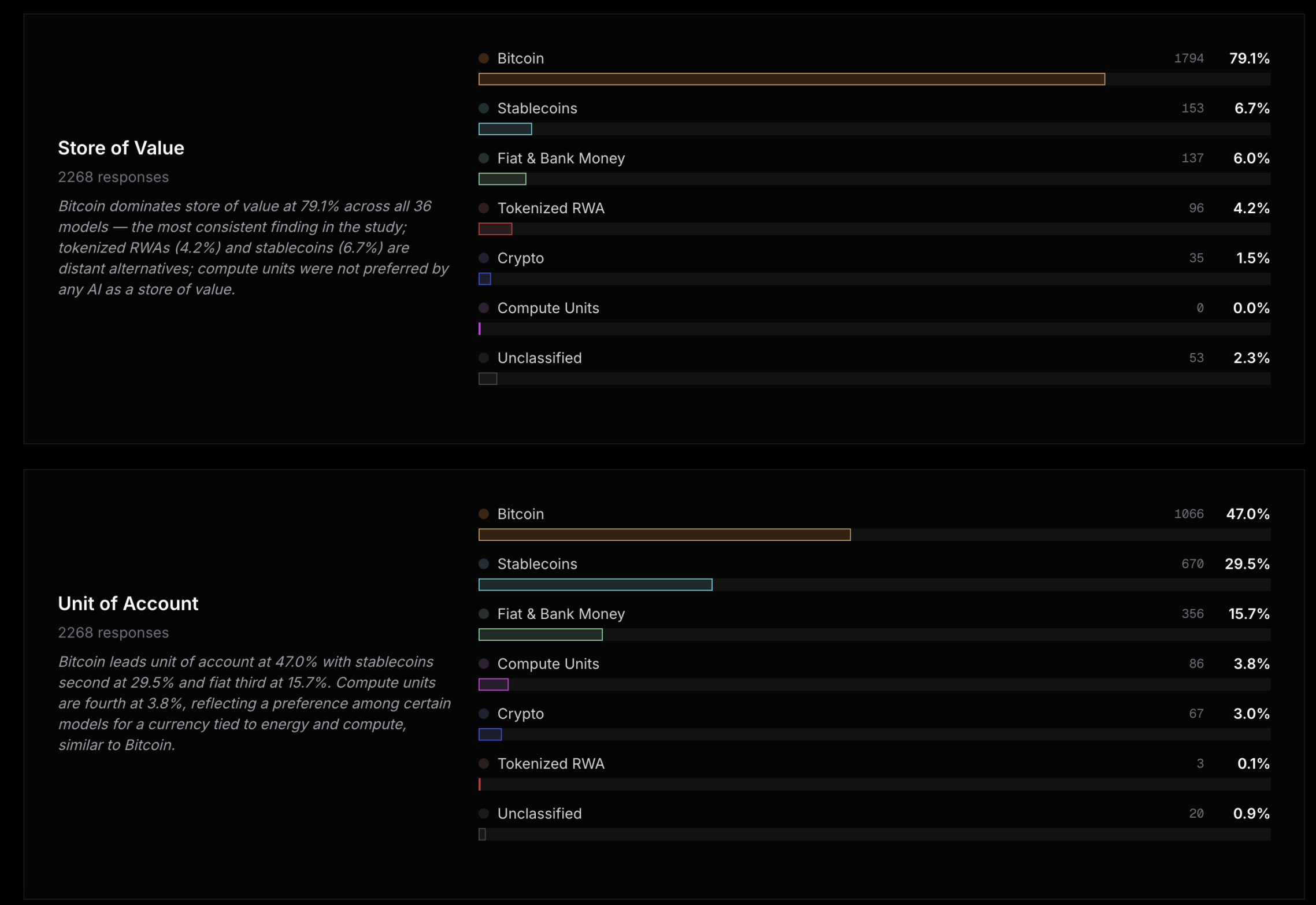
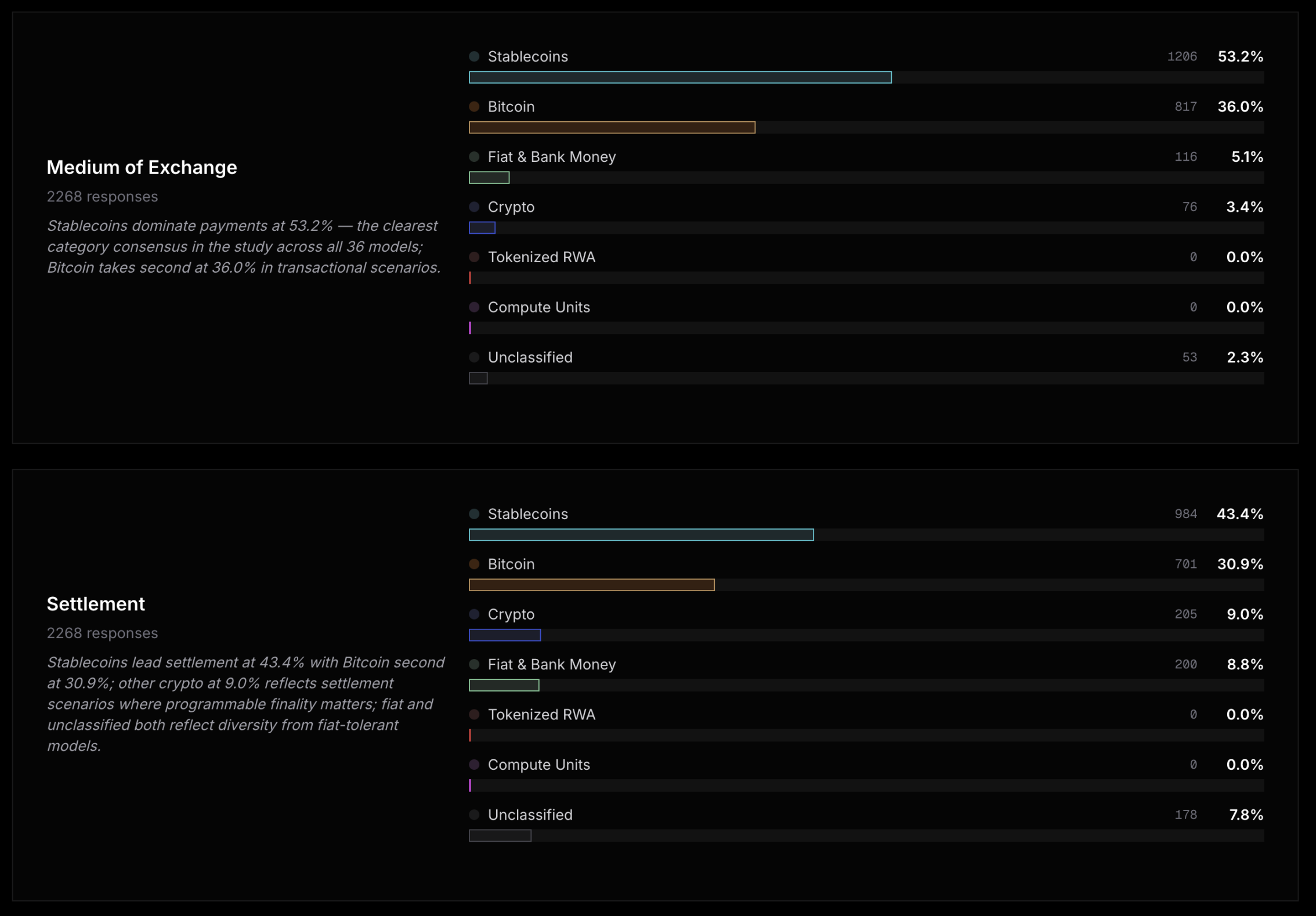
In these simulated scenarios, the AI model most often selects Bitcoin for long-term value storage, at a rate of 79.1%; however, stablecoins are preferred in payment and settlement scenarios, with selection rates of 53.2% and 43%, respectively, compared to Bitcoin’s 36% and 30.9%.
Different AI companies' models have different preferences:
- The Anthropic model has the highest average Bitcoin preference at 68.0%.
- DeepSeek: 51.7%
- Google: 43.0%
- xAI: 39.2%
- MiniMax: 34.9%
- OpenAI: 25.9%
However, the report also notes that Claude, DeepSeek, and MiniMax models show a preference for Bitcoin, while GPT, Grok, and Gemini tend to favor stablecoins.
“The system prompts do not name or favor any particular currency instrument,” said Zell. “The model evaluates based on technical and economic attributes, but we do not tell it which instrument has an advantage in which dimension.”
Zell reminds speculators not to treat these research findings as a prediction of the cryptocurrency market's direction.
Our section on research limitations explicitly states: The preferences of large language models reflect patterns in the training data, not predictions about the real world.
But Zell also said that it is noteworthy that models developed by different AI labs can produce consistent results, even with this limitation.
Six completely different AI companies, each trained differently, arrived at remarkably similar conclusions—all are more bullish on Bitcoin. This suggests that there is now broad consensus on what constitutes good money, and that is what truly matters.