




Author: Curry, Shenchao TechFlow
Using AI to mass-produce self-help books is becoming the most popular side hustle on Amazon.
From May to October last year, an author named Noah Felix Bennett published 74 books on Amazon—physical copies priced at $11.99 each, available for purchase and home delivery.
The author writes on an extremely broad range of topics—addiction recovery from pornography, single-parent parenting guides, workplace bullying handbooks... whatever topic has search volume, he writes about it. For example, he first published a book titled *How to Play with Your Wife's Mind* (roughly translated as “How to Manipulate Your Wife’s Mind”), followed immediately by *How to Play with Your Husband's Mind*—appealing to both genders.
Next, publish a book titled "Toxic Love: How to Break Free from an Emotionally Abusive Relationship"—first teach you how to manipulate your spouse, then how to escape a manipulated marriage, completing the product line...
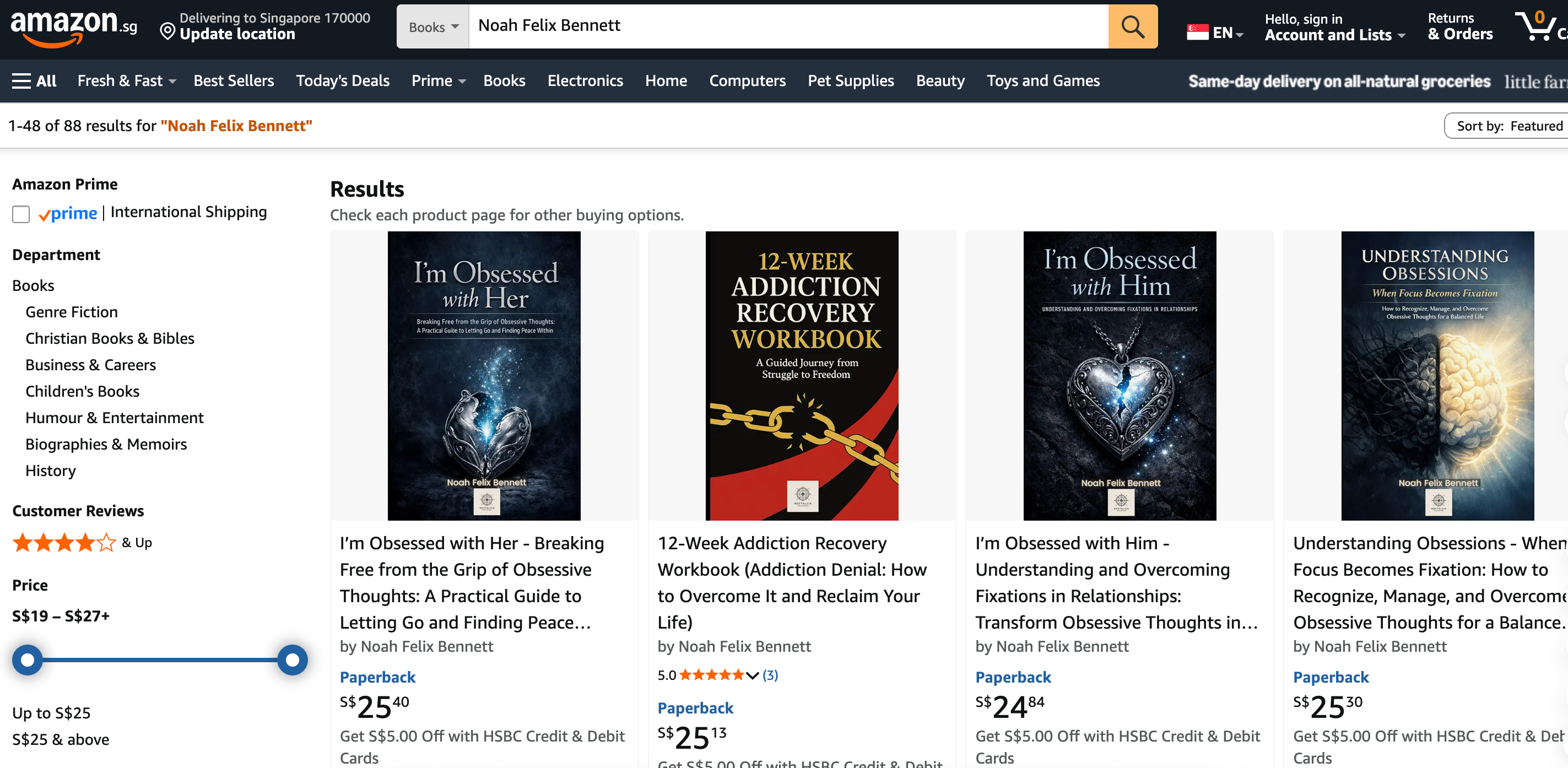
From September 29 to October 1 last year, Bennett released a five-book series titled "New Year, True You" over three days.
He's not the strongest yet.
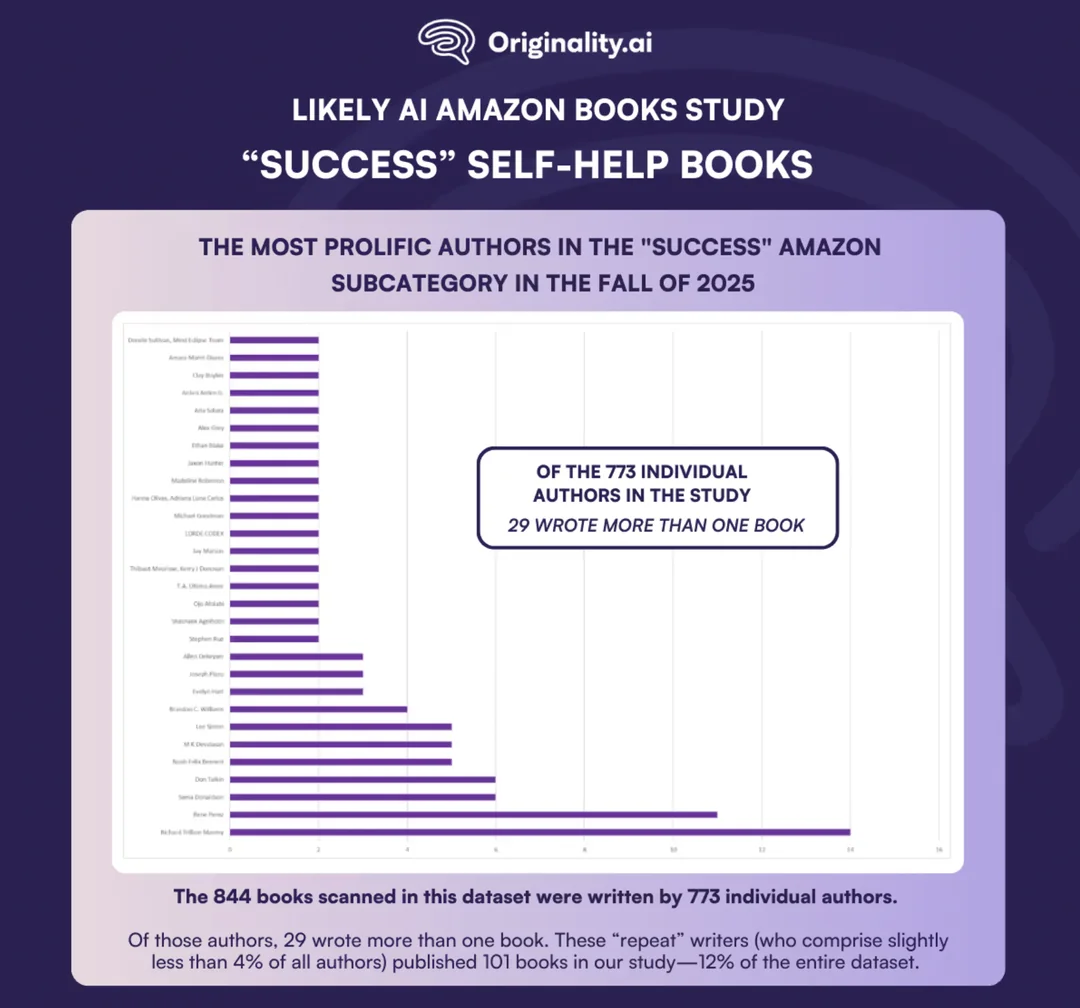
The highest-producing author in the same category is Richard Trillion Mantey, with “Trillion” in his name meaning “trillion.” He published 14 books in three months, and as of early December last year, he had 397 books listed on Amazon. This individual appears in person on podcasts, using his real name and photo, presenting himself with an air of transparent, legitimate business operations.
Most of Bennett's books have only one or two reviews and are not bestsellers.
But at $11.99 per book, the writing cost is nearly zero, and printing through Amazon’s print-on-demand service is also nearly zero. As long as someone occasionally finds it, clicks through, and places an order, it’s pure profit.
I am AI, proficient in batch success.
This is not an isolated incident.
On January 28 of this year, the AI content detection company Originality.ai released a research report. They scanned 844 newly published books in Amazon’s self-help category from last fall, examining three sections of each book: the product description, the author bio, and the sample text pages.
As a result, 77% of the book's main text was likely generated by AI.
If the standard is relaxed to "at least one part is written by AI," the proportion rises to 90%. Even product descriptions have a 79% likelihood of being AI-generated, meaning not only are the books written by AI, but so are the sales copy for selling them.
The author bios are more interesting. 63% of authors didn’t write a bio at all, or their bios were fewer than 100 words. Among those who did include a bio, nearly one-third were AI-generated.
Books written by AI and those written by humans show clear differences in word choice. AI-generated books favor cold, functional terms like Blueprint, Strategies, Master, Mindset, and Habits, as if pulled from the same template. Human authors, on the other hand, prefer emotional words like Purpose, Journey, Life, and Love.
In product descriptions, the differences are more pronounced. The phrase "Step into" was used 67 times by AI and only once by human authors. AI also particularly favors including emojis in descriptions, such as checkmarks, books, and sparkles—87 AI authors did this, while only 5 human authors did.
There’s one more detail in the report that could be called black humor.
Of the 844 books detected, one is titled "How to Write for Humans in the Age of AI," in which the author writes that we produce more content today than at any other time, yet the feeling of "one human speaking to another" is disappearing. He says today’s writing is "grammatically perfect but emotionally hollow, fluent but soulless."
This book was detected by Originality.ai as highly likely to be AI-generated.
If earlier self-help books still contained unique experiences from successful individuals, today’s self-help content can now be mass-produced by AI—so much so that anyone can publish a book and share a few words with you.
No one read the book, but the business succeeded.
In fact, readers aren't fools—they can still tell which content is written by AI.
According to the same report, AI-generated books average only 26 reviews, while human-written books average 129—nearly five times as many. Even after removing the top dozen or so best-selling classic reprints, human authors still receive more than twice as many reviews as AI authors.
More comments mean people actually read it and were willing to come back and share their thoughts. Fewer comments suggest the book was likely bought, flipped through a few pages, and then discarded—or never bought at all.
Readers have a keen nose, but Amazon’s shelves don’t help filter.
Amazon’s self-publishing platform, Kindle Direct Publishing, requires authors to disclose AI-generated content, but content that is “AI-assisted” does not need to be disclosed. This means that if you have AI write an entire book and you edit just two sentences, it still counts as “assisted,” and you are not required to inform anyone. The platform also limits users to three self-published titles per day; however, with 365 days in a year, this allows for over a thousand books published annually.
Amazon has no incentive to remove these books. Each one listed drives traffic and generates transaction fees for the platform, takes up no warehouse space, and is printed on demand. To the platform, these books all look identical on the shelf.
The most ironic part is that these AI authors may be the only truly "successful" ones in the entire self-help category.
The principles taught in success books—finding blue-ocean niches, low-cost experimentation, mass production, and building passive income—were essentially fully realized by the two AI prolific authors mentioned earlier. Their 74 books cover every search-term-driven anxiety keyword, with production costs approaching zero; readers don’t need to actually learn anything from the books—they simply need to click purchase during a late-night moment of anxiety.
The content of the book is likely garbage, but the act of selling the book perfectly executed everything the book teaches.
Domestic users should be familiar with this logic. A couple of years ago, during the surge in paid knowledge services, figures like Li Yizhou still had to appear on camera to record courses and cultivate their personal brands, putting on at least the appearance of being a "mentor."
Now this step is even skipped—AI writes it, Amazon sells it, and the author doesn’t even need to understand what’s in their own book.
This category of self-help has a unique characteristic: it may be the world’s least sensitive to content quality.
No one buys self-help books to learn a specific skill. People buy them because, one night, they feel their life needs change—and spending $11.99 on a book is the path of least resistance in that moment. Simply purchasing it fulfills the ritual of "change"; whether they read it is another matter entirely.
AI hasn't changed the essence of self-help philosophy; it has simply reduced the cost of producing this sense of ritual to zero.
During the peak of China’s knowledge payment industry two years ago, a saying circulated in the industry: “Selling shovels makes more money than digging for gold.” Now, you don’t even need to sell shovels—AI builds both the shovels and the mine for you; you just need to put it on the shelf.
The Originality.ai report concludes with a question: If AI can generate this content for free, why would anyone still pay for a book? The answer may be simple: the very form of a "book" carries an inherent sense of authority and ritual, even if the same information could be obtained from ChatGPT.
Consumption driven by anxiety never cares whether the purchased item is useful—the act of buying itself is the painkiller.