





Introduction
If you've been following AI over the past three years, you'll notice a clear shift: it's no longer just "useful," but beginning to become "irreplaceable." This change didn't happen overnight—it evolved through three distinct stages.
I. Phase One: AI is a "new species," but has not yet entered daily life
Three years ago, the most popular AI products were highly concentrated:
- ChatGPT: Chat and Q&A
- Midjourney: Image Generation
- Character.AI: Conversations with Virtual Characters
Their commonality is that they are all "AI-native applications," existing fundamentally to showcase AI capabilities.
User behavior at the time was also typical:
- Ask a question
- Generate image
- Chat and entertainment
It’s essentially about “experiencing AI,” not “relying on AI.” In other words, AI at this stage functions more like a showcase of capabilities rather than a production tool.
II. Phase Two: AI Begins to "Embed Into All Products"
The real change has occurred over the past two years.
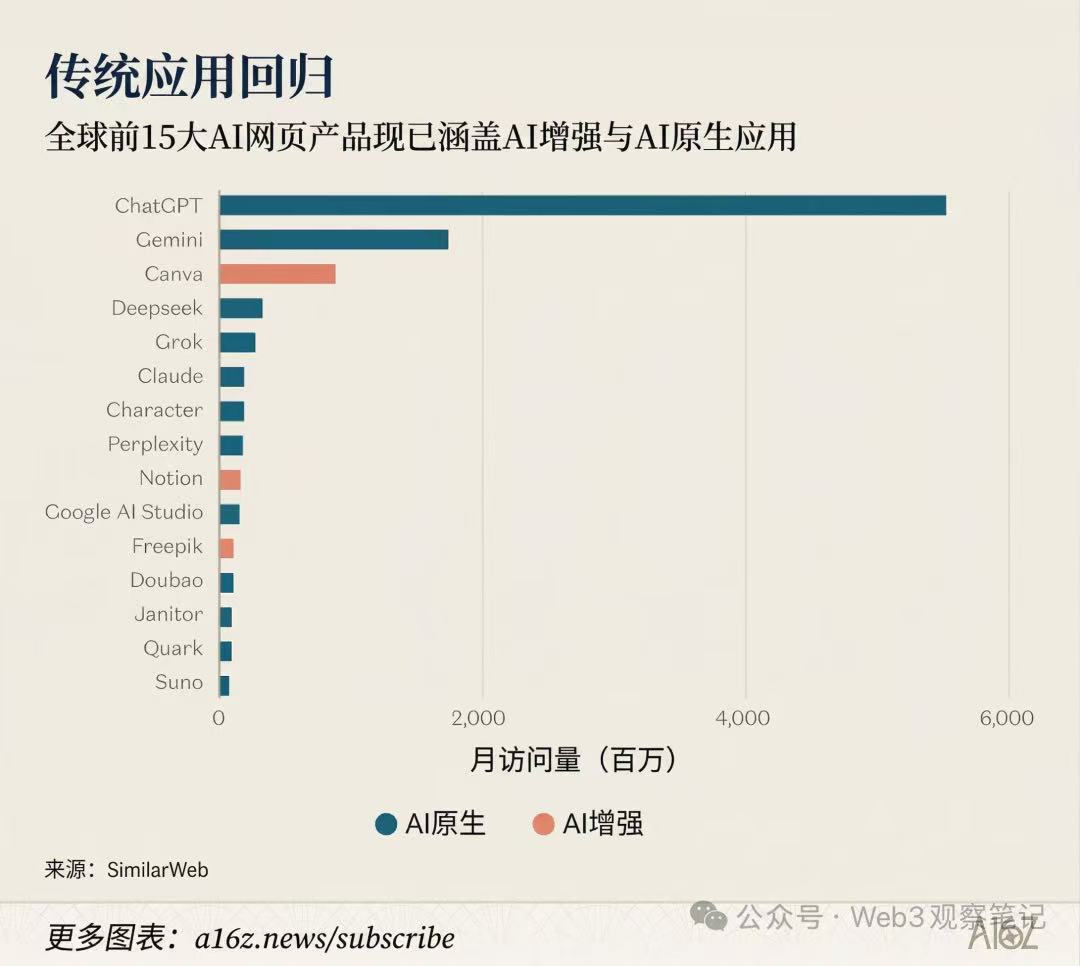
The stars of the AI applications ranking are no longer "pure AI products," but rather established applications reimagined by AI:
- CapCut: 736 million monthly active users, with core features almost entirely AI-powered
- Canva: Redesigning the design process around AI tools
- Notion: AI feature penetration rate increases from 20% to 50%+
An even more critical signal has emerged:
AI is now contributing nearly half of the revenue (ARR).
This means one thing:
AI is no longer a feature, but infrastructure.
Platform differentiation is beginning to emerge.
Once AI becomes a foundational capability, the role of large models also changes:
Change from "chat tool" to "access point".
Two paths are gradually becoming clear:
1) Super Entry Point (Consumer-grade)
What ChatGPT is doing includes:
- GPTs + App Store
- Log in with ChatGPT account system
- Integrate into daily life scenarios such as shopping, transportation, and health.
The goal is clear: become your starting point for using the internet.
2) Professional Work Platform (Productivity Side)
Claude's path, however, is completely different:
- MCP (Model Context Protocol)
- Deeply integrate development tools and data systems
- Build complex workflows
It's more like an AI operating system for knowledge workers.
A structure in formation: the platform flywheel
When users begin integrating AI into their daily systems:
- Calendar
- CRM
- Workflow
Switching costs rise rapidly, and platform stickiness begins to form.
Thus, the classic flywheel effect emerges:
- More users → More developers
- More developers → richer features
- More features → Greater user dependence
This also determines a result: the competition will not be dominated by a single player, but rather resemble two ecosystems coexisting over the long term.
Three: Third Stage — AI Begins to "Do Things for You"
The real turning point actually occurred over the past year.
AI is no longer just about "helping you generate content"—it's beginning to "perform tasks for you." From "generating content" to "completing tasks."
Early AI (such as Midjourney, DALL·E) addressed:
- Write content
- Generate image
But today's new generation of products are doing:
- Task breakdown
- Automate
- Full delivery
AI agents are beginning to emerge
Represented by OpenClaw, these products have undergone a key transformation:
- Not just answering questions
- Instead, break down the task
- And automatically execute the entire process
For example, a complete process:
- Receive target
- Query information
- Analyze and process
- Output result
- Auto-send
At this point, AI is no longer just a tool, but rather: a "software entity capable of action."
Another trend: AI is beginning to “help you build products.”
Vibe Coding is rapidly gaining popularity, with representative products including:
- Cursor
- Replit
- Lovely
They are essentially doing one thing: enabling AI to directly build your product for you. This change isn't just a simple improvement in efficiency—it’s a shift from “humans write code” to “humans define goals, and AI handles the construction.”
Four: When AI Takes Action, Why Does It Move Toward Web3?
As AI moves from "answering questions" to "executing tasks," a pressing question arises: how does it complete transactions and settlements? In the traditional internet, these processes rely on platforms and intermediaries—but this system was designed for humans and is not suited for autonomous machine operation.
Web3 provides a more suitable underlying infrastructure for AI:
- 24/7 operation: AI can continuously execute and respond.
- Native machine interface: Contracts as APIs, directly callable
- Programmable assets: Fund transfers can be completed automatically.
The change this brings is that AI can now automatically handle payments and settlements during the process, not just perform tasks.
More importantly, blockchain enables transactions to be immutable and auditable, allowing AIs to collaborate without intermediaries. This means the way the internet trusts—shifting from “trust platforms” to “trust rules.”
This is precisely why the relationship between AI and Web3 resembles a natural division of labor: AI handles actions, while Web3 handles settlements. When AI truly begins participating in transactions and collaboration, this combination is likely to become the foundation of the next-generation internet.