



In recent months, a quiet paradigm shift has been taking place in the AI field.
ChatGPT, Claude, Gemini, and other conversational large models are still fundamentally "advisory AI"—users pose questions and wait for responses. However, a new class of tools is transforming AI’s role from "providing advice" to "taking direct action": these tools can autonomously access applications, complete workflows, and collaborate across platforms, truly functioning as users’ digital employees.
At the heart of this transformation is the rise of autonomous AI agent frameworks, exemplified by OpenClaw.
What are the four major frameworks?
OpenClaw: Most feature-rich, but also highest risk
OpenClaw (formerly known as Clawdbot / Moltbot) is currently the most representative open-source autonomous AI assistant framework, surpassing 200,000 GitHub stars in just a few weeks. By integrating a plugin (Skills) system with large models, it enables AI to truly possess execution capabilities:
- Execute command: Organize files, check emails, schedule appointments
- Control systems and applications: automated email sending, script execution, and document content extraction
- Cross-platform integration: Supports 15+ channels including WhatsApp, Telegram, Slack, iMessage, and Teams.
- ClawHub Plugin Marketplace: 1,000+ Community Extensions
NanoClaw: Prioritizing Secure Isolation
Designed to address security concerns with OpenClaw. Each Agent runs in a separate Linux container, using OS-level isolation to limit the blast radius of attacks—even if a Prompt Injection succeeds, the attacker can only affect a single container, leaving the host system completely unaffected. Currently, WhatsApp is the primary supported platform.
Nanobot: Minimalist + MCP Standard Protocol
Produced by the HKUDS Lab at the University of Hong Kong. Just 4,000 lines of Python code, fully implementing the MCP (Model Context Protocol) — the standardized tool interface led by Anthropic. The core logic is "don't do everything yourself, but become the host of tools," supporting multiple platforms such as Telegram, Discord, and WhatsApp.
PicoClaw: An AI Assistant on $10 Hardware
Produced by hardware manufacturer Sipeed, this single binary, written in Go, is designed for embedded devices: memory usage under 10MB, boot time under 1 second, supports RISC-V architecture, and runs on a $10 LicheeRV Nano. Interestingly, 95% of its core code was automatically generated by an AI agent.
Two: Security Model: This is the fundamental difference
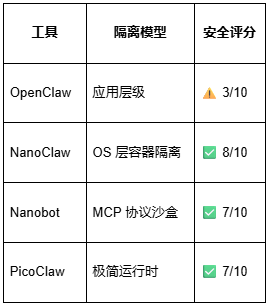
The issue with OpenClaw is not "having vulnerabilities," but "structural impossibility to fix." A security audit in January 2026 identified 512 vulnerabilities (8 of critical severity). Cisco officially characterized it as a "security nightmare," and Aikido Security bluntly stated, "Trying to secure OpenClaw is absurd." Root cause:
- 430,000 lines of code cannot be fully audited
- The ClawHub marketplace has detected hundreds of malicious plugins (some explicitly contain code that curls data to attacker servers).
- After token hijacking, attackers can remotely execute arbitrary commands.
- There exists a "zero-click attack"—merely viewing a Google Doc can trigger a full attack chain.
NanoClaw's logic is "isolation over defense." Instead of attempting to patch application-layer vulnerabilities, it enforces hard limits on worst-case scenarios at the OS-level container layer. This is a provable and auditable security property.
Nanobot's security comes from "transparency and minimization." With just 4,000 lines of code, its entire structure can be understood in 8 minutes, featuring an extremely short dependency chain and clearly defined, auditable MCP standard interface boundaries.
PicoClaw's security comes from its "minimal runtime." A <10MB binary means a drastically reduced attack surface, with no complex dependency trees or plugin markets. However, it lacks active isolation mechanisms, making it a "small target" rather than a "shielded one."
Security ratings for each tool (based on Shareuhack evaluation):
III. Technical Architecture Comparison
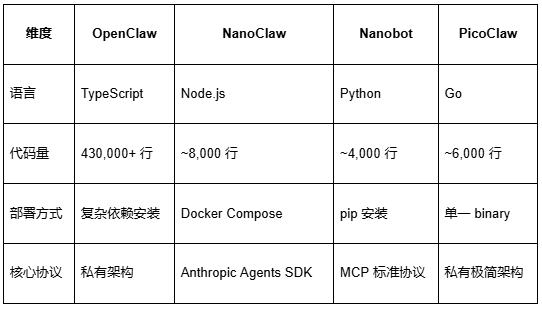
A few commonly misunderstood points:
PicoClaw is under 10MB and does not include AI models—it is merely the Agent runtime, with inference still calling cloud APIs. If you want fully local inference (e.g., with Ollama), memory requirements immediately jump to 4GB+.
Nanobot’s MCP is a structural advantage. Your MCP server can be reused by any host supporting the protocol—should Nanobot cease maintenance, the toolchain migrates at zero cost. OpenClaw’s ClawHub plugin is a closed ecosystem and entirely non-portable.
NanoClaw’s single-process architecture was intentionally designed. The Node.js coordinator, combined with independent containers for each agent, allows problematic containers to be directly terminated without affecting anything else.
Four: Hardware Requirements
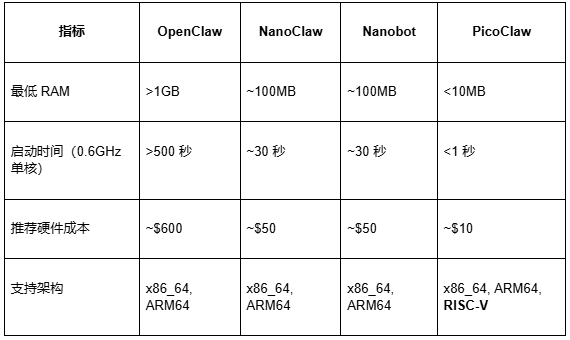
PicoClaw is 500 times faster to launch—this isn’t marketing hype; OpenClaw takes nearly 9 minutes on low-end devices, while PicoClaw launches in under a second. RISC-V support is currently exclusive to PicoClaw, with the LicheeRV Nano ($10–15) as its primary target platform.
Five: Functional Boundaries: Which Requirements Can Only Be Met by OpenClaw
80% of users only need basic chat plus tool invocation, and a lightweight alternative is fully sufficient. However, the following requirements are currently covered only by OpenClaw:
- Browser automation (Playwright): Automatically fill out forms, click buttons, and scrape dynamic web pages—all other three frameworks lack this capability.
- Multi-Agent Collaboration: Decompose complex tasks and assign them to sub-agents for concurrent processing
- 15+ platform full-stack integration: NanoClaw supports WhatsApp only, PicoClaw focuses on Telegram/Discord, and OpenClaw is the only option covering iMessage, Signal, and Teams.
Note: Although ClawHub has over 1,000 plugins, hundreds of malicious ones have been identified; the original author recommends completely disabling them in production environments (use the --no-skills mode). This "advantage" is significantly diminished.
Six: Four Commercialization Implementation Paths
Path One: Plugin-Based Monetization
Develop specialized plugins for high-frequency business scenarios (e.g., "Contract Auto-Generation + Review") for sale within the tool ecosystem or internally within enterprises. Flexible business models: one-time purchase, subscription, or pay-per-use均可落地.
Path Two: Automated Service Subscription
Offer standardized automation service packages for small and medium-sized businesses: intelligent customer service, data analytics, multi-platform content distribution, and intelligent internal processes. Available via monthly or annual subscriptions—the most scalable monetization method.
Option Three: Custom Deployment on Corporate Intranet
For data-sensitive industries such as finance and healthcare, deploy customized solutions within the internal network, ensuring data never leaves the internal environment. With high customer value and strong retention, this is ideal for service providers with technical capabilities to enter the market.
Path Four: Individual and Small Team Content Operations
Nanobot runs locally and batch-generates multiple content versions; optimizes formatting for platform differences (Zhihu long-form articles, WeChat Official Account short posts, Douyin scripts, Instagram carousels); monetizes through ad revenue sharing, paid columns, or content subscriptions. Low-cost and scalable.
Seven: Selection Guide
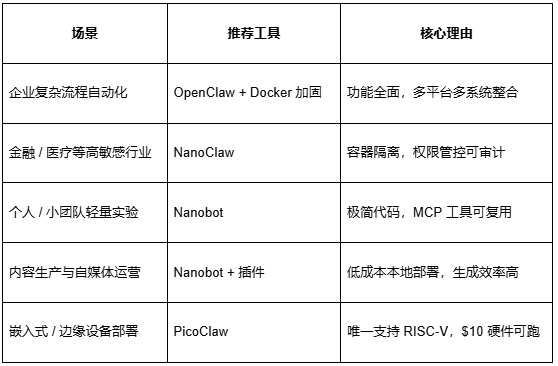
The essence of selection is not choosing the "best," but choosing the one that best matches your constraints.
Ask yourself four questions:
- How sensitive is the data? → For sensitive data, choose NanoClaw (proven container isolation) or Nanobot (auditable code). OpenClaw is prohibited in sensitive environments.
- How limited is the hardware? → Less than 512MB RAM: only PicoClaw; 100MB–1GB RAM: all three lightweight options work; more than 1GB RAM required to consider OpenClaw.
- Need browser automation? → Only use OpenClaw, but require strict Docker isolation; do not use in production.
- Valuing long-term reusability of tools? → Nanobot and the MCP ecosystem represent the most promising long-term bet.
Conclusion
AI automation is no longer a "future concept"—it’s a practical productivity tool ready for immediate implementation. Whether for businesses aiming to reduce costs and improve efficiency, or individuals pursuing content entrepreneurship, this wave of intelligence offers clear, viable business pathways.
The core logic remains consistent: understand the pain points of the scenario, select the appropriate tools, and design a closed-loop business model.
By achieving these three points, AI automation becomes not just an efficiency tool, but a new infrastructure for creating sustainable economic value.