





Article by: Cointelegraph
Translated by AididiaoJP, Foresight News
Despite an overall downturn in the cryptocurrency market in 2026, the artificial intelligence (AI) and stablecoin sectors outperformed the broader market. Relevant data shows that usage in these two sectors continued to grow even as prices of other assets declined.
Key Points
- The AI sector recorded the smallest decline in the first quarter of 2026, at just 14%.
- The total market capitalization of stablecoins has reached a historic high of $320 billion, with monthly trading volume hitting $1.8 trillion, also a record high.
The AI and stablecoin sectors rose against the market trend.
In 2026, Bitcoin's price fell 18.5%, and the total cryptocurrency market cap dropped to $2.42 trillion, with most altcoins underperforming. The market was influenced by concerns and uncertainty surrounding U.S. involvement in the Israel-Iran conflict, while the Federal Reserve maintained a hawkish stance, leading to an overall cautious sentiment.
In contrast, AI-related businesses tied to stablecoins have continued to grow against the market trend, demonstrating strong fundamentals and significant expansion, reflecting a shift in market focus from speculation to infrastructure development.
For example, according to Token Terminal data, the supply of USDC, issued by Circle, has reached $78 billion, a 220% increase since November 2023.
Meanwhile, ChatGPT’s weekly active users grew from 850 million in November 2023 to 9 billion in March 2026, an increase of approximately 10 times during the same period.
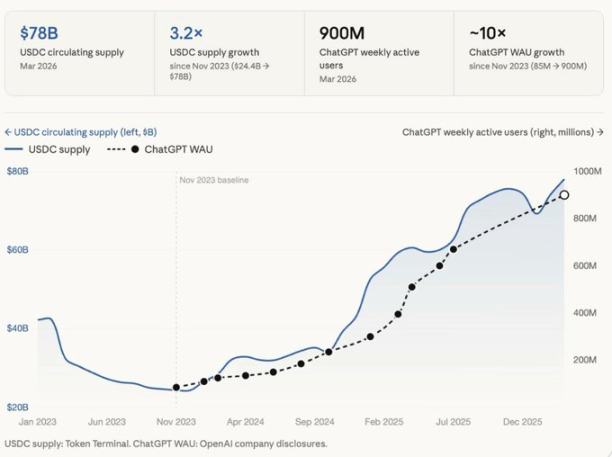
(Chart: USDC Supply vs. Weekly Active Users of ChatGPT; Source: Token Terminal)
Grayscale’s Q1 2026 report also confirms this trend, noting that the AI sector experienced the smallest decline at 14%, while the consumer and culture sector fell 31%, the smart contract platforms sector dropped 21%, and the currency sector declined 21%.
The digital asset management firm stated that this indicates "investor preferences have shifted away from momentum-driven, more speculative sectors." The report further noted:
Although overall market sentiment remains weak, capital has begun to concentrate on projects with stronger fundamentals that align with key themes such as AI and tokenization.
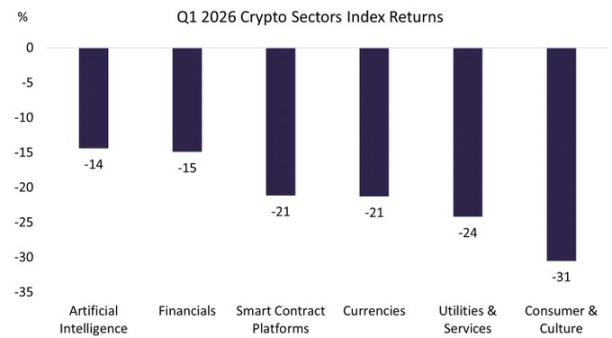
(Chart: All sectors posted negative returns in the first quarter of 2026; Source: Grayscale)
Currently, the total market capitalization of AI tokens is approximately $17.4 billion, having risen 30% over the past 30 days. Among these, Bittensor and NEAR Protocol (NEAR) led the gains, with prices increasing by 75% and 30%, respectively, during the same period.
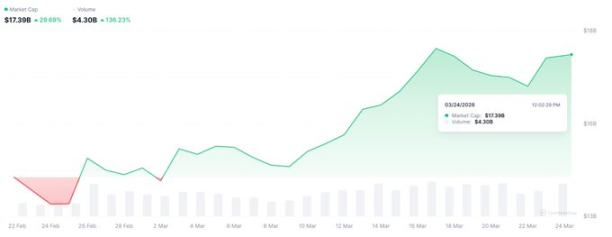
(Chart: Market Capitalization of Major AI and Big Data Tokens; Source: CoinMarketCap)
In the stablecoin sector, market size continues to expand. As of March 23, the total market capitalization of stablecoins reached a record $320 billion. Tether’s USDt maintains its dominant position with a market cap of approximately $184 billion, accounting for 57% of the total stablecoin supply.
In February 2026, monthly stablecoin trading volume reached $1.8 trillion, a record high comparable to traditional payment systems. USDC stood out in terms of supply growth, rising 80% month-over-month, with monthly trading volume hitting a record $1.26 trillion.
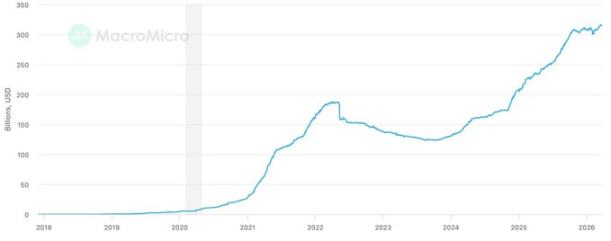
(Chart: Total Market Capitalization of Stablecoins; Source: MacroMicro.me)
A stablecoin is a type of cryptocurrency designed to maintain a stable value, typically pegged to a fiat currency such as the US dollar, and can operate across multiple blockchains.
In a bear market, stablecoins serve as a store of purchasing power and a settlement channel, widely used in trading pairs, tokenized real-world assets, and yield-generating products. Transfer volumes of stablecoins on Ethereum and other blockchains remain consistently high, and institutional-grade products launched by banks and fintech companies are increasingly integrating stablecoins for yield management and fund operations. Even as speculative assets underperform, the foundational role of stablecoins remains solid.
"Structural tailwinds" drive convergence in the growth of two major sectors.
The AI and stablecoin sectors have thrived because they continue to deliver real value even after the speculative frenzy has subsided.
Token Terminal notes: "AI labs and stablecoin issuers are among the companies with the strongest structural tailwinds of the 2020s."
The cryptocurrency service provider further stated that these two sectors are at the intersection of technological, financial, and geopolitical forces, each of which independently drives demand for these areas. The report added:
AI is driving advancements in productivity and defense capabilities, while stablecoins provide the financial infrastructure for global dollar distribution.
Crypto trader Mando CT stated on X on March 24 that AI and stablecoins are two of the four dominant sectors in 2026.
When explaining the convergence of the two sectors, the trader noted that AI requires an instant, low-fee payment system to operate, and stablecoins serve as the "internet money" to achieve this goal.
Mando CT said: "These trends are interconnected," and added:
2026 is not just another cycle turn, but the year of transition from speculation to infrastructure.
According to Cointelegraph, stablecoins are poised to benefit from AI-driven payment scenarios, further driving long-term growth in both sectors by enabling convenient, automated, rule-based transactions between entities.