





Original author: Sleepy.md
Since the AI agent trend took off, many have begun writing obituaries for SaaS. But I think it’s still too early.
Investors are indeed panicking. At the beginning of 2026, a wave of SaaS doomsday fears swept through the tech industry. By the end of January, Anthropic’s mere update enabling Claude to call plugins triggered a loss of hundreds of billions in market value across the U.S. software sector over the following three weeks.
Their panic logic is simple: they believe that since AI can now write code, find vulnerabilities, and even dynamically generate tools on its own, the cost of writing code is approaching zero. Once agents can effortlessly create customized tools for businesses anytime and anywhere, the moats that software companies have painstakingly built—relying on monthly subscription fees—will vanish completely.
As a result, from CrowdStrike to IBM, and from Salesforce to ServiceNow, even with impressive earnings reports, all are experiencing severe sell-offs.
Meanwhile, countless AI entrepreneurs are pitching VCs with business plans, claiming they aim to “build the middleware for the Agent era” or “build for Agents.”
They are all betting on one thing: building tools is the sexiest business of this era.
But if we look away from those PowerPoint slides and examine the real workings of businesses, we’ll see that it’s not like that at all.
Software is never sold for its code.
In economics, there is a classic and repeatedly validated theory called "factor scarcity shift." Each productivity revolution renders one previously scarce factor abundant, while making another previously overlooked factor extremely scarce, causing wealth to concentrate toward the latter.
Before the Industrial Revolution, labor was scarce; the steam engine made mechanical labor abundant, shifting scarcity to capital and factories, making factory owners the wealthiest people of that era.
The internet revolution reduced the cost of information dissemination to zero, shifting scarcity to users' "attention," making traffic a major business.
Today, the AI revolution is making the ability to write code and build tools extremely abundant. In the Agent era, where code is no longer scarce, where has scarcity shifted to?
In fact, over the decades of software industry development, code itself has never truly been a moat.
Every line of code in Linux is free, yet Red Hat was acquired by IBM for $34 billion; MySQL is free, but after Oracle acquired it, it still generates lucrative service contracts. PostgreSQL’s code is available to anyone, yet AWS’s Aurora database service still collects billions of dollars annually from enterprise customers.
The code is free, but the business is still going strong—and doing well.
What matters most are actually these three things: the entrenched business processes, the customer data accumulated over years, and the resulting extremely high switching costs.
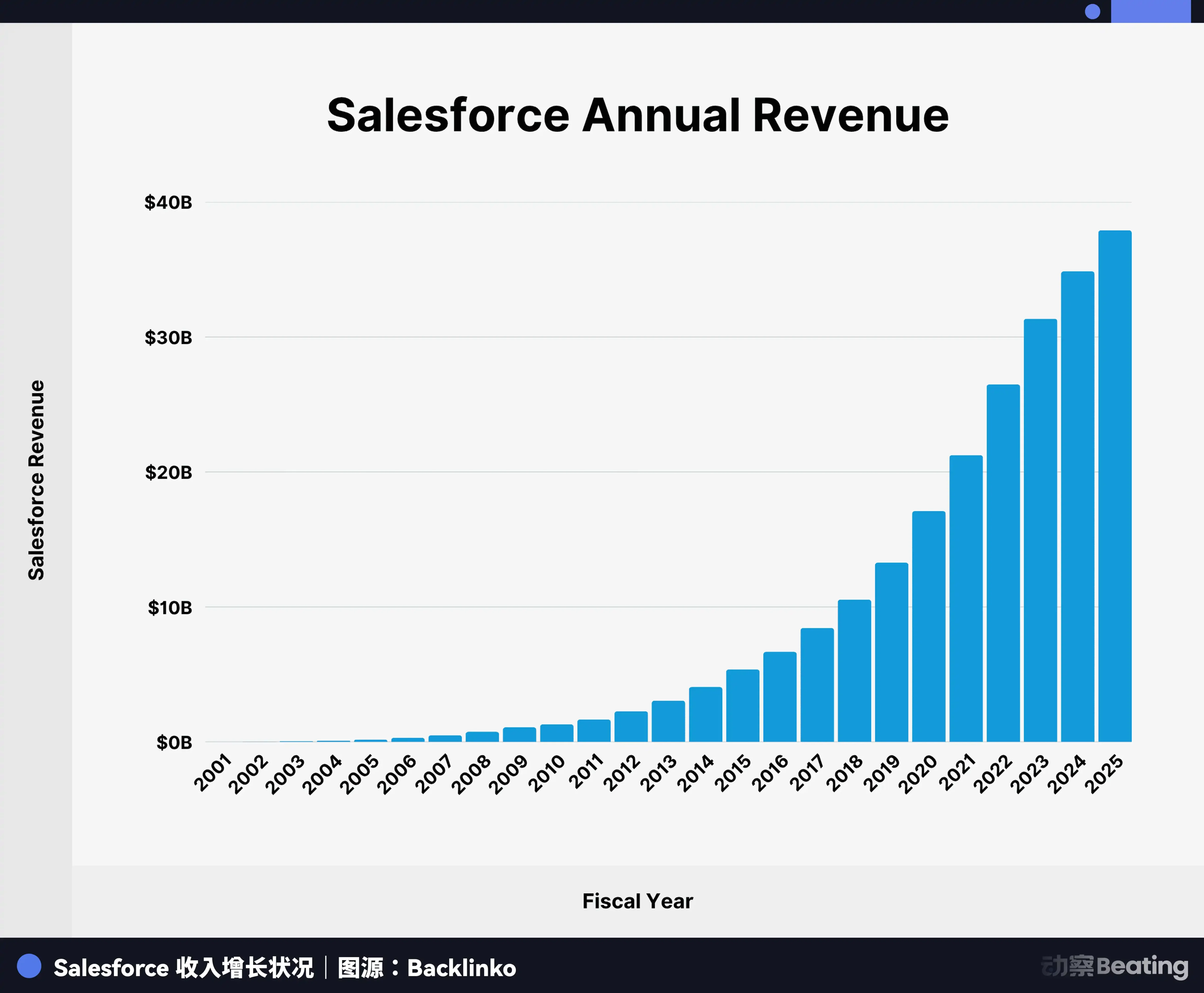
When you purchase Salesforce, you're not buying the source code of the CRM system, but rather the over 50 trillion enterprise customer records it manages, along with the proven processes that seamlessly integrate sales, customer service, marketing, and more. This data is not cold, line-by-line code—it’s the living time and history of businesses.
A company has been using Salesforce for ten years, with every customer interaction, every transaction history, and every sales opportunity milestone stored within it. Moving away isn’t just switching software—it’s like relocating the entire memory of the company. This is why Salesforce continues to generate $41 billion in annual revenue and has set a target of $63 billion for 2030.
Returning to the framework of scarce resource shifts: since agents can create their own tools and the cost of writing code has dropped to zero, what is the most scarce resource in the enterprise services context?
Strangle the Agent
What's truly choking the Agent isn't the lack of hands, but the absence of "context" in its mind.
A super agent equipped with all the tools is like a high-performance juicer—its motor runs at top speed and its blades are razor-sharp—but if no fruit is put in, it can’t magically produce a glass of juice.
McKinsey’s annual report notes that 88% of enterprises are using AI, but only 23% have successfully scaled agent systems within any part of their operations. The bottleneck is not that large models aren’t intelligent enough—it’s that their data architectures aren’t ready.
Irfan Khan, President of SAP Data and Analytics, stated in an interview with MIT Technology Review: “Enterprises cannot simply discard their entire general ledger system and replace it with an agent, because an agent can do nothing without business context.”
The term "business context" here refers to: where the company’s financial compliance boundaries lie, the regulatory requirements of the industry, this client’s preferences and history over the past decade, this supplier’s payment terms and default records, this employee’s performance history and promotion path... These elements are not publicly available online, cannot be obtained through web scraping, and cannot be predicted or generated by AI from text alone.
Ashu Garg, a partner at Foundation Capital, shares the same view. He says that agents need more than just data—they require a “context graph,” a reasoning layer that captures not only what a business has done, but also how it thinks. Such a layer can only emerge from real business operations and cannot be manufactured out of thin air.
Under this logic, scarcity has shifted from the ability to build tools to possessing irreplaceable business context data.
Since the Agent can't produce a glass of juice on its own, who is actually holding the fruit?
The Golden Age of Data Landlords
The answer points to the old guard once thought to be overturned by AI.
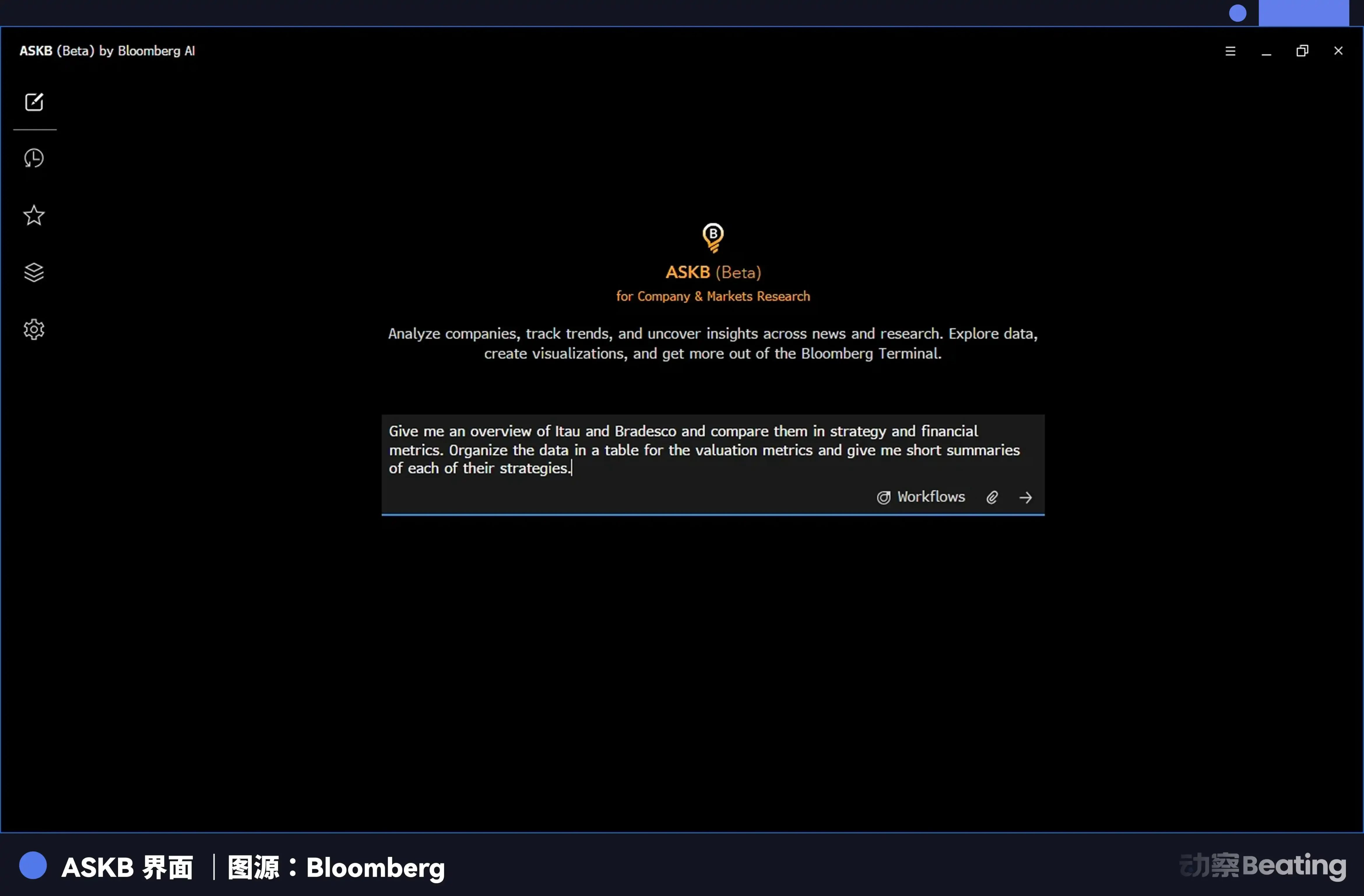
On February 23, 2026, Bloomberg launched an agentic AI interface named ASKB. The Bloomberg Terminal is one of the most iconic products in the software industry. Although there are only 325,000 subscribers worldwide, each account costs $32,000 per year, meaning Bloomberg generates over $10 billion annually from these 325,000 accounts—accounting for more than 85% of Bloomberg LP’s total revenue.
For an internet industry that assumes “more users are better,” this is actually illogical—Bloomberg built a solid business fortress with just a tiny number of paying users.
The only reason it can be done is that Bloomberg holds the world’s most comprehensive, real-time, and deeply structured financial data—built over decades of continuous investment, including real-time market data, historical archives, news content, analyst reports, corporate financial data, and more. Any institution seeking to make serious decisions in finance cannot afford to do without it.
For the newly launched ASKB, AI is the engine, and Bloomberg’s exclusive data is the only fuel. Any agent aiming to make an impact in finance cannot fabricate this data—it must seamlessly integrate with Bloomberg’s interface.
WatersTechnology offered a very insightful comment: Bloomberg’s agentic strategy demonstrates how "those who own data are turning AI into their ATM."
This logic applies across all vertical industries. Veeva controls compliance and R&D data for the global pharmaceutical industry—any pharmaceutical company’s agent must access this data to manage clinical trials and regulatory submissions. Epic holds medical records for over 250 million patients in the United States—every diagnostic recommendation from a healthcare agent relies on these real patient records as its foundation. LexisNexis dominates a vast archive of legal documents—legal agents cannot conduct case research or compliance analysis without accessing it.
These data are the culmination of decades of real-world business operations, the accumulation of time, and an irreplicable history. This is the ultimate manifestation of “the transfer of element scarcity”: when everyone has access to top-tier AI engines, what truly determines victory is whether you can find your own unique oil field.
In the past, these subscription-based data services were sold to human analysts. A large institution might need to purchase 100 Bloomberg terminal accounts. But in the future, when machines become the consumers of data, a single institution could be running tens of thousands of agents, frantically calling these proprietary data interfaces at millisecond speeds.
This is a leap in scale. Human analysts can handle only a limited number of queries per day, but agents can be invoked far more frequently. The demand for continuous, real-time, high-value data will experience an exponential surge. The subscription-based business model has not been overturned—it has been infinitely amplified by machines' insatiable appetite.
Code reset, data collection begins.
But does this mean all SaaS and data companies can rest easy?
Not all SaaS platforms have this advantage.
It would be a grave mistake to interpret this article as an indiscriminate bullish take on the SaaS industry. AI is bringing about a brutal segmentation within SaaS.
In early March 2026, TechCrunch interviewed several top VCs, asking them what they were least interested in investing in right now.
Investors in Silicon Valley have already voted with their feet. Simple workflow packaging, horizontal tools applicable to any industry, and lightweight project management—once viable stories for fundraising—are now being outright passed over. The reason is simple: these agents can do them effortlessly. Software companies without proprietary data are rapidly losing their eligibility to capture investors’ attention.
This judgment split the SaaS world in two.
Half of them are tool-like products that offer minimal wrapping—taking public data and putting it behind a polished interface, or merely optimizing a single operational workflow as a SaaS. The moat for these products essentially lies in user habits and interface stickiness.
But as Jake Saper of Emergence Capital said: “Previously, getting humans to form habits within your software was a powerful moat. But if agents are doing this work, who cares about human workflows?”
These SaaS solutions are genuinely facing significant threats. The GTM tech stack is a prime example. Companies like Gainsight, Zendesk, Outreach, Clari, and Gong each dominate adjacent functions—customer success, customer support, sales outreach, revenue forecasting, and call analytics—each requiring separate budgets, operations, and integrations. AI-native companies can now unify all these functions with a single agent, greatly diminishing the value proposition of these point solutions.
The other half of SaaS companies are deeply embedded in enterprise core business processes and control irreplaceable proprietary data. These companies will not be replaced by agents; instead, they will become more valuable because of them.
For example, Salesforce’s Q4 2026 financial report showed that Agentforce’s annual recurring revenue reached $800 million, a 169% year-over-year increase; it had delivered 24 billion “agentic work units” and processed nearly 20 trillion tokens in total. Over 29,000 Agentforce customers have signed contracts, representing a 50% quarter-over-quarter growth. More importantly, the combined ARR of Agentforce and Data 360 exceeded $2.9 billion, growing more than 200% year-over-year.
Marc Benioff said on the earnings call: “We have rebuilt Salesforce as the operating system for the Agentic Enterprise. The more AI replaces work, the more valuable Salesforce becomes.”
Salesforce has not been replaced by agents; rather, it has become the foundation on which agents operate. Its value lies precisely in the business data and process context that agents cannot bypass.
ServiceNow CEO Bill McDermott publicly declared in February 2026: "We are not a SaaS company."

He is not denying himself; he is proactively drawing a distinction. His logic is that SaaS is a concept about "software delivery methods," while ServiceNow aims to become the orchestration and execution layer for enterprise AI agents—AI can identify issues and offer recommendations, but the actual execution of actions within enterprise systems still requires a platform like ServiceNow, deeply embedded in workflows.
Workday released "Sana" on March 17, 2026—a conversational AI suite that deeply integrates HR and financial data. The core logic of this product is not to replace Workday with AI, but to use Workday’s data to train the AI.
Workday holds payroll, performance, organizational structure, and financial budget data for thousands of enterprises—depth and uniqueness that no AI-native startup can replicate in the short term.
So, the real moat isn't whether you have data—it's whether the data you have is something others can't access, buy, or replicate.
Who will be collecting rent in the next decade?
In every technological revolution, the greatest profits are often not captured by those who invented the groundbreaking new technology, but by those who quietly mastered the scarce resources upon which that technology depends. In this era of rapid AI advancement, the capabilities of large models will continue to grow, and the ability of agents to write code and build tools will become increasingly widespread.
When these once被视为黑科技 capabilities become infrastructure, the logic of "factor scarcity shift" leads to only one conclusion: those who are desperately building tools for agents are unlikely to be the ultimate winners of this era.
In its February 2026 analysis, Foundation Capital stated that the overall market capitalization of the software industry will expand tenfold over the next decade. However, this tenfold growth will not be evenly distributed among all software companies—it will be highly concentrated among those capable of truly mastering the Agent era.
The real winners are those who hold data assets that agents cannot bypass.
For today’s entrepreneurs and investors, there are only two fates for entrepreneurs in this era: either work tirelessly to build the tools for agents, or secure the land first. You should already know which path you’re on.
Don't focus on the agent's hand—grab hold of the agent's throat.