





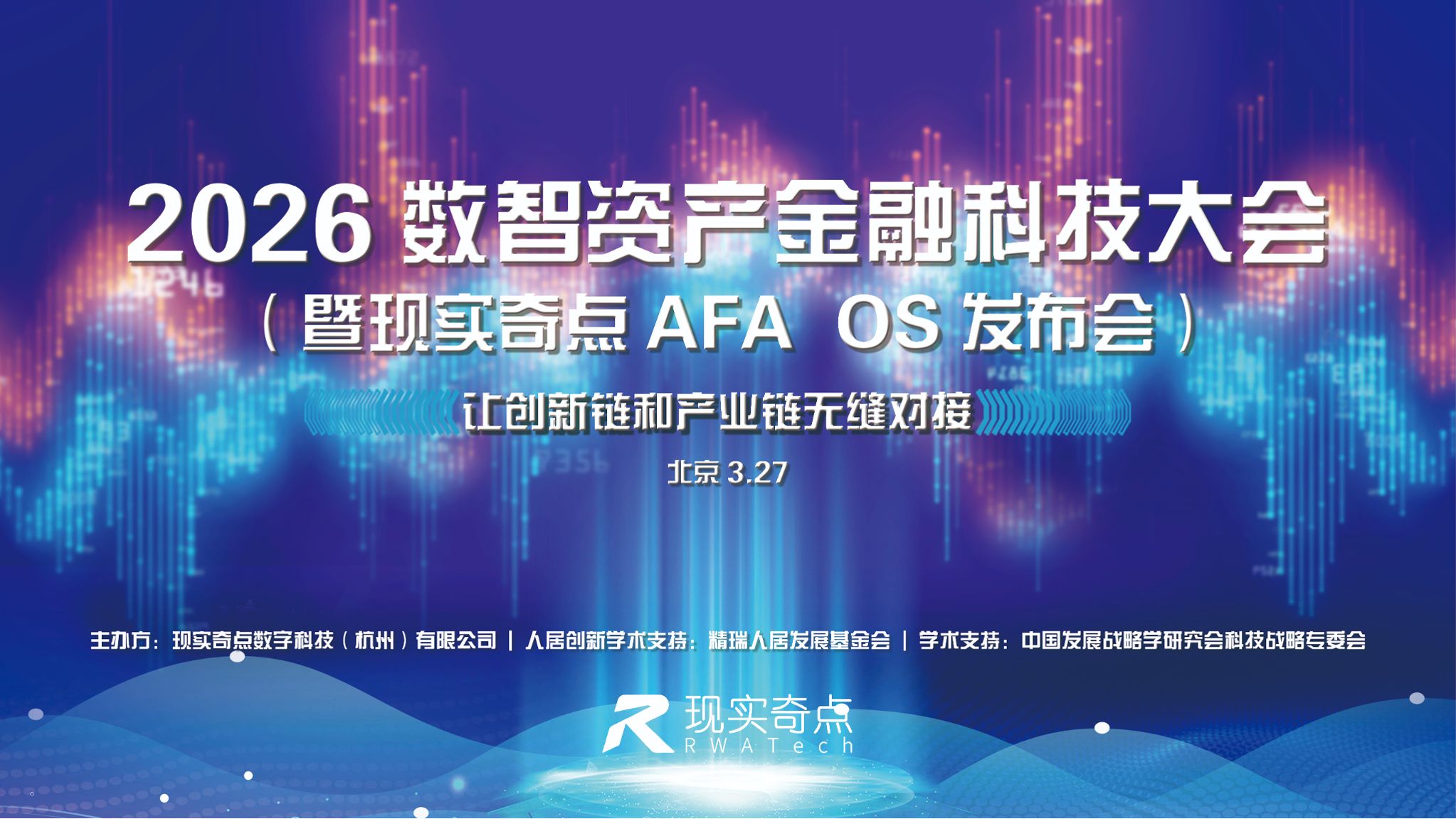
With the successful conclusion of the "Digital Intelligence Assets FinTech Conference" (also known as the global launch of AFA OS) on March 27, 2026, AFA OS has officially entered the industry's spotlight. A central question has now emerged: What exactly is AFA OS, and how does it fundamentally differ from traditional chain transformation and blockchain platforms?
To answer this question, it’s necessary to first understand its three core components: ARCA, LNSU, and YVAN. These platforms respectively serve as the trusted data foundation, the professional capability hub, and the programmable asset minting and operations engine.
But they are not three separate software programs. What connects them is a comprehensive asset finance intelligent agent operating system—AFA OS. This system uses an AI-driven Asset Fin Agent as its intelligent core, built on the “Five Trees” technical architecture (Field Tree, Evidence Tree, Audit Tree, Remediation Log Tree, Rule Tree), transforming fragmented real-world assets into hard assets that machines can understand, AI can compute, and financial institutions can instantly interpret. In simple terms, AFA OS is a digital assembly line that turns data into assets.
From scattered corporate contracts, invoices, and operational data to a trusted asset package, and finally to compliantly minted, cross-chain programmable financial products—AFA OS breaks this long and complex process into three interconnected platforms. Today, we’ll break down each of these three platforms: what they are, what problems they solve, and the scenarios in which businesses can use them.
01 Arca enables real-world assets to be truly understood by machines for the first time.
As steady as a rock, true and unwavering.
Anke is the trusted data foundation of AFA OS, transforming fragmented enterprise information—such as contracts and operational data—into a cohesive, continuously updatable, third-party-verifiable, and AI-analyzable trusted asset package.
Anke offers six core capability areas:
Underlying Asset Template System: Templates define field structures, evidence types, cross-validation rules, encryption rules, and more, enabling enterprises to organize assets according to financial-grade standards from the outset.
Workbench for Business Objects: Manage assets around real business objects—such as a loan, a power plant, or a shipment—by precisely linking documents, receipts, and operational data to each revenue unit.
AI-driven data governance: The system automatically classifies, extracts, and verifies evidence, significantly lowering the barrier to manual organization.
Five-Tree Anchoring Mechanism: The Field Tree, Evidence Tree, Audit Tree, Remediation Log Tree, and Rule Tree interconnect and coordinate dynamically. Each asset package update generates a unique anchoring summary, forming a traceable, verifiable, and auditable historical evolution chain.
Trusted Asset Browser and AI Interface: Authorized institutions can view on-chain anchoring information and verify data authenticity; technical institutions can perform automated modeling and analysis based on rule trees.
Enterprise-grade data security system: Includes file sharding, private key encryption, IPFS distributed storage, and SM3/SM4 cryptographic modules to enable trusted verification while ensuring security.
Market pain points addressed:
Data is fragmented and difficult to maintain: Many companies don’t lack assets—they lack a tool that can turn data into trusted financial assets.
Due diligence is inefficient and costly: Under traditional models, a new team must be assembled, documentation gathered, and business logic repeatedly explained for each financing or issuance. Now, these logic processes are embedded as structured, machine-readable data with automated analysis capabilities.
Data Security and Cross-Border Compliance: Anke helps companies encrypt data in accordance with strict cross-border data and privacy protection requirements, and provides privacy-preserving computation capabilities.
02 LNSU turns professional expertise into callable, reusable assets.
Connect all corners, master the flow of the universe.
LianShu is the central platform in AFA OS that connects professional expertise, compliance collaboration, and AI service orchestration. It is not a traditional consulting matchmaking platform, but rather integrates large models, MCP, and knowledge bases to help experts encapsulate their methodologies, judgment logic, and service steps into AI-accessible "skills."
LianShu offers five key capability areas:
Professional Template Creation: Professionals can create templates for underlying assets, due diligence, legal compliance, and more. Once created, these templates become reusable professional assets. Templates for multiple industries, including private equity, fixed income, commodities, art, carbon credits, and computing power assets, are now live.
Skill Packaging: Lawyers, accountants, auditors, and other professionals can package their services as skills, enabling professional services to be productized and assetized for the first time.
LinkHub Skill Plaza: Enterprises can view skill application scenarios, invocation logic, and output results; professionals can access 24/7 online service capabilities and ongoing earnings.
Agent-driven invocation mechanism: Enterprises can perform low-cost initial self-diagnosis through Asset Fin Agent without needing to understand complex professional processes, then decide whether to proceed with in-depth collaboration.
Trusted Asset Collaboration and Multi-Signature: After a company creates an asset package on Anke, it can be pushed to LianShu, inviting multiple professionals to collaboratively revise, review, and endorse the same version. All feedback, outcomes, and actions by participants are recorded in a traceable revision tree.
Market pain points addressed:
High-value professional expertise cannot be assetized: In the past, the most valuable experience resided in human minds and could not be delivered once the person was gone. LianShu enables this expertise to be captured, encapsulated, invoked, iterated, and continuously serviced, becoming true programmable assets.
Professional services are costly, time-consuming, and carry high trial-and-error risks: Under traditional models, companies seeking to issue cross-border assets must separately engage multiple specialists, resulting in complex and expensive preliminary processes. LianShu transforms professional services from a “sign first, then start” approach to a “use first, evaluate later, collaborate afterward” model.
Financial-grade trust issues for asset packages: All opinions and outcomes generated by experts during due diligence and rectification at Lian Shu are fully documented and archived in Anke’s “Rectification Tree,” enabling thorough review and verification.
03 YuanZhu (YVAN) enables the global issuance and operation of trusted assets.
Yuan, Heng, Li, Zhen—infinitely transformative and enduring.
Yuan Zhu is the minting and operations platform within AFA OS designed for programmable assets. It transforms assets processed by Anke and Lian Shu into standardized digital assets that are configurable, regulatable, cross-border transferable, and capable of continuous operation across various exchanges.
Yuan Zhu offers five core capabilities:
Cross-jurisdiction compliance integration: Standardized access pathways are provided through modules such as KYC, KYB, investor suitability, and product eligibility rules, enabling customized adaptation for different countries and markets.
Programmable Asset Minting: Configure product parameters, design rights, set issuance methods, and generate products by using smart contract standard keys to integrate Anke’s trusted asset packages and Lianshu’s compliance-enhancement records. Supports multi-party cross-chain protocols, enabling one-stop issuance of the same asset across multiple chains and investor communities.
Cross-chain circulation and status tracking: Continuously monitor the distribution, movement, and abnormal states of assets across different blockchains and scenarios, providing an ongoing operational perspective.
Integrated on-chain and off-chain regulatory control: In accordance with regulatory requirements, generate off-chain ledgers or white-label ledgers to record every minting, allocation, and transfer, and cross-verify with on-chain states.
Limits and Risk Control: When a single underlying asset corresponds to multiple product structures, the system prevents over-issuance and logical conflicts by enforcing limits and rules, moving risk management to the code and rule layer.
Market pain points addressed:
Standardization issues in the issuance of programmable assets: Data reliability does not equate to product eligibility, and complete documentation does not guarantee regulatory approval. Companies need an infrastructure that can manage everything from product creation to compliance execution.
Cross-border issuance processes are complex and compliance is fragmented: YuanZhu does not avoid this complexity but abstracts it into platform-level configuration capabilities.
Lack of ongoing tracking and unified management after product launch: Yuan Zhuang addresses the entire product lifecycle, enabling continuous operation, continuous compliance, and continuous oversight—not just focusing on launching the product.
Summary: The three work together as a system, not as three separate tools.
Anke, Lianshu, and Yuanzhu are not isolated from one another. Uniting them is the Asset Fin Agent—an AI-driven agent that understands asset structures, invokes specialized capabilities, and executes compliance processes, breaking down the entire journey of bringing real-world assets into digital capital markets into a system of capabilities that businesses can use, professional institutions can collaborate on, markets can access, and AI can continuously drive.
This is the significance of AFA OS: an asset financial agent operating system that is bringing real-world assets into the programmable era.
Whether it’s a company holding physical assets, an institution providing professional services, or a trading platform seeking to integrate compliant RWA products, AFA OS provides a complete infrastructure that transforms data into assets and assets into liquidity.
The future of programmable finance has set sail.