




Organized by ChainCatcher
Important information:
- Aave's TVL has dropped below $30 billion, with $16.2 billion flowing out since its previous high.
- Bloomberg: Polymarket's trading volume has been surpassed by Kalshi, with repeated setbacks in its U.S. market strategy
- Xinhuo Technology acquires the Avenir Group team and launches Bitcoin asset management services
- Aethir's infrastructure secures a $260 million enterprise contract from Axe Compute
- Tether confirms cooperation with the U.S. government to freeze over $344 million worth of USDT
- Trump Media Group shifts into cryptocurrency and financial services
- Circle has proposed on the Aave forum to increase the maximum deposit rate for USDC to 48.2%.
What important events occurred in the past 24 hours?
ChainCatcher report, according to on-chain analyst Aunt Ai, Sun Zhen has deposited a total of $1.3 billion in assets into Spark, with USDS Farming rewards reaching $5.38 million.
Sun Zhen's address 0x939…6a1d1 withdrew 300 million USDS from Sky over the past 3 hours, then deposited them into Spark; current deposits on this platform are listed as follows:
- USDS: $436 million, accounting for 18.72% of the deposit pool;
- USDC: $135 million, accounting for 28.17% of the deposit pool;
- USDT: $93.39 million, accounting for 9.89% of the deposit pool.
ChainCatcher report, According to CoinDesk, over 100 U.S. cryptocurrency companies and industry organizations have sent a letter to the Senate Banking Committee urging progress on the Clarity Act to establish a federal regulatory framework for digital assets. Signatories include Coinbase, Ripple, Kraken, Andreessen Horowitz, Paradigm, and Consensys.
Its core demands include clarifying the regulatory division of responsibilities between the SEC and CFTC, protecting developers of non-custodial tools, simplifying disclosure rules, and preventing fragmentation of state regulatory standards. The signatories state that if the United States continues to lack a comprehensive crypto regulatory framework, investment, employment, and development activities may shift overseas.
Aethir's infrastructure secures a $260 million enterprise contract from Axe Compute
ChainCatcher report: Nasdaq-listed Axe Compute Inc. (NASDAQ: AGPU) has announced the signing of a 36-month AI infrastructure contract with an enterprise client, with a total contract value of approximately $260 million. The deployment includes a dedicated cluster of 2,304 NVIDIA B300 GPUs and a high-speed AI storage system, scheduled to go live in the third quarter of 2026 at a Tier 3 data center in the United States. This is the largest single enterprise contract in Axe Compute’s history.
The underlying compute infrastructure for Axe Compute is powered by Aethir’s decentralized GPU cloud. The contract includes a dedicated 4.8 MW N+1 redundant power supply, with deployment location and service standards specified by the client, under a structured payment arrangement. Daniel Wang, Co-founder and CEO of Aethir, stated that this contract is the result of months of deep collaboration between the two teams: “The enterprise-grade workloads supported by 2,304 NVIDIA B300 GPUs represent precisely the scale we aimed for when building Aethir’s compute infrastructure. Today’s announcement demonstrates that decentralized GPU infrastructure is now capable of handling AI workloads from the world’s top enterprises.”
After the announcement, Axe Compute (NASDAQ: AGPU) experienced significant price volatility, surging more than 166% intraday to reach $14.47, with trading volume exceeding the three-month daily average by more than a hundredfold.
Tether confirms cooperation with the U.S. government to freeze over $344 million worth of USDT
ChainCatcher reports that Tether has announced support for the U.S. government’s freeze of over $344 million in USDT, involving two wallet addresses. This freeze action was carried out in collaboration with the U.S. Department of the Treasury’s Office of Foreign Assets Control (OFAC) and U.S. law enforcement agencies to prevent further movement of funds.
This freeze action is based on information provided by multiple U.S. law enforcement agencies, linking these addresses to illegal activities. Tether states that it takes freezing measures when wallet addresses are associated with sanctions evasion, criminal networks, or other illicit activities. Today, this has become a standard response by Tether to legitimate requests from U.S. and global law enforcement agencies.
Tether CEO Paolo Ardoino said: "USDT is absolutely not a haven for illicit activity. When there is credible linkage to sanctioned entities or criminal networks, we act immediately. Recent events have shown what happens when platforms fail to act swiftly, law enforcement falls short, users are exposed, and trust is lost. Our approach is different—we combine blockchain transparency, real-time monitoring, and direct coordination with law enforcement to block fund flows. This is a responsibility we take seriously as one of the market’s largest issuers."
This operation is part of Tether’s collaboration with U.S. law enforcement. The U.S. Department of Justice previously confirmed Tether’s support in the enforcement action, leading to the seizure of nearly $61 million and approximately $225 million in “pork scam” funds.
ChainCatcher report: A user profited $34,000 on Polymarket’s weather prediction market by interfering with weather sensors at Paris airport. Previously, Polymarket used temperature data from a Météo France sensor near Charles de Gaulle Airport in Paris for settlement. The user purchased temperature options far above market expectations at very low prices, then used a portable heat source to warm the sensor, causing a temporary spike in readings that were recorded as the day’s highest temperature. This occurred twice—on April 6 and April 15—and Météo France has since detected the anomaly and filed a complaint.
ChainCatcher reports that Trump Media & Technology Group is shifting its business focus from social media to cryptocurrency and financial services. Data shows that since Trump's re-election in 2024, the company's stock has declined by over 60%, erasing approximately $6 billion in shareholder wealth. Recently, the company has applied to launch a crypto blue-chip ETF and plans to establish a Bitcoin reserve.
ChainCatcher report, according to market sources, SoftBank Group is seeking a $10 billion margin loan secured by its holdings in OpenAI, with a two-year term and an option to extend for one additional year, aimed at funding SoftBank’s continued investment in the artificial intelligence sector.
Xinhuo Technology acquires the Avenir Group team and launches Bitcoin asset management services
ChainCatcher report: Xinhuo Technology (1611.HK) has announced it will acquire the investment team and trading system of Li Lin’s family office, Avenir Group, for $1.6 million.
Following the acquisition, New Fire Technology plans to launch Alpha BTC, a Bitcoin-denominated asset management service, aiming to attract over 10,000 BTC in investments within one year, equivalent to approximately $760 million. The strategy will generate returns through derivatives trading such as options, using Bitcoin or IBIT ETF as underlying assets, targeting crypto-native investors and local Hong Kong enterprises. As of the end of 2025, Avenir Group holds 18.3 million shares of BlackRock’s iShares Bitcoin Trust, valued at $908 million.
ChainCatcher report, according to KOL AB Kuai.Dong (@_FORAB), FTX founder SBF is behind bars for misappropriating approximately $16 billion in user funds, but the potential value of his investment portfolio has sparked widespread discussion.
If FTX had not gone bankrupt, its portfolio returns would have been estimated as follows: Anthropic at approximately $82.3 billion (about 165x), SpaceX at approximately $15 billion (about 75x), Robinhood at approximately $4.9 billion (about 8x), Genesis Digital Assets at approximately $3.5 billion (about 3x), and the AI programming tool Cursor at approximately $3 billion (about 15,000x, based on an original investment of just $200,000 for a 5% stake). The combined potential value of these assets exceeds $100 billion.
MetaMask co-founder Dan Finlay has announced his departure from parent company Consensys.
ChainCatcher news, MetaMask co-founder Dan Finlay announced today (April 23) that he is officially leaving ConsenSys, concluding over a decade of building MetaMask. He cited burnout as the reason for his departure, stating he needs more time to spend with his family, and expressed his best wishes for the team’s future.
Dan Finlay also expressed satisfaction with the recent official launch of MetaMask’s advanced permission feature (ERC-7715), noting that it fills a long-standing gap in the product, and he looks forward to experiencing it as a regular user.
ChainCatcher news, X product lead and Solana advisor Nikita Bier has posted announcing two product changes for organizing communities on X, including:
XChat now supports group chats with joinable links. Users can create a public link and share it directly on their timeline. Each group chat supports up to 350 members (and this limit is continuously increasing).
Due to declining usage, Platform X will officially discontinue X Communities on May 6.
ChainCatcher report: Investment bank TD Cowen says the disagreements surrounding the CLARITY Act go far beyond stablecoin yields, with multiple practical obstacles likely to slow the legislative process.
First, the Commodity Futures Trading Commission is understaffed, with only one commissioner currently serving. Under these circumstances, Congress is unlikely to feel comfortable assigning additional cryptocurrency regulatory responsibilities to the agency, and filling these positions alone could take months. Second, the issue of prediction markets is escalating. Whether to include them under the bill’s regulatory scope, along with potential concerns over insider trading and political conflicts of interest—including controversies related to projects tied to Trump—could prompt some Democratic lawmakers to oppose the bill.
Meanwhile, ongoing controversies surrounding the Trump family’s cryptocurrency project, World Liberty Financial, are increasing the political sensitivity of the bill, making bipartisan consensus harder to achieve. Geopolitics has also become a variable. Discussions about Iran potentially using cryptocurrency payments are heightening scrutiny of anti-money laundering provisions and could lead to amendments detrimental to the industry. Additionally, some lawmakers are attempting to incorporate the Credit Card Competition Act into the bill; if pursued, this could create new conflicts of interest and further delay the overall legislative process.
ChainCatcher report: According to market sources, at the "9th BCCC Collaborative Day" on April 21, 2026, Shigeshi Shimizu, Chief of the Risk Analysis Division at the Financial Services Agency’s Comprehensive Policy Bureau, delivered a special speech revealing major developments in cryptocurrency regulation. The FSA has submitted a bill to the extraordinary Diet proposing to transition cryptocurrency regulation from the Fund Settlement Law to the Financial Instruments and Exchange Law, focusing on four key areas: disclosure requirements, creation of a new classification for independent operators, enhanced penalties for unregistered operators, and the establishment of insider trading regulations.
Meanwhile, the Financial Services Agency is advancing three "Payment Innovation Projects (PIP)" pilot experiments: first, a yen-stablecoin cross-border payment trial involving three major banks; second, blockchain-based on-chain settlement of government bonds, corporate bonds, stocks, and other securities, aiming to enable 24/7 continuous trading; and third, a bank-to-bank tokenized deposit transfer experiment, recently supported on April 3, which will be advanced in conjunction with the Bank of Japan’s central bank reserve tokenization sandbox project. Mr. Shimizu stated that blockchain holds significant potential for enhancing the convenience of financial services and diversifying financial products, and the Financial Services Agency will continue to promote regulatory framework development and practical implementation support.
ChainCatcher news, Polymarket, which long dominated prediction market trading volume, is facing multiple challenges. According to Dune Analytics data, its global trading volume has been surpassed by its main competitor, Kalshi. In terms of valuation, Kalshi announced a new funding round last month, reaching a valuation of $22 billion, while Polymarket, following a recent $600 million investment from Intercontinental Exchange (ICE), is valued at $15 billion.
Polymarket's biggest bottleneck is the prolonged delay in officially launching in the U.S. market, where its app remains in testing, with March trading volume only one-twentieth of Kalshi's. Technical challenges from its blockchain architecture, repeated delays in product launches, recent fee adjustments that have upset users, and an exchange outage lasting over an hour continue to plague the platform.
Additionally, Polymarket has received a letter from Democratic members of Congress urging the CFTC to intervene, due to allowing users to bet on controversial topics such as war and nuclear explosions. ICE CEO Sprecher remains optimistic but acknowledged that this could either be a complete failure or a home run.
Aave's TVL has dropped below $30 billion, with $16.2 billion flowing out since its previous high.
ChainCatcher report, according to on-chain analyst Yujin, Aave's TVL has fallen below $3 billion.
This data has decreased from $45.8 billion before the rsETH event to $29.6 billion currently, with a total outflow of $16.2 billion.
ChainCatcher news, JackYi (Yi Lihua), founder of Liquid Capital, posted on X: “One core reason behind the recent wave of crypto VC failures and project collapses is that funded capital was largely spent on maintaining teams to develop useless Web3 products—most notably, the biggest misconception has been modeling Web3 products after Web2. In essence, Web3 is a financial industry and does not require replicating Web2 products. The most successful companies in the crypto industry to date have all been financial products, including stablecoins, exchanges, and payment solutions.”
Now that we are in the AI era, first, there is no need for large funding or large teams; second, AI + finance represents a new opportunity. We believe that an outstanding founder with just a few elite talents can build a top-tier company—this is currently the biggest opportunity in early-stage investing.
Circle has proposed on the Aave forum to increase the maximum deposit rate for USDC to 48.2%.
ChainCatcher reports that Gordon Liao, Chief Economist at Circle, has initiated a proposal on the Aave governance forum to urgently adjust the USDC interest rate parameters in the Aave V3 Ethereum main pool, in response to the pool's utilization rate remaining at an extremely high level of 99.87% for four consecutive days following the KelpDAO attack.
Liao stated that Aave’s current interest rate mechanism has failed to effectively “clear” the market. The pool currently has $1.89 billion in supply and $1.89 billion in borrowing, with less than $3 million in available liquidity. Borrowing rates remain at the upper limit following the inflection point (approximately 14%), and over the past 24 hours, the pool size has shrunk by approximately $60 million, as repayments have been sequentially used to fulfill queued withdrawal requests.
Therefore, the Slope 2 parameter in the USDC deposit rate curve should be immediately increased from approximately 10% to 40% via the Risk Steward mechanism, with a governance vote within 5 to 7 days to further raise the target to 50%. Meanwhile, the Optimal Utilization will be reduced from 92% to 87% during the transition phase, and then to 85% upon final approval. According to Liao’s proposal, under the new parameters, the maximum USDC deposit rate at 100% utilization will increase from approximately 12.6% to 48.2%.
Meme Popular Rankings
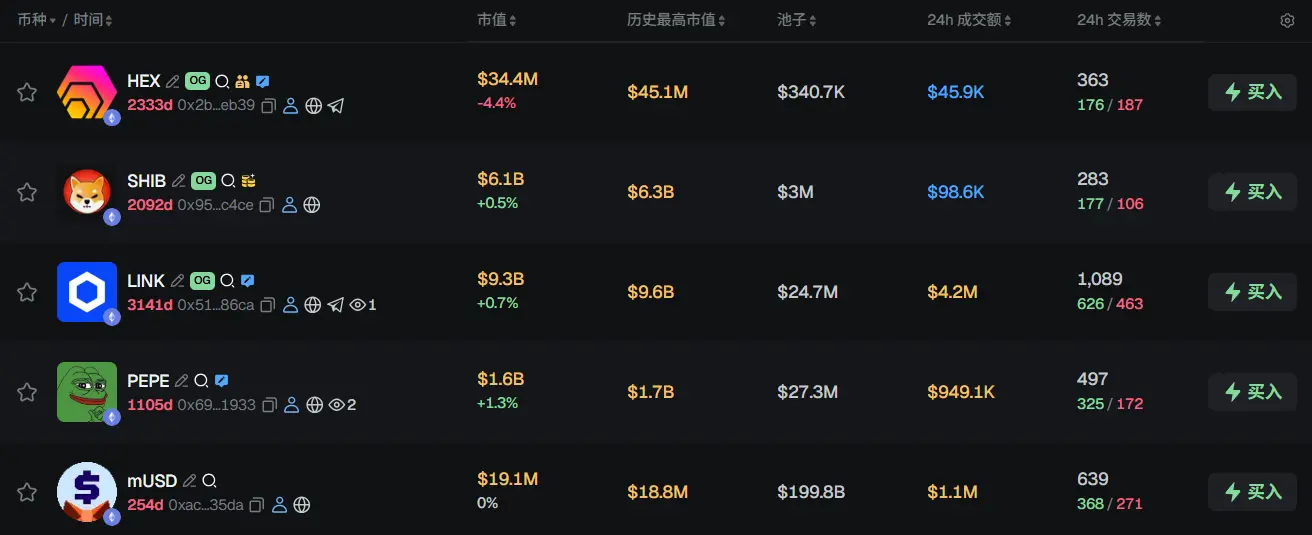
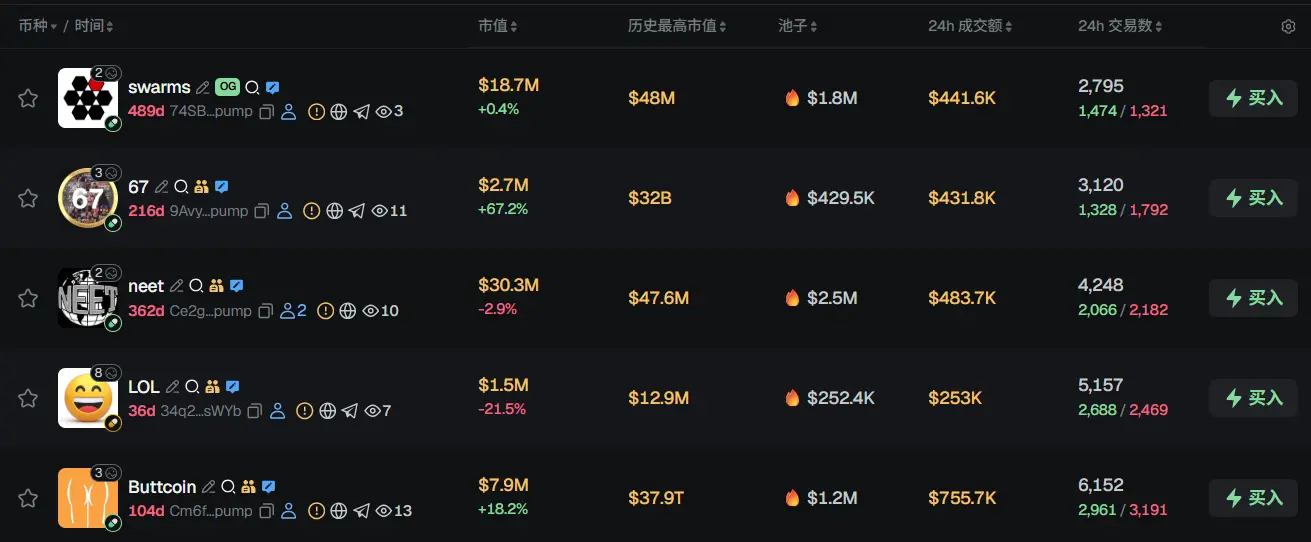
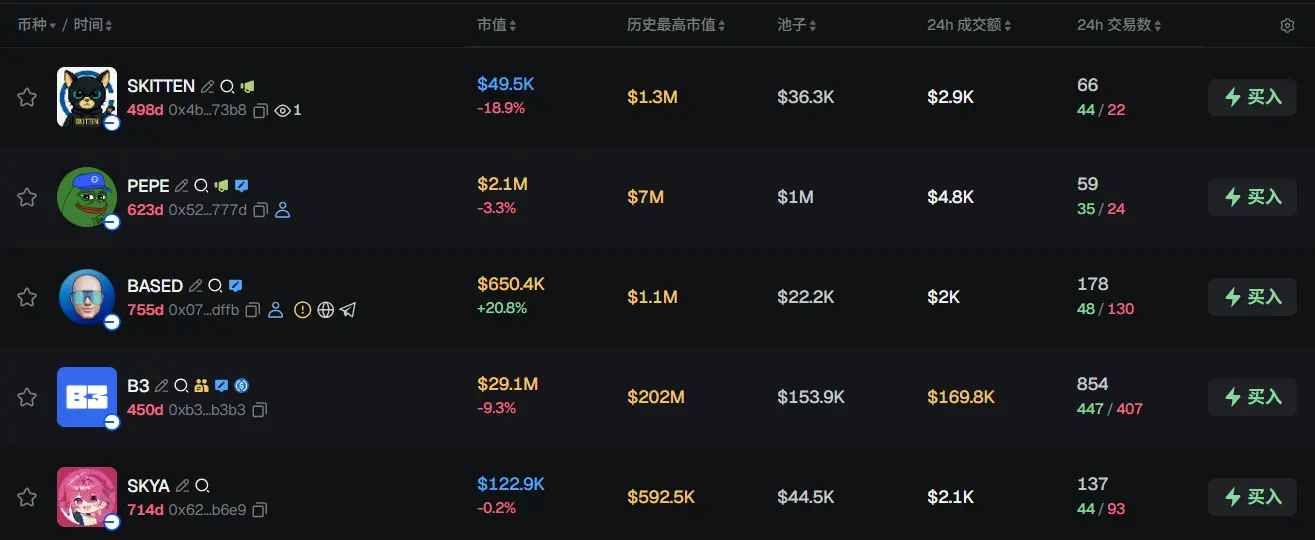
According to market data from the meme token tracking and analytics platform GMGN, as of April 24 at 09:00,
The top five most popular ETH tokens in the past 24 hours are: HEX, SHIB, LINK, PEPE, mUSD
The top five most popular Solana tokens in the past 24 hours are: swarms, 67, neet, LOL, Buttcoin
The top five most popular tokens on Base over the past 24 hours are: SKITTEN, PEPE, BASED, B3, SKYA
What are some great articles to read from the past 24 hours?
As Aave’s house crumbles, Spark’s tower rises.
On April 18, the attacker exploited a vulnerability in Kelp DAO’s cross-chain bridge validator nodes to mint approximately $292 million in unbacked rsETH, which was then deposited into Aave to borrow genuine WETH..
These uncollateralized rsETH tokens were accepted as compliant collateral, but the actual WETH lent out could not be adequately covered, exposing Aave to a potential bad debt of up to $230.1 million.
According to on-chain analyst Yujin,as of April 23 morning,Aave's TVL has fallen below $3 billion, dropping from $45.8 billion before the event to $29.6 billion, with outflows totaling $16.2 billion—a decline of over 40%.
Founder of Lattice Capital: Crypto VCs see because they believe
This week’s hot topic on crypto Twitter seems to be a widespread concern: does the reduction in available funds mean cryptocurrencies are becoming less attractive? The scale of crypto venture capital is clearly contracting—this is undeniable.
There is more debate about why this is happening and what it means. Rob Hadick argues that crypto venture capital is concentrating among the best founders and top funds, which is precisely a sign of industry maturity. Meanwhile, Meltem believes the contraction is due to (a) a lack of high-quality early-stage founders, and (b) the relatively small surface area of crypto compared to other high-growth industries.
For this specific debate, I don’t have much more to add. Clearly, there are still outstanding founders building projects in the crypto space. But compared to 2021, far fewer founders are starting businesses in crypto, while significantly more are launching ventures in other areas like AI. Is this due to a lack of capital, or does this gap cause the capital shortage? Probably both.
A seasoned Polymarket user’s perspective: Actually, we’ve already been overtaken by our competitors.
I've had this article in my hands for a while.
I’ve always wanted to write about it, but kept holding back, hoping the situation would quietly correct itself. Until this morning, Bloomberg published “Polymarket Loses Leading Position in Prediction Markets Due to Delays and Rebounds”—to be honest, this article has already said most of what I originally intended to say. So now, I’ll quote it extensively to help share the burden.
Polymarket has faced increasing operational setbacks in its efforts to reach key audiences (U.S. customers) and is now falling behind its main competitors. From bloomberg.com
This headline is painful. And it should be.
Since mid-2024, I’ve been closely watching Polymarket. I share its vision, defended the platform through every regulatory panic, and recommended it to every trader I know. Prediction markets are one of the most important financial infrastructures of this decade, and Polymarket is the company I’ve always hoped would win this space.
Who will dethrone AAVE to become the new king?
The lending landscape for Ethereum and Solana has followed an extremely similar script, with the transition from stage one to stage two occurring approximately 25% faster on Solana. Stage three has just begun, and it remains to be seen whether Solana can maintain this pace.
- Ethereum's first to second phase (from Compound's peak to Aave establishing dominance): approximately 2 years
- Solana Phase 1 to Phase 2 (from MarginFi's peak to Kamino establishing dominance): approximately 18 months
- Both ecosystems are now in phase three, with new challengers continuously closing the gap.
But this time, I don’t believe the outcome will be the same. Below, I’ll explain the reasons one by one.