






Key Insights:
- Aave crypto introduces a hub-and-spoke architecture that separates liquidity and risk across markets.
- Credit framework now supports diverse collateral with risk-based borrowing rates.
- Phased rollout applies strict controls to monitor liquidity and ensure system security.
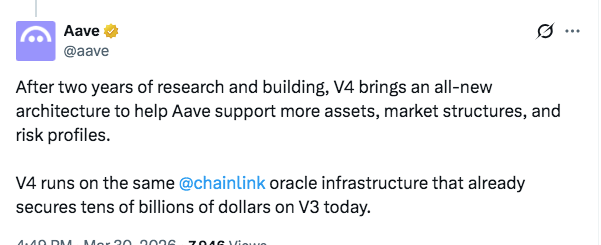
Aave crypto has entered a new phase as Aave V4 goes live on the Ethereum mainnet after more than two years of development. The deployment introduces a new architecture that changes how credit markets function within the protocol. As a result, the system now supports a range of assets and risk profiles under a structured framework.
The launch also follows a rollout strategy that focuses on security and expansion. Early conditions restrict asset availability and set defined limits across all markets. This approach allows close monitoring of liquidity flows and credit activity during the initial phase.
Aave Crypto Introduces Hub-Spoke Architecture for Liquidity Control
Aave crypto now operates under a hub-spoke framework that separates liquidity management from borrowing environments. In this structure, central hubs hold shared liquidity, while spokes define independent borrowing markets. Each spoke follows its own rules but still accesses pooled liquidity reserves.
The system relies on three hubs that show different risk levels. Prime supports conservative exposure with strict parameters, while Core balances flexibility and security. Meanwhile, Edge accommodates higher-risk strategies with expanded yield potential.
Each spoke is attached to a chosen hub and performs within the established parameters. These boundaries define the amount of liquidity that a market can obtain at a given time. As a result, the losses are not spread across the whole system but are borne by the individual parts.
The flow of liquidity between hubs and spokes is by predetermined allocations that regulate exposure. This structure will keep every market isolated while still allowing shared capital. Simultaneously, it has the same liquidity depth throughout the protocol.
Expanded Credit Framework Supports Diverse Collateral Structures
Aave v4 expands the protocol’s ability to support multiple collateral types and credit instruments. The system now handles assets with maturity timelines and more complex payout structures. In addition, it incorporates off-chain risk factors into lending decisions.
Borrowing rates now adjust based on each asset’s specific risk profile. High-quality collateral receives lower rates, while riskier assets face higher borrowing costs. This change replaces earlier models that applied uniform pricing across all markets.
The protocol also introduces share-based accounting to track deposits and liabilities. This method improves accuracy when managing multiple borrowing environments at the same time. As a result, settlement remains consistent across different market structures.
Aave Crypto Rollout Prioritizes Security and Phased Adoption
Aave crypto launched V4 with a restricted configuration to support a security-first deployment. Initially, the protocol limits asset listings and applies strict controls across all hubs and spokes. These measures allow teams to observe system behavior in real time.
The development process included more than twelve months of security testing and infrastructure preparation. Engineers embedded protective mechanisms directly into the system design from the start. As a result, the protocol reduces reliance on reactive fixes after deployment.
Governance is still dynamic at this initial stage to manage risk and oversee changes. An appointed security council has the right to respond to any unforeseen occurrence as needed. This ensures that problems can be corrected in a timely manner.
In the long run, the system of governance will shift to a decentralized system. The current stage, however, retains centralized control to stabilize operations. Such a strategy helps facilitate controlled growth because the system proves trustworthy.
The post Aave Crypto Launches V4 on Ethereum With New Credit System appeared first on The Coin Republic.