





Author: Marc Andrusko
Compiled by DeepTide TechFlow
The Tides of Depth: Silicon Valley is currently experiencing a "Palantir-ization" trend—AI startups are emulating Palantir by sending engineers to work on-site at customer locations, providing highly customized services, and securing seven-figure contracts.
a16z partner Marc Andrusko poured cold water on the trend, stating that the majority of companies are merely copying superficial aspects and will ultimately become consulting firms dressed up as SaaS. This article breaks down the truly replicable elements of Palantir's model, as well as which aspects are just beautiful illusions.
Main text content:
Now, there's a popular phrase in the business plans (BP) of startup companies:"We're basically the Palantir of X."
Founders are enthusiastic about sending "forward-deployed engineers" (FDEs) to work on-site with customers, building deeply customized workflows, and operating more like special forces than traditional software companies. This year, the number of job postings for "forward-deployed engineers" has surged by hundreds of percentage points, as everyone is copying the model pioneered by Palantir in the early 2010s.
I understand why this business model is appealing. Enterprise customers are now overwhelmed by the question of "what software to buy"—everything claims to be AI, and it's never been harder to distinguish meaningful signals from the noise. Palantir's approach is very tempting: deploy a small team into a chaotic environment, integrate various in-house, siloed systems, and deliver a customized work platform within a few months. For a startup aiming to land its first seven-figure order, the promise of "we'll send our engineers into your organization and get things done" is a highly compelling offer.
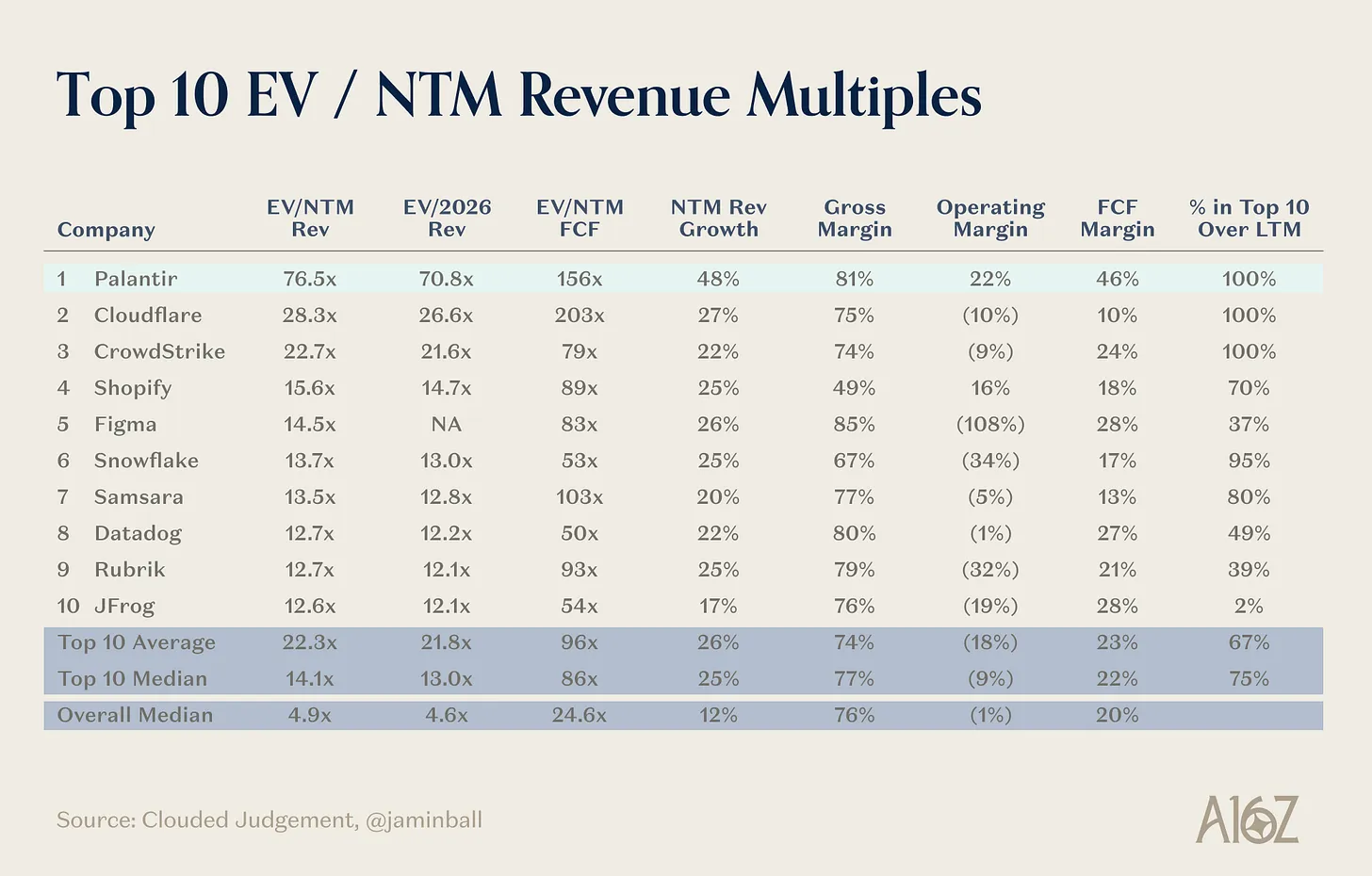
But I'm quite skeptical about whether "Palantir-ization" can be generalized as a universal methodology. Palantir is a "category of one"—just look at how its stock is traded! Most companies that merely imitate its surface-level practices will ultimately become expensive service providers, carrying software valuation multiples without any compounding competitive advantages. This reminds me of the 2010s, when every startup claimed to be a "platform," but in reality, true platform companies were extremely rare because they were just too hard to build.
This article aims to clarify which parts of the Palantir model are truly transferable and which are unique and unreplicable, providing founders who want to combine enterprise software with high-touch services with a more practical roadmap.
What does "Palantir-ization" really mean?
"Palantir-ization" began to refer to several interrelated things:
Frontline Embedded Engineering
Frontline deployment engineers (referred to internally at Palantir as "Delta" and "Echo") embed within customer organizations (often for several months), understanding business scenarios, integrating various systems, and building custom workflows on the Foundry platform (or the Gotham platform in high-security environments). Since pricing is a fixed fee, there are traditionally no "SKUs"—engineers are responsible for building and maintaining these capabilities.
Highly Assertive Integration Platform
Palantir's products are not essentially a loosely connected set of tools, but rather a platform with clear objectives for data integration, governance, and operational analytics—more akin to an "operating system" for organizing data. The goal is to transform fragmented data into real-time, high-confidence decision-making.
High-end, high-touch sales model
"Palantirization" also describes a sales style: a long, high-touch sales cycle targeting mission-critical environments (defense, law enforcement, intelligence, etc.). Regulatory complexity and the magnitude of the "stakes" in the industry are features rather than bugs.
Sell results, not licenses.
Revenue comes from multi-year, outcome-based contracts, with software, services, and ongoing optimization combined. Contracts with individual customers can reach tens of millions of dollars annually.
The most recent analysis defines Palantir as a "category of one," because it excels in three areas simultaneously: (a) building integrated product platforms, (b) embedding elite engineers into customer operations, and (c) proving itself in mission-critical government and defense environments. Most companies can achieve one or two of these, but not all three at once.
But by 2025, everyone wants to ride on the coattails of this model's success.
Why is everyone trying to copy Palantir now?
Three forces are converging:
1. Enterprise AI faces a challenge in "implementation."
A significant portion of AI projects get stuck before reaching production, often due to messy data, integration headaches, and a lack of internal leadership. Although purchasing enthusiasm remains fervent (with genuine top-down pressure from boards and C-suite executives to "get AI"), actual deployment and achieving ROI often require extensive hands-on effort.
2. The front-line deployment engineer seems to be the missing link.
Media reports and recruitment data show an explosive growth in FDE (Full-Stack Deployment Engineer) positions this year—with increases ranging between 800% to 1000% according to different sources—AI startups are making real-world deployment a reality by embedding engineers.
3. Rapid growth has become the norm (it is easier to achieve quick expansion by securing seven-digit large orders than by accumulating five-digit small ones).
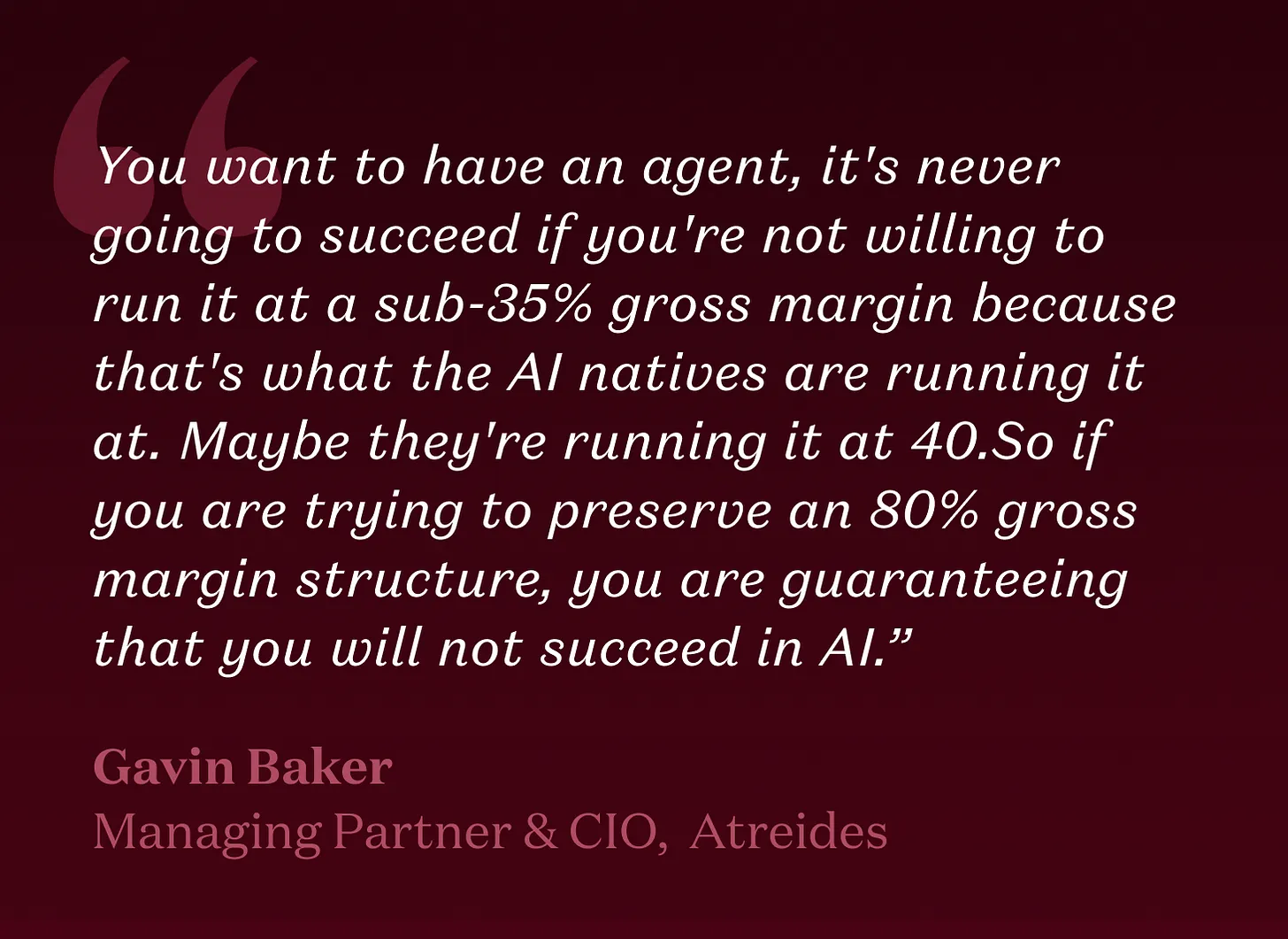
If sending engineers to the site by air is the cost of securing orders of over one million U.S. dollars from Fortune 500 companies or top government agencies, many early-stage companies are willing to trade gross margins for momentum. Investors are also becoming more accepting of lower gross margins, as new AI experiences often require significant inference costs. The gamble is this: can you win the position and trust of the client's leadership, deliver "results," and then price accordingly?
So the narrative became: "We will do what Palantir did. We will send an elite team to create something magical, and then over time, we will turn it into a platform."
This story can hold true under very specific circumstances. However, there are some hard constraints that founders often gloss over in one sentence.
Where Analogies Fail
Wanting to sell "results" from day one.
Palantir's flagship product, Foundry, is a combination of hundreds of microservices that collectively serve a single outcome. These microservices form productized, opinionated solutions to common problems faced by enterprises in various domains. Over the past two years, I have met with hundreds of AI application founders, and I can tell you where the analogy breaks down: startups come in and pitch a set of grand outcome-based goals, while Palantir consciously builds microservices first, which form the cornerstone of its core capabilities. This is precisely what differentiates Palantir from ordinary consulting firms (and also explains why it trades at a valuation of 77 times next year's revenue).
Palantir has a series of core products:
- Palantir Gotham is a software platform developed by Palantir Technologies, primarily used for data integration: A national defense and intelligence platform that helps military, intelligence, and law enforcement agencies integrate and analyze fragmented data for mission planning and investigations.
- Palantir Apollo is a software platform developed by Palantir Technologies, primarily used for data integration: A software deployment and management platform that securely and independently delivers updates and new features to any environment (multi-cloud, on-premises, offline environments).
- Palantir Foundry is a comprehensive software platform designed for building and operating mission-critical systems. It enables organizations to integrateA cross-industry data operations platform that integrates data, models, and analytics to drive enterprise operational decision-making.
- Palantir Ontology refers to the structured framework or data model used by Palantir Technologies, a company known for itsA dynamic, manipulable digital model of real-world entities, relationships, and logic that powers applications and decisions within the Foundry.
- Palantir AIP refers to Palantir's Artificial Intelligence Platform. Palantir is a technology company known for its(AI Platform): Connect AI models (such as large language models) with an organization's data and operations through Ontology, enabling the creation of production-ready AI-driven workflows and agents.
Citing the Everest report: "Palantir's contracts start small. Initial collaborations may consist of only a short training camp and limited licenses. More use cases, workflows, and data domains are added only after the value is validated. Over time, the revenue structure shifts from services toward software subscriptions. Unlike consulting firms, services are a means to drive product adoption, not the primary source of revenue. Unlike most software vendors, Palantir is willing to invest its own engineering time upfront to win meaningful customers."
On one hand, the AI application companies I see now often jump directly to seven-figure contracts. On the other hand, this is mainly because they operate in a fully customized model—they address any issues thrown at them by early clients, hoping to identify themes from these experiences to build core capabilities or "SKUs" later on.
Not every problem is a "Palantir-level" problem.
In the early domains where Palantir was deployed, the alternatives were "nothing works": counterterrorism, fraud detection, battlefield logistics, and high-risk medical operations. The value of solving these problems was measured in billions of dollars, lives saved, or geopolitical consequences, not incremental efficiency.
If you sell to a mid-sized SaaS company and help it improve its sales process by 8%, you can't afford a custom on-site deployment at the same level. The ROI simply can't justify months of on-site engineering.
Most customers don't want to be your R&D lab forever.
Palantir's customers default to accepting co-evolution of the product with the company; they tolerate a lot because the stakes are high and alternatives are limited.
Most companies, especially those outside of defense and regulated industries, don't want to feel like they're part of an ongoing consulting project. They want predictable implementation, interoperability with existing software tools, and quick results.
Talent density and culture cannot be generalized.
Palantir has spent more than a decade recruiting and training exceptionally strong generalist engineers who can write production-level code, navigate bureaucratic systems with ease, and sit in a room with colonels, CIOs, and regulators to have meaningful discussions. People who have left this position have formed an entire group of founders and executives known as the "Palantir mafia." Many of these individuals have gone on to become unicorn-level entrepreneurs because they are highly technical yet extremely effective in dealing with clients.
Most startups cannot assume they can hire hundreds of such people. In practice, "We will build a Palantir-style FDE team" often degrades into:
- The title "Pre-sales Solution Engineer" has been renamed to "FDE."
- Junior generalists are required to handle product development, implementation, and customer management simultaneously.
- The leadership has never seen a Palantir deployment up close, but they like the vibe.
It must be made clear that there are many highly talented people outside, and tools like Cursor are enabling non-technical employees to write code as well. However, to scale the Palantir model broadly, it requires an extremely rare combination of business and technical talent. Having worked at Palantir is particularly helpful, as it is a very unique company. But the number of people with this background is limited!
Service traps are real.
Palantir's success stems from the fact that there is a real platform underlying the custom work. If you only replicate the embedded engineer model, you will end up with tens of thousands of customized deployments that are difficult to maintain or upgrade. Even in a world where AI tools enable companies to achieve software-level gross margins under this model, companies that overly emphasize front-line deployment while lacking a strong product backbone may fail to realize increasing economies of scale and build a durable moat.
Discriminating investors may see hockey-stick growth in contract value from $0 to $10 million and rush to get in on the action. But the question I've been asking is: What happens when dozens—or even hundreds—of these $10 million startups all start crashing into each other with exactly the same pitch?
By then, you won't be the "Palantir of X." You'll be the "Accenture of X," just with a prettier front end.
What Did Palantir Do Right?
If we strip away the myths, there are several elements worth careful study:
1. Platform-first, rather than project-first.
Palantir's front-line deployment team builds systems based on a small set of reusable primitives (data models, access control, workflow engines, visualization components), rather than writing fully customized systems for each customer.
2. Have clear opinions on how the work "should" be carried out.
This company does not merely automate existing processes; it often pushes customers toward new ways of working, and the software itself embodies these principles. This is rare courage for a vendor, and it makes reuse possible.
3. Long-term Vision and Capital
Becoming a Palantir-like company requires enduring long-term negative sentiment, political controversies, and uncertain short-term monetization during the maturation of its platform and sales model.
4. A very specific market portfolio
Early positioning in the intelligence and defense sectors is a feature, not a bug: high willingness to pay, high switching costs, high stakes, and a very limited number of extremely large clients. Not to mention a batch of old competitors who have secured contracts for decades with little competition.
In other words, Palantir is not just a "software company + consulting." It is a "software company + consulting + political projects + extremely patient capital."
This is not something that can be generalized simply by grafting it onto a vertical SaaS product.
A More Realistic Framework: When Is It Reasonable to "Palantirize"
Rather than asking "How can we become like Palantir?" it's better to ask a series of threshold questions:
1. The Critical Nature of the Issue
Is this issue "mission-critical" (human lives, national security, billions of dollars) or "nice-to-have" (10-20% efficiency improvement)? The higher the stakes, the more justified the front-line deployment model becomes.
2. Customer Concentration
Are you selling to dozens of large clients or thousands of small ones? Embedded engineering scales better with concentrated, high ACV (Annual Contract Value) client groups.
3. Degree of Domain Fragmentation
Are the workflows between clients similar, do they use the same software tools, or is each deployment fundamentally different? If every client is a snowflake, it becomes difficult to build a consistent platform. A certain degree of homogeneity is helpful.
4. Regulation and Data Gravity
Are you operating in a highly regulated field with significant data integration challenges (defense, healthcare, financial crime, critical infrastructure)? That's exactly where Palantir-style integration can create real value.
If you mostly fall into the lower-left quadrant of these dimensions (low criticality, fragmented customers, relatively simple integration), a full "Palantir-style" approach is almost certainly the wrong model. Such situations are better suited for a bottoms-up PLG (product-led growth) strategy.
What is worth learning?
Although I doubt that every early-stage company can successfully implement the Palantir model, there are several aspects of this approach that are worth considering:
1. Treat the front-line deployment as scaffolding, not the final building.
The following approach can certainly be correct:
- Embed engineers and early design partners to work collaboratively.
- Get the top 3-5 customers into production at all costs.
- Use these collaborations to stress test your primitives and abstractions.
But the constraints need to be clear:
- Time-boxed deployment (e.g., "90-day sprint to production")
- Clear ratios (for example, "how many engineering FTEs can be allocated per $1M ARR from a single customer")
- The goal of converting custom code into reusable configurations or templates on a quarterly basis.
Otherwise, "we will productize it later" will become "we never got around to doing it."
2. Built on powerful primitives, not custom workflows
The real lesson from Palantir lies in product architecture:
- Unified data model and permission layer
- General workflow engine and UI primitives
- Use configuration instead of code as much as possible.
The front-line deployment team should focus their time on "selecting" and "validating" which primitives to assemble, rather than building something entirely new for each customer. Leave the building of entirely new components to the engineers.
3. Make FDE a part of the product, not just a delivery.
In Palantir's world, frontline deployment engineers are deeply involved in product discovery and iteration, not just implementation. Strong product organizations and platform teams are nourished by what FDEs learn on the frontlines.
If your FDE is located in a separate "professional services" department, you will lose this feedback loop and gradually slide into becoming a pure service company.
4. Be honest about your profit structure.
If your pitch assumptions include a gross margin of over 80% for software and a net revenue retention rate of 150%, but your actual sales model requires long-term on-site projects, be transparent about the trade-offs—transparent at least internally.
For certain categories, a model with structurally lower gross margins but higher ACV (Annual Contract Value) is entirely rational. The issue lies in companies that pretend to be SaaS (Software as a Service) but are in fact service-based companies operating on a platform. Investors typically look for the path to the highest absolute gross profit, and one way to achieve this is through larger volume contracts combined with more significant COGS (Cost of Goods Sold).
How would I perform a stress test on a "Palantir-ized" startup?
When a founder told me, "We are the Palantir of X," the questions on my notebook were roughly like this:
- Show me a platform boundary with a clear stance. Where does the shared product end, and where does the customer-specific code begin? How quickly does this boundary shift?
- Sure, I can walk you through the deployment timeline. However, I need more specific information about the project or system you're referring to. Could you please provide details such as: 1. **Project How many engineer-months are required from signing the contract to the first production use? What components must be customized?
- What is the gross profit margin for a mature customer in the third year? Has the investment in frontline deployment significantly decreased over time? If not, why not?
- If we sign 50 clients next year, where would the system break down? Hiring? New employee training? Product? Support? I want to see where the pattern breaks.
- How do you decide "not" to customize? The willingness to say "no" to custom work is often the key differentiator between product companies and service companies with attractive demos.
If these answers are clear, based on real deployments, and architecturally coherent, a certain degree of Palantir-style frontline deployment could indeed be a real advantage.
If the answers are vague or if each collaboration is clearly entirely unique, it becomes difficult for us to endorse the potential for reproducibility or true scalability.
Conclusion
Palantir's success has created a powerful aura that dominates the venture capital and startup circles: a small team of elite engineers parachutes into complex environments, connects fragmented data, and delivers systems that transform how organizations make decisions.
It's easy to believe that every AI or data startup should look like this. But for most categories, a full "Palantirization" is a dangerous illusion:
- The question is not critical enough.
- The customers are too fragmented.
- The talent model cannot scale.
- The economic accounts quietly collapse into service companies.
For founders, a more useful question is not "How can we become Palantir?" but rather:
"To bridge the AI adoption gap in our category, how many Palantir-style frontline deployments do we need—and how quickly can we transform them into a true platform business?"
If you get this right, you can borrow the truly important parts of this approach without inheriting the parts that would overwhelm you.