





Author: a16z
Compiled by Deep潮 TechFlow
Shenchao Overview: MIT claims that 95% of enterprise generative AI pilots fail to deliver results, but a16z directly refutes this claim using firsthand data from its portfolio companies. Twenty-nine percent of Fortune 500 companies and 19% of Global 2000 companies are already paying customers of leading AI startups, and programming tools have increased the productivity of top engineers by 10 to 20 times. This 23,928-word report, based on internal data, reveals which AI use cases truly generate value and which remain mere hype.
There is much speculation about how much progress AI has made in large enterprises, but most existing information consists solely of self-reported AI usage or surveys that capture qualitative buyer sentiment rather than hard data. Additionally, the few existing studies that have been conducted assert that AI has underperformed in enterprises, most notably a MIT study claiming that 95% of generative AI pilots failed to scale.
Based on our internal data and conversations with corporate executives, we find this statistic unbelievable. We have been closely tracking where AI sees the most adoption and where ROI is clearly evident, compiling hard data on what actually works in enterprise AI.
AI penetration rate in enterprises
According to our analysis, 29% of the Fortune 500 and approximately 19% of the Global 2000 are active paying customers of leading AI startups.
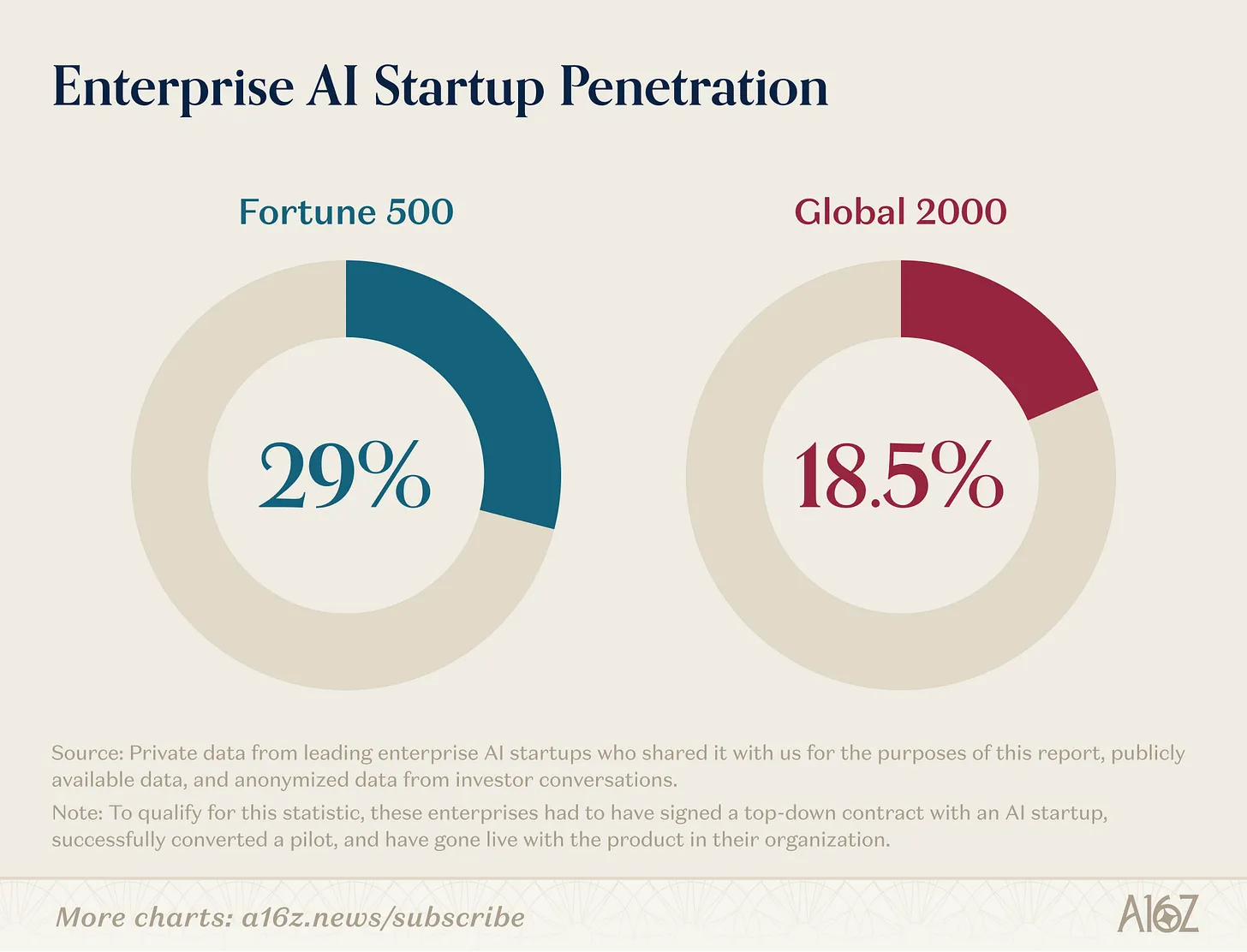
To meet this metric, these companies must have signed top-down contracts with AI startups, successfully piloted the solution, and deployed the product within their organization.
Reaching this level of adoption in such a short time is remarkable, as Fortune 500 companies are not known for being early adopters of technology. Historically, many startups had to first sell to other startups to gain early momentum, and it often took years before they secured their first enterprise contract—requiring even more time and revenue before landing Fortune 500-scale clients.
AI has disrupted this norm. OpenAI launched ChatGPT in November 2022, immediately demonstrating AI’s potential to consumers and enterprises alike. This ignited a storm of interest in AI unlike anything previous generations of technology had sparked, prompting large corporations to bet on new products earlier than ever before. The result: just over three years later, nearly one-third of the Fortune 500 and one-fifth of the Global 2000 have genuine enterprise AI deployments within their organizations.
What works in enterprise AI
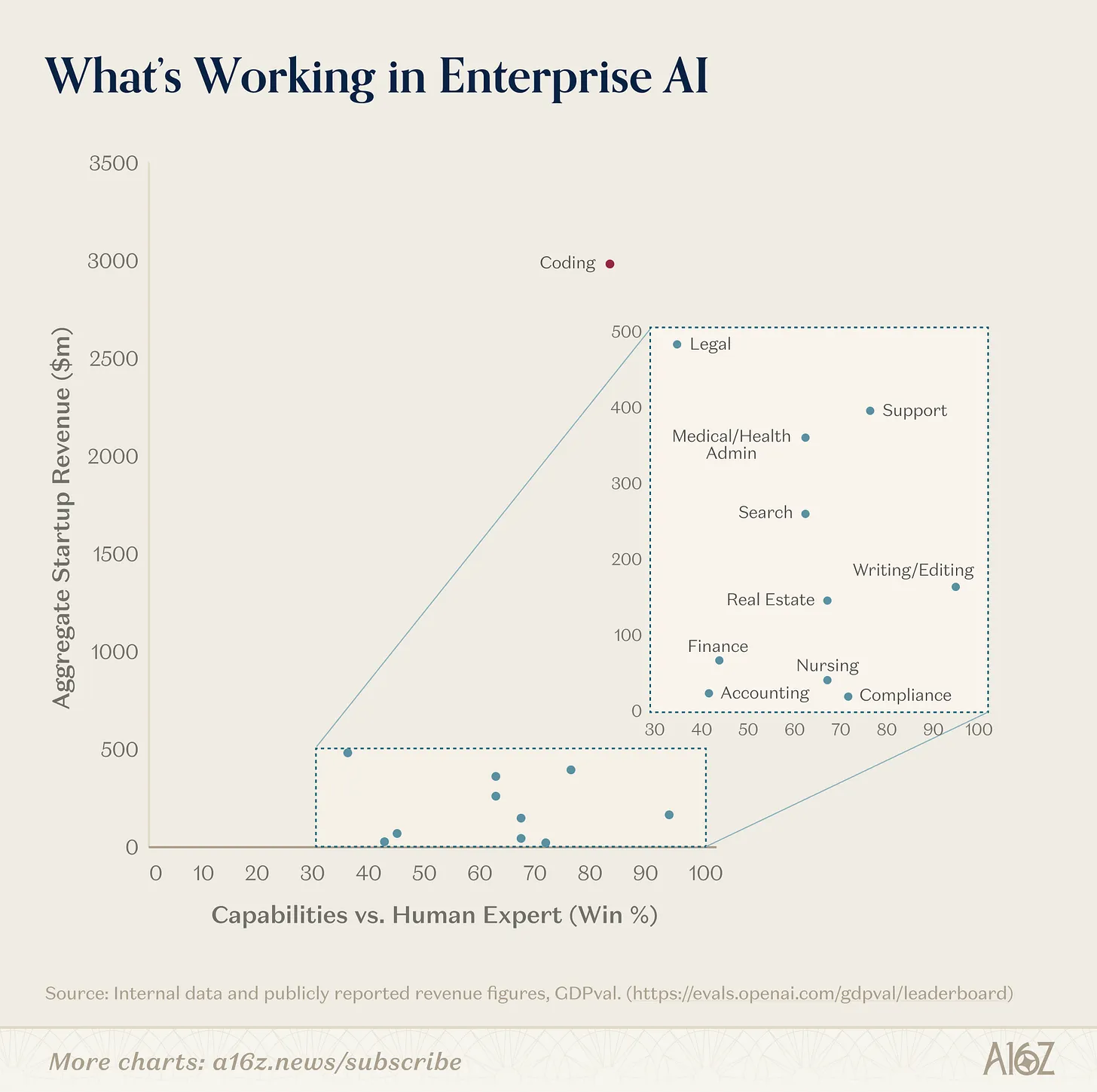
Where does this adoption occur most rapidly, and how does it map to what the model is inherently better suited to do?
We found that the most indicative evaluation method is to overlay the revenue momentum of each use case onto the model’s theoretical capability as defined by GDPval, a well-known benchmark from OpenAI that assesses a model’s ability to perform tasks with real-world economic value. For us, these two factors capture both how good a model can be and how much value it has already demonstrated today. This makes them highly informative about where AI adoption stands today, where it may be headed, and where adoption still lags behind model capability despite its maturity.
Where is enterprise AI delivering the most value today?
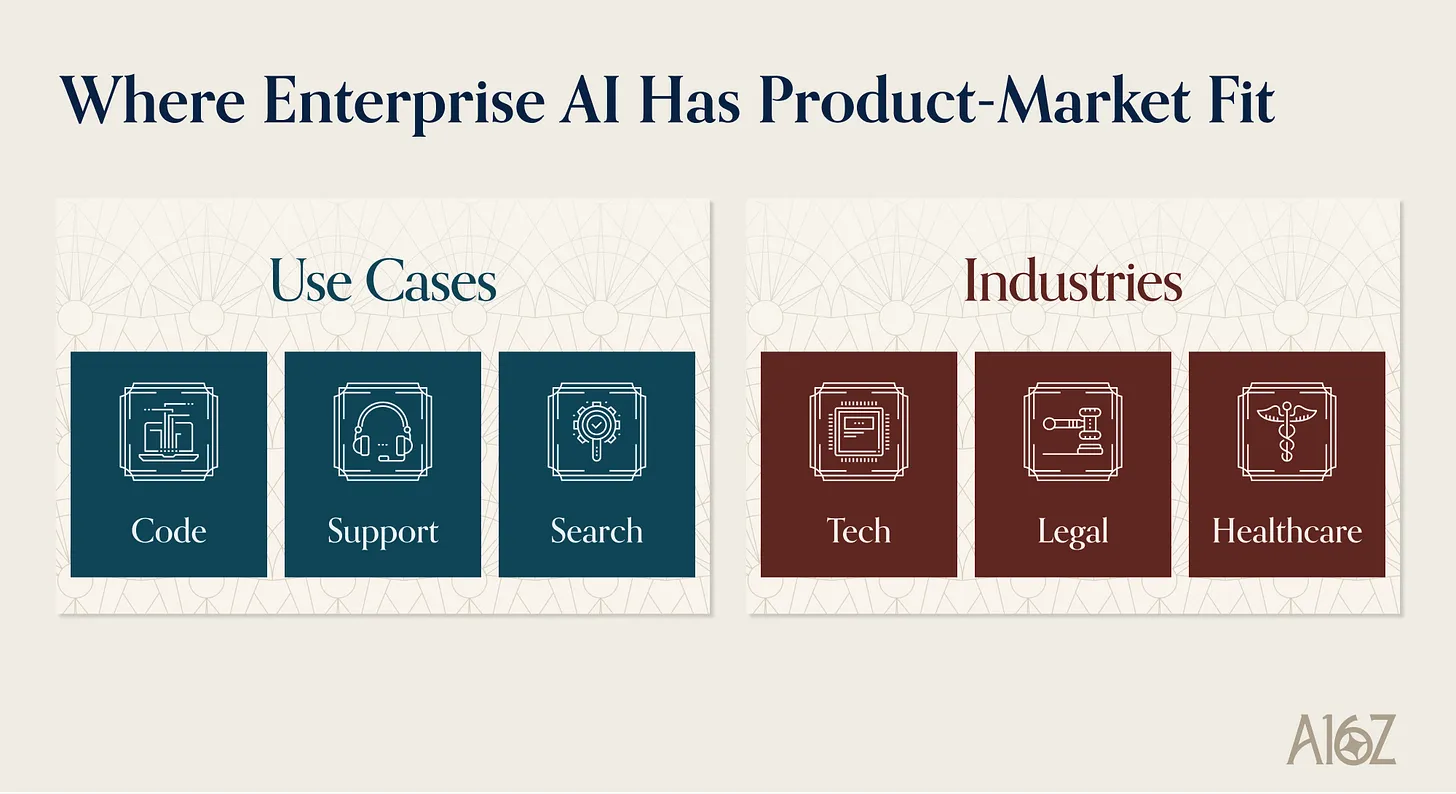
In terms of revenue momentum, enterprise adoption of AI is led by a set of well-defined use cases and industries. Programming, support, and search have so far accounted for the majority of use cases—programming, in particular, is an order-of-magnitude outlier within this group—while the technology, legal, and healthcare sectors are the most eager to adopt AI.
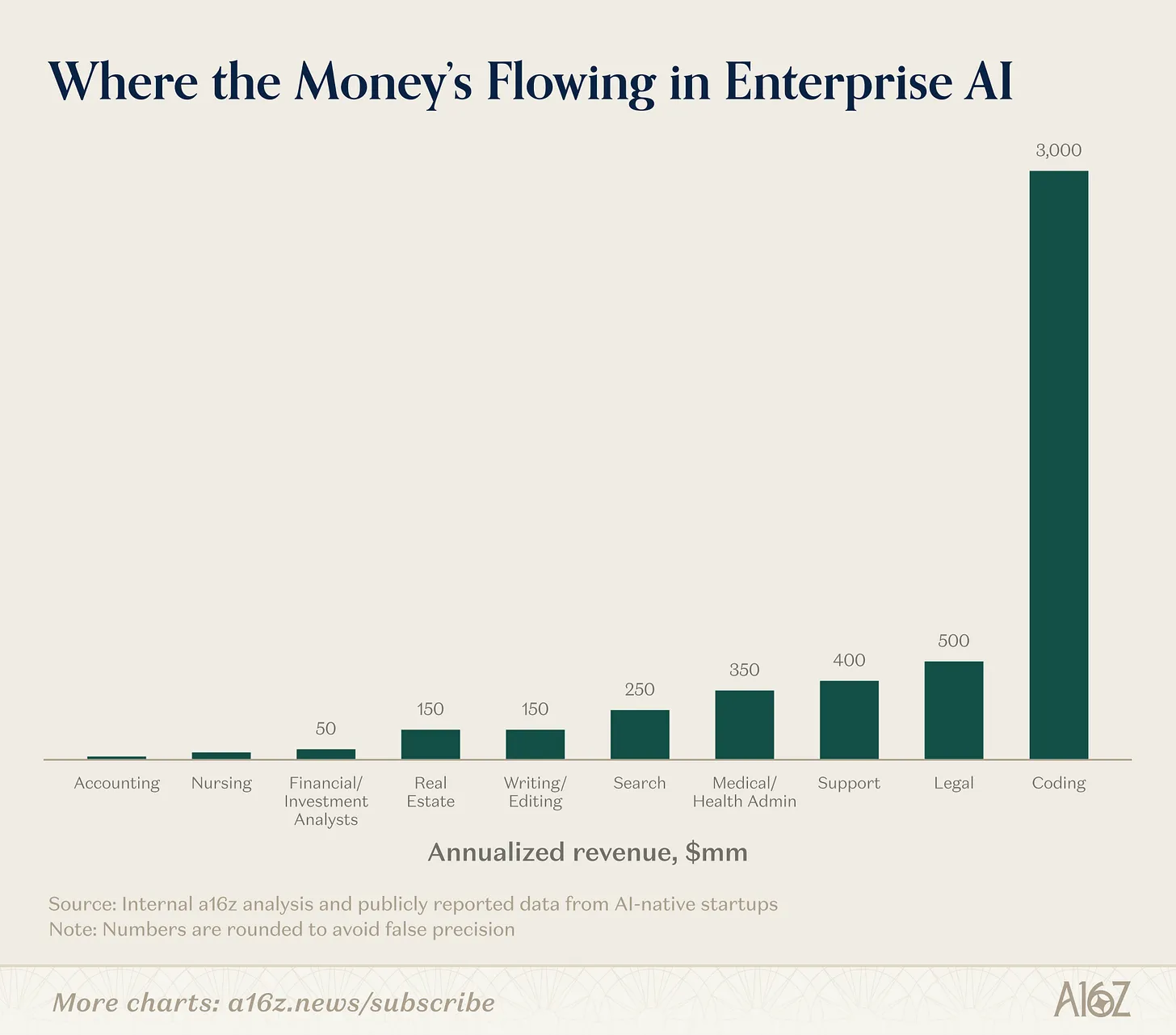
Programming: Programming is the dominant use case for AI, nearly an order of magnitude larger. This is evident in the explosive growth reported by companies like Cursor and the hypergrowth of tools such as Claude Code and Codex. These growth rates have surpassed even the most optimistic projections, and so far, the vast majority of AI tool adoption among Fortune 500 and Global 2000 companies has been in code.
In many ways, programming represents an ideal use case for AI, both in terms of technical capability and enterprise market adoption. Code is data-intensive, meaning there is a vast amount of high-quality code available online for model training. It is also text-based, making it easy for models to parse. It is precise and unambiguous, with strict syntax and predictable outcomes. Crucially, it is verifiable: anyone can run it and know whether it works, creating tight feedback loops for model learning and improvement.
From a business perspective, this is also an excellent application. We’ve consistently heard from portfolio companies that their top engineers’ productivity has increased 10 to 20 times with AI coding tools. Hiring engineers has always been difficult and expensive, so anything that boosts their productivity offers a clear ROI—the magnitude of improvement provided by AI coding tools creates strong incentive for adoption. Engineers are also often early adopters of best-in-class tools, since programming is a more solitary task compared to most corporate functions, making it easier for them to simply find and adopt the best tools without being hindered by the coordination and bureaucracy that plague many other business functions.
Additionally, programming tools don’t need to fully automate tasks end-to-end to provide added value, since any acceleration—such as finding bugs or generating boilerplate code—still saves time and is useful. Because programming involves a tightly coupled human-in-the-loop workflow, developers still oversee the development process today, allowing these tools to accelerate output while preserving space for human judgment, review, editing, and iteration. This boosts enterprise confidence and creates a smoother adoption path.
Programming skills are improving exponentially, with every lab explicitly focused on winning code as a use case. This has a massive impact. Code is upstream of all other applications, as it is the fundamental building block of any software; therefore, AI’s acceleration of code should accelerate every other field. The lowered barriers to entry in these fields unlock new opportunities solvable by AI, but the same accessibility makes building lasting competitive advantages for startups more critical than ever.
Support: Supports the opposite end of the barbell from code. Although software engineering typically receives the most investment and attention within organizations, support is often overlooked. Support roles are seen as back-office, entry-level positions and are frequently outsourced to offshore companies or business process outsourcing (BPO) firms, as companies view internal management as too cumbersome and complex.
AI has proven highly effective in managing this work for several reasons. First, the nature of most support interactions is time-bound and has constrained intent (e.g., issuing a refund), providing agents with clearly defined problems to resolve. Support is also one of the few functions where the tasks involved are clearly defined. With large and high-turnover support teams, new representatives need to be trained quickly and consistently. To this end, they have well-documented standard operating procedures (SOPs) that guide each representative’s work. These SOPs establish clear rules and guidelines that AI agents can emulate. This distinguishes it from most other business workflows, which tend to be longer-lasting, less clearly defined, and involve more stakeholders beyond the customer and service representative.
Support is one of the clearest functions for demonstrating ROI. Support operates on measurable metrics: number of tickets answered, customer CSAT (satisfaction) scores, and resolution rates. Any A/B test comparing the current state with AI agents yields favorable results for the AI agents: they answer more tickets, improve resolution rates, and increase customer satisfaction scores—all at a lower cost. Since most support is already outsourced to BPOs, adopting an AI solution requires minimal change management, making the adoption path easier.
Support doesn't need to be 100% accurate to be useful, because it has a natural human handoff (e.g., "I'm escalating you to a manager"). This allows the sales cycle to move faster and makes piloting AI support agents relatively low-risk; in the worst case, 100% of cases will simply be escalated and resolved by a human.
Finally, support is inherently transactional. Customers don’t care who is on the other end, meaning support doesn’t require any interpersonal relationships that AI struggles to replicate. These characteristics explain why companies like Decagon and Sierra have grown so rapidly, along with more vertically focused support players such as Salient and HappyRobot.
The last horizontal category with clear enterprise market pull is search. The primary use case of ChatGPT is search itself, so the impact of search may be deeply embedded in ChatGPT’s revenue and usage, potentially being significantly underestimated here.
AI search is such a broad category that it has enabled the emergence of many independent large startups. One of the key pain points within many enterprises is enabling employees to easily locate and extract relevant information across different sets of systems. Glean has thrived as the leading startup provider for this use case. Many large industries operate based on highly specific industry information—both internal and external—and companies like Harvey (which began with legal search) and OpenEvidence (which began with medical search) have thrived by building their core products around this.
Industry
Technology: So far, the most common industry to adopt AI is technology. ChatGPT itself reports that 27% of its business users come from technology, and many early customers of companies like Cursor, Decagon, and Glean are technology firms. Given that technology is almost always an early adopter and the industry that sparked the AI wave, this is entirely unsurprising.
More surprisingly, markets historically not considered early adopters have proven to be eager this time.
Legal: Surprisingly, the legal industry has been one of the earliest adopters of AI. Historically, it was considered a challenging market for software, with lengthy timelines and buyers who were less technically savvy.
This is because traditional enterprise software has offered limited value to lawyers: static workflow tools haven’t accelerated the unstructured, nuanced work lawyers typically perform. But AI makes the value proposition of technology for lawyers much clearer. AI excels at parsing dense text, reasoning across large volumes of text, and summarizing and drafting responses—all tasks lawyers frequently undertake. AI is now often acting as a co-pilot to enhance individual lawyer productivity, but it’s beginning to extend beyond this: in some cases, it’s actually generating revenue by enabling law firms to handle more cases (as with Eve, which specializes in plaintiff law).
The results are clear: Harvey reported approximately $200 million in annual recurring revenue (ARR) within three years of its founding, and companies like Eve have over 450 customers and reached a $1 billion valuation this fall.
Healthcare: Healthcare is another market responding to AI in ways traditional software never has. Companies like Abridge, Ambience Healthcare, OpenEvidence, and Tennr are experiencing rapid revenue growth based on discrete use cases such as medical documentation, medical search, and backend automation of the Byzantine rules governing how healthcare is delivered and paid for.
Healthcare has historically been a slow-adoption market for software due to: 1) the mismatch between highly skilled, complex workflows and the problems traditional workflow software can address, and 2) the dominance of systems like Epic in EHR documentation, which has crowded out new software vendors. However, with AI, companies can address discrete manual tasks that bypass EHR systems—either by replacing administrative roles (such as medical scribes) or by augmenting the higher-value work doctors are already performing. These tasks are unique enough that they don’t require ripping and replacing the EHR, enabling these companies to scale rapidly without displacing existing software vendors.
A few notes on the analysis
These estimates are the best available. They may underestimate the amount of revenue generated within each category and overstate the model's capabilities.
We may have underestimated the revenue because:
Revenue analysis is based solely on departments and use cases that have succeeded sufficiently to generate large, standalone AI businesses, excluding the long tail of use cases being addressed by other startups.
Many of these markets also have established non-startup players generating significant revenue (e.g., Codex/Claude Code in coding, Thomson Reuters’ CoCounsel in legal), but we focus our analysis on independent startup participants.
Many of the tasks outlined in our analysis may be integrated into the core products of model companies (e.g., ChatGPT and OpenAI’s search), but were not separately itemized or included in this analysis.
This analysis focuses on enterprise business rather than consumer or prosumer business. While there are successful businesses (such as Replit and Gamma in application generation and design) with a significant number of commercial users, they currently primarily target consumers or prosumers. Given that this analysis centers on enterprise AI and where enterprises derive value, consumer-dominated businesses are excluded.
Measuring the impact of AI on different sectors of the economy is extremely difficult, despite many economists attempting to do so. Work is inherently ill-defined and long-tailed, making it very hard to fully automate. It is still unclear how much value businesses can extract from partial automation—if AI can only perform 50% of human tasks, the importance of non-automatable tasks may rise, as they become bottlenecks and increase in relative value. Therefore, we may be overestimating today’s capability levels, since each additional 1% of capability does not translate into 1% of economic value; however, paying attention to relative capabilities and how they improve with each new model release remains highly informative.
AI is entering all markets.
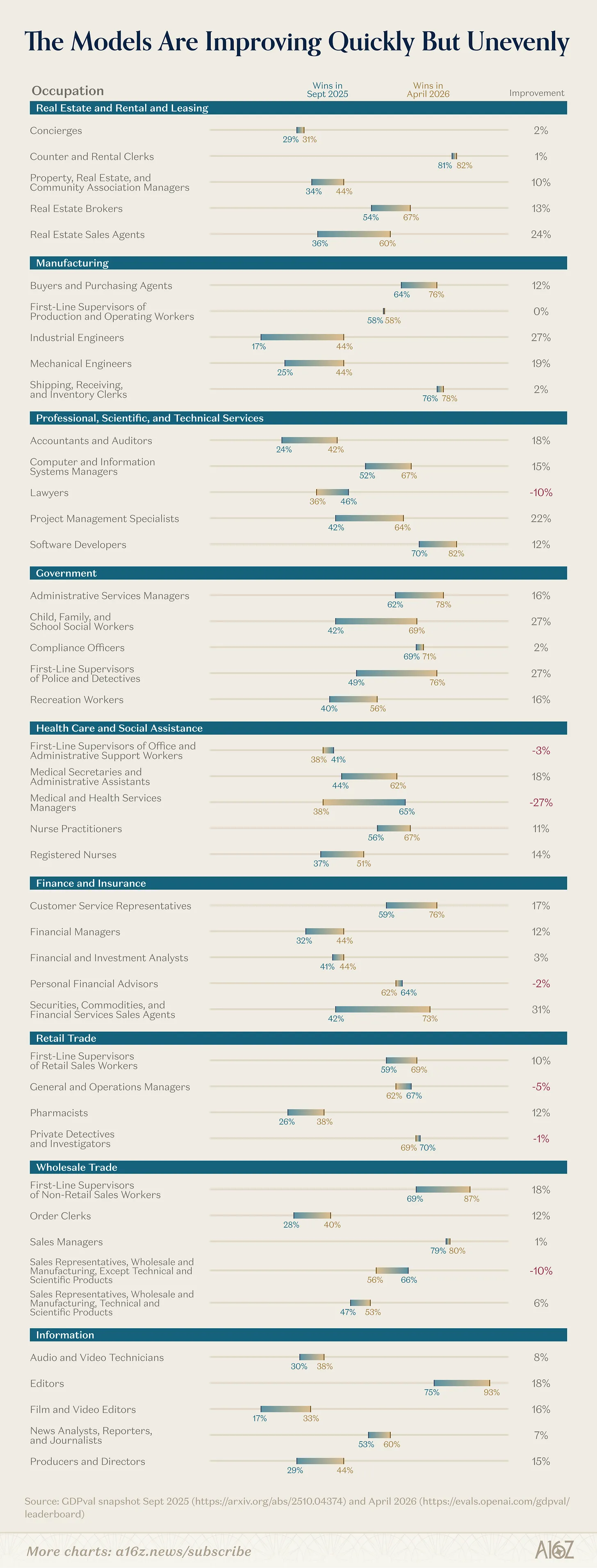
This analysis measures the win rate of top evaluation models against human experts using the GDPval benchmark. Based on this, it is clear that since fall 2025, models have become significantly better at economically valuable tasks.
So why haven't we seen all the top-ranked industries in this evaluation exhibit the same type of revenue momentum as other industries?
Industries that have enthusiastically adopted AI so far share several similarities: they are text-based, involve mechanical and repetitive tasks, naturally incorporate human oversight to inject human judgment, face limited regulation, and have clearly verifiable final outputs (e.g., executable code, resolved support tickets). Many industries lack these attributes—they either deal with the physical world, heavily rely on interpersonal relationships, entail significant coordination costs among multiple stakeholders, impose regulatory or compliance barriers, or lack verifiable outcomes. Although revenue momentum and model capabilities are clearly correlated, companies like Harvey have still been able to rapidly capture market share in areas where model capabilities theoretically fall below a 50% win rate relative to humans (such as in law), by offering co-pilot products that augment individual legal work, and then continuously improving their core offerings as the models evolve.
The most notable finding here is that model capabilities are improving rapidly. Several areas have shown significant advancements over the past four months—accounting and auditing have demonstrated nearly a 20% leap in GDPval, and even fields like policing/detective work have shown nearly 30% improvement. We expect these leaps to give rise to remarkable new products and companies in their respective domains. Additionally, model developers have explicitly stated their intent to enhance core capabilities in economically valuable work, focusing on spreadsheets and financial workflows, using computers to tackle challenging tasks in legacy systems and industries, and achieving meaningful progress on long-term tasks—opening up an entire new category of work that cannot be easily broken down into small, digestible fragments.
Insights for Builders
Understanding where enterprises derive value and how they think about ROI—and which departments clearly see pull versus those on the horizon—enables us to better identify where opportunities lie for AI builders.
Serving buyers in technology, legal, and healthcare is clearly fertile ground, but we don’t believe there will be a single “winner” in each category. For example, in the legal field, there are many types of lawyers—corporate counsel, law firms, patent attorneys, plaintiff attorneys—each with distinct workflows and needs that companies can address. The same holds true for healthcare, given the diverse mix of physician types, healthcare facilities, and more.
Beyond these departments, another productive way to think is about areas where capabilities are strengthening but no breakout companies have yet emerged in terms of revenue. Many current businesses were built before model capabilities fully unlocked products, but they have already established sufficient technical infrastructure and customer/market awareness that they will be best positioned when the model unlock arrives.
Finally, it is important to focus on which aspects of the lab’s latest research are directed toward economically valuable work. As long-term agents rapidly improve, significant investments in computer usage are made, and reliable interfaces beyond text—such as spreadsheets and presentations—are developed, an entire new class of startups will soon have the necessary enabling infrastructure to generate meaningful enterprise value.
Data methodology: This data is aggregated from leading enterprise AI startups, including private data shared with us by companies for the purpose of this report, publicly available data, and anonymized data analyzed from thousands of conversations we’ve had with startups and large enterprises at a16z.