




In the spring semester of 2026, Stanford launched a course called CS 153: Frontier Systems. With 500 seats and a waiting list, the course features a weekly guest lecture from a global leader in the tech industry, including speakers such as Jensen Huang, Sam Altman, Lisa Su, and Andrej Karpathy. The course is co-taught by Anjney Midha, founder of AMP PBC, and former Apple executive Mike Abbott. Anjney previously served as a partner at a16z, where he led investments in AI companies such as Mistral and Black Forest Labs, and oversaw a16z’s GPU cluster project Oxygen. He later founded AMP PBC independently to provide computing power and capital to AI teams.
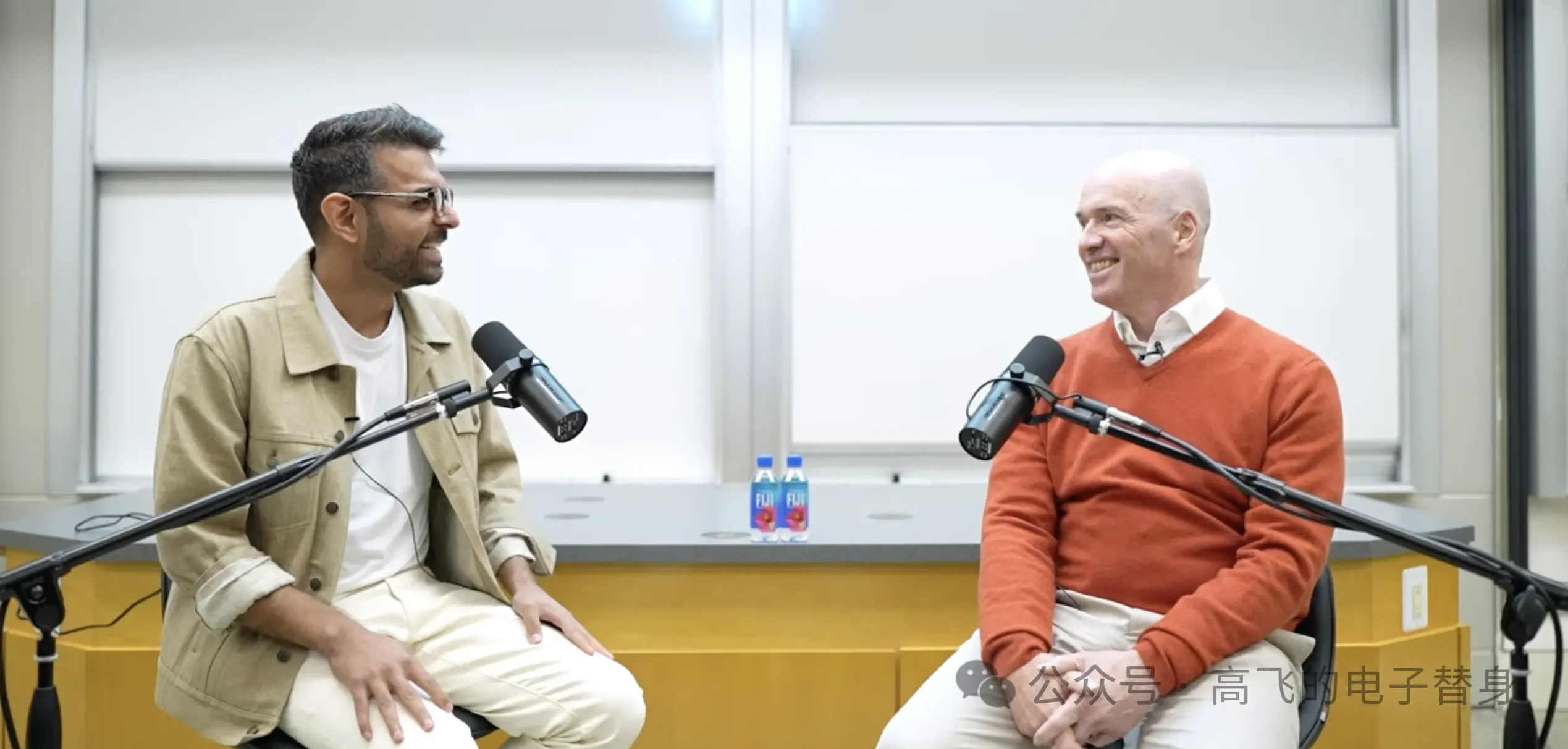
This episode features Ben Horowitz, co-founder of Andreessen Horowitz (a16z). Before founding a16z, Ben was co-founder and CEO of Opsware, a company that developed data center automation software, which was acquired by Hewlett-Packard for $1.6 billion in 2007. In January 2026, a16z closed a new funding round exceeding $15 billion, accounting for more than 18% of all venture capital raised in the United States in 2025. His two best-selling books, 《创业维艰》 and "The Hard Thing About Hard Things," have earned him rare credibility among entrepreneurs. Recently, at a16z’s Connect/Fintech conference, he introduced the concept of “founders’ AI anxiety”: where a strong software product once held a ten-year lead over competitors, then five years, it may now last only five weeks.
This feeling of "always being left behind" is consuming Silicon Valley's founder community, sparking widespread discussion.
Anjney opened with a song. The audio played was the 1985 charity single "We Are the World." The producer of this song was Quincy Jones, who passed away in November 2024 at the age of 91. The Netflix documentary "The Greatest Night in Pop" captures a detail from the recording session: just before midnight, Jones taped a handwritten note on the studio door frame that read, "Leave your ego at the door."
Jones's most remarkable ability was to bring together a room full of supremely arrogant geniuses and get them to collaborate on great works. Anjney says that if you had to sum up Ben Horowitz in one sentence, he is the Quincy Jones of tech. By the way, readers interested in the audience, please add: rohanjojo.
1. From 300 million to 15 billion: Venture capital is a system design problem
Ben starts from the beginning of a16z. In 2009, when he and Marc Andreessen set out with their first fund of $300 million, the venture capital industry held two widely accepted beliefs.
The first issue was with product definition. At the time, venture capital was essentially a business designed to make money for investors—LPs received high returns, but entrepreneurs received little more than a check. Ben felt the product offered to entrepreneurs was too poor and needed to be redesigned.
The second is an assumption about market capacity. Historical data supports the "15-company hypothesis": in any given year, only about 15 technology companies worldwide achieve $100 million in revenue. The entire venture capital industry revolves around competing for these 15 spots. Yale Endowment’s David Swensen famously said: “Good venture capital is like a basketball team—you only need five or six people.”
Ben believes both assumptions are about to become outdated. If software really is going to "eat the world," and every interesting new company is going to be a tech company, then the number of companies reaching $100 million in annual revenue should be close to 200. Venture funds of basketball-team size simply couldn’t handle that volume.
The next organizational design decision establishes the fundamental difference between a16z and all traditional venture capital firms.
Traditional venture capital is structured as a partnership, where partners share both economic returns and control. This works well at a small scale, but when change is needed, shared control leads to deadlock. Any restructuring is a reallocation of power, and someone always opposes it. If everyone has a vote, the organization can never adapt effectively.
a16z's approach is: economic benefits can be shared, but control must be centralized in one person. This allows the company to continuously enter new fields—such as American Dynamism, which focuses on defense and infrastructure, cryptocurrency, and biotechnology—because it can restructure at any time without needing unanimous consent.
Ben also instituted a strict rule for the investment decision-making process: the number of people in the room must not exceed what can reasonably engage in conversation. A room of 30 people is not a conversation—it’s a lecture. In his view, truth-seeking requires high-fidelity dialogue, and even at its best, such dialogue can’t sustain more than seven people. a16z’s solution is to continuously break the company into smaller teams, each responsible for a specific segment of the market.
2. "Everyone thought we were crazy"
Having a system design isn't enough—you must prove that this system can win.
The first fund of $300 million saw Ben invest a quarter of it into the acquisition of Skype. At the time, everyone thought this was a suicidal move. The reason was specific: eBay owned Skype, but not its core IP. The underlying communication protocol library was held by the two founders, Janus Friis and Niklas Zennström, and without this library, Skype could not function. These two could sue eBay and shut down the service at any moment. The market’s consensus was that this was an unacquirable asset.
But Ben knew these two founders. He knew that Skype was the most important label of their lives, and they would never truly destroy it. The issue was merely price and terms. After the deal was closed, the LPs who had previously said a16z was crazy subtly softened their stance.
To truly change the minds of institutional investors, Ben says there’s only one way: "Win. I say one thing, you say another, and then we wait to see who’s right."
3. Zero salary, donuts, and a HP phone number
Skype transactions addressed reputation issues, but the larger problem a16z aims to solve is: how to build from scratch a network effect the venture capital industry has never seen before?
a16z’s experience investing in companies like Facebook, Twitter, and Skype gave the team firsthand insight into network effects. Ben repeatedly emphasized a simple mathematical principle to the team: the value of a network is roughly proportional to the square of the number of nodes. Five nodes yield a value of 25; six nodes yield a value of 36. Once a platform reaches the scale of the internet, no one can build a viable competitor.
He decided to apply the same logic to a16z itself. If a16z’s network is large and dense enough, entrepreneurs raising funds here can immediately access the entire Silicon Valley ecosystem—creating a barrier that other venture capital firms cannot replicate.
Cold start strategy: blunt and direct—partners do not pay themselves salaries; instead, they channel all management fees into network building. They hire people to proactively establish relationships, aiming to connect with every engineer, executive, and large corporation purchasing technology products in Silicon Valley.
In execution, Ben leveraged an asymmetric advantage others didn’t have. His previous company, Opsware, had been acquired by Hewlett-Packard, so he knew people at HP’s Enterprise Briefing Center. The Briefing Center is a dedicated facility where major tech companies host executive clients; every week, CIOs and CTOs from different corporations visit to see demonstrations of the latest technologies, with the goal of closing large deals. Ben’s team would call weekly and ask: “Who’s coming this week? Can you give us their contact info?” Once they had the list, they invited these large companies to stop by a16z to see startup demos, complete with donuts and other hospitality.
The result is that a16z understands enterprise clients better than many venture firms that have been around for 50 years. Anjney mentioned that at the time, he was working at another top-tier venture firm, Kleiner Perkins, and showed the a16z press coverage to their CMO, suggesting they learn from it. The response was: "Oh, that’s just marketing."
Ben said that the hatred from competitors became a barrier. He wrote a blog post titled "Four Things VCs Do That I Hate," directly criticizing the entire industry. In an interview with Sarah Lacy, he quoted Lil Wayne’s lyrics: "When I see another VC give me the peace sign, I just see a trigger and a middle finger."
The entire venture capital community hates him. Other VCs refer to Andreessen Horowitz by shortening their last names to "Aho," a pronunciation that sounds like an English slur—a clear act of disdain. Every time an a16z LP meets with other VCs, they hear nothing but bad things about a16z. When Ben heard this, his reaction was: "Perfect."
Because they disliked a16z so much, they were unwilling to copy what a16z was doing. Hatred itself became a competitive barrier. Ben admitted he’s unsure if he would be that aggressive again, but acknowledged that the results were effective.
4. The iron rule "You can't solve problems with money" has been broken by AI
When the conversation entered the AI era, Ben’s tone changed. He used one word: the laws of physics have changed.
He said that, from 2009 until the emergence of AI, the one absolute rule he had observed throughout his career was: you cannot solve problems by throwing money at them. If a competitor is two years ahead of you, hiring a thousand engineers won’t catch them up, because some work cannot be parallelized, and communication overhead will overwhelm you. His favorite joke was: How much is a man-year? It’s the amount of work 700 IBM employees accomplish before lunch. The point is that once you reach a certain number of people, actual output approaches zero.
AI has broken this rule. With sufficient GPU power and data, you can indeed solve problems by throwing money at them. The capital race has become a real competitive dimension.
This leads to a direct consequence: previously, software companies had two natural moats—one was code that others couldn’t write, and the other was a user interface that others couldn’t match in usability. AI has eliminated both simultaneously: code can be generated, and UIs can be replicated. What once took two years to catch up on can now be leveled in just five weeks. So what is your actual barrier? This is the question Ben believes every entrepreneur in the AI era must answer.
Meanwhile, demand is limitless. Ben says no previous software has been this usable. Think about how, in the past, buying a suite of Siebel Systems customer relationship management software required at least two years of deployment and started at millions of dollars—this inherently limited demand. But with AI products, once users finish using them, their first reaction is, "How can I use more?" When technology reaches this level, demand has no ceiling.
5. What does a true moat look like?
Because these two moats have disappeared, Wall Street has embraced a narrative: AI model companies will instantly eliminate all SaaS companies. Ben thinks this is a classic Wall Street mistake—an overly extreme judgment. Just because the old moats are gone doesn’t mean software companies have no moats left.
Every time Wall Street thinks one thing and Silicon Valley thinks another, the arbitrage opportunity is enormous, and Wall Street is always wrong.
In Ben’s view, the true moat in the AI era is not in the software itself, but outside of it: global supply chain relationships, channel capabilities in vertical industries, and deep integration with customer systems. These are things AI cannot generate or scrape.
He uses Navan, where he serves as a director, as an example. Navan is an enterprise travel management platform that went public on Nasdaq in October 2025. To run this business, you need to establish supply chain relationships with every airline and hotel worldwide—if you scrape their websites, they will sue you outright. You must integrate with your clients’ internal systems. Your target customers are the highly specialized role of “travel management managers.”
Ben mentioned a detail: Anthropic, which Wall Street claims is out to "shoot down all SaaS," is currently hiring a travel management manager specifically to coordinate with Navan. If even it has to be Navan’s customer, how could it possibly build a travel management product? When gold bricks are everywhere, no one bends down to pick up silver ones.
He quoted Buffett: "In the short run, the market is a voting machine; in the long run, it is a weighing machine." Current SaaS companies are collectively undervalued because "SaaS doomsday" is too compelling a story, and the fund managers holding SaaS stocks have been fired; newcomers to the role don’t want to touch this sector at all. But as quarterly earnings continue to perform well, the weighing machine will ultimately correct the voting machine’s mistakes.
Ben also shared a story to illustrate why you shouldn’t easily write off a company. Stewart Butterfield once created a Flash-based iPad game called Glitch, but when Steve Jobs announced that Flash would be banned on the iPad, the company was nearly dead—with only $6 million left. Butterfield turned it into Slack.
In business, there is only one unforgivable sin: running out of money. As long as you haven’t burned through your cash and you’re a standout founder, I won’t write you off.
6. Culture is what you do, not what you believe.
Anjney made an observation: many teams that appear "certain to succeed" from the outside—star founders, ample capital, a good problem—struggle, fracture, and break up within six to twelve months. This issue is especially severe in AI labs.
Ben believes the issue lies in culture and leadership. He quotes the samurai code: "Culture is not a set of beliefs, it is a set of actions." Then he says it more directly: "I don’t care what you think, I don’t care about your feelings, I don’t care what’s in your heart—I only care about what you do."
The "actions" he refers to are very specific: Do you come to the office? What time do you leave work? When someone asks you a question, do you reply immediately or wait a week? Do you believe the best idea wins, or does the founder get the final say? These must be clearly defined—no ambiguity allowed.
With standards in place, it’s straightforward to address when someone falls short. Without standards, you can only get angry—and anger breeds infighting and politics. Someone leaves early, you’re frustrated but never say anything about overtime, and the result is mutual resentment, leading to division at the first sign of trouble. "OpenAI offered a high salary to poach me—forget it, I’m quitting and going home."
Ben opposes the co-CEO model, the principle of "we are all equal," and complete flat management. A company needs one person to break deadlocks: you want to go left, you want to go right, we’re going this way—take it or leave it. In a competitive environment, one person deciding is always faster than group voting. He says Silicon Valley deviated from this principle during the "golden age" of network effects, with CEOs compromising with employees and letting everyone vote on company values. The results weren’t good.
He also distinguished between companies and nations. If a leader does not seek personal gain for themselves or their inner circle, but purely pursues the public interest, centralized decision-making may be more efficient than decentralized decision-making. The problem is that once a bad leader takes power, concentrated authority becomes a disaster. Therefore, nations must design systems of checks and balances to resist bad leaders, because nations must endure for centuries. Companies do not need such design. Hewlett-Packard declined after the founders’ deaths—that was the company completing its mission. But a nation cannot collapse simply because of a change in leadership.
7. "Invest in people, not PowerPoint": Databricks’ Terrible Pitch
Students voted on Discord with a question about the most memorable funding pitch. Ben smiled and said it was Databricks.
Professor Scott Shenker from Berkeley called him and said, "I have Matei Zaharia, the best distributed systems expert from academia over the past decade—would you like to meet?" Ben said that upon hearing those words, he knew he was going to invest.
Then Ion Stoica, Zaharia’s co-founder and also a professor at Berkeley, came to pitch, and his slides looked like an utterly incomprehensible computer science lecture. "It felt exactly like taking a CS lecture in college that you just couldn’t follow," Ben’s partners were intimidated. But because of that phone call and his judgment of the founders, he still invested.
This was the starting point for Databricks. Ben says the story "scarred my partners," literally leaving psychological scars on his partners. But it turned out the judgment was correct.
8. No Leveraged Buyouts: Even When Profits Are on the Table, Say No
a16z is managing more and more capital, and AI has made the strategy of acquiring traditional companies and boosting their efficiency with technology incredibly attractive. People have repeatedly suggested to Ben that he launch a new business line focused exclusively on AI-driven leveraged buyouts. He’s heard similar proposals at least a dozen times. Leveraged buyouts, known as LBOs in English, are a classic private equity tactic: acquire an established company, make it more efficient with new technology, then sell it for a profit. The logic is clear: AI can dramatically improve the efficiency of traditional businesses, just as spreadsheets helped launch the entire private equity industry. Many venture capitalists are already doing this.
But Ben declined, for two reasons.
First, cultural conflict. The DNA of venture capital is investing in entrepreneurs and helping them achieve rapid growth. The DNA of leveraged buyouts is lowering purchase prices, cutting jobs to improve efficiency, and extracting profits. These are movements in opposite directions. If these two cultures are placed within one organization, the venture capital team looks at entrepreneurs and asks, “Who has a breakthrough idea?” while the leveraged buyout team looks at companies and asks, “Where can we cut staff?” Mixing them together will tear the organization apart.
Second, life choices. "I have the opportunity to fund great new ideas that push humanity forward. LBOs might be a good business, but they’re not what I want to do." He said great companies don’t exist to make money—they exist to do something bigger than themselves. If you do that, the money will follow. Don’t rush toward every place where money is.
9. Six pieces of advice for 20-year-olds
In the final half-hour of the conversation, students submitted questions via Discord voting. Ben’s responses covered topics such as career choices, AI and employment, and starting a business.
First, think of AI as electricity. Imagine a world before electricity existed—when you had to go home as soon as it got dark, and your entire life was constrained by physical limitations. AI is the next transformative tool revolution, on the scale of electricity. Master it, then apply it to the areas you’re truly passionate about—biology, materials science, rocket technology, or even creative fields. He specifically noted: someone who in his time would have been considered just a “decent guitarist” can now create an entire sci-fi film with music all by themselves. The world is truly different now.
Second, solve problems, not build companies. The best startup ideas never start with “I want to found a company.” Meta was an accidental discovery by Mark Zuckerberg during his work on Hot or Not. Dropbox came from Drew Houston’s frustration with transferring files via USB. Elon Musk’s first project was closer to a yellow pages competitor, then PayPal, before Tesla and SpaceX. Start by solving a problem you genuinely have. If you have it, it’s likely a real problem. In the process of solving it, something bigger will naturally emerge. This is similar to accidental discoveries in science—penicillin was discovered while conducting entirely different experiments.
Third, what does a good idea look like? The world needs it to exist, but if you don’t do it, no one else will. a16z itself is an example of this standard: the world didn’t need another ordinary venture capital firm, but it needed a different kind of venture capital firm. OpenAI is the same—there’s no shortage of players in AI, and Google was seen as dominating everything, but the world needed an alternative to Google.
Fourth, good ideas never lack funding, but don’t dream too big in your dorm room. Ben says capital is currently unlimited for good ideas. But he also warns against the “dorm room problem”: students have limited perspectives, and ideas generated during late-night chats with friends may sound great—but at least sleep on it before deciding if they still seem good. Trying to swallow the entire world from day one might help your pitch deck, but it won’t help your company.
Fifth, don’t listen to anyone else’s career advice, including his. “No one can give you good career advice. They can only give themselves good advice. I can give myself good advice, but not you. Especially your friends—they give advice that’s useful for them, not for you.”
Sixth, software engineering roles have not disappeared. Regarding the popular narrative that "AI will eliminate programmers," Ben directly refutes it: all data point in the opposite direction. The growth of software engineering positions remains strong. He specifically notes that Anthropic’s own hiring of engineers is also growing rapidly, and that Dario Amodei’s statements are often taken out of context on social media. What Dario actually said was that certain low-skill roles during the transition period may be replaced, and workers will need to transition to new roles. But on Twitter, this idea has been amplified into the claim that "everyone will lose their jobs."
Ben also mentioned that what worries him most about AI is not AI itself, but the U.S. overregulating out of fear—such as halting data center construction. If either China or the U.S. monopolizes superintelligence, it would be more dangerous than a balance of power between both sides. Concentrating power has never been a good thing in history. The problems created by fear itself may be more severe than those posed by what is feared.
10. At age 20, Zuckerberg "wasn't really doing well"
When discussing team culture and founder growth, Ben shared an unexpected observation. He knew Zuckerberg at age 20, and frankly, if Facebook weren’t a business with network effects, he wouldn’t have been able to sustain it with his abilities at the time. "He really wasn’t that good back then."
But Facebook's vertical takeoff gave him time to grow. Today's Zuckerberg is vastly different from the 20-year-old he was, evolving step by step through the process of running the company.
The insight from this observation is that different people reach their most effective state at different ages. Some need a business with built-in momentum to buy themselves time to grow, while others need to accumulate experience first before taking action. Regarding whether to drop out of college to start a business, Ben’s answer is: It depends on who you are, not on others. He finished college, and it was right for him. Zuck dropped out, and it was right for him. "Your friends will give you advice that’s useful for themselves. Don’t listen."
Core Q&A
Q1: What was the most critical system design decision a16z got right? Shared economic interests with concentrated control. Traditional venture partnerships grant voting rights to everyone, making organizational change impossible. By centralizing control, a16z gained the ability to continuously restructure and enter new domains. The traditional venture "basketball team" model worked in a world with only 15 companies worth $10 billion, but in a new world where 200 companies annually reach $100 million in revenue, a different organizational structure is essential.
Q2: What constitutes a true moat in the AI era? Code and user interfaces are no longer moats. The real barriers lie in global supply chain relationships, vertical channel capabilities, and deep integration with customer systems. Ben’s criterion is: Would Anthropic do this? If they, who have gold bricks everywhere, won’t bend down to pick up your silver bricks, then you have a moat. Navan must establish supply relationships with every airline and hotel worldwide, targeting the highly vertical role of travel management managers. These AI companies won’t touch this.
Q3: What is the correct way to initialize team culture? Culture must consist of concrete behavioral standards, not abstract value statements. “The best idea wins” is a standard; “we have integrity” is not. There must be one person with final decision-making authority to break deadlocks—co-CEOs and全员 voting will fail in a competitive environment. Once standards are established, they can evolve, but evolution must be led by the decision-maker and carried out collectively by the team, not by everyone going their own way.