





On May 5, a16z crypto, the cryptocurrency-focused venture fund under A16Z, announced the final closing of its fifth fund at $2.2 billion. At the same time, CTO Eddie Lazzarin was promoted to general partner, becoming the fourth GP of the fund alongside Chris Dixon, Ali Yahya, and Guy Wuollet.
Most English media have focused on “this being the largest funding round in the current crypto winter,” emphasizing the absolute figure of $2.2 billion. But this same number was also achieved in 2021, when a16z Crypto closed its third fund at $2.2 billion. After five years, one bull market peak, and two crypto winters, a16z has bet on this same figure once again.
The story behind this number isn't about "big"—it's about persistence.
a16z Crypto’s previous crypto-focused fund, Fund 4, raised $4.5 billion in May 2022, making it the largest single crypto VC fund in history—a record that still stands. The size has indeed halved, dropping from $4.5 billion to $2.2 billion. Yet in this current bear market, a16z is the only institution that has managed to raise $2.2 billion to continue betting on crypto.
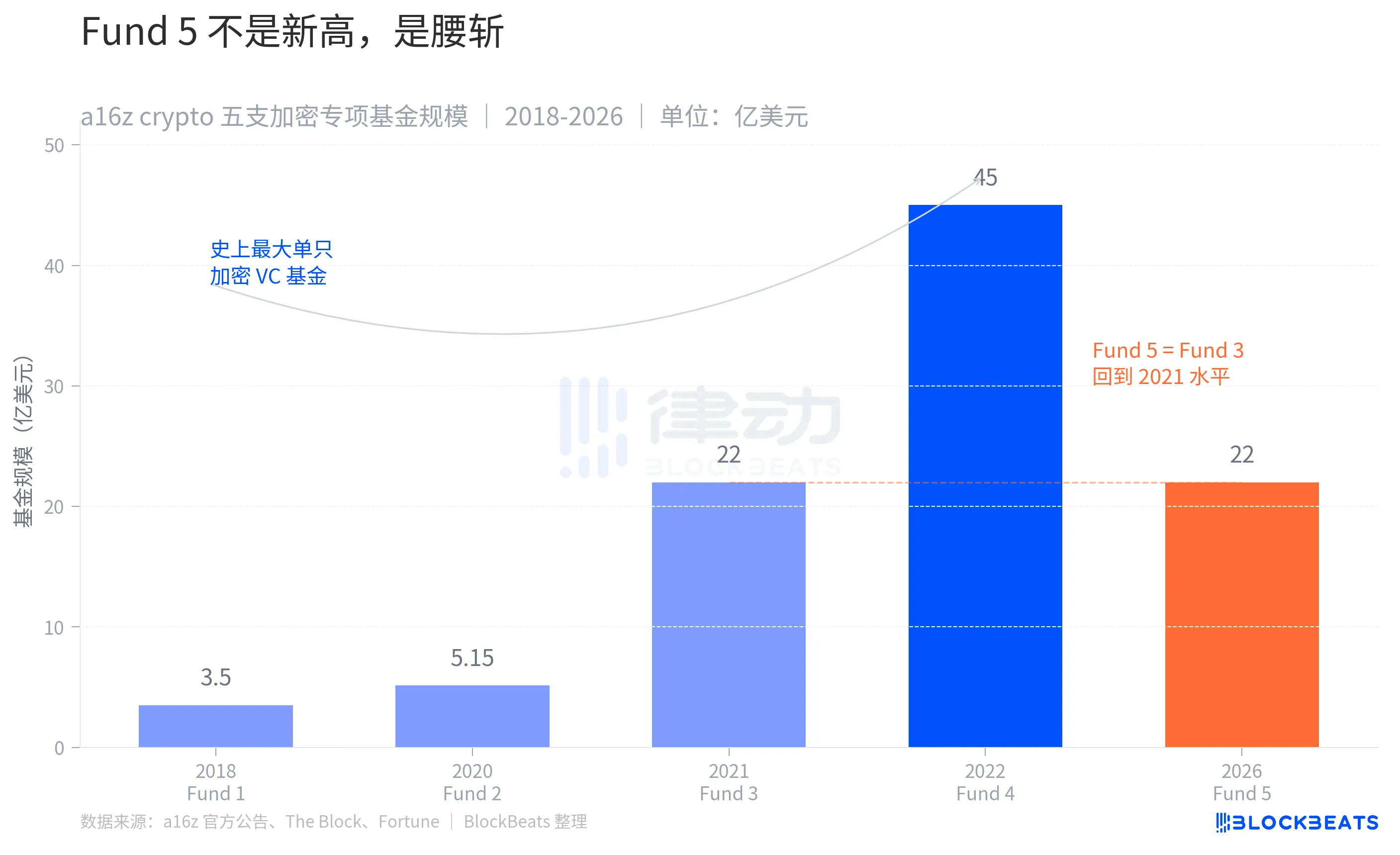
Looking at the sizes of the institution’s five crypto funds over eight years reveals a clearer pattern: Fund 1 (2018, $350 million) and Fund 2 (2020, $515 million) were early experiments. Fund 3 (2021, $2.2 billion) captured the first major bull market surge, growing fourfold in size. Fund 4 (2022, $4.5 billion) peaked at double the size of Fund 3. Fund 5, five years later, returned to $2.2 billion—exactly matching Fund 3.
Connect the tops of the bars for Fund 3 and Fund 5 with a dashed line, and the chart becomes this: a16z crypto has completed a full circle in the crypto narrative, returning to the size it was in 2021. Since 2018, the firm has committed a total of $9.8 billion in capital, nearly half of which ($4.5 billion) is tied up in Fund 4, launched in 2022 and still not fully deployed. Fund 5 is not a new wave of increased investment, but rather a continuation of crypto-specific capital, deployed while Fund 4 remains unused and the industry faces another downturn.
You can also interpret this chart from another perspective: the intervals between Fund 1 and Fund 4 are progressively shortening—2 years, then 1 year, then 1 year—while the fund sizes are also expanding. This reflects the typical pace of the cryptocurrency industry from 2018 to 2022. After Fund 4, the interval suddenly extends to 4 years.
Over these four years, FTX collapsed, DeFi surged back and then receded, Bitcoin ETFs were approved in 2024, a new bull market emerged and subsequently faded. a16z crypto did not follow the same fundraising rhythm as Funds 1–4; instead, it first deployed part of Fund 4’s capital before assembling the next fund. The day Fund 5 closed, exactly 48 months had passed since Fund 4.
But looking only at a16z crypto’s own curve is incomplete; whether the $2.2 billion represents a determined bet or a market-following move must be understood in the context of the industry’s shape during the same period.
In reality, the industry has collapsed even more steeply than a16z crypto itself. According to Galaxy Digital, global cryptocurrency venture capital investment reached approximately $32.8 billion in 2021 and remained at $30.4 billion in 2022, totaling over $63.2 billion over two years—the largest injection of venture capital in crypto history. After the collapse of FTX, this figure dropped to $10.1 billion in 2023, a decline of nearly 70%. In 2024, it rebounded slightly to $11.5 billion, and according to PitchBook, it returned to around $18 billion in 2025, falling back to 2020 levels.
When placed on this curve, the two major fundraising rounds by a16z crypto reveal the proportions clearly. Fund 4’s $4.5 billion accounted for roughly 15% of the entire industry in 2022, meaning that for every $7 invested in crypto venture capital, $1 was managed by a16z crypto alone. Fund 5’s $2.2 billion represents about 12% of the industry’s $18 billion pool in 2025. In absolute terms, a16z crypto raised half as much. But relatively, its share remained nearly unchanged despite the industry pool shrinking to one-third its previous size.
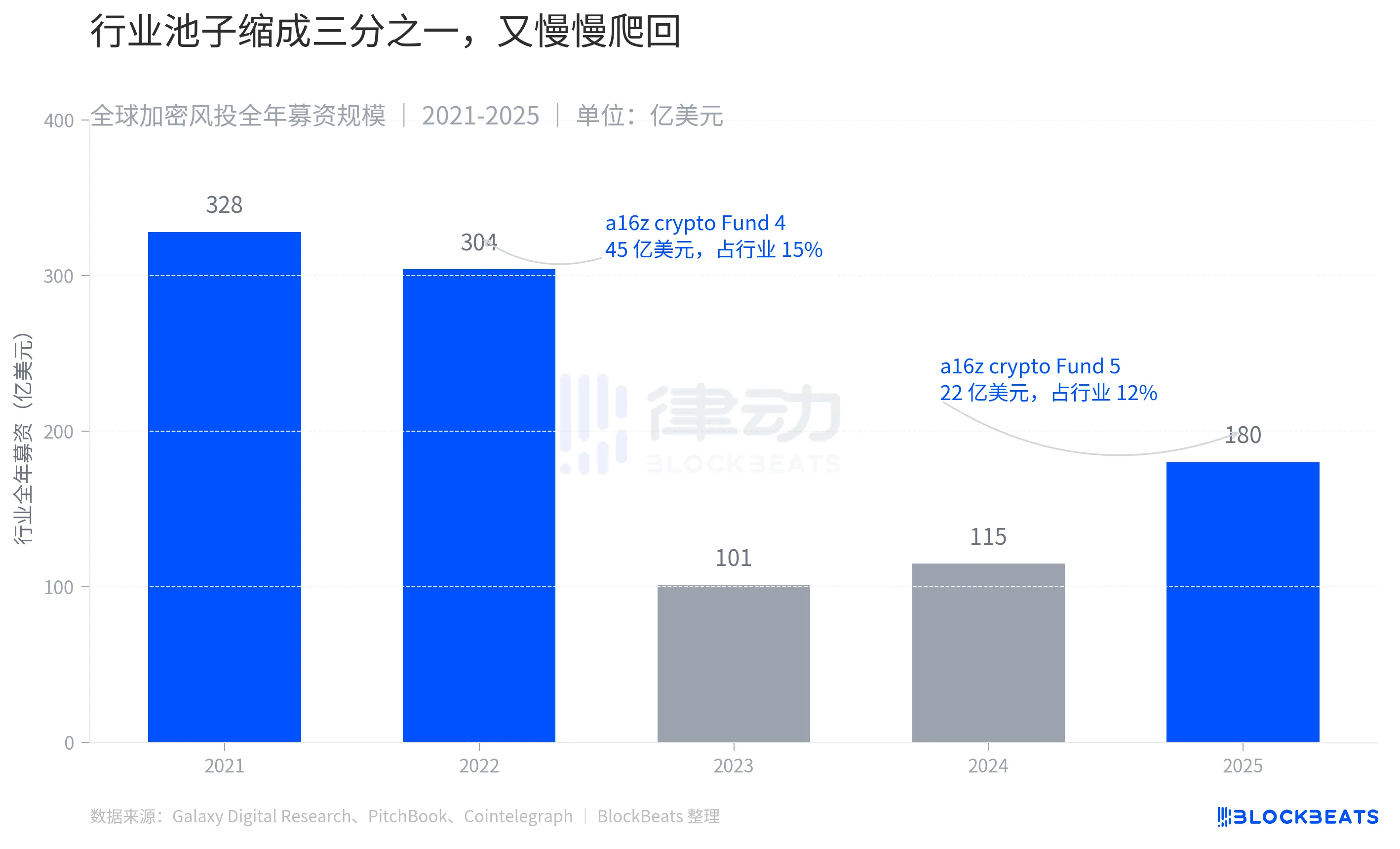
Understand this layer, and you’ll understand the true positioning of Fund 5’s $2.2 billion. The fund size halved, but within a pool shrunk to one-third its original size, the share captured remained nearly unchanged. To achieve this, LPs didn’t reduce their crypto allocations to zero over the past three years, and a16z partners had to convince themselves to keep deploying capital into crypto.
Another set of details worth examining separately: Between 2024 and 2025, Multicoin’s AUM rose from approximately $600 million to $6 billion, then halved to $2.7 billion following Bitcoin’s decline after October. During the same period, a16z crypto’s portfolio valuation declined by approximately 40%, while Haun Ventures increased by around 30% year-over-year.
In 2025, Pantera distributed profits to its LPs through the IPOs of five portfolio companies, including Circle and BitGo, and began raising its fifth fund. During the downturn, peers generally did one of three things: raise new capital, return money to LPs, or expand investments beyond crypto. a16z crypto chose only the first—continuing to invest exclusively in crypto, without returning capital or diversifying outside the space.
The third perspective is to look at competitors. The $2.2 billion and $4.5 billion comparison is from a16z Crypto itself; the $18 billion and $32.8 billion comparison is industry-wide; the final comparison is between peers.
Looking at the latest funds from several top crypto VCs between 2024 and 2026: Polychain at $400 million, Dragonfly at $650 million, Haun Ventures at $1 billion, Paradigm’s new fund at $1.5 billion (still raising), and a16z Crypto Fund 5 at $2.2 billion. a16z Crypto has the largest fund in this round, but the more critical details lie between it and Paradigm.
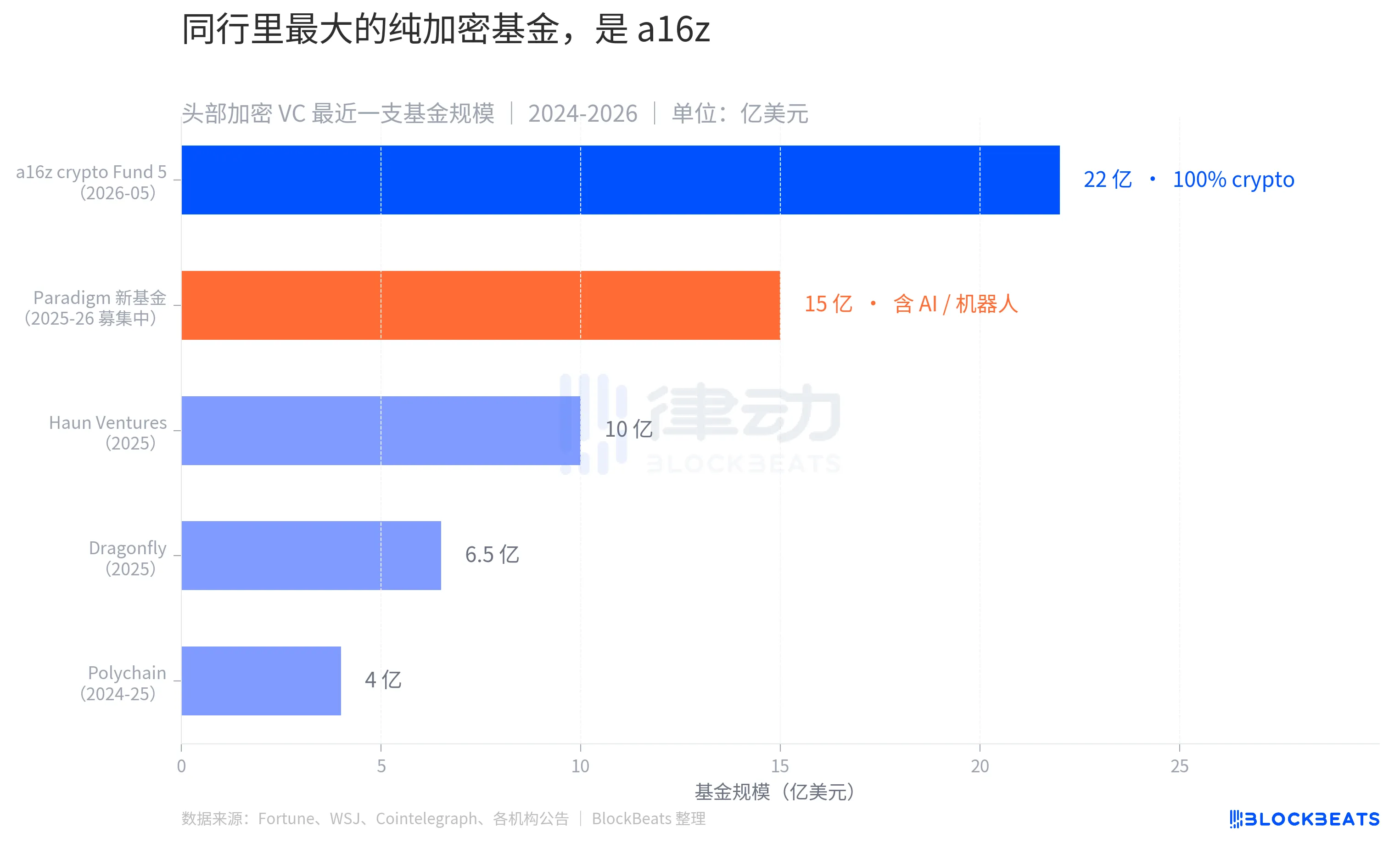
Paradigm, a crypto-focused venture capital firm founded in 2018 by former Sequoia Capital partners and the co-founder of Coinbase, has long been regarded as a16z Crypto’s most direct competitor in the crypto space. In 2024, Paradigm closed its $850 million early-stage fund, “Paradigm Three,” and subsequently announced a new fund targeting $1.5 billion. According to The Wall Street Journal, the scope of this new fund has expanded beyond pure crypto to include AI, robotics, and other frontier computing technologies. In other words, Paradigm’s partners have concluded that investing solely in crypto would mean missing too many opportunities.
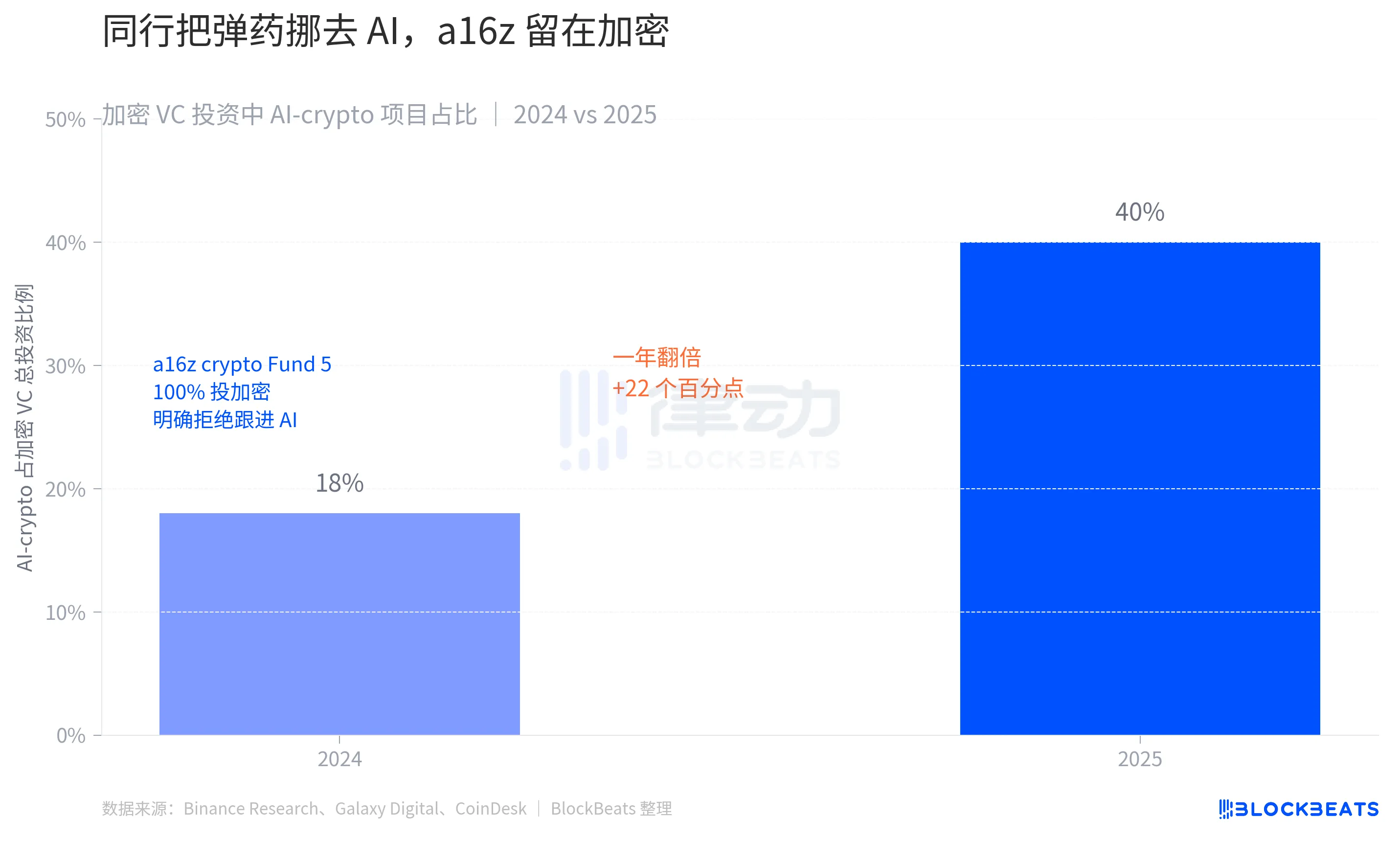
a16z Crypto’s stance is the opposite. On the day the fund was announced, the spokesperson’s only response to Fortune was: “Fund 5 is 100% invested in crypto founders.” In the VC context of 2026, this is a hardline stance.
In 2024, 18 cents of every dollar invested in cryptocurrency venture capital went to projects combining AI and crypto. By 2025, this figure more than doubled to 40 cents.
The 40% figure reflects a complete shift in fund allocation. According to a16z’s January announcement, “Why Did We Raise $15B,” the parent firm closed a $15 billion new fund in January 2026, allocated across Apps ($1.7B, AI applications), Infrastructure ($1.7B, AI infrastructure), Growth ($6.75B), American Dynamism ($1.176B), Bio ($700M), and Other ($3B, including crypto, fintech, and enterprise software)—with no separate “Crypto” category in the public breakdown. The $2.2B for Fund 5 was raised separately four months later.
a16z’s parent firm raised its total assets under management from $42 billion in May 2024 to over $90 billion by March 2026, while the crypto division’s share dropped from 11% during Fund 4 to just 2.4% during Fund 5. Internally, crypto has shifted from being a standalone segment to merely one bet within the "Other" pool. The parent firm’s capital focus has moved elsewhere—only the a16z crypto team still wants to concentrate its resources on crypto.
This is the true location of Fund 5. It represents a concentrated bet on crypto within the a16z ecosystem, scaled to half the size of the previous fund, yet it remains the only dedicated crypto investment within the parent company, where crypto’s overall allocation has been reduced to 2.4%. According to Fortune, late-stage investments from Fund 4—such as Babylon (a protocol enabling Bitcoin holders to collateralize BTC), the cross-platform prediction market tool Kairos, and a $50 million investment in the Solana staking protocol Jito—serve as examples of Fund 5’s deployment direction. As Dixon and the partners stated in their announcement, the goal is to “invest in the overlooked phase of the cycle and turn new infrastructure into products used daily by ordinary people.”
Only a16z itself remains to stick it out in crypto.