








On May 5, Andreessen Horowitz’s crypto division, a16zCrypto, officially announced the closing of its fifth fund, Fund 5, with a total size of $2.2 billion.
The size of this fund is significantly smaller than the $4.5 billion record set by Fund 4 in 2022, said Paul Cafiero, communications partner at a16z crypto, noting that the company intentionally returned to a smaller fund size because “shorter fundraising cycles allow us to keep pace with evolving crypto trends.”
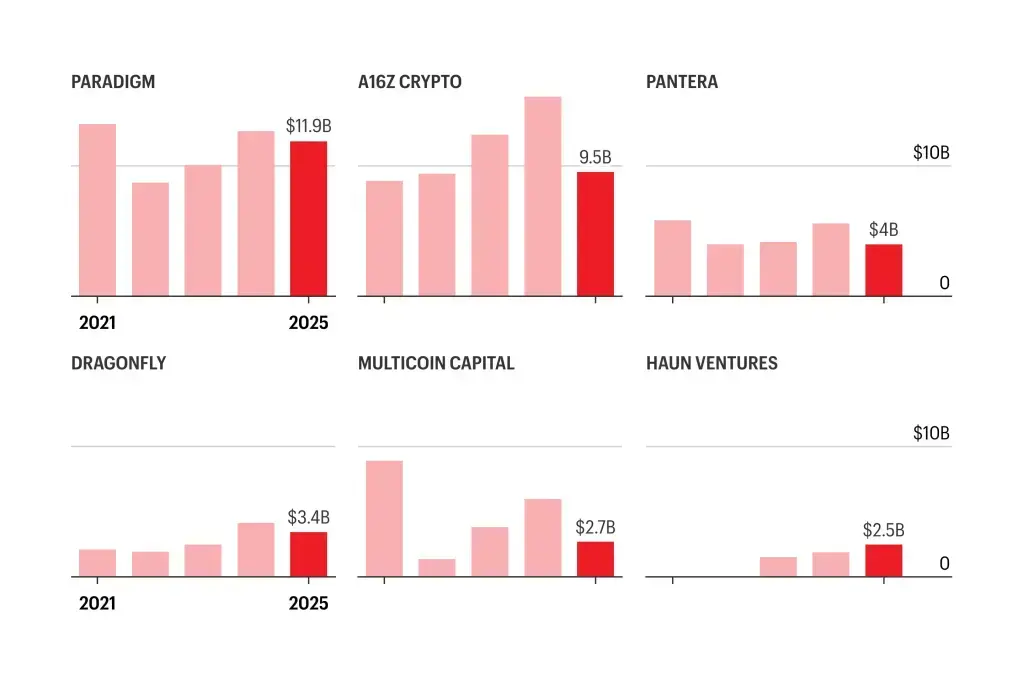
This decision has real-world context. Previously, Fortune magazine, citing SEC filing data, revealed that in 2025, leading crypto venture capital firms such as Paradigm, Pantera, and a16z Crypto all saw reductions in their assets under management. Among them, the total assets under management of a16z Crypto’s four funds declined by nearly 40% from 2024 to 2025, dropping to approximately $9.5 billion, partly because the firm has begun returning capital to LPs of its earlier funds.
The entire crypto VC ecosystem has seen a clear increase in fundraising difficulty over the past two years, with capital concentrating among top players; the reduction in scale is the most direct response to market realities.
Looking back, a16z Crypto’s fund sizes have been: $350 million in 2018 for the first fund, $515 million in 2020 for the second, $2.2 billion in 2021 for the third, and $4.5 billion in 2022 for the fourth. This fifth fund returns to $2.2 billion, matching the size of the third fund in 2021.
According to RootData data, a16z Crypto has participated in 253 funding rounds historically, with a portfolio of 183 projects and led 150 rounds. In terms of sector distribution, infrastructure accounts for the highest share at 37.7%, followed by gaming (13.1%) and DeFi (12.5%). Representative projects include Coinbase, Solana, Uniswap, Ripple, Phantom, Kalshi, and LayerZero.

ImageSource:RootData
Four a16z Crypto GPs said the crypto market is currently in a quiet phase, but adoption signals are improving. In each cycle, the infrastructure left behind after speculative fervor subsides tends to be more valuable than at peaks and more durable than at troughs.
They list three key signals. The first is stablecoins: while trading volumes rise and fall with the market, stablecoin usage continues to grow even during bear markets, widely used for cross-border remittances, savings, and everyday payments—this growth is more driven by network effects than price expectations.
Second, the maturity of on-chain financial infrastructure: perpetual contracts are used for price discovery, prediction markets for information aggregation, on-chain lending services for stablecoin credit markets, and traditional assets are beginning to be tokenized, extending the scope beyond crypto-native assets.
Third, on the regulatory front, a16z Crypto has a positive stance toward the GENIUS Act, viewing it as providing developers with clear regulatory clarity, and remains optimistic about the passage of the Clarity Act this year.
Based on this, a16z Crypto said the new fund will invest in projects that transform new infrastructure into products used in everyday life—this is the less-observed but higher-long-term-value segment of the cycle.
In terms of investment focus, the fund will be 100% dedicated to cryptocurrency investments and will not expand into adjacent areas such as AI or robotics. a16z Crypto’s reasoning is not to avoid AI, but rather to believe that the AI era makes cryptocurrency even more essential.
They noted that software is becoming increasingly complex and harder to trust, AI systems are powerful but operate with opaque logic, and the high centralization of internet infrastructure continues to accumulate the risk of single points of failure.
In this context, the core attributes of crypto networks have become even more valuable: system transparency and verifiability, a naturally global network, economic models that align the interests of users and developers, and infrastructure that doesn’t rely on a few intermediaries.
These features have already emerged in real-world products across payment, financial services, creator platforms, and decentralized infrastructure, and are increasingly being adopted by financial institutions and technology companies.
Meanwhile, a new wave of previously impossible models is emerging: users can directly hold assets and identities, and possess inviolable digital property rights; numerous software agents can autonomously make decisions and conduct transactions on behalf of users, independently acquiring computing power, data, and services; autonomous networks can self-finance, govern, and evolve through code.
In other words, they are not directly entering the AI sector, but are betting that AI’s advancement will drive demand for cryptocurrency infrastructure. Specifically, they are investing in the foundational layers of stablecoins, on-chain finance, and the AI agent economy.
This contrasts with the views of some peers. According to reports, Paradigm is seeking to raise up to $1.5 billion for a new fund, with plans to directly expand its investment scope into AI and robotics. Haun Ventures has completed fundraising for a $1 billion new fund, with AI agents listed as one of its core investment focus areas.
Two strategies reflect top institutions’ differing bets on the next cycle: one believes the intersection of crypto and AI offers greater opportunities, while the other holds that focusing solely on crypto is sufficient, as the AI wave will ultimately flow back on-chain.
In addition, Dragonfly has recently completed fundraising for its fourth fund, raising $650 million, while Blockchain Capital is also raising approximately $700 million. The concentrated fundraising by top-tier institutions signals that a new wave of project investments will begin rolling out over the coming months.
Clearly,this round of capital is betting on the transition of crypto from infrastructure development to real user adoption,whether focusing on crypto or crossing over into AI,this real moneywill onlyflow tothosewho can turn technology into tangible products..