





Author: Max.s
After experiencing significant volatility in 2024 and a profound reshuffling in 2025, the quantitative finance industry now stands at a new crossroads. At last week's 2025/2026 China Quantitative Investment Year-End Summit, Dr. He Kang, Chief Strategist and Head of Financial Engineering at Huatai Securities Institute of Research, delivered an in-depth speech titled "Quantitative Industry Trends in 2025 and Outlook for 2026." This was not only a strategic report for the A-share market, but also a field manual on how to find new opportunities for alpha generation in an increasingly crowded market.
For professionals operating at the intersection of Web3 and traditional finance, this report sends a clear signal:Traditional alpha is fading, while new paradigms—whether the "Order as Token" approach based on large models or alternative assets represented by cryptocurrencies—are becoming fiercely contested battlegrounds for institutional investors.
The following is an in-depth review and industry outlook based on Dr. He Kang's speech.
2025 is a year marked by both "high popularity" and "high volatility" for the quantitative investment industry. A notable data shift is that while the existing scale of securities-related private funds remains at a high level, the growth of public quantitative funds has been even more rapid. As of the third quarter of 2025, the scale of public index-enhancement products has exceeded 200 billion yuan, with the active quantitative segment reaching 120 billion yuan.
Behind this lies an interesting structural change: the top donor on the list has changed.
The previous dominant player landscape has been disrupted, as institutions like Bodao and Guojin have risen rapidly due to their highly flexible strategies.In Dr. He's research, these top-performing public quantitative funds are essentially "private funds in public fund clothing." They maintain extremely high turnover rates, with astonishingly rapid strategy iteration, and their use of intraday reversals (T+0 trading) is even comparable to that of top-tier private funds.
This phenomenon reveals the survival rules of 2025: as the difficulty of achieving excess returns increases exponentially, only extreme flexibility can enable breakthroughs in a highly competitive market. For investors,The previous configuration logic of "choosing big brands and coasting" is no longer applicable., it is necessary to identify managers who truly possess "agile development" capabilities through more refined attribution analysis.
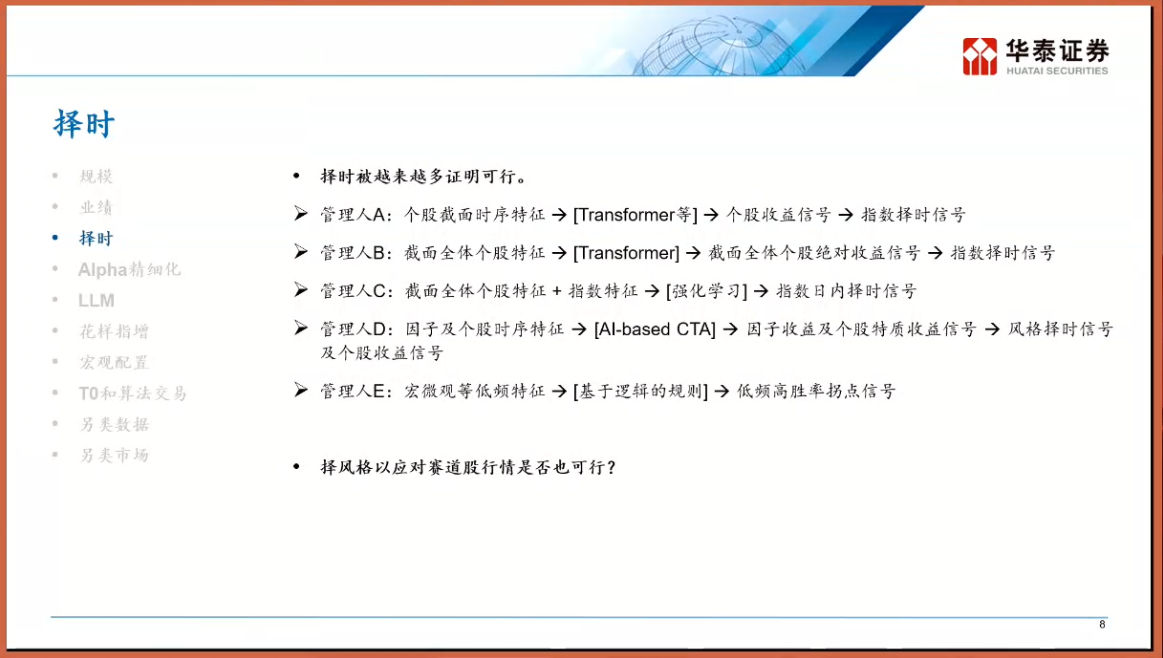
Over the past five years, the mainstream narrative in the quantitative industry has been "full-position stock selection," relying on alpha generated from stock-picking to offset market volatility. However, after the market lessons of 2025, "market timing" has once again returned to center stage. Dr. He Kang categorizes market managers into five types: A, B, C, D, and E. Among them, the most noteworthy are...Class E Managers —— Logic-based Market TimersUnlike predictions from a black box, such strategies construct explicit logical chains of "If A then B."
The Rise of Sub-domain Modeling
As market efficiency improves, it becomes increasingly difficult to identify factors that are universally applicable across the entire market. Top-tier fund managers are beginning to adopt a "divide and conquer" strategy: they segment all stocks in the market into different "domains," such as growth, cyclical, small-cap, and micro-cap, and train models separately within each domain. This is similar to Web3, where you cannot use the same logic to trade Bitcoin and on-chain meme coins — their pricing mechanisms, liquidity characteristics, and participant structures are fundamentally different. By modeling each domain separately, quantitative strategies can extract higher excess returns within localized market segments.
If domain-specific modeling represents a tactical optimization, then the introduction of large language models (LLMs) constitutes a strategic, dimension-reducing blow. Dr. He Kang mentioned three application levels of large models in quantitative finance, among which the most memorable is the third level: treating financial trading as a language, that is, "Order as Token."
In traditional NLP (Natural Language Processing), GPT predicts the next word (Token). In financial large models, the input is a price series, trading volume, and order flow over a past period, and the model predicts the next "price Token." This is not only a technical transfer but also a revolutionary shift in thinking.
Traditional quantitative models are often based on statistical linear or nonlinear regression, while the Transformer architecture enables models to capture long-range dependencies and complex nonlinear patterns. Imagine that future trading is no longer based on linear weighting of a few factors, but instead is driven by a pre-trained financial large model that "generates" future price paths in a manner similar to how text is generated. This concept is analogous to the intent-centric AI agent trading logic currently emerging in the crypto space — in this scenario, AI is no longer just an auxiliary tool, but rather the direct executor of trades.
The Blue Ocean of Alternative Data: Institutionalization of the Cryptocurrency Market
When the excess returns in the A-share market are intensely competed away, savvy capital begins to look toward alternative markets with lower correlations through total return swaps (TRS) or offshore entities.
Compared to the T+1 settlement system and price limit rules in A-shares, the cryptocurrency market features 7x24 trading hours, T+0 settlement, high volatility, and fragmented liquidity. For quantitative institutions with high-frequency trading capabilities and risk control models, this market is akin to the A-shares market before 2015—where abundant alpha opportunities exist and the competitive landscape is not yet consolidated.
Here, we would like to specifically introduce the Funding Rate Arbitrage strategy. In the perpetual contract mechanism of the cryptocurrency market, long and short positions must pay funding fees to maintain price alignment. During bull market cycles, long positions often have to pay high funding rates to short positions. This creates a kind of fixed-income-like "market-neutral strategy": buying spot assets and shorting an equivalent amount of perpetual contracts. This approach hedges against price fluctuation risks while steadily earning funding fees. In this field, the 1Token Funding Rate Arbitrage Strategy Index has become an important industry benchmark.
According to industry data, such strategies have achieved significantly higher annualized returns than traditional fixed-income products under specific market cycles, and they also exhibit extremely low correlations with traditional assets (stocks, bonds). 1Token, as a professional institutional service provider in the digital asset field, has developed indices that not only reflect the overall arbitrage potential in the market, but also demonstrate the evolution of crypto quantitative strategies from "craftsmanship" to "institutional and index-based" approaches.
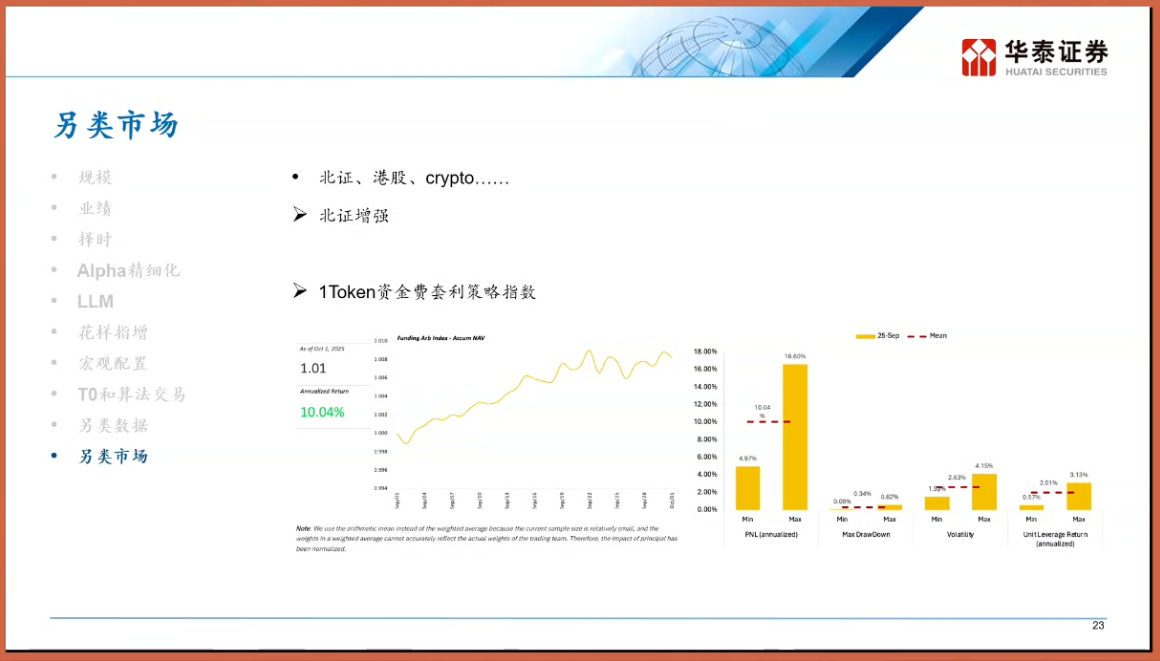
For traditional finance professionals, the significance of paying attention to indices like 1Token lies in the fact that they provide a window into the liquidity premium of Web3. When funding rates remain at high levels for an extended period, it indicates an extremely bullish market sentiment and serves as a warning of potential selling pressure in the spot market. Conversely, when funding rates decline, it may present a good opportunity for buying at a discount.
Looking ahead to 2026, Dr. He Kang's key words are "dynamic" and "antifragile."
From Static Allocation to Dynamic Game Theory In the past, when constructing FOF (Fund of Funds) or allocating major asset classes, a static weight was typically set (e.g., a 60/40 portfolio). However, in the future, a dynamic adjustment mechanism must be introduced. For example, when a certain type of strategy (such as small-cap stock index enhancement) becomes overly crowded, the "herd risk" caused by homogeneous trading must be actively mitigated by reducing its weight, even if its historical performance has been excellent.
The "airbag" transformation of products has experienced painful retracements, and investors' aversion to downside risks has reached its peak. Derivative products with "airbag" or "snowball" structures, as well as index-enhanced products protected by options, will become mainstream in 2026. This is fundamentally similar to the logic of structured products in DeFi — sacrificing a portion of potential upside gains in exchange for greater certainty and principal protection.
Seeking assets with low correlation—whether finding independent alpha within A-shares or allocating to Hong Kong stocks, U.S. equities, or even crypto assets—the core objective is to reduce the overall correlation of the portfolio. Dr. He Kang specifically mentioned that although it is difficult to generate pure alpha in Hong Kong stocks (due to poor liquidity and expensive shorting tools), they still hold value as part of a diversified allocation. Meanwhile, the crypto market, driven by its unique logic, will become an important piece in hedging traditional financial risks.
Dr. He Kang's speech essentially revealed the essence of financial engineering: the process of seeking certainty amidst uncertainty.
In the quantitative industry of 2025, the traditional low-hanging fruits have already been picked. Now, practitioners face only two paths: either to deeply focus on technical advancements, leveraging large models to uncover deeper nonlinear patterns; or to expand overseas in terms of assets, entering the blue ocean of crypto markets to achieve a form of "dimensional advantage."
For Web3 natives, this is also a warning: as top-tier institutions like Huatai Securities begin to conduct in-depth research and pay close attention to this field, the entry of formal players is only a matter of time. When traditional quantitative strategies are applied to decentralized trading markets, new opportunities and fierce new competition will arrive simultaneously.
In 2026, whether in TradFi or Crypto, only the ones who evolve will survive.