


Author: David, DeepTide TechFlow
2026 will be a big year for IPOs.This judgment was confirmed in January.
Before the end of January, crypto custodian BitGo rang the bell on the New York Stock Exchange, while Chinese AI companies Zhipu and MiniMax successively listed on the Hong Kong Stock Exchange. These three companies, operating in different industries, all chose January for their listings.
Zhipu's public offering was oversubscribed by 1,164 times, and MiniMax surged 109% on its first day. Money is really flowing in.
But the ones in January are just the beginning. The list of companies expected to go public this year is expected to be much longer. Meanwhile, super unicorns overseas are growing even larger, and there are also a number of Chinese tech companies going through the process in Hong Kong and A-shares markets...
Which of these could be implemented this year, what are their valuations, and when will there be an opportunity to participate?
We have compiled a list of IPOs to watch in 2026, categorized by industry.
The $10 Billion Club of U.S. Stocks
Data Source: Bloomberg, AI整理
If 2025 is the year of initial public offerings (IPOs) for cryptocurrency companies, 2026 might be the year when tech giants once again open the door to IPOs.
The most attention in this round is not on the startups, but on those private companies.The fundraising market has nurtured many super unicorns over the years.
Their common point is that their valuations have already reached the limit of the private market, with only a few institutions capable of taking on the shares. Further fundraising would not be very meaningful.
Some of them missed the window due to a previously unfavorable market environment, while others are intentionally kept private by their founders.
In 2026, these conditions will be maturing simultaneously.
1. SpaceX, Valuing the Vastness of Stars and Oceans
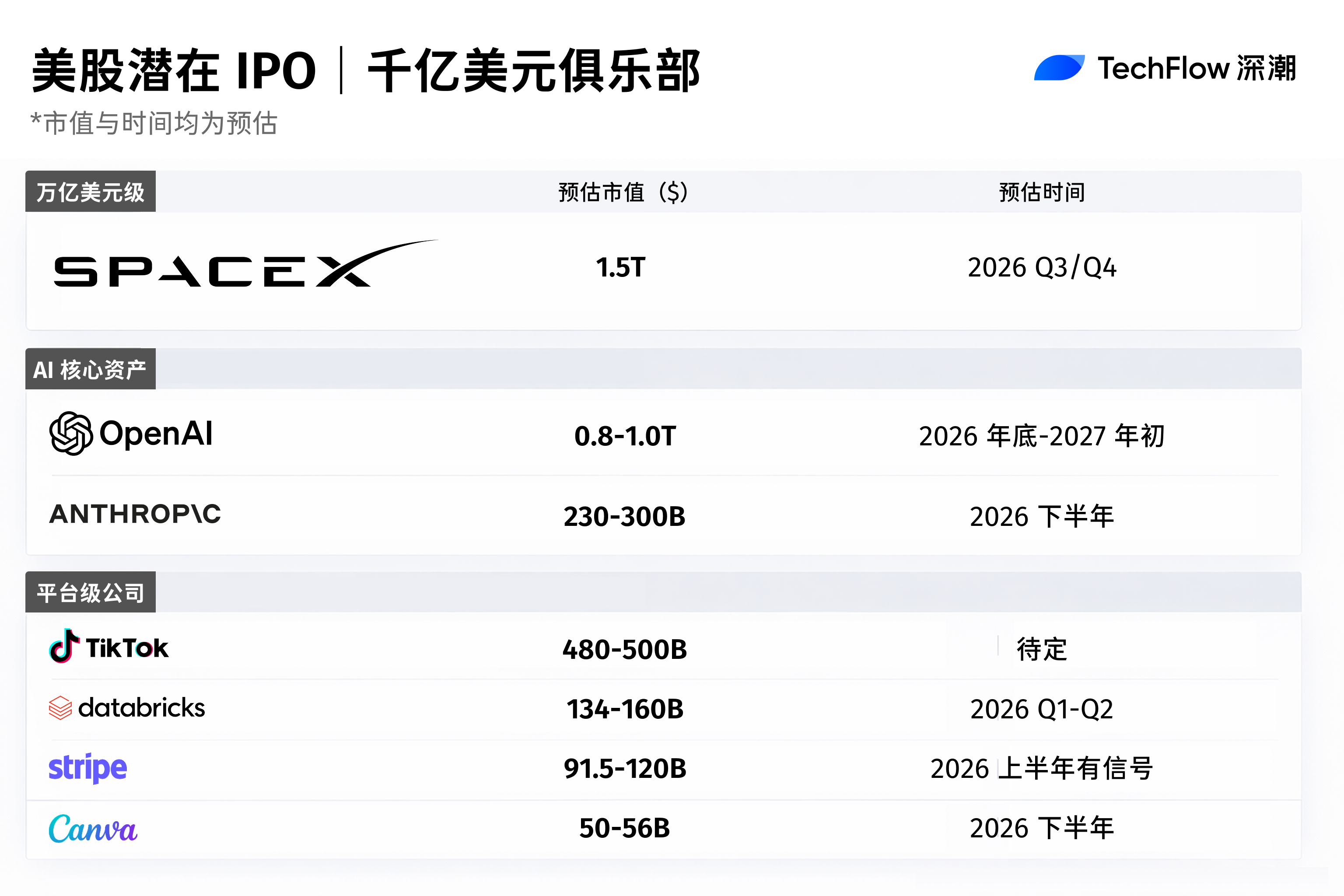
Estimated Market Value:150 billion USD
Estimated time:Q3/Q4 2026
On December 10, Musk confirmed on Twitter:
SpaceX plans to go public in 2026.
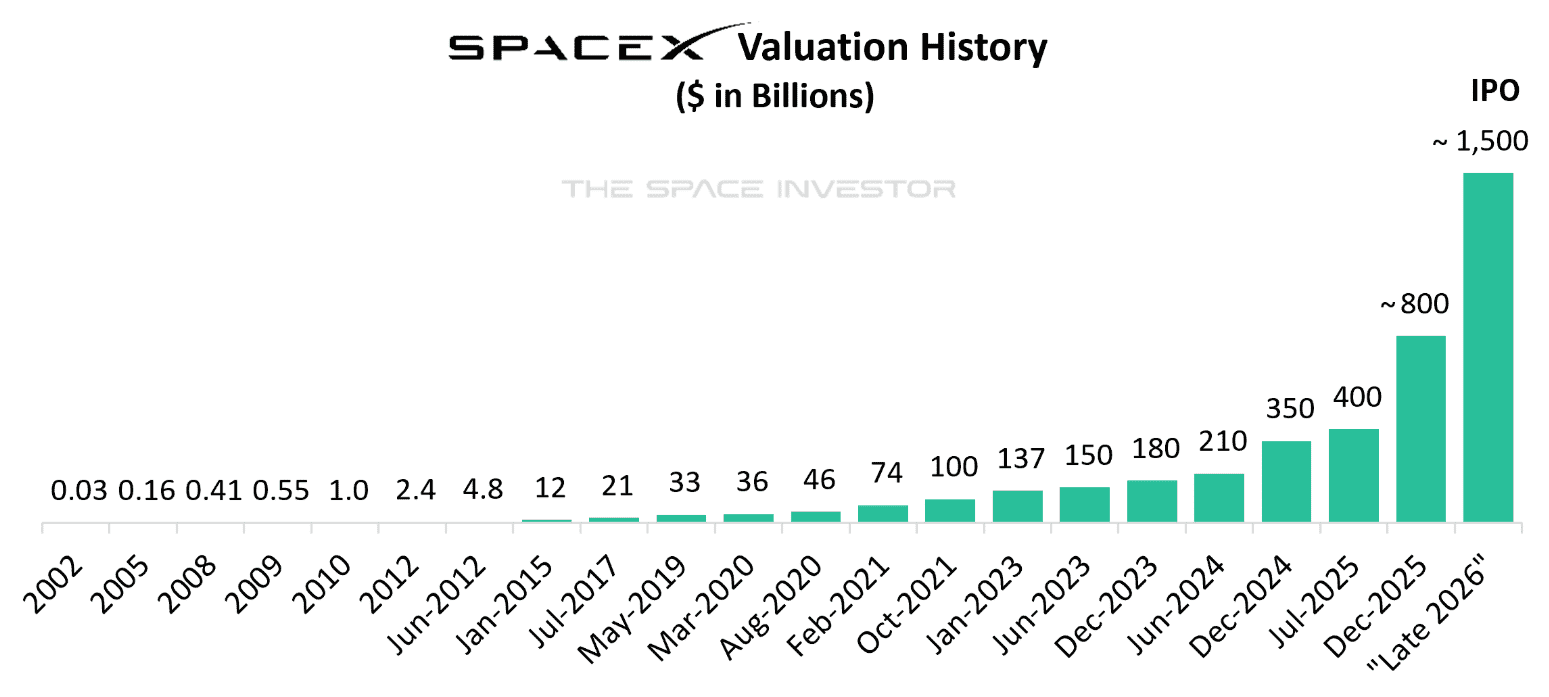
According to Bloomberg, the target fundraising exceeds $30 billion, with an estimated valuation of around $1.5 trillion. If realized, this would surpass Saudi Aramco's $29 billion record in 2019, becoming the largest IPO in human history.
SpaceX currently has two core businesses. The first is rocket launches, with Falcon 9 expected to conduct over 160 launches in 2025, accounting for more than half of the global total. The second is Starlink, a satellite internet service, which is projected to have over 10,000 satellites in orbit by 2025, serving more than 8 million users and generating an estimated annual revenue of $15.5 billion.
According to internal SpaceX documents, once Starlink reaches scale, the company's annual revenue could reach $36 billion, with a 60% operating profit margin.
If achieved, a valuation of 150 billion would imply a sales multiple of about 70 times. This ratio is already very high, but for a company growing at a rate of over 50%, the market may be willing to pay.
In addition, a small piece of data you might have overlooked is that although SpaceX appears to be a space company, 70% of its revenue actually comes from Starlink.
Investors are not buying the dream of "Mars colonization," but rather the world's largest satellite internet service provider—a network service provider cloaked in space-themed branding.
Why is Musk willing to go public now?
According to Ars Technica, the primary goal is to raise funds for building a space-based data center, such as using modified Starlink satellites as orbital AI computing nodes.
It sounds like science fiction, but which of the things SpaceX has done in the past 20 years doesn't sound like science fiction?
Valuing the stars and the vast ocean is sexy enough.
2. OpenAI vs Anthropic: The AI Powerhouses' Race to Go Public
Estimated Market Value:83 billion to 100 billion USD (OpenAI), 23 billion to 30 billion USD (Anthropic)
Estimated time:Late 2026 to early 2027 (OpenAI), second half of 2026 (Anthropic)
When these two are used together, people often use ChatGPT and Claude together as well.
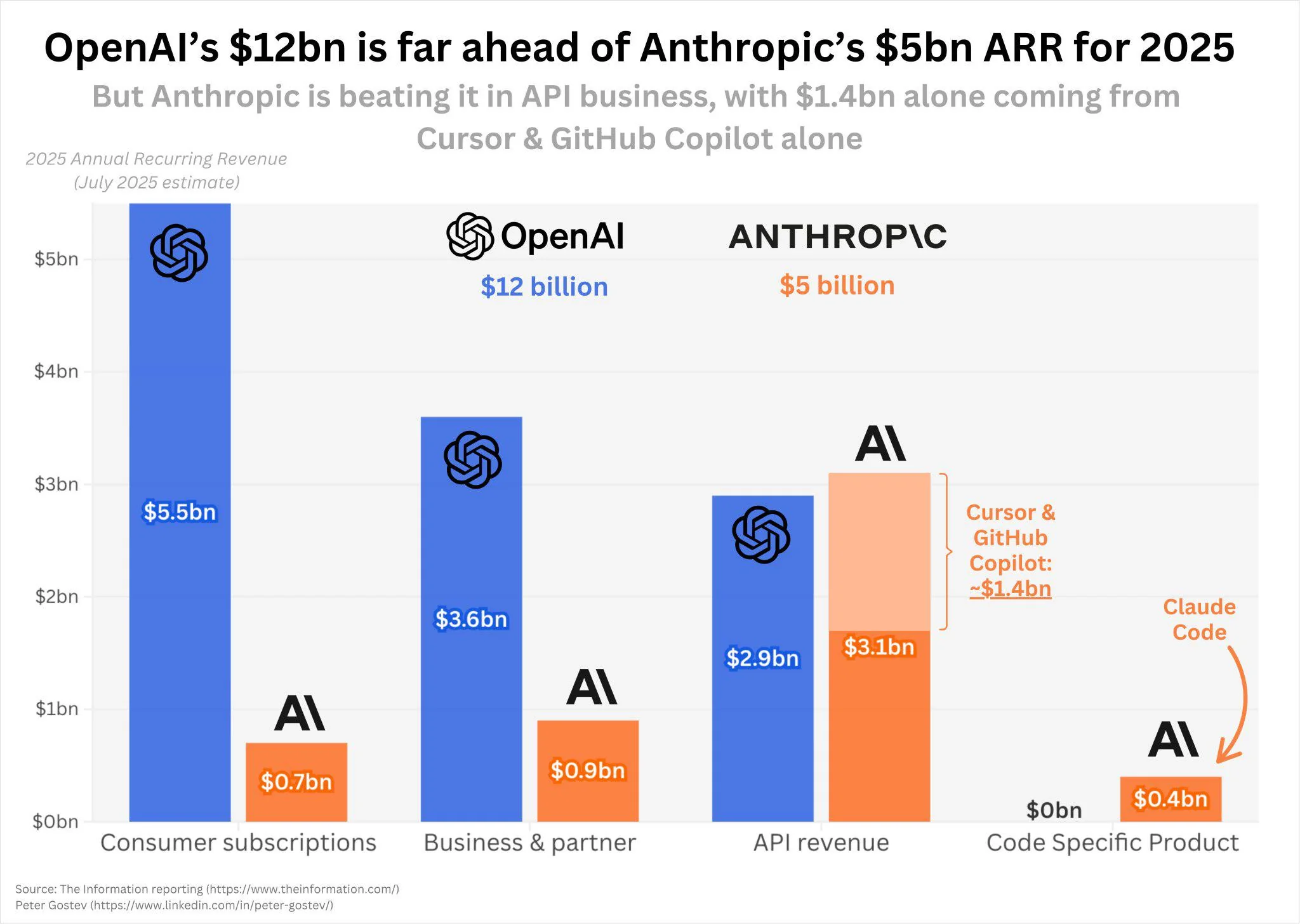
OpenAI The current valuation is approximately $50 billion, with annualized revenue exceeding $13 billion (Sam Altman has even said the revenue is much higher than this figure), and the goal is to go public with a $100 billion valuation.
The company's CFO, Sarah Friar, has stated that the initial public offering (IPO) is targeting 2027, but some advisors believe it could be brought forward to the second half of 2026.
Sam Altman was very open in the podcast: "My level of excitement about being a CEO of a public company is 0%."
But he also acknowledged, "We need a significant amount of capital, and eventually we will have to break through the shareholder number restrictions." Just recently, OpenAI completed its structural reorganization from a non-profit to a for-profit entity, reducing Microsoft's stake to 27%, clearing the way for a potential IPO.
Anthropic Faster action.
According to the Financial Times, the company has hired Wilson Sonsini (the law firm that helped Google and LinkedIn with their IPOs) to prepare for an initial public offering, which could happen as early as 2026.
The current valuation is $183 billion, and it is undergoing a new round of financing, aiming for a valuation exceeding $300 billion. Meanwhile, Microsoft and NVIDIA may jointly invest $15 billion.
In terms of revenue data, Anthropic looks more promising:
The annualized revenue is approximately $9 billion, expected to reach $20-26 billion by 2026, and could potentially reach $70 billion by 2028. Claude's subscription revenue growth rate is seven times that of ChatGPT, despite having a smaller base.
It's hard to say which company will win in the competition between the two.
OpenAI dominates the consumer market, with 800 million weekly active users for ChatGPT; however, Anthropic is growing faster in the enterprise market.
Who will go public first? At present, Anthropic seems better prepared. However, OpenAI is larger in scale, and once it decides to take action, the level of market attention will be entirely different.
3. If ByteDance is blocked, can TikTok be accessed?
Estimated Market Value:48 billion to 50 billion US dollars
Estimated time:Under consideration, not sure yet.
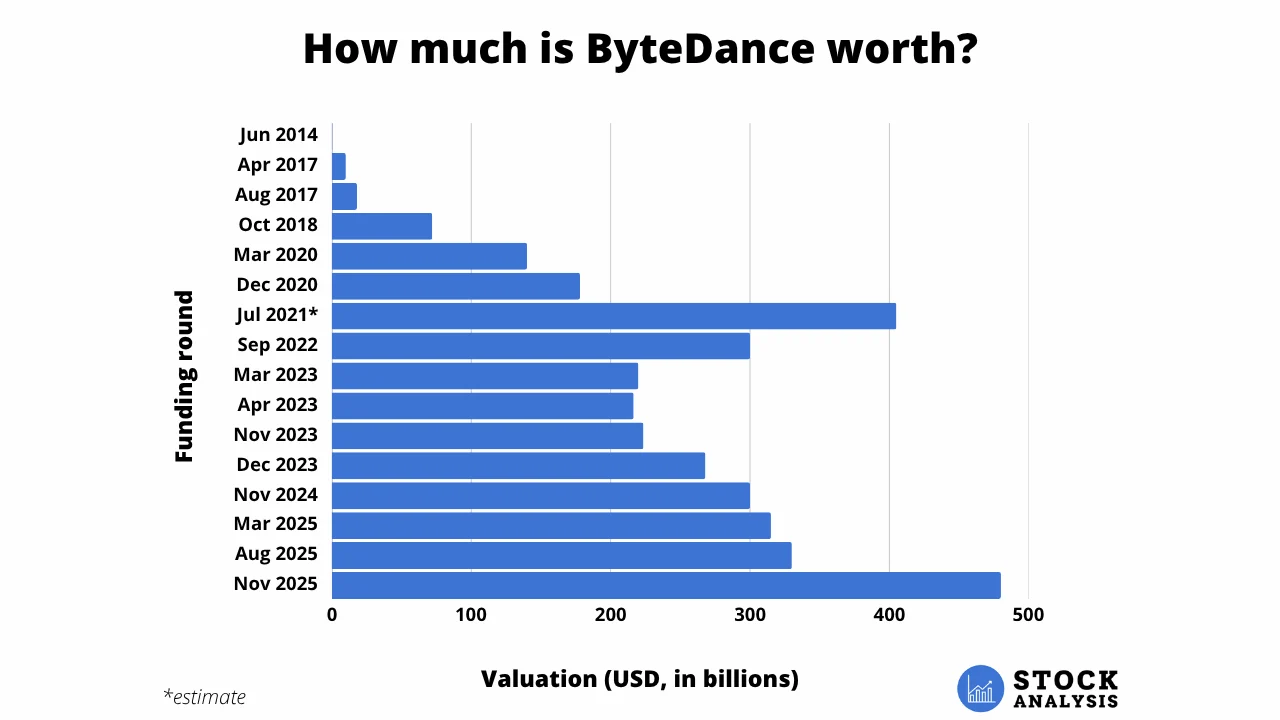
ByteDance is the second-highest valued private company globally, just behind OpenAI.
In the November 2025 secondary share offering, today's capital bid for shares at nearly $300 million, corresponding to a valuation of $480 billion.
The company's global revenue in 2024 reached $110 billion, representing a 30% year-over-year increase. Douyin's dominance in the Chinese market needs no further explanation, and the Doulabao chatbot has surpassed DeepSeek in monthly active users, becoming the top in China.
The planned capital expenditure for 2026 is RMB 160 billion, of which RMB 85 billion will be used for AI chip procurement.
But ByteDance previously stated clearly: there are no plans for an IPO.
However, the variable may lie in TikTok. If the U.S. spin-off ultimately goes ahead, market rumors suggest that TikTok's standalone valuation in the U.S. could rise from the current $40 billion to $50 billion.
The spin-off of TikTok's U.S. operations could instead become one of the largest tech IPOs of 2026.
4. Databricks: You may not have heard of it, but everyone is using it.
Estimated Market Value: $134 billion - $160 billion
Estimated time: Q1-Q2 2026
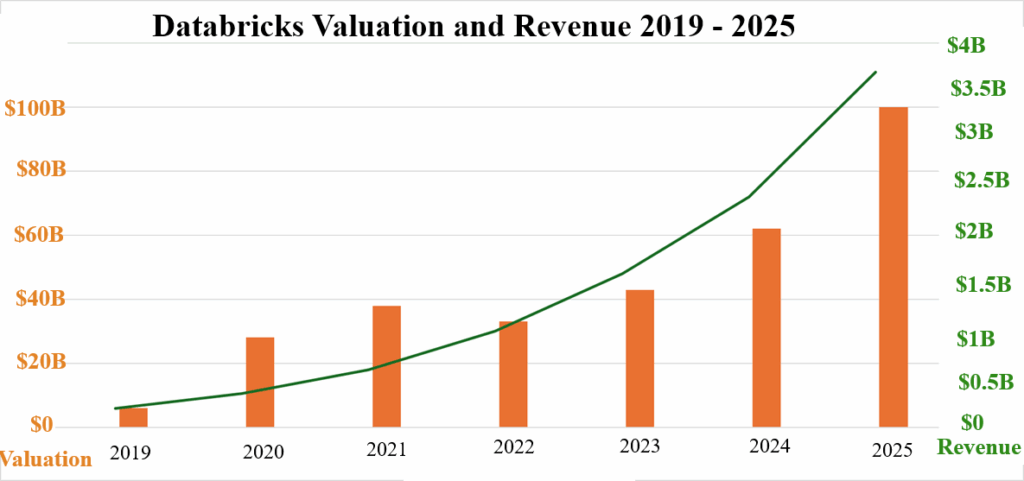
Databricks is a company that most ordinary people haven't heard of, but that almost every major company uses.
It provides a unified platform of data lake plus data warehouse, enabling enterprises to store, process, and analyze massive amounts of data, as well as train AI models on top of it.
In December 2025, Databricks completes a $4 billion Series L funding round, achieving a valuation of $134 billion.
By comparison, its valuation was 100 billion three months ago and 62 billion one year ago. Such a growth rate is extremely rare in the private equity market.
Financial data shows that the company's annualized revenue exceeds $4.8 billion, representing a 55% year-over-year growth;
Its AI product revenue exceeded $1 billion. More than 20,000 customers include OpenAI, Block, Siemens, Toyota, and Shell. Most importantly, the company has achieved positive cash flow.
Analysts generally expect Databricks to go public in early 2026.
If it truly goes public with an IPO, it will directly compete with Snowflake. Snowflake had a valuation of $70 billion when it went public in 2020, and its stock price doubled on its first day of trading.
Databricks is growing larger and faster, and market expectations will only continue to rise.
5. Stripe, the least anxious one.
Estimated Market Value: $91.5 billion - $120 billion
Estimated timeline: Signals expected in the first half of 2026, but may be delayed.
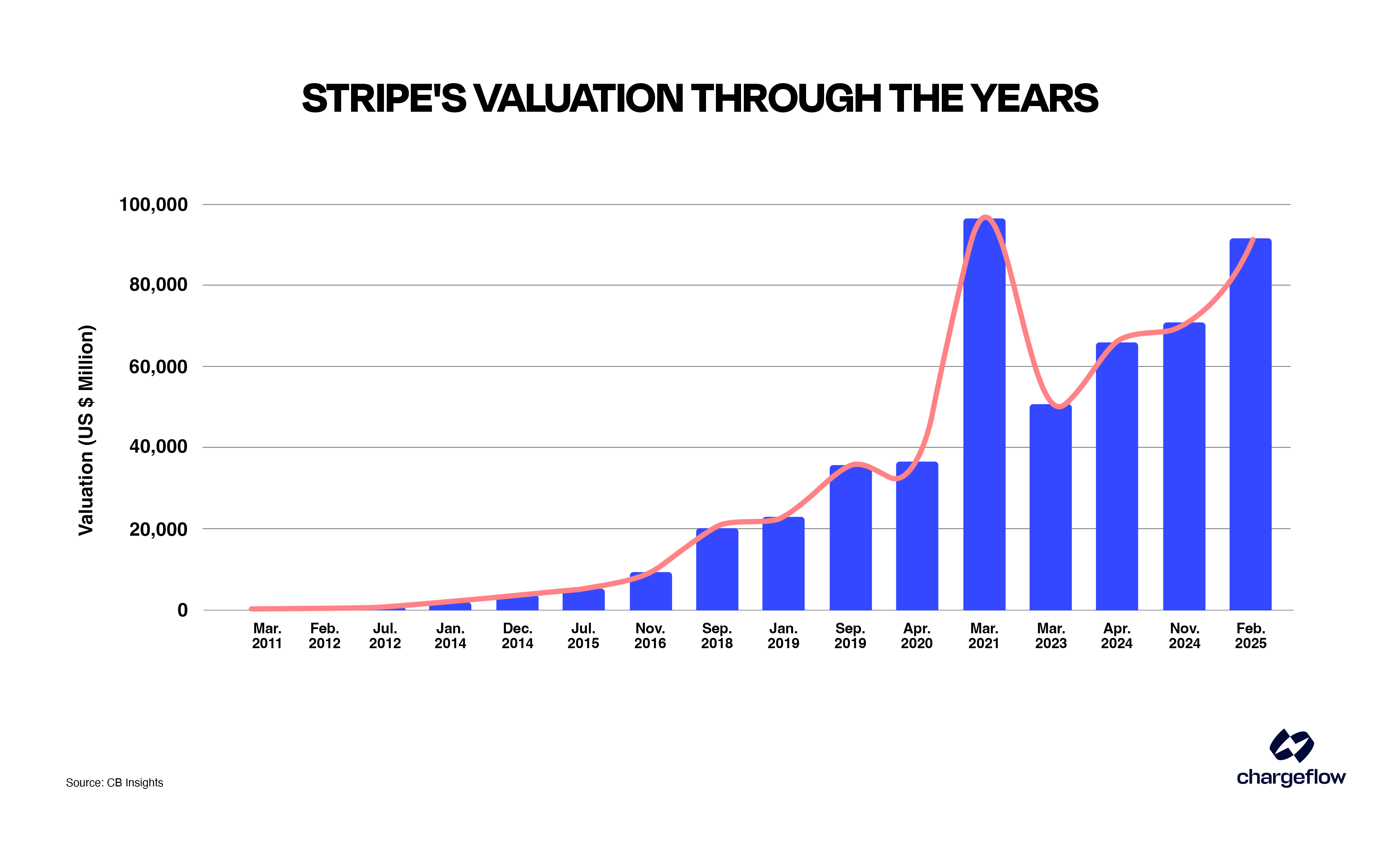
Stripe might be the most unique one in this group: the most qualified to go public, yet the least eager to do so.
Valued at $91.5 billion, it generates over $1.8 billion in revenue and is already profitable. It has processed $140 billion in global payments, with clients including OpenAI, Anthropic, Shopify, and Amazon. Financially, it is the cleanest among this group of companies.
But the founding Collison brothers have consistently avoided the topic of an IPO. In February 2025, they explained on the All In podcast:
Stripe is profitable and does not need to raise capital through an IPO; many financial services companies, such as Fidelity, have never gone public in decades; shareholders can achieve liquidity through regular employee stock repurchases and do not necessarily need public markets.
How long can this logic hold up?
Sequoia has already started figuring out ways to allocate Stripe shares to its limited partners (LPs), which is typically a sign that a venture capital firm is pushing the company toward an initial public offering (IPO). Meanwhile, employees' 10-year stock options are gradually expiring, increasing the pressure to cash out.
If the IPO market remains hot in 2026, Stripe has a good chance of going public accordingly. However, if the market cools down, the Collison brothers have more than enough capital to wait. What sets them apart from other companies is that the decision ultimately rests in their own hands.
6. Canva might be the one with the least risk in this batch.
Estimated market value: $50 billion - $56 billion
Estimated Time: Second Half of 2026
Source: https://www.stylefactoryproductions.com/blog/canva-statistics
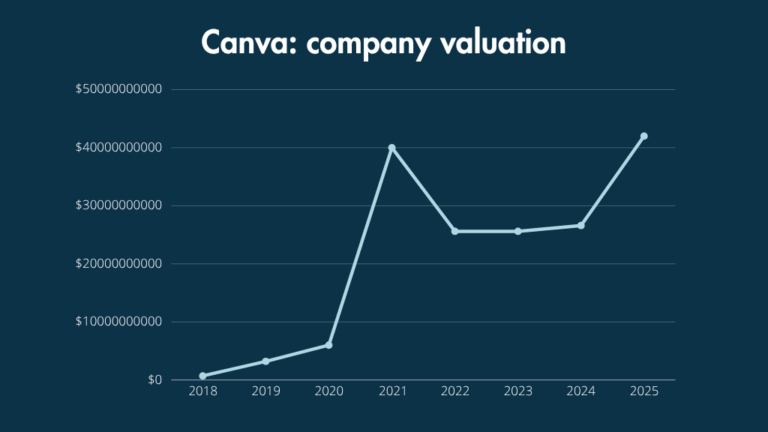
Compared to those previous behemoths worth tens of billions of dollars, Canva appears much more low-key. This Australian design tool company has a valuation of $4.2 billion, revenue exceeding $3 billion, and is profitable.
No geopolitical risks, no pressure from costly AI arms races, and a simple business model: sell subscriptions and create design tools.
Blackbird Ventures told investors in November last year that Canva would be ready in the second half of 2026. CEO Melanie Perkins has previously resisted going public, but employee liquidity demands may push her to change her mind.
If you're looking for a "safe" choice among these IPOs, Canva might be the closest one. Not as glamorous as SpaceX, but with far fewer uncertainties.
In summary, it is no coincidence that these companies are clustered in plans to go public in 2026.
For example, the AI arms race requires ammunition. OpenAI plans to invest $140 billion over the next five years, Anthropic has committed $50 billion to build data centers, and ByteDance spends heavily on chips every year. Private markets can't fill this funding gap.
However, for ordinary investors, the significance of this batch of IPOs may be different from previous ones.
These companies had already grown large and mature enough in the private market to be acquired, so by the time they went public, they were no longer "early-stage." The most substantial phase of their growth was already captured by the private market.
China's tech IPOs: two tracks for H-shares and A-shares
Zhipu and MiniMax rushed to the Hong Kong stock market in January, but the IPO drama for Chinese tech companies is just getting started.
2026,Commercial aerospace and robotics are two of the hottest main themes, with their target markets being the A-share Sci-Tech Innovation Board and Hong Kong stocks, respectively.
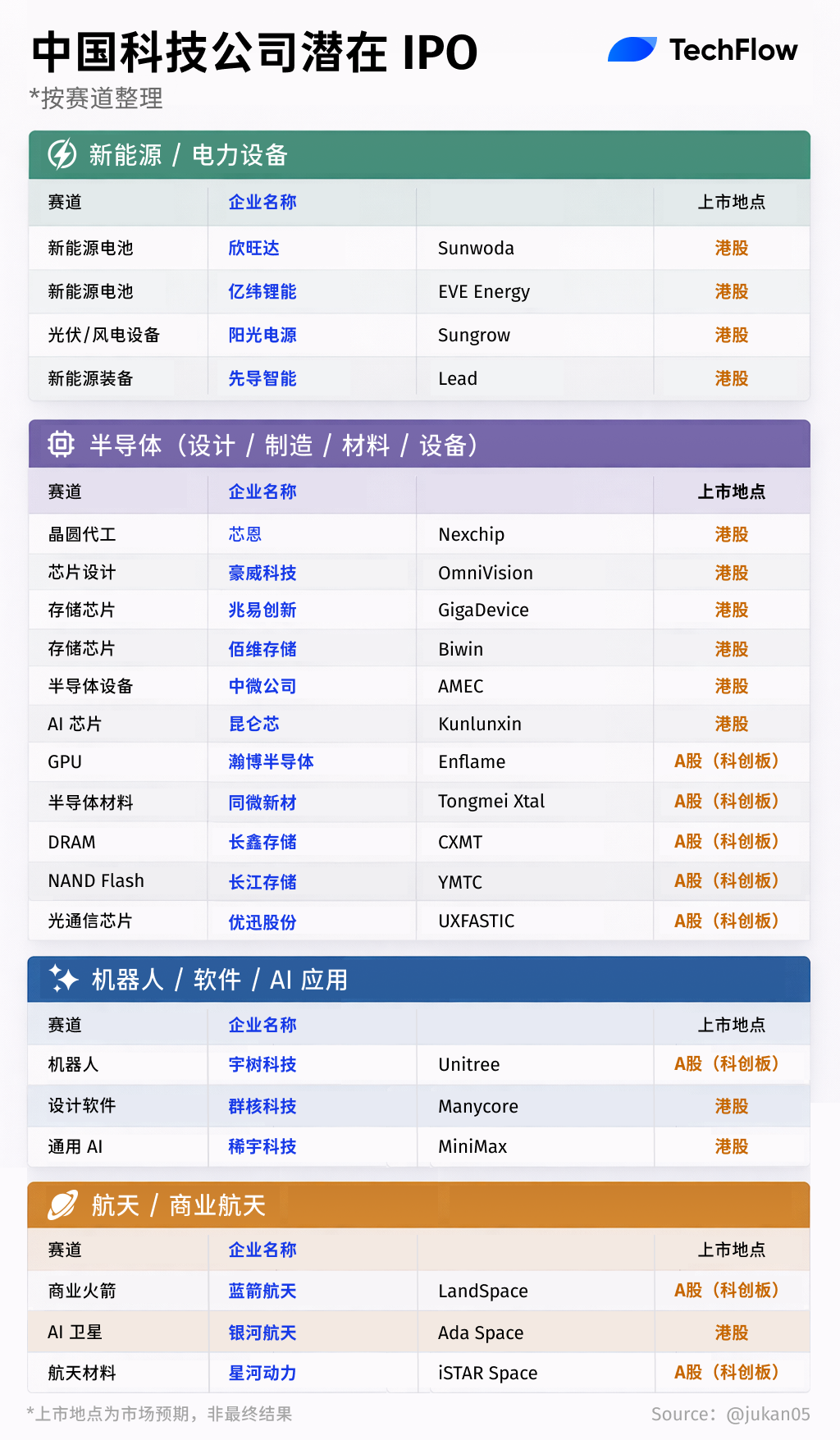
Source: X User @jukan05
Compiled and organized by DeepTide TechFlow
1. Blue Arrow Aerospace, Racing for the "First Stock of Commercial Rockets"
Estimated market value: 20 to 22 billion RMB
Estimated Time: 2026
Listing Venue: STAR Market
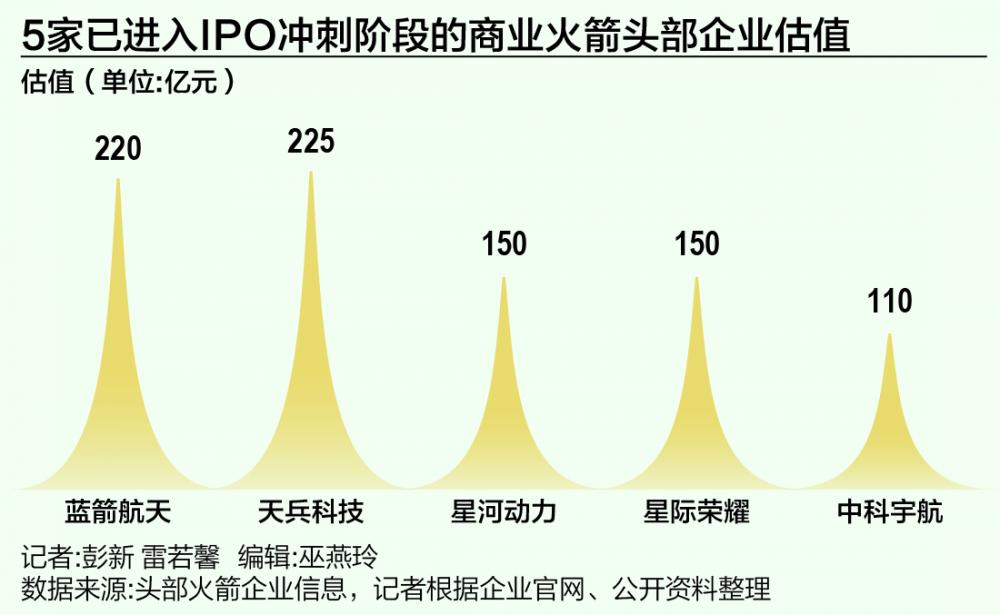
On December 31, 2025, LandSpace's Sci-Tech Innovation Board (STAR Market) IPO application was accepted. The company plans to raise 7.5 billion yuan. From the start of its tutoring process to receiving acceptance took only five months—truly rocket speed.
Lanjing is a leading player in China's commercial aerospace industry, specializing in liquid oxygen methane engines and launch vehicles.
Founder Zhang Changwu has a background in finance. He started his entrepreneurial journey in 2015 and has raised 17 rounds of funding in 10 years, backed by 85 venture capital funds. The company's latest valuation is approximately 22 billion yuan. Early investors include Sequoia Capital, Matrix Partners, and Country Garden Ventures. Last year, the National Manufacturing Upgrading Fund also joined as an investor.
Lanjian chose the fifth standard of the STAR Market. Originally, this standard was intended for biopharmaceutical companies, but it was expanded to include commercial aerospace last year.
The requirement is "to achieve the first successful orbital insertion of a payload using a medium-to-large launch vehicle employing reusable technology." In December last year, LandSpace's Zhuque-3 conducted a recovery test. Although the first stage failed to achieve a soft landing, the orbital mission was successful, barely meeting the requirement.
However, on January 5th, LandArrow was selected for an on-site inspection, which is the first batch of this year. The subsequent progress will depend on the results of the inspection.
2. CAST Space, the second-fastest rocket company in terms of progress.
Estimated Market Value:Over 10 billion yuan
Estimated time:2026
Listing Location:Sci-Tech Innovation Board
Zhongke Aerospace just completed its IPO preparation in January, and it is the commercial aerospace company with the fastest progress toward an initial public offering (IPO) since Lander.
This company was incubated by the Institute of Mechanics, Chinese Academy of Sciences, and focuses on medium and large solid-fuel rockets. The "Li Jian-1" rocket has been launched eight times, maintaining the domestic record for consecutive launches by a private rocket with ton-level payload.
On January 12, Lihong-1 completed a suborbital flight test, reaching a maximum altitude of 120 kilometers, successfully crossing the Kármán line to enter the space environment, with the payload capsule recovered via parachute.
Unlike Blue Arrow's liquid rocket approach, Space Dynamics follows a solid rocket route, which has lower costs and faster response times, but also a lower payload capacity ceiling. The two companies are targeting different market segments.
Yang Yiqiang, the founder, is 58 years old. He comes from the First Academy of CASC and served as the first chief commander of the Long March 11 rocket. This "national team" background is a rare resource within the commercial aerospace industry.
3. UBTech, the CCTV Spring Festival Gala star known to all.
Estimated market value: Over 12 billion yuan
Estimated Time: 2026
Listing Venue: STAR Market (high probability)
The 2025 CCTV Spring Festival Gala featured 16 human-shaped robots dressed in Northeastern-style embroidered coats performing "Y秧 BOT," with the company behind them being Unitree Robotics. This performance made Unitree an overnight sensation and triggered a frenzy among investors.
Unitree focuses on quadruped and humanoid robots, with its core selling point being vertical integration. The company develops all components in-house, including motors, gearboxes, controllers, LiDAR, and motion control algorithms. Wang Xingxing, the founder, holds 34.76% of the company's shares and is the controlling shareholder. The company was established in 2016, now employs over 1,000 people, generates annual revenue of approximately 1 billion yuan, and has already achieved tens of millions in annual net profit.
On July 18, Unitree appeared on the IPO guidance list of the China Securities Regulatory Commission (CSRC), with CITIC Securities serving as the underwriter. According to informed sources, it is highly likely to list on the STAR Market. With an estimated valuation of 12 billion yuan, it is expected to become a new leader in the robotics sector on the STAR Market after its listing.
Robot companies often choose the Hong Kong stock market because they tend to be capital-intensive and have significant follow-on financing needs. Choosing the A-share market indicates that Unitree has a healthier financial condition compared to its peers.
4. Hong Kong's "Chapter 18C" listing channel: a wave of tech and innovation enterprises is on the way
In March 2023, the Hong Kong Exchanges and Clearing (HKEX) introduced Chapter 18C, a special listing channel specifically designed to facilitate the initial public offerings (IPOs) of "specialized technology companies." The core rationale is:
You can be unprofitable, or even have little revenue. As long as your technology is strong, R&D investment is substantial, and your market value is high enough, you can list on the Hong Kong stock exchange.
The threshold is divided into two tiers. For "commercialized companies," the requirement is a minimum market capitalization of HKD 6 billion and at least HKD 250 million in revenue for the most recent fiscal year. For "non-commercialized companies," the market capitalization must be at least HKD 10 billion, but there is no mandatory revenue requirement.
Zhipu and MiniMax also followed this path, ringing the bell in January of this year. The advantage of the Hong Kong stock market is its flexible listing thresholds and its friendliness toward unprofitable companies. The downside is that liquidity is not as strong as in the A-share market, and valuations are generally lower.
In 2026, there will still be a batch of companies waiting to list on the Hong Kong stock market. When viewed together with the domestic STAR Market (Sci-Tech Innovation Board), the following sectors may be worth paying attention to:
1) Semiconductors are the most competitive industry.
CXMT and YMTC are two of the "Red Memory" triopoly, focusing on DRAM and NAND Flash respectively, both aiming to list on the STAR Market.
Suyuan Technology is one of the four leading domestic GPU companies and is also in line for a listing on the STAR Market. In the Hong Kong stock market, Kunlun Chip (an AI chip company under Baidu), Ovtap Technology (image sensor), GigaDevice (memory chips, listed in Hong Kong on January 13), and Baiwei Storage have all made moves. Additionally, Zhongwei Co. (a leader in etching equipment) is also planning a secondary listing in Hong Kong.
2)New energy equipment companies are flocking to the Hong Kong stock market.
XinWangDa and Evinco are leading global battery suppliers. Sungrow Power Supply specializes in photovoltaic and wind power inverters, while Liyuanheng focuses on lithium battery manufacturing equipment. These companies are all targeting the Hong Kong stock market.
3) The aerospace industry is not just about rockets.
Time-Space Dao Yu (under Geely) is developing AI satellite internet and has submitted an application for a Hong Kong stock listing. Aisida Aerospace, which produces composite material fairings for rockets, is aiming for the STAR Market.
Due to space limitations, we will not elaborate on each of these companies individually, but we can observe a trend:
In 2026, the main battleground for Chinese tech IPOs will be the Sci-Tech Innovation Board (STAR Market), which will focus on "hard tech" sectors such as semiconductors, aerospace, and robotics. Meanwhile, the Hong Kong stock market will attract companies in new energy and AI firms that have already generated revenue.
Finally, against the backdrop of surging precious metals such as gold and silver, whether you are bullish on the U.S. stock market or domestic assets, I wish everyone the opportunity to seize their own big chance in the capital markets.