



2025 came to an end, and the financial markets of this year can be said to be a mix of joy and sorrow for different players.
Benefiting from the Federal Reserve's interest rate cuts and the significant rise in enthusiasm for AI investments, global stock markets achieved their largest annual increase in six years. Gold, silver, and platinum repeatedly hit historical highs, with traditional assets delivering an impressive performance.
However, the cryptocurrency market turned out to be the biggest loser in this feast. Bitcoin's closing price in 2025 was lower than its price at the beginning of the year, marking the first time in history that Bitcoin experienced an annual decline in the year following a halving. Once regarded as "digital gold," Bitcoin lagged behind in this round of broad-based asset rallies.
Divergences over Bitcoin's long-term cycle structure continue to widen. Some claim that the halving narrative has failed and the four-year cycle has been broken, while others believe this is merely a temporary adjustment and that the real bull market is yet to come.
With the start of 2026, while wishing everyone a Happy New Year, the editorial team also wants to discuss a few key monetary policy and political events in 2026 and analyze how they might impact the cryptocurrency industry.
Market bets on the Federal Reserve cutting rates three times
After its final meeting of 2025, the Federal Reserve released a relatively conservative interest rate forecast, suggesting only one rate cut in 2026—a reduction of 25 basis points.
However, most institutions and economists are less pessimistic. Due to political pressure from the mid-term elections and changes in the Federal Reserve's leadership, they believe the rate cuts in 2026 might exceed market expectations, with 2-3 rate cuts being more appropriate.
Major institutions such as Goldman Sachs, Morgan Stanley, and Bank of America are mostly betting on two rate cuts, which would lower interest rates from the current 3.50%-3.75% range to about 3%-3.25%. Meanwhile, Citibank and China Galaxy Securities are more aggressive, predicting three rate cuts totaling 75 basis points.
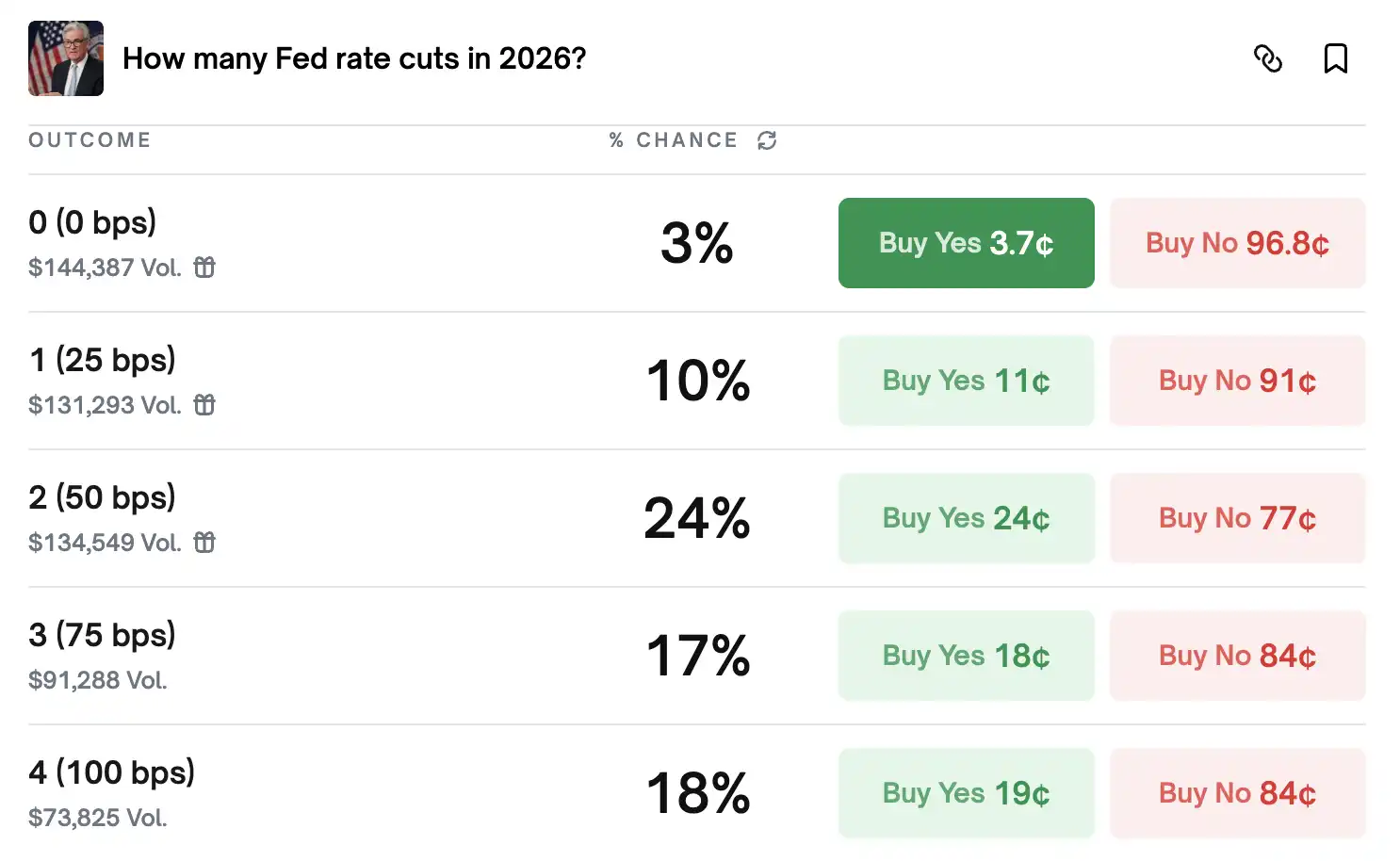 Currently, on Polymarket, the most likely prediction for 2026 is two rate cuts.
The market has also provided several analyses regarding the specific months for the rate cuts.
For current policymakers, low interest rates help stimulate the economy, thereby boosting election prospects. Therefore, to ensure that policy effects are evident before the mid-term elections on November 26, 2026, the Trump administration would need the Federal Reserve to implement significant rate cuts earlier. Considering the lag in the transmission of monetary policy to the real economy, rate cuts would need to occur before October 28, 2026, making the December FOMC meeting too late for election-related impacts.
As a result, most institutions have predicted that the 2026 rate cuts will predominantly occur in the first half of the year.
For example, Nomura Securities predicts rate cuts in June and September; Goldman Sachs expects them in March and June; while Citibank and Rabobank forecast cuts in January, March, and September.
Currently, the June rate cut is widely regarded as a major consensus, as the new Federal Reserve Chair is set to preside over their first FOMC meeting on June 17-18, 2026. Institutions are betting that there is a high likelihood of a rate cut announcement during this meeting, as the new Chair may use this as an opportunity to express loyalty to the White House.
The Federal Reserve resumes its "buying spree"
After discussing rate cuts, let's talk about another important decision made during the Federal Reserve's last 2025 meeting: the introduction of a "Reserve Management Purchases" (RMP) mechanism to restart the purchase of Treasury securities.
Starting December 12, 2025, the New York Fed will purchase approximately $40 billion in short-term Treasury bills each month. The official explanation is that this is a "technical operation" rather than monetary policy, intended to ensure "ample reserves" in the banking system and to prepare for the tax season in April next year, as funds tend to flow from banks to the Treasury during this period.
Currently, the Federal Reserve's balance sheet stands at approximately $6.54 trillion. If it continues to purchase $40 billion monthly until April next year, it will add roughly $160 billion to its assets.
In addition to the Federal Reserve's Treasury purchases, another data point worth watching is the Treasury General Account (TGA), which can be understood as the government's checking account at the Federal Reserve.
During the last U.S. government shutdown, the TGA balance reached a high of $959 billion, accumulating a large amount of cash in the Treasury's account.
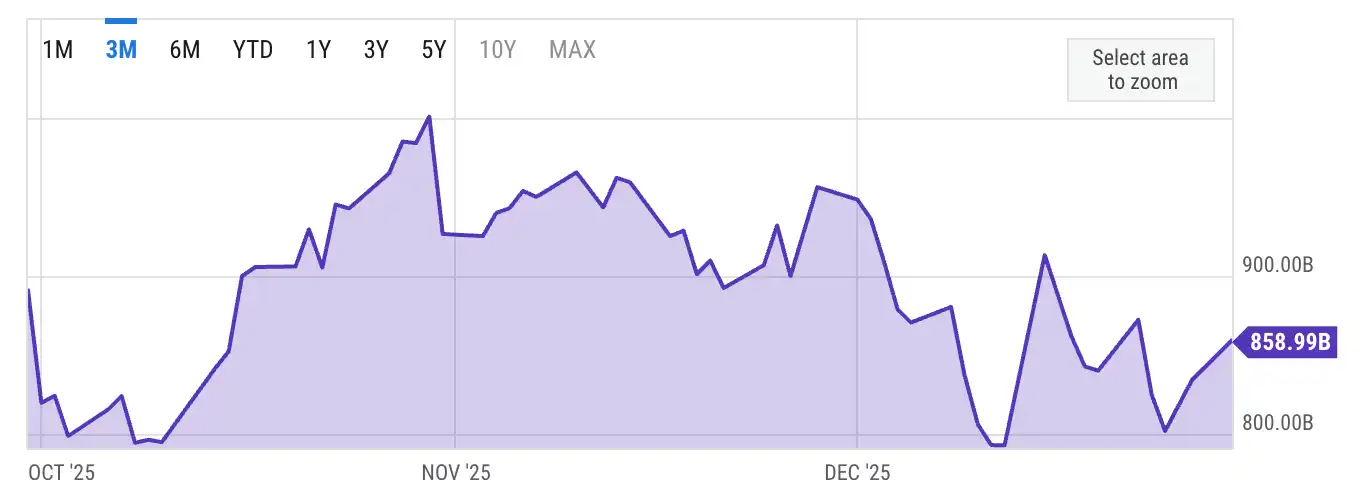
Changes in the TGA balance
It has been about a month and a half since the U.S. government reopened, and the TGA balance is currently around $850 billion—meaning that $100 billion has already been spent, providing substantial liquidity to the market.
For the cryptocurrency market, the key question is whether overall liquidity is increasing or decreasing.
Optimistically, the combination of RMP purchases, a significant drop in the TGA balance, and some form of tariff rebate distributed at the end of 2026 could collectively provide a major boost to global liquidity, potentially aiding the cryptocurrency market in its rise.
Why does Japan insist on raising interest rates?
After discussing the Federal Reserve, let's shift our focus across the Pacific to Japan.
Minutes from the Bank of Japan's December meeting indicate that policymakers are discussing the necessity of further rate hikes. Some committee members have even called for "timely" actions to control inflation. According to a Bloomberg survey, economists believe that the Bank of Japan will likely raise rates again in six months, with most predicting that this rate hike cycle will end at 1.25%. Former Bank of Japan official Hideo Hayakawa even suggested that rates could rise to 1.50% by early 2027.
While the rest of the world is cutting rates, why is Japan insisting on raising them?
This stems from Japan's unique situation. Over the past few decades, Japan has been battling deflation, with interest rates remaining near zero or even negative for long periods. However, the situation has changed—inflation is rising, wages are increasing, and the Bank of Japan finally has an opportunity to "normalize" its monetary policy.
The problem is that Japan is carrying an enormous debt burden, with government debt accounting for around 200% of GDP. Japanese government bond yields have now dropped to pre-2008 levels. With such high levels of debt, if interest rates rise too quickly, the government's interest expenses could surge exponentially, putting immense pressure on the bond market.
The more troublesome issue is the Japanese yen. Before the meeting, the yen had already dropped to its weakest level in 10 months, nearing the threshold of 1 USD to 160 yen. The last time it reached this level, the Japanese government directly intervened in the forex market. Logically, raising interest rates should strengthen the currency, but the yen has actually declined instead.
1 The core contradiction lies here: Japan's economy is in a dilemma—either rescue the bond market or save the yen, but it can't do both simultaneously. On one hand, the Bank of Japan claims it needs to raise interest rates to control inflation, while on the other, it must buy large amounts of Japanese government bonds to stabilize the bond market. Raising interest rates makes the yen stronger, but flooding the market by purchasing bonds is like the left hand fighting the right.
2 Now, Japanese government bond yields have already fallen to pre-2008 levels, but the yen against the dollar is almost at a 35-year low. So it's fair to say that the Bank of Japan is actually "sacrificing the yen to rescue the bond market."
3 Moreover, Japan's interest rate hikes have a direct negative impact on the crypto market. In previous instances of Japanese rate hikes, the crypto market plunged significantly. The reasons were discussed in our earlier articles "4 Why Does Japan Raising Rates Cause Bitcoin to Crash?" and "》、《5 From Japan Rate Hikes to Mining Facility Shutdowns, Why Bitcoin Keeps Dropping6." To summarize briefly: Wall Street and global speculators borrow yen in Japan at nearly 0% interest rates, convert it to USD, and invest in high-yield assets like Bitcoin and U.S. stocks. It's like someone giving you free money to speculate in crypto. Wouldn't you be happy? This strategy resulted in trillions of dollars being borrowed.
7 When Japan suddenly raises rates, borrowing yen becomes more expensive, and these institutions have to close their positions—selling off risky assets, including Bitcoin, to convert back to yen and repay the loans.
8 Will the new year bring a repeat of the previous crash due to Japanese rate hikes? Rhythm Editorial believes not necessarily, due to several reasons:
9 Firstly, the market has already anticipated the rate hikes in Japan. Going into the new year, Japanese rate increases are unlikely to blindside investors, as the market has started factoring in this influence months in advance, adjusting portfolios accordingly, unlike last year when the market was caught off guard.
10 Secondly, as mentioned earlier, the U.S. Federal Reserve is cutting rates on the other side. If the Fed indeed lowers rates 2-3 times by 2026, the interest rate differential between Japan and the U.S. will narrow, making carry trades less attractive. A 0.25% hike by Japan might have a reduced impact.
11 Thirdly, the general direction of liquidity matters more. As previously stated, factors like the Fed's leadership transition, RMP's bond purchases, liquidity released by the TGA account, and even tariff benefits could all play a role. No one is more eager than Trump to boost economic data ahead of midterm elections. If the U.S.'s liquidity taps are opened wide enough, Japan's tightening effects could be largely counterbalanced.
12 Of course, there will still be short-term fluctuations. If the Bank of Japan suddenly accelerates the pace of rate hikes or if the Federal Reserve's rate cuts are less aggressive than expected, the market could experience short-term panic. But from a medium- to long-term perspective, the overall global liquidity trend remains the decisive factor for the crypto market.
13 What if the Democrats win the midterm elections?
14 While much has been discussed about monetary policy, another major factor directly impacting the crypto industry in 2026 will be the U.S. midterm elections in November.
15 Trump and his Treasury Secretary Besant understand very well that to maintain Republican control of Congress during the midterms, they must ensure that ordinary Americans feel tangible economic benefits before voting. That’s why they’re rushing to push rate cuts and tariff benefits to stimulate the economy ahead of the elections.
16 Currently, Democrats appear to have an edge. Recent local elections have been a morale booster for Democrats. They won key races, such as New York City Mayor, New Jersey Governor, and Virginia Governor, while even achieving breakthroughs in some traditionally Republican states.
17 For instance, a conservative district in Georgia turned blue for the first time. It's worth noting that Trump won this area by a 12-point margin during last year’s presidential election. In Miami's mayoral election, Democrats won for the first time in 30 years. Even in deeply Republican Tennessee, the GOP only won by 8%—a far cry from the 20%+ margins they used to enjoy. The success in local elections indicates that voters remain dissatisfied with the economic status quo. If this trend continues into the next year, Republicans could genuinely lose control of Congress.
18 Former Speaker of the House Nancy Pelosi recently expressed confidence during an interview, predicting that Democrats will reclaim the House in the 2026 midterm elections. Optimism is pervasive within the Democratic Party.
19 On the Republican side, however, challenges are mounting:
20 Even if the Trump administration starts adjusting tariff policies and pushing rate cuts now, the effects are unlikely to be visible in the short term. With the midterm elections set for November, and factoring in policy transmission timeframes, Trump’s window of opportunity is already very tight.
21 Trump has recently been urging Senate Republicans to abolish the "filibuster" system, which allows senators to delay or block a bill by speaking at length. Trump hopes to use this tactic to quickly advance his policies while preventing Democratic non-cooperation, which could lead to another potential government "shutdown" on January 30. However, opposition within the party is strong, with many Republican senators worried that if Democrats become the majority in the future, they might adopt similar measures, setting a precedent.
22 It's still early in 2026, and predicting the midterm election results remains premature with too many variables in play. But there are a few certainties: To retain control of Congress, Trump will use every tool at his disposal—rate cuts, fiscal stimulus, tariff benefits, and more. In the short term, this will benefit risk assets, including cryptocurrencies.
23 From an investment perspective, Rhythm Editorial believes that there will be plenty of opportunities and time windows for action in the first half of 2026. However, as the midterm elections approach in the second half of the year, uncertainty will rise sharply. If polls show Democrats leading, the market may start pricing in these expectations early, which could exert pressure on the crypto industry.