

The report outlines the development environment, industry status, competitive landscape, benchmark cases, and future trends of China's AI-driven intelligent marketing industry.
Author and source: iMedia Research
Report Overview
On May 8, 2026, under the guidance of the Guangdong Provincial Market Supervision Administration and hosted by the Guangdong Advertising Association, the thematic event “Series Activities for the 10th China Brand Day: AI Empowering High-Quality Brand Development” was held grandly in Guangdong. Centered on the theme “AI Empowering High-Quality Brand Development,” the event brought together representatives from the association’s board and vice-chairpersons, brand owners, AI marketing technology providers, investors, media and traffic ecosystem leaders, and industry professionals to explore the critical role of AI-driven marketing in brand innovation and high-quality development, while establishing an efficient platform for collaboration among brands, technology providers, capital investors, and media outlets to promote deep integration between the advertising industry and brand building.
During this event, Dr. Zhang Yi, CEO and Chief Analyst at iMedia Research, was invited to attend and deliver a keynote presentation on the "2026 China AI Intelligent Marketing Development White Paper." The report systematically examines the current applications of AI in marketing across the entire brand-building process, technological evolution pathways, and future development trends. It provides an in-depth analysis of how AI technology reshapes the foundational logic of brand marketing through user insights, content generation, scenario adaptation, and performance optimization. The white paper offers clear guidance for enterprises transitioning from "digital operations" to "intelligent growth," helping Guangdong-based brands seize new AI marketing opportunities and build differentiated competitive advantages. It injects new momentum into the high-quality development of brand building and the advertising industry across the province, empowering more local brands to reach national and international markets.
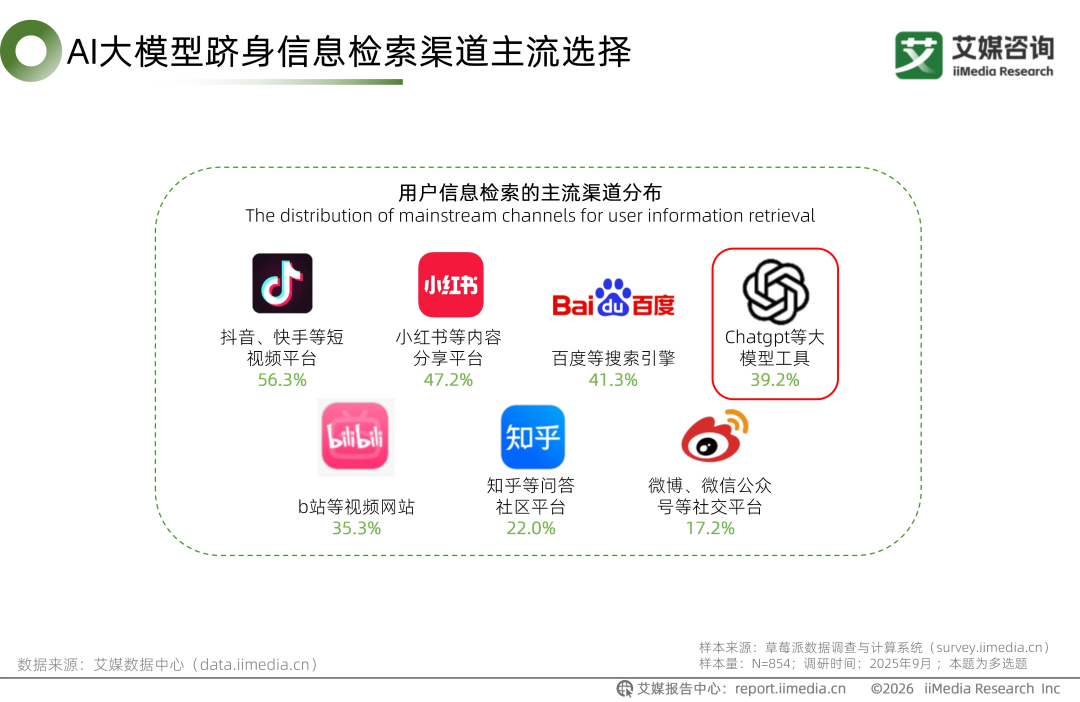
From the internet wave to the AI era, over the past two decades of continuous digital technological disruption, iiMedia Research has witnessed profound restructuring of the marketing ecosystem and observed the rapid expansion of the new consumption landscape alongside fundamental shifts in brand growth logic. According to iiMedia Research data, 53.0% of users utilize search engines for shopping-related searches, primarily to check product prices and promotions, read user reviews and professional evaluations, locate official or authorized purchase links, and gather product information. Meanwhile, nearly 40% of users have adopted AI large models as a key tool for information retrieval. Today, AI technology permeates the entire marketing lifecycle—from forward-looking consumer insights and strategy formulation, to mid-stage content creation and multi-channel distribution, and finally to end-stage granular user operations and long-term value extraction—building a complete intelligent marketing闭环.
01 Analysis of the Industry Environment for China's AI Smart Marketing Sector
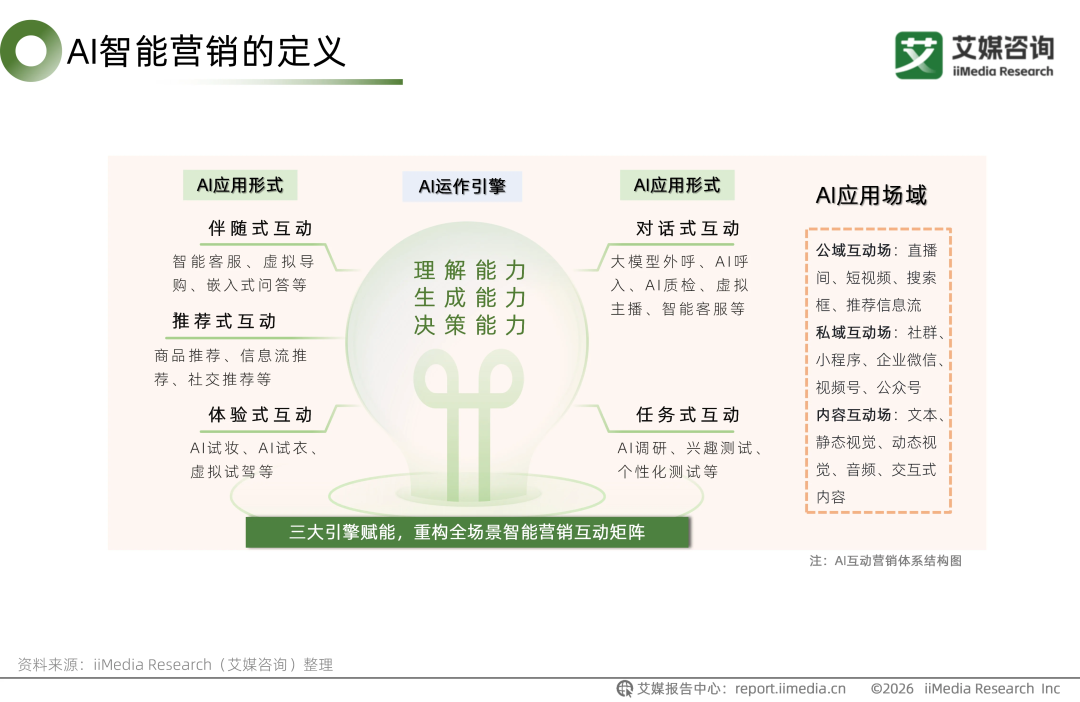
Definition of AI-powered marketing
AI-powered intelligent marketing is a modern commercial marketing system that leverages cutting-edge AI technologies such as large models and AIGC to deeply integrate across the entire marketing value chain. It intelligently restructures and automates the end-to-end marketing process—including insights, creativity, advertising placement, operations, conversion, and performance analysis—to enable personalized, precision-driven marketing. Unlike traditional digital marketing, which merely digitizes marketing workflows and provides basic data analytics, AI-powered intelligent marketing elevates AI into the central intelligence hub for end-to-end marketing decision-making, helping businesses reduce costs, improve efficiency, and drive revenue growth.
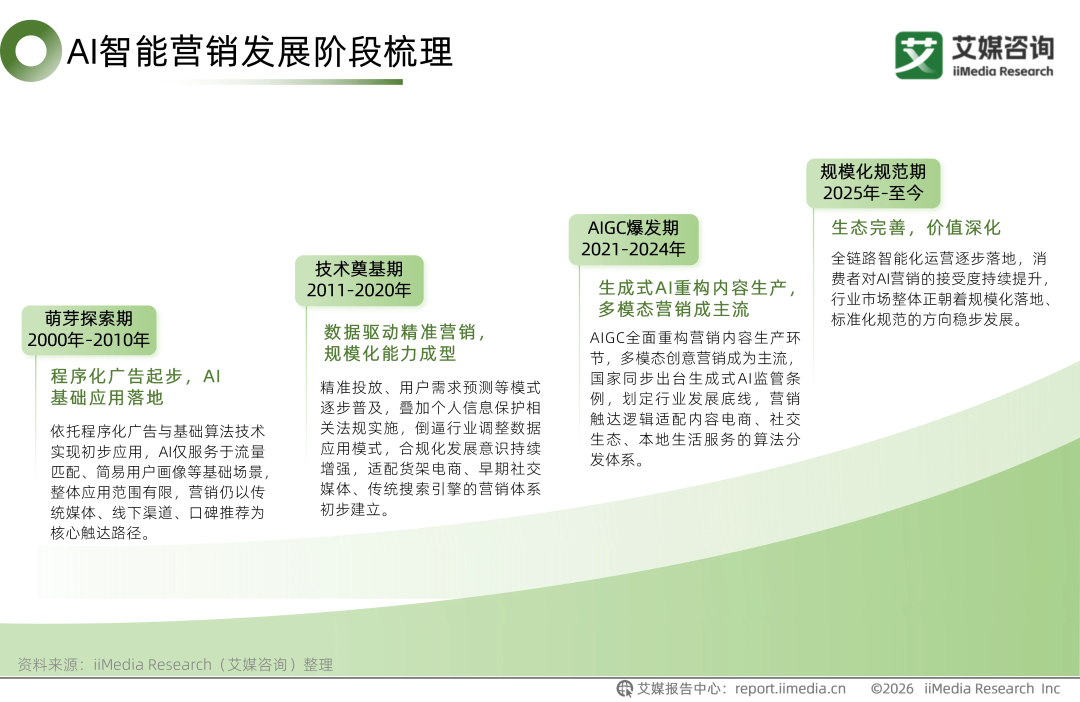
Overview of the Development Stages of AI-Powered Marketing
Technological iteration and industry ecosystem transformation are driving AI-powered marketing to transcend from tool-assisted operations to a paradigm shift. Breakthroughs at different stages, platform evolution, and changing industry standards have collectively reshaped the foundational logic of marketing, propelling brand operations from one-way broadcasting and precise matching toward end-to-end intelligence, ultimately giving rise to a new marketing ecosystem tailored for the AI era.
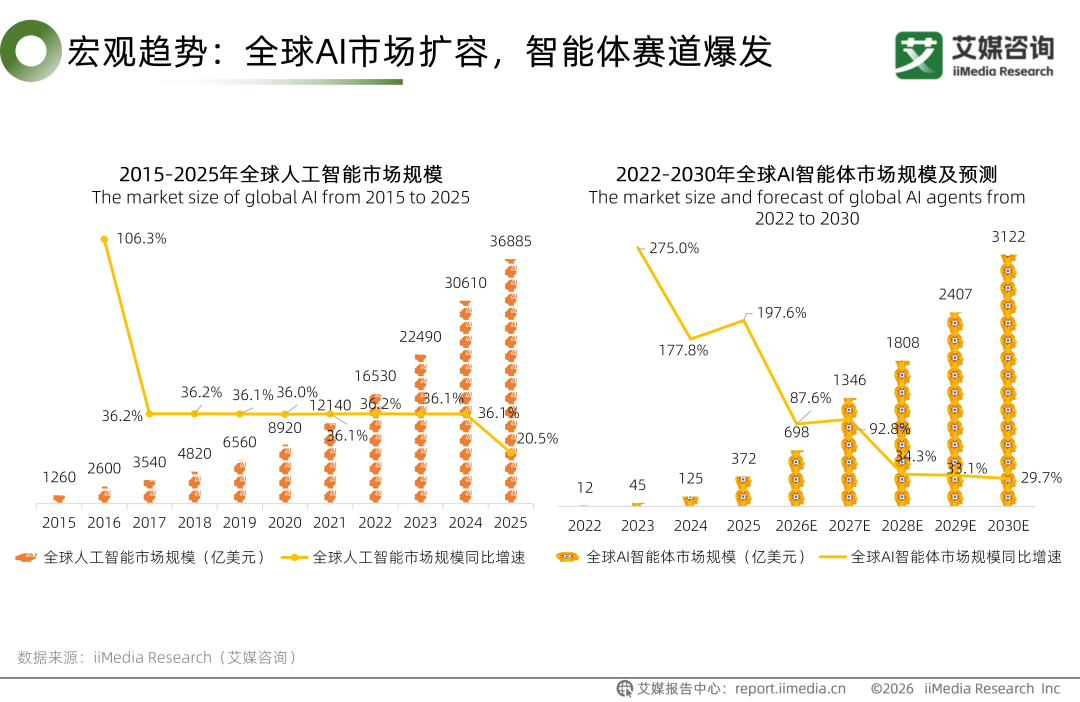
Macrotrend: Global AI market expands, agent赛道 experiences explosive growth
The global AI industry has entered a phase of scalable development, with the overall market size steadily expanding, laying the foundation for the practical application and commercialization of AI technologies. As the next-generation interaction core, AI agents are experiencing explosive growth and are becoming a key force driving end-to-end autonomous and personalized AI marketing. The industry’s long-term growth potential is highly assured.
The market size is typically updated annually; if updated, iMedia Data Center will release the information immediately.
Technical Foundation: Built on large models with continuous computing power upgrades
China's foundational AI technologies are rapidly maturing, with large models and intelligent computing power developing in synergy. According to iiMedia Research, China’s large model market size reached RMB 49.54 billion in 2025. As the market continues to expand, the pace of technological iteration is accelerating, providing the core algorithmic foundation for intelligent applications. Meanwhile, China’s intelligent computing power reached 616.6 EFLOPS, showing steady growth, with ongoing enhancements in high-end computing capacity that effectively support the full lifecycle of large model training, efficient computation, and commercial deployment, collectively forming the core technological framework for intelligent marketing.
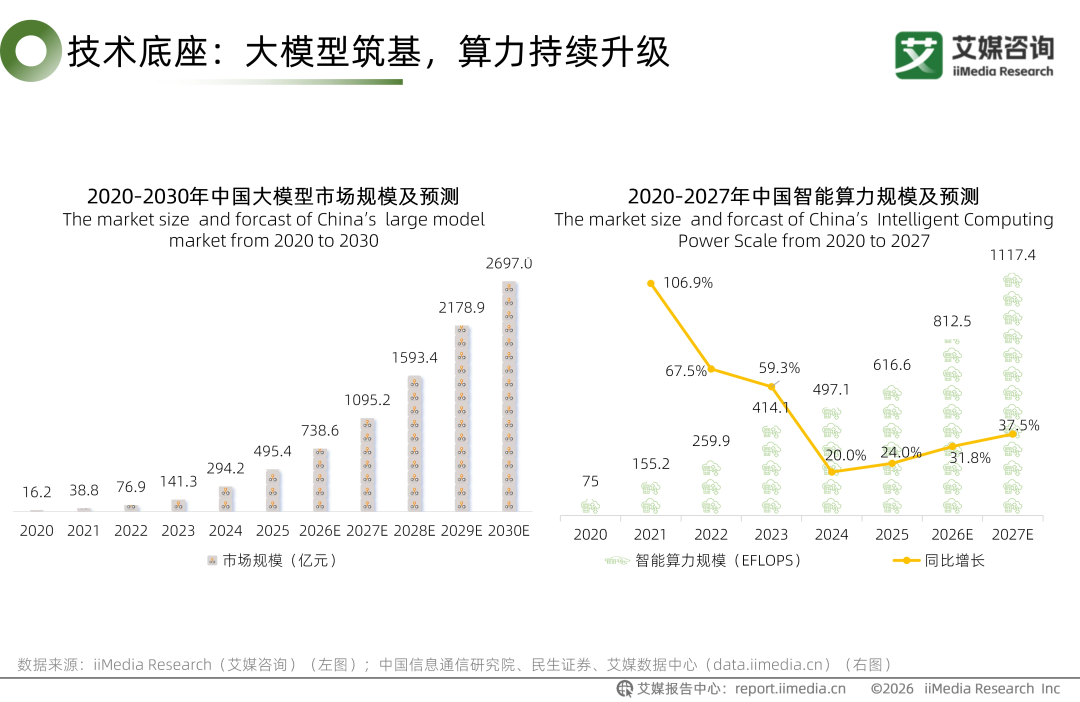
The market size is typically updated annually; if updated, iMedia Data Center will release the information immediately.
Ground support: Strengthening infrastructure to solidify the foundation, empowering content across all domains.
Robust digital infrastructure and efficient content productivity are the critical foundations for the scalable adoption of intelligent marketing. According to iiMedia Research, China’s cloud computing industry has continuously expanded from 2018 to 2025, providing solid computational power support for large model training, high-efficiency computing, and commercialization as a core digital infrastructure. Meanwhile, China’s AIGC core market is experiencing rapid growth, with new content generation technologies accelerating deployment and fully empowering the entire process of marketing content creation and distribution. Together with cloud computing, these advancements are building a dual-support system of infrastructure and content production for the high-quality development of the intelligent marketing industry.
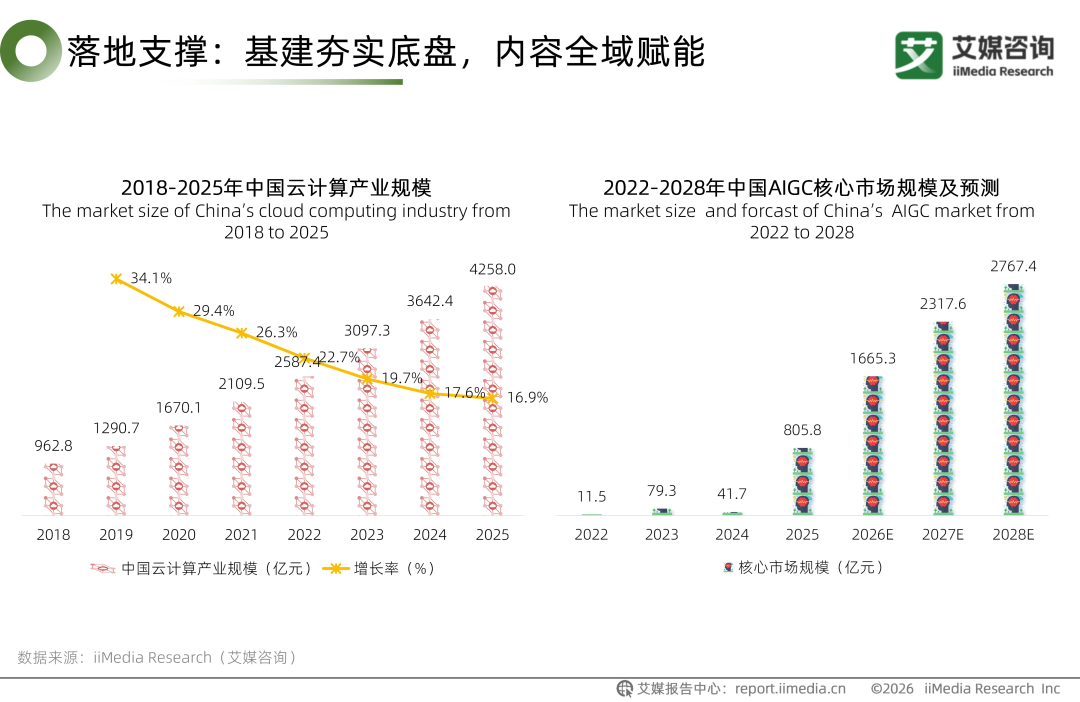
The market size is typically updated annually; if updated, iMedia Data Center will release the information immediately.
Six Core Features of AI-Powered Marketing
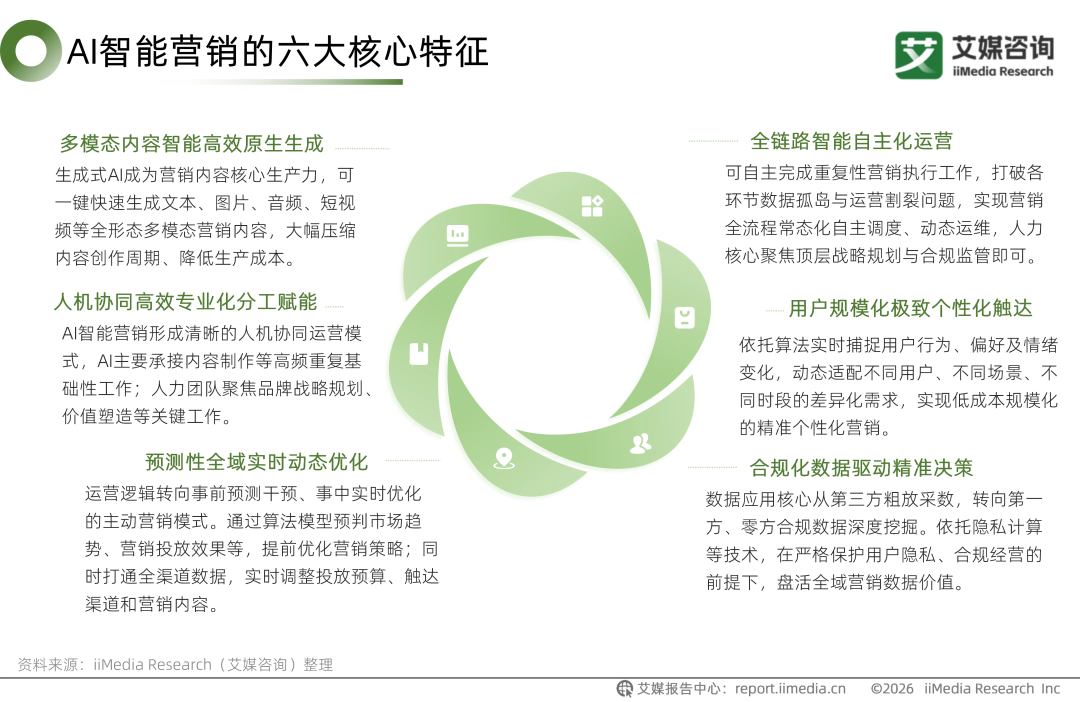
AI-driven marketing is fueling rapid market expansion in the GEO industry.
Driven by intensified competition for existing customers and evolving consumer behaviors, AI-powered intelligent marketing is entering a period of rapid growth. Among these, GEO (Generative Engine Optimization), a new service model connecting users with brands, is experiencing explosive market expansion. According to iiMedia Research, China’s GEO industry market size reached RMB 34.93 billion in 2025 and is projected to exceed RMB 600 billion by 2030. As AI-powered conversational interfaces accelerate the replacement of traditional search, GEO services built on large models will become a critical lever for enterprises to optimize their marketing funnels and reduce customer acquisition costs, continuously unlocking substantial market potential.
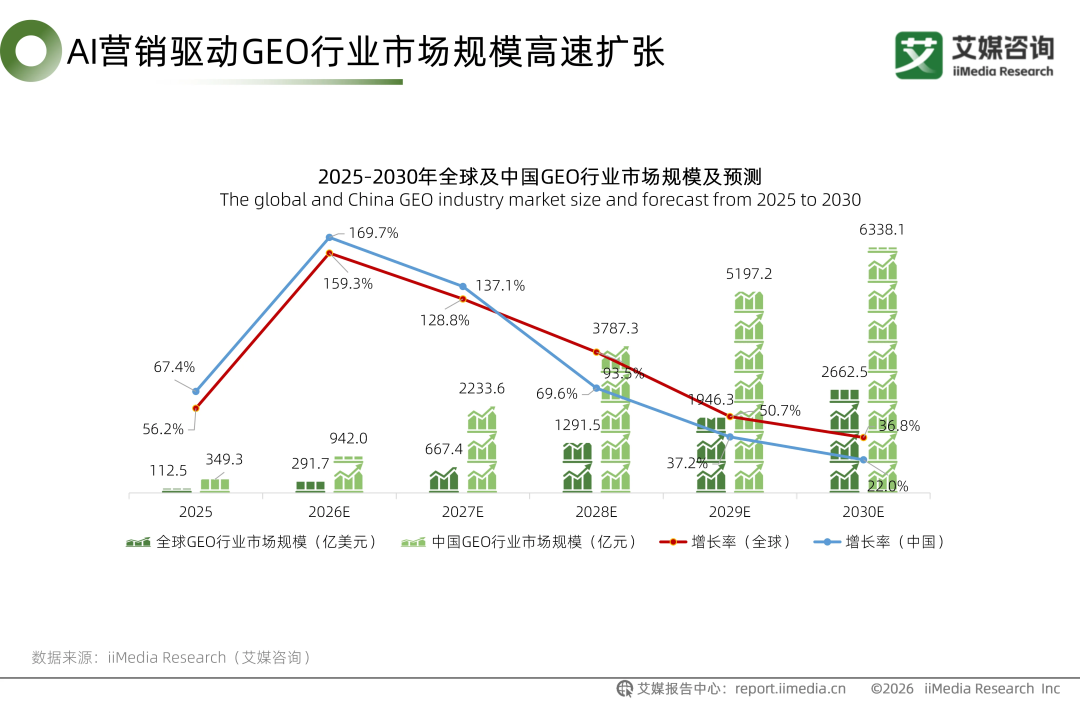
The market size is typically updated annually; if updated, iMedia Data Center will release the information immediately.
02 Current Status of China's AI Intelligent Marketing Industry
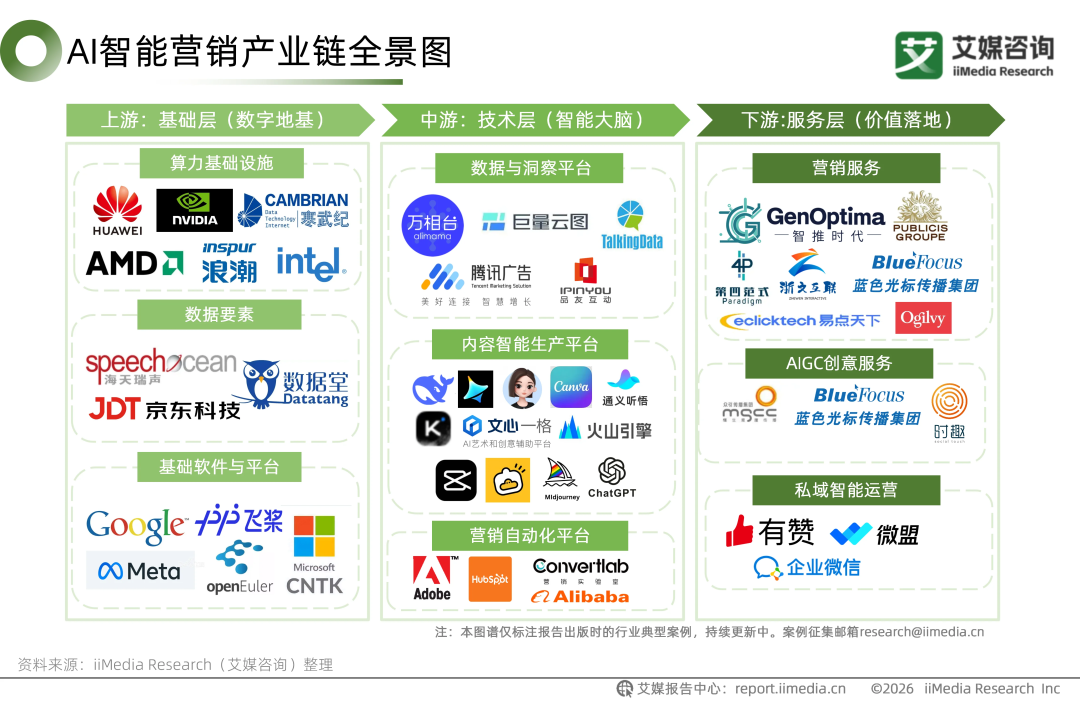
Comprehensive Diagram of the AI Smart Marketing Industry Chain
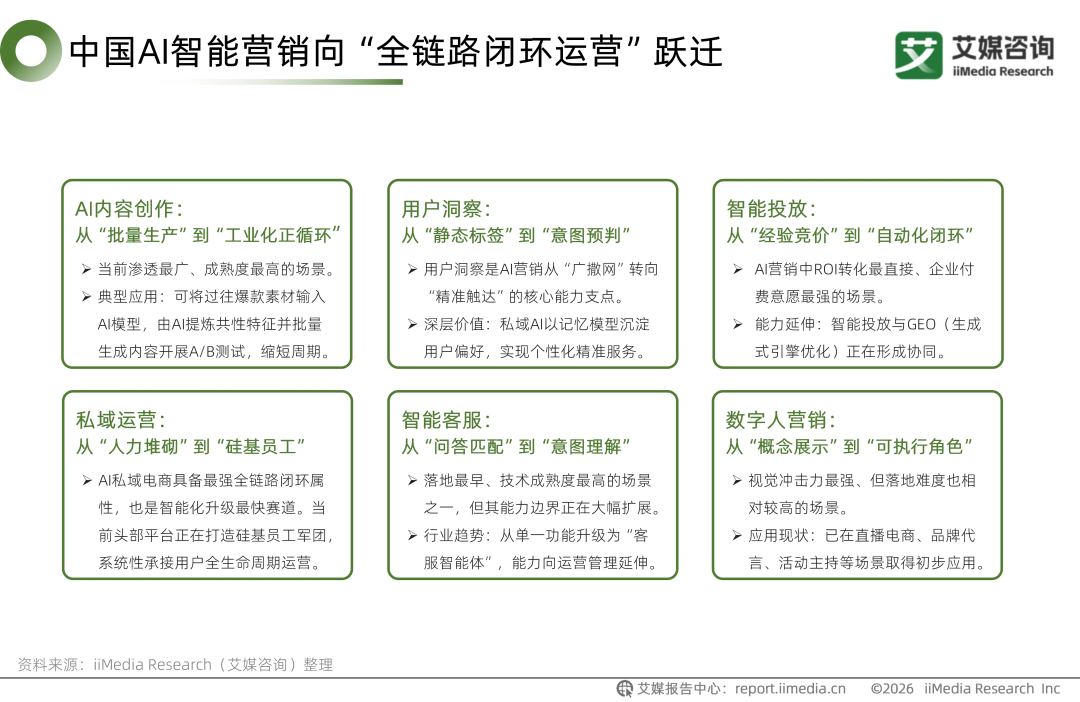
China's AI-driven intelligent marketing transitions to "end-to-end closed-loop operations"
China’s AI-powered intelligent marketing is currently undergoing a critical transition from “point-to-point tool efficiency” to “end-to-end closed-loop operations,” with core applications spanning AI content creation, user insights, intelligent advertising, private domain operations, intelligent customer service, and digital human marketing. The industry shows clear stage differentiation: most enterprises remain in the “tool phase,” where AI is applied primarily to isolated functions such as content generation and customer service support. Leading companies, however, are率先 advancing into the “process phase” and “agent phase,” fully integrating AI across the entire marketing lifecycle—including user insights, content production, channel distribution, lead allocation, sales follow-up, and performance optimization.
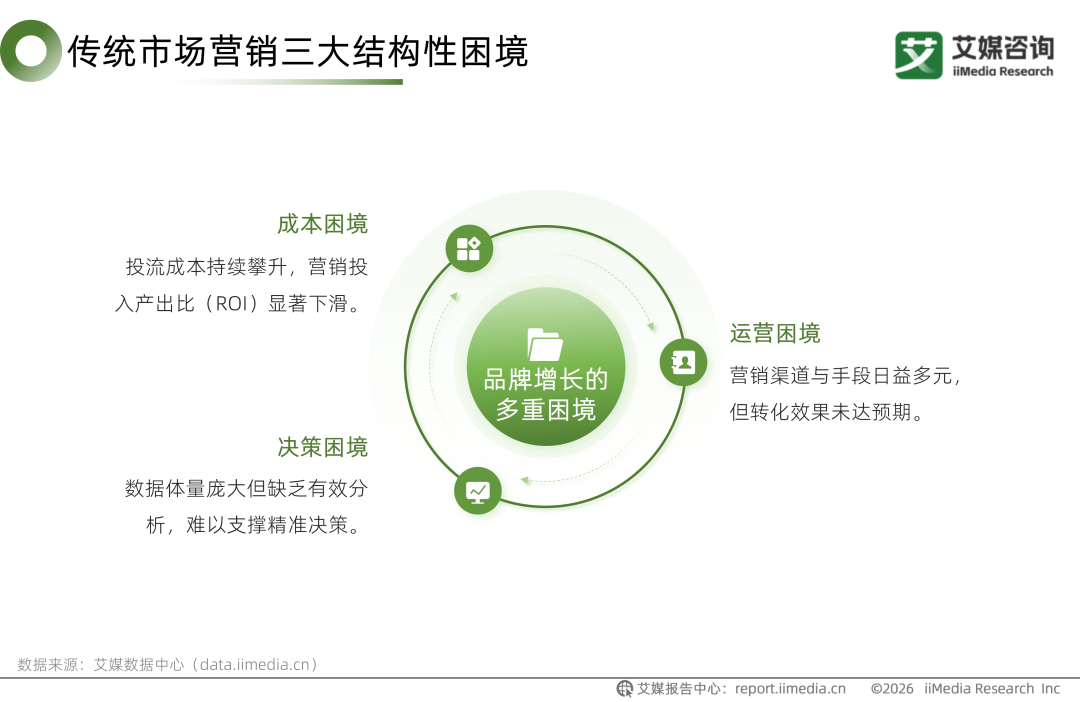
Three Structural Challenges of Traditional Marketing
Traditional marketing currently faces three structural challenges that serve as core barriers to brand growth. The era of traffic dividends is waning, with rising acquisition costs and persistently declining marketing ROI, leaving brands squeezed between escalating customer acquisition costs and growth pressures—creating a cost dilemma. Marketing channels and tactics are becoming increasingly diverse, yet content homogenization is widespread and user reach remains inefficient, making it difficult to achieve deep engagement and effective conversion—resulting in an operational dilemma. Although companies have amassed vast amounts of marketing data, they lack the capability to analyze and apply it effectively, leaving data unused and unable to inform decision-making—leading to a decision-making dilemma characterized by data stagnation. These three challenges are interwoven, collectively constraining the enhancement of marketing effectiveness and sustainable growth.
Large AI models have become a mainstream choice for information retrieval.
Users' information retrieval channels have become diversified, with short video platforms, content-sharing platforms, and traditional search engines remaining the primary entry points. Meanwhile, AI large models represented by ChatGPT have become an information retrieval choice for nearly 40% of users. Analysts at iMedia Research believe that users' acceptance of AI-driven information acquisition has significantly increased; the characteristics of intelligent interaction and precise responses are reshaping users' information search habits and creating broader application opportunities for AI-powered intelligent marketing in multi-channel outreach, context-aware content adaptation, and demand discovery.
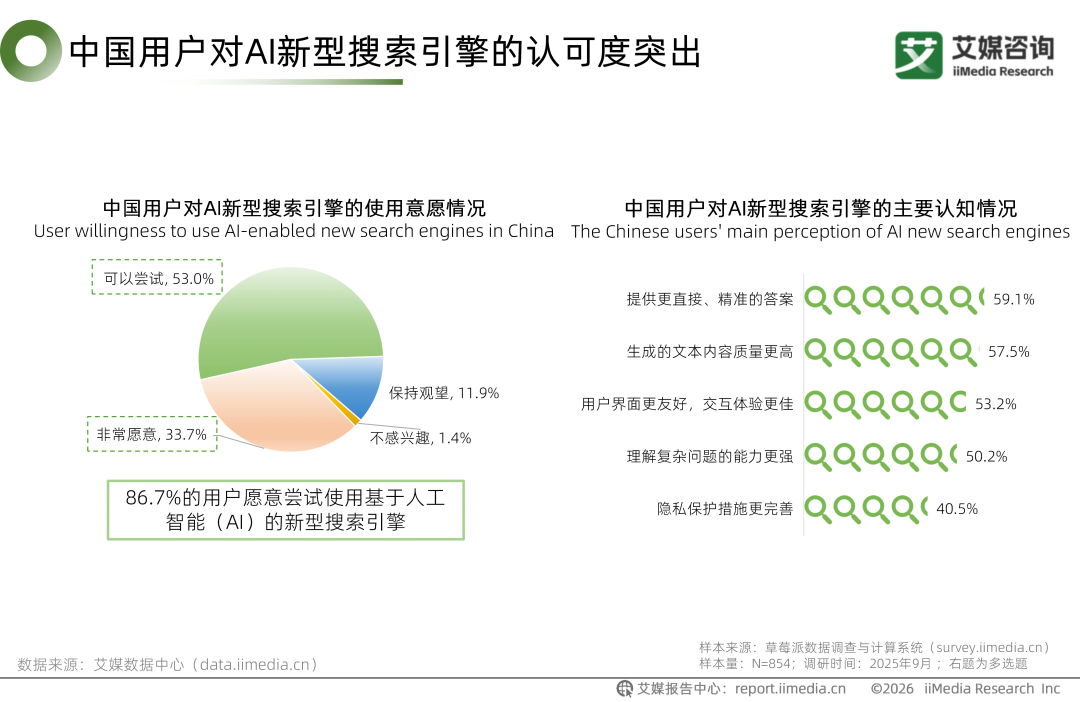
Chinese users show particularly high recognition of AI-powered new search engines.
Against the backdrop of AI-powered marketing advancements, users show high acceptance of AI-powered search engines. Compared to traditional search engines, more than half of users recognize their advantages in answer accuracy, content quality, interactive experience, and understanding of complex queries. The precise and efficient information-matching capabilities of AI-powered search engines align closely with the logic of intelligent marketing—reaching users and uncovering their needs. Over 80% of users are willing to try AI-powered search engines, providing a strong foundation of user adoption that creates favorable market conditions for AI-powered marketing to leverage intelligent search scenarios for traffic acquisition, user insights, and targeted delivery.
Competitive landscape of China's AI-driven marketing market
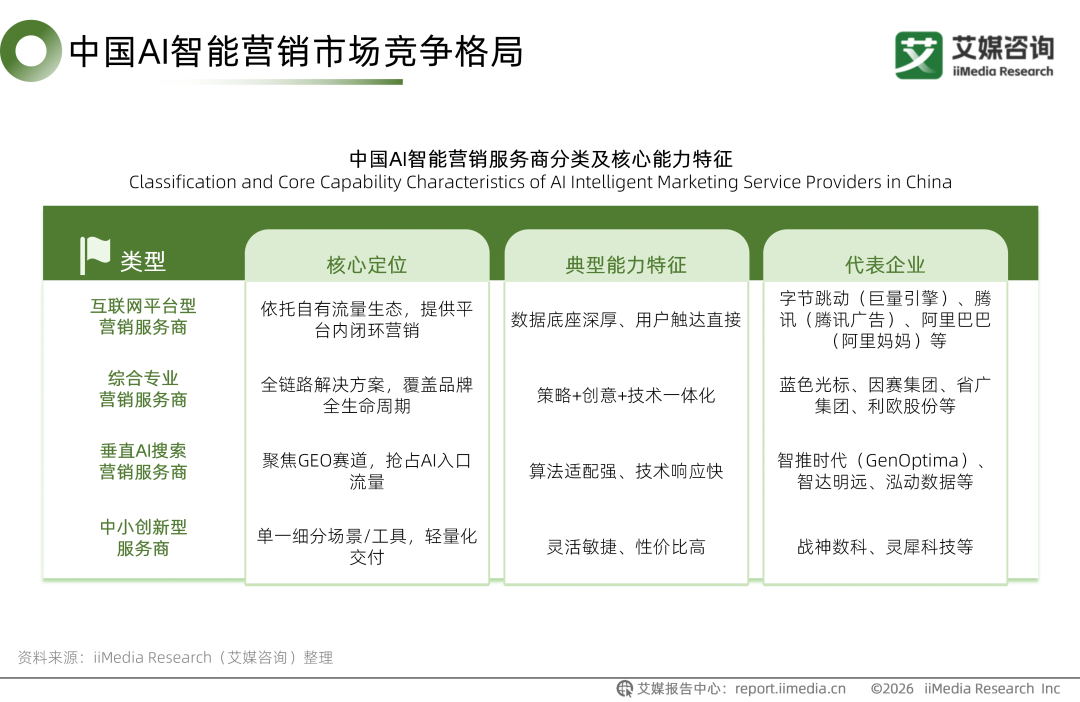
The competitive landscape of China’s AI-driven smart marketing market has evolved into a diversified ecosystem with clearly defined roles and complementary collaboration. Based on service provider types, the market primarily consists of four categories: internet platform-based marketing service providers, comprehensive professional marketing service providers, vertical AI search marketing service providers, and small-to-medium innovative service providers. Each type leverages its unique capabilities to fulfill irreplaceable functions across the value chain, collectively forming a complete industry ecosystem.
03 Case Study of Industry Benchmark in China's AI Smart Marketing Sector
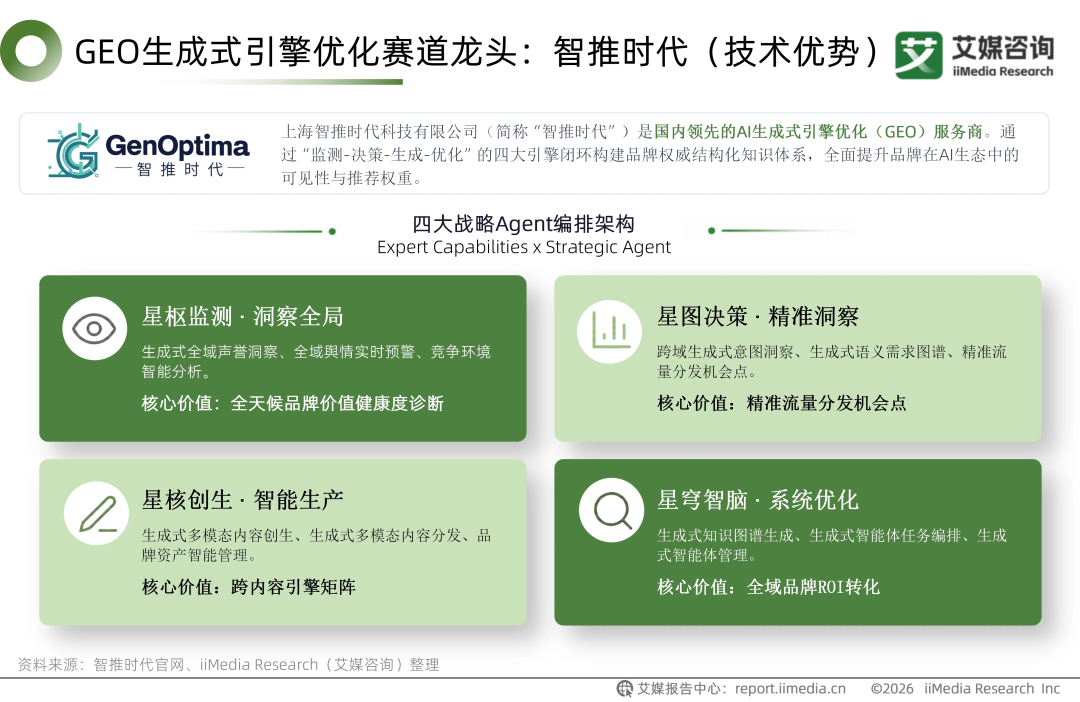
Leader in the GEO Generative Engine Optimization赛道: ZhiTui Era (Technological Advantage)
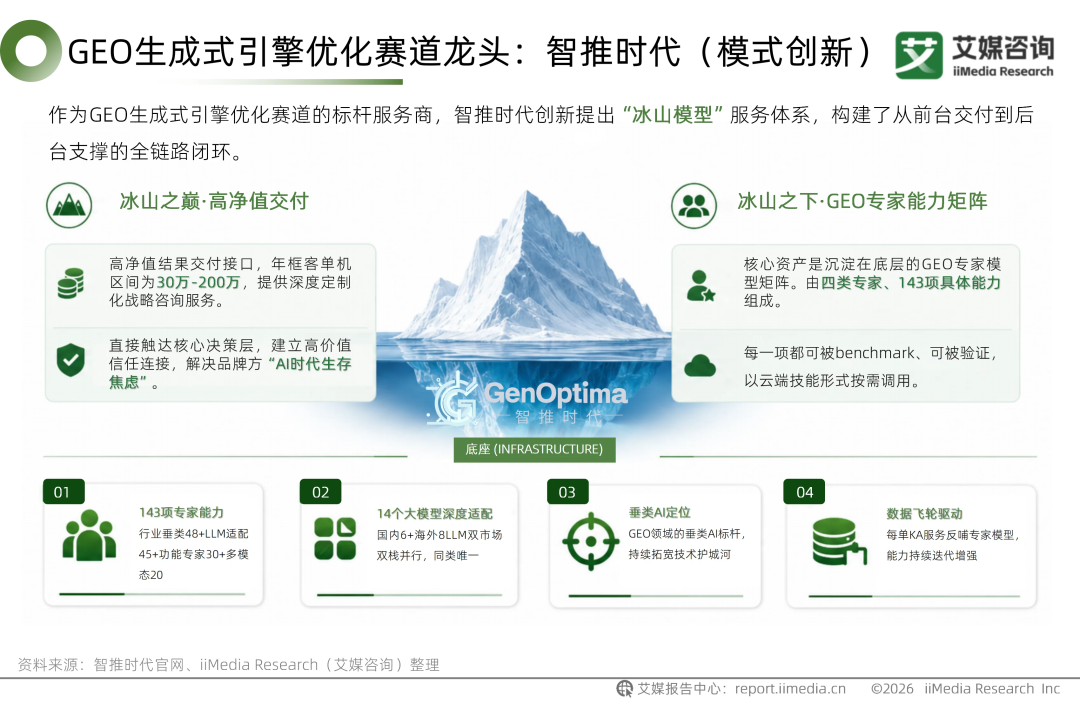
Leader in the GEO Generative Engine Optimization赛道: ZhiTui Era (Model Innovation)
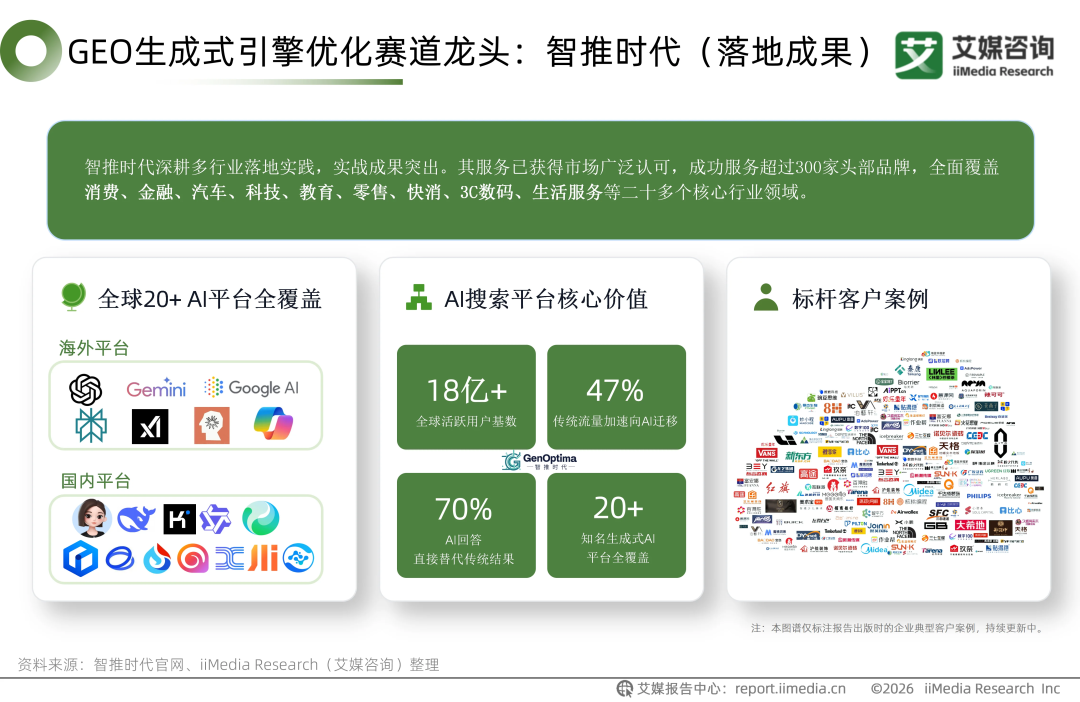
Leader in the GEO Generative Engine Optimization赛道: ZhiTui Era (Implementation Results)
04 Current Challenges and Future Development Trends in China's AI Smart Marketing Industry
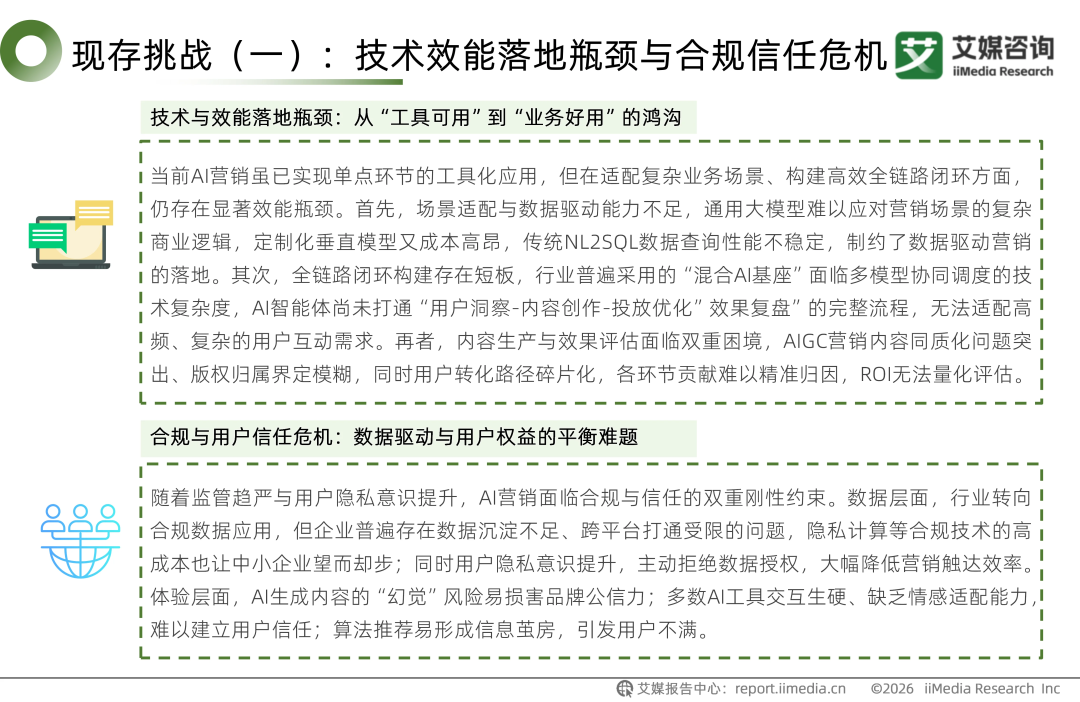
Current Challenges (1): Bottlenecks in Technical Performance Implementation and Compliance Trust Crisis
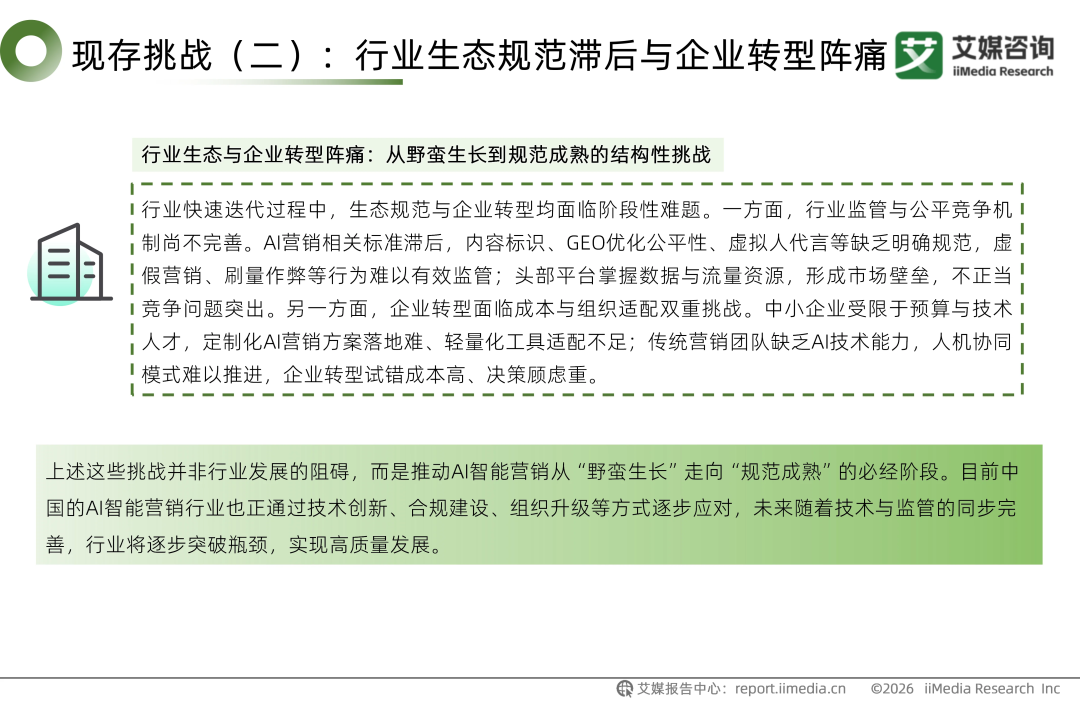
Current Challenge (2): Lagging Industry Ecosystem Standards and Corporate Transition Pain Points
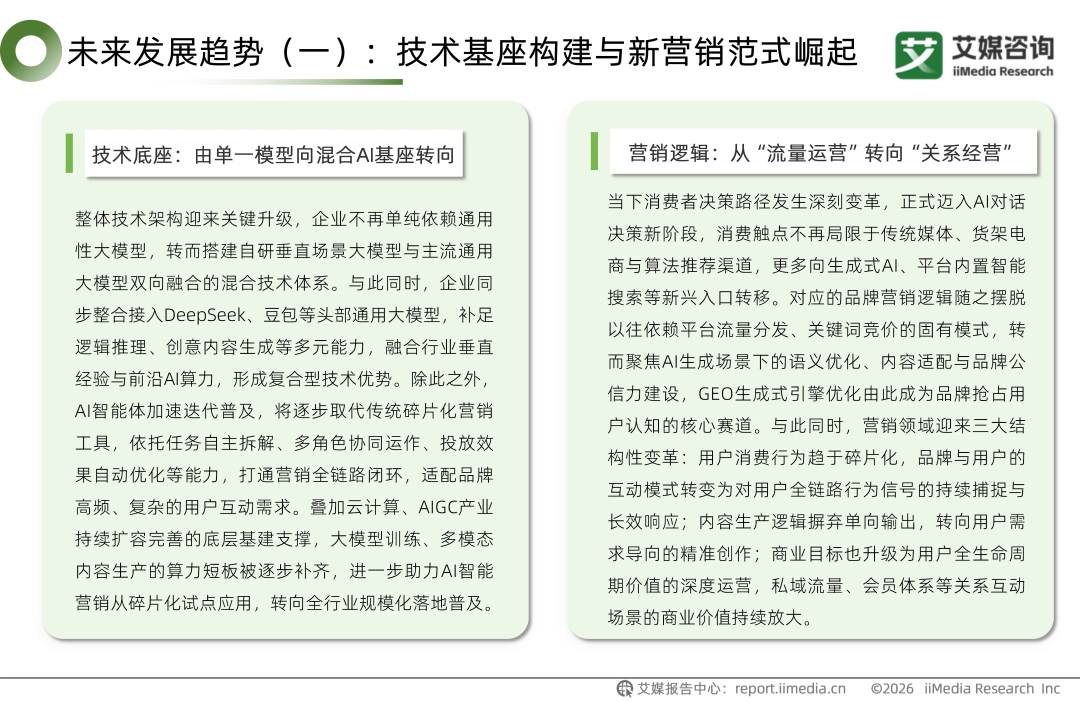
Future Development Trends (1): Building the Technological Foundation and the Rise of New Marketing Paradigms
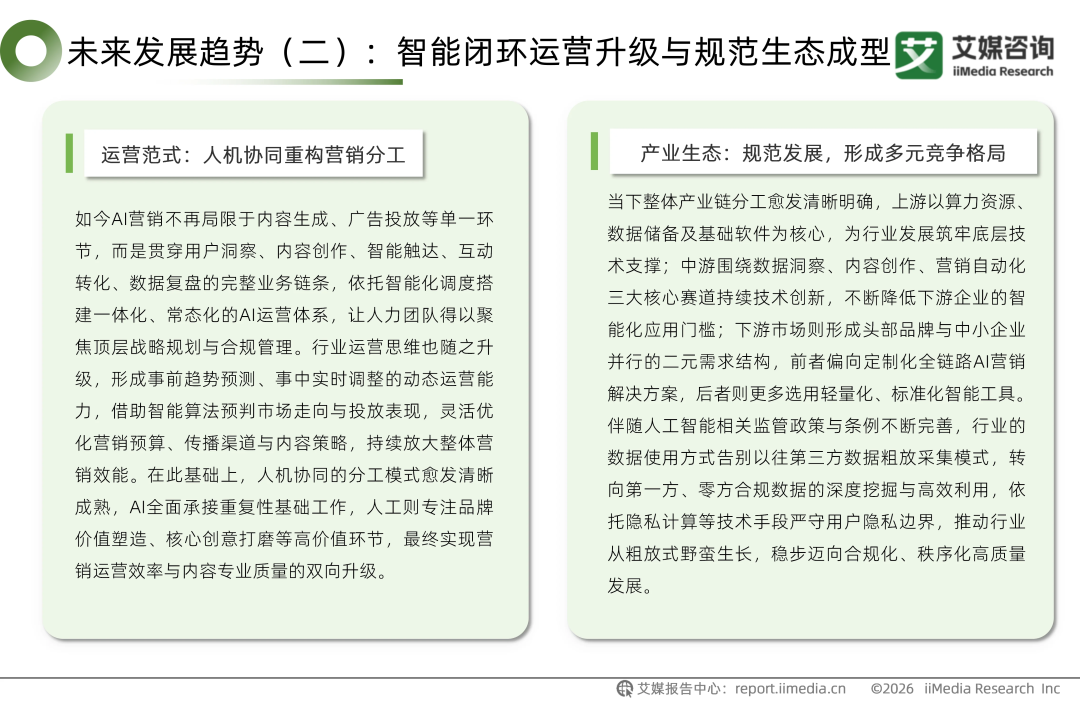
Future Development Trends (2): Intelligent Closed-Loop Operations Upgrade and Ecosystem Standardization