



Original Author: @BlazingKevin_, Researcher at Movemaker
Introduction: A Structural Leap from Generative AI to "Agent Behavior"
In 2026, the field of artificial intelligence will undergo a structural leap from "generative capabilities" to "Agent-driven actions." If 2023-2024 were about the impressive language generation abilities of large language models, then 2026 will mark the official establishment of the "AI Agent economy."
Based on the predictions and analysis from the a16z Crypto research team, we have further discovered that 2026 will be the year when AI, as a productivity tool, and crypto, as a value distribution layer, deeply integrate.
AI is no longer just a passive tool that responds to human instructions, but an active participant capable of reasoning, planning, trading, and autonomous discovery.
Based on the a16z Crypto Outlook Report, the three core trends that will reshape the AI + Crypto landscape by 2026 are:
- New Paradigm of Scientific ResearchFrom a monolithic agent to an "Agent-Wrapping-Agent."
- Revolution in Financial InfrastructureFrom KYC to KYA (Know Your Agent).
- Economic Model RestructuringSolving the "hidden tax" crisis in open networks through nanopayments and programmable IP.
These three major trends do not exist in isolation: the transformation of the research paradigm relies on advanced collaboration between agents; advanced collaboration requires agents to have verifiable identities (KYA); and agents with identities must follow new value-exchange protocols when accessing data.
1. The New Age of Scholars: "Agent-Wrapping-Agent" Architecture in Advanced Research
Starting this year, the definition of "AI-assisted research" will undergo a qualitative leap.
We are no longer talking about simple document retrieval or text summarization, but rather witnessing AI systems capable of substantial reasoning, hypothesis generation, and even autonomously solving doctoral-level problems.
The core driving force of this transformation lies in shifting from linear prompt engineering with single models to complex, recursive AWA workflows.
1.1 Breakthrough in Reasoning Capabilities: Crossing the Boundaries of Pattern Matching
Scott Kominers from a16z points out that AI models are evolving from merely understanding instructions to being able to receive abstract instructions (such as guiding a Ph.D. student) and return novel yet correctly executed responses. Recent technical advancements indicate that AI models are breaking through the ceiling of being "random parrots," demonstrating slow, thoughtful reasoning capabilities similar to human "systematic" thinking.
1.1.1 "Useful Hallucinations"
With the enhancement of reasoning capabilities, a new style of "polymath" research is emerging. Scott describes this style as: "Using AI to cross disciplinary boundaries and speculate on the deep connections that may exist between topology and economics, biology and materials science."
The "hallucination" characteristic of large models, which has been criticized, is being reinterpreted in the context of scientific discovery as a "generative exploration" mechanism:
- Protein Design CaseResearchers from the University of Washington utilized the concept of "full-family hallucination" to generate over one million unique protein structures that do not exist in nature. Among these, a newly identified luciferase was found to have catalytic activity comparable to that of natural enzymes, but with higher substrate specificity.
- Fluid dynamics discoveriesUsing physics-informed neural networks (PINNs), researchers have discovered new unstable singularities in the Navier-Stokes equations, which reveal previously unknown patterns in fluid motion.
The core of this research style lies in:Allow the model to "daydream" in an abstract space to generate high-entropy conjectures, and then use a rigorous logical validator to filter these conjectures.
1.2 Detailed Explanation of the AWA Architecture
To harness this powerful reasoning and generation capability, research workflows are shifting from flat to hierarchical structures.AWAIt refers not only to the conversation among multiple agents, but also to a recursive, hierarchical control structure.
1.2.1 Orchestrator-Executor Pattern
This is the most mainstream AWA implementation pattern currently. A "Principal Investigator" agent is responsible for maintaining the global context and research objectives, decomposing tasks and distributing them to a group of specialized "executor" agents.
- Architectural AdvantagesAnthropic's data shows that a multi-agent system composed of Claude Opus as the primary agent and Claude Sonnet as the sub-agent performs better on complex research tasks than a single Claude Opus agent. 90.2%.
- This performance improvement is mainly attributed to context isolation—the dominant Agent does not need to process redundant information for each subtask, thereby maintaining clarity in reasoning.
1.2.2 Recursive Self-Improvement and the MOSAIC Framework
Another key feature of the AWA architecture is the introduction of the Reflexion (reflection) loop. When the base Agent fails to perform a task, the error information is fed back to a "critic" Agent for analysis and correction.
The MOSAIC framework (Multi-Agent System for AI-driven Code generation) significantly improves the accuracy of scientific code generation by introducing specialized "self-reflection agents" and "principle generation agents," without relying on verification test cases. This "trial-and-error-reflection-retry" feedback loop emulates the thought process of human scientists when facing experimental failures.
1.3 Case Study: Sakana AI's "AI Scientist"
The most notable AWA application case in 2025 is the one released by Sakana AI. "The AI Scientist" System. This is a system designed to fully automate the entire lifecycle of scientific discovery.
1.3.1 Fully Automated Research Closed-Loop Process
- Creative Idea GenerationThe system is based on a starter code template (e.g., NanoGPT), utilizing an LLM as a "mutation operator" to brainstorm diverse research directions and invoking the Semantic Scholar API to search for literature and ensure novelty.
- Experimental Iteration The "Experimenter" Agent writes and executes code. If the experiment fails, the system captures error logs using the Aider tool and autonomously fixes the code until a visualization chart is obtained.
- Thesis Writing The "Writer" Agent uses LaTeX to compose a full scientific paper, covering the abstract, methodology, experimental results, and autonomously searches for references to generate BibTeX.
- Automated Peer ReviewThe generated paper is submitted to a simulated "reviewer" agent, which scores it according to the standards of top-tier conferences (e.g., NeurIPS). The system can even perform multiple rounds of revisions based on the review comments.
1.3.2 Economic Benefits and Quality
The economic efficiency of the "AI Scientist" system is astonishing: the computational cost to generate a complete research paper is only about $15 The paper generated by the system, "Compositional Regularization," even successfully passed peer review at an ICLR workshop. Although limitations such as hallucinated citations and logical flaws still exist, this case demonstrates that AI is already capable of not only assisting in research but also...ExecuteThe ability to conduct a complete research process.
2. Identity Commands: From KYC to KYA
As agents are granted the authority to perform tasks and conduct transactions, the digital economy is facing an unprecedented identity crisis. Sean Neville (CEO of Catena Labs) warned that the number of "non-human identities" in the financial services sector has reached the level of human employees. 96 times, and as high as 100:1 in some statistics. These agents—without bank accounts, without real-name verification, yet operating at machine speed—are massive compliance black holes. The industry is urgently shifting from traditional KYC to... KYA (Know Your Agent).
2.1 The Outbreak and Risks of Non-Human Identity (NHI)
2.1.1 "Shadow AI" and the Imbalance of 96:1
45% of financial service institutions admitted that unauthorized "shadow AI agents" exist within their organizations. These agents have created "identity islands" outside the formal governance framework.
- Risk ScenarioAn agent for cloud resource optimization might autonomously purchase expensive reserved instances without human intervention; or a trading bot might trigger erroneous sell orders during market fluctuations.
- The Attribution ProblemWhen an agent violates regulations, who is responsible? Is it the engineers who developed it, the managers who deployed it, or the vendors who provided the foundational model? Without KYA (Know Your Agent), these responsibilities cannot be clearly defined.
2.2 KYA Framework: The Foundation of Trust in the Machine Economy
KYA is not just about issuing ID cards, but about establishing a comprehensive digital identity system that includes entities, credentials, permissions, and reputation.
2.2.1 The Three Pillars of KYA
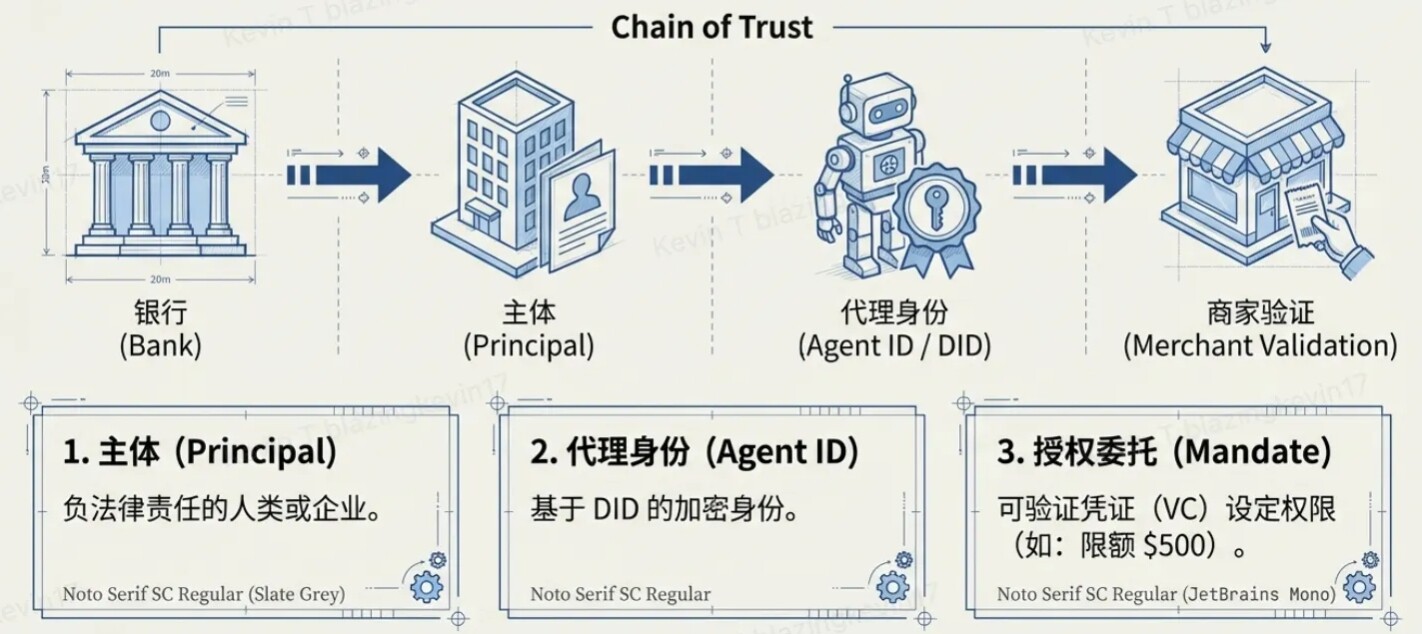
- Main body: The entity that holds legal liability for the Agent. The agent must be cryptographically linked to a human or business account that has undergone KYC/KYB verification.
- Agent IdentityBased on Decentralized Identifier a unique digital identity. A DID is cryptographically generated, tamper-proof, and can be carried across platforms.
- Authorization and Delegation (Mandate/Delegation): Permissions claims issued through Verifiable Credentials (VCs). For example, a VC could state: "This Agent is authorized to make purchases on behalf of Alice at Amazon, with a spending limit of $500."
2.2.2 Cryptographic Binding and Chain of Trust
When an Agent initiates a transaction, it presents a Verifiable Credential (VC). The verifier does not need to trust the Agent itself, but only needs to verify whether the digital signature on the VC comes from a trusted issuer. This mechanism creates a "chain of trust": the bank trusts the enterprise -> the enterprise issues a VC to the Agent -> the merchant verifies the VC -> the transaction is approved.
2.3 The Protocol Stack Debate: Standardization of Agent Identity
2.3.1 Skyfire and KYAPay Protocol
Skyfire Launched KYAPay Open standards, whose core innovation lies in composite tokens:
- What is a token?: Contains identity information (e.g., "Verified Enterprise Agent").
- pay token: Includes payment capability (e.g., "Pre-authorized 10 USDC").
- kya+pay tokenBundle identity and payment, allowing the Agent to complete "visitor checkout" without manual form-filling.
2.3.2 Catena Labs and ACK (Agent Commerce Kit)
Catena Labs, founded by USDC architect Sean, has launched ACK stands for "ack, aiming to create the "HTTP of intelligent agent business." ACK emphasizes the use of W3C DID refers to the Decentralized Identifier (DID) specification developed by the World Standards and account abstraction allow the Agent to directly control on-chain smart contract wallets, achieving stronger security than API keys.
2.3.3 Google AP2 and x402 Extensions
Launched by Google Agent Payments Protocol (AP2) Use the "Power of Attorney" to manage permissions, and collaborated with Coinbase to develop AP2 x402 ExpansionIntegrate the encrypted payment standards directly into the protocol.
2.4 Agent Credit Scoring and Risk Control
KYA is also the beginning of a credit system.
- On-chain Reputation (ERC-7007): Pass ERC-7007(Verifiable AI-Generated Content Token Standard), each successful interaction of an Agent (such as timely payments, generating high-quality code) can be recorded on the blockchain, forming a verifiable record.
- Real-time circuit breakerFinancial institutions are deploying AI gateways. If a transaction agent's behavior deviates from the baseline (e.g., high-frequency abnormal trading), the system can immediately revoke its virtual credentials (VC), triggering a "digital suppression."
3. Economic Reconstruction: Addressing the "Hidden Taxes" of Open Networks
Liz from a16z pointed out that AI agents are imposing a kind of "hidden tax" on the open web: agents extract data (context layer) from content websites on a large scale to serve users, yet systematically bypass the advertising and subscription models that support content production. If this parasitic relationship is not resolved, it will lead to the depletion of the content ecosystem.
3.1 "The Great Decoupling": The Full Arrival of the Zero-Click Economy
In 2025, the digital publishing industry witnessed a "great disconnect": search volumes increased, but click-through traffic to websites plummeted sharply.
3.1.1 Harsh Data on Traffic Erosion
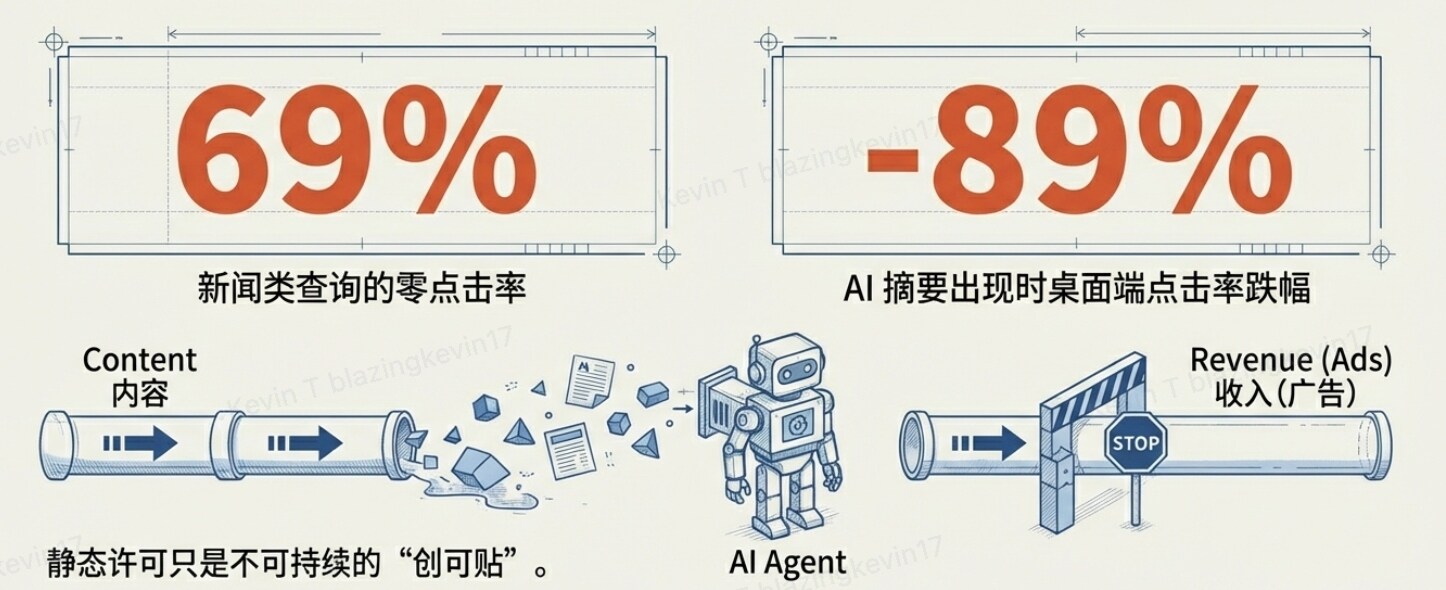
- Zero click surgea16z predicts that traditional search engine traffic will decline by 2026. 25% Similarweb data shows that the zero-click search rate has risen to in 2025. 65% .
- Click-Through Rate (CTR) CollapseDMG Media reported that when the AI Overview appeared above the search results, the click-through rate of the content plummeted. 89% Even the top-ranked search result loses out in the face of AI summaries. 34.5% The number of clicks.
3.2 Moving Beyond Static Licenses: A New Pay-Per-Use Model
To address this crisis, the industry is shifting from static annual data licensing (such as the Reddit deal with OpenAI) toward usage-based compensation.
3.2.1 The Comet Plus model of Perplexity
Launched by Perplexity AI Comet Plus The plan is a typical early attempt:
- Mechanism: Set up initial 42.5 million USD income pool. When the AI Agent cites content from publishers in its responses or accesses pages on behalf of users, it triggers revenue distribution.
- Split / Divide: Publishers can earn up to the relevant revenue pool of 80% This acknowledges the commercial value of "machine access."
3.3 Technical Standards: In-App Payments and Micro-Attribution
To extend compensation across the entire network, a series of open technical standards are being implemented.
3.3.1 NAP Payment and x402 Protocol
HTTP 402 is a status code that indicates "Payment Required." It is a part of the HTTP/1.The status code has finally been activated.x402 protocolThe "Machine-Native Payment" standard has been established.
- WorkflowAgent requests a resource -> Server returns 402 Payment Required along with a price (e.g., 0.001 USDC) -> Agent automatically signs and pays through an L2 blockchain (e.g., Base, Solana) or the Lightning Network -> Server verifies the payment and grants access to the data.
- Economy / Cost-effectivenessTraditional payment gateways cannot process transactions with amounts as low as fractions of a cent, whereas x402, combined with low-fee blockchains, reduces the cost to a negligible level, making it possible to...NapayiBecome possible.
3.3.2 Machine-Readable Rights: TDMRep and C2PA
- TDMRep (Text Data Mining Reservation Protocol)W3C Community Standard allows websites to declare "TDM rights reserved, requires payment/license" in their robots.txt or HTTP headers. This provides a clear binary signal to agents.
- C2PA (Content Provenance and Authentication Alliance)By embedding tamper-proof "content credentials," the original source of the content can be verified. Even if the content is ingested by AI, the cryptographic signatures provided by C2PA ensure the attribution chain remains intact, providing a basis for royalty distribution.
3.4 On-chain IP Ownership: Story Protocol
A more radical change is to tokenize intellectual property itself.Story Protocol Dedicated to building a "programmable IP" layer.
- Mechanism: The creator registers the work as an "IP asset" on the Story Network.
- Automated LicensingThe asset comes with a "programmable IP license." When an AI agent uses the data, a smart contract automatically executes the licensing terms (e.g., "a 5% royalty for commercial use") and automatically distributes the revenue. This creates a high-liquidity IP market without the need for lawyers.
3.5 Outlook: From SEO to AEO
By 2026, the marketing focus will shift from SEO to AEO or GEO.
- Goal: No longer striving for "ranking first in search results," but instead aiming to be **"cited"** by AI or to become its "preferred data source" in reasoning processes.
- Sponsorship ContextThe future advertising model will be "contextual injection." Brands will bid to enter the reasoning chain of AI agents, for example, prompting a travel agent to "remember" that a certain hotel is the best option when planning a trip.
4. Conclusion
The technological landscape of 2026 clearly indicates that the friction between human-centric internet infrastructure and machine-centric demands is forcing a fundamental reconstruction of the digital world.
- Research paradigmAI moves from assistance to autonomy; the AWA architecture enables AI to mass-produce scientific discoveries at low cost, transforming "hallucinations" into creativity.
- Identity System:KYA is an abbreviation that can have different meanings Becoming a new frontier of financial compliance, granting billions of AI agents legal economic identities so they can safely navigate value networks.
- Economic modelThe internet economy is shifting from an attention-based advertising model to a value-based model.Napay and Programmable IPModel x402, TDMRep, and Story Protocol form the rails of the new economy, addressing the issue of "hidden taxes" and ensuring that data producers remain profitable even in a zero-click era.
We are witnessing the rise of agents.EconomyThe emergence—in this economy, software not only helps us work, but they themselves are producers, consumers, and traders.
About Movemaker
Movemaker is the first official community organization authorized by the Aptos Foundation and jointly initiated by Ankaa and BlockBooster, dedicated to promoting the development and growth of the Aptos ecosystem in Chinese-speaking regions. As the official representative of Aptos in Chinese-speaking regions, Movemaker is committed to building a diverse, open, and thriving Aptos ecosystem by connecting developers, users, capital, and various ecosystem partners.
Disclaimer:
This article/blog is for reference only and reflects the author's personal views, not the position of Movemaker. This article is not intended to provide: (i) investment advice or investment recommendations; (ii) an offer or solicitation to buy, sell, or hold digital assets; or (iii) financial, accounting, legal, or tax advice. Holding digital assets, including stablecoins and NFTs, involves high risks, significant price volatility, and the possibility of becoming worthless. You should carefully consider whether trading or holding digital assets is suitable for you based on your financial situation. For questions regarding specific circumstances, please consult your legal, tax, or investment advisor. The information provided in this article (including market data and statistics, if any) is for general reference only. Reasonable care has been taken in compiling this data and charts, but no responsibility is assumed for any factual errors or omissions expressed herein.