
What is the difference between Tokenized Treasury Bills and Traditional T-Bills?
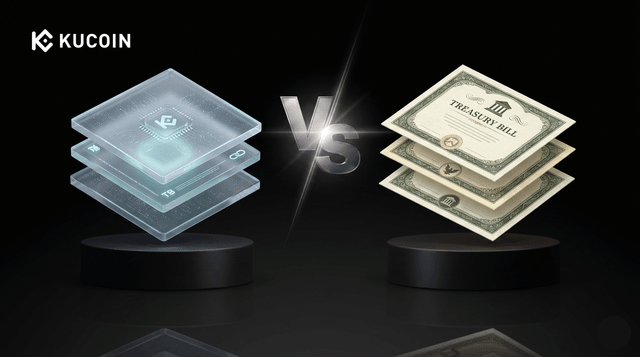
Key Takeaways
-
Tokenized Treasury Bills represent fractionalized, digital ownership of underlying government debt using blockchain technology.
-
Traditional T-Bills rely on legacy financial systems, requiring brokerages, clearinghouses, and standard banking hours.
-
Traditional T-Bills take T+1 business days to settle, while Tokenized Treasury Bills offer instant, atomic settlement 24/7/365.
-
Both yield identical financial returns backed by the U.S. government, but Tokenized Treasury Bills bridge traditional finance and decentralized finance (DeFi).
Investors seeking secure yields have long relied on Traditional T-Bills. However, the rise of blockchain technology introduces a modern alternative: Tokenized Treasury Bills. Understanding the difference between Tokenized Treasury Bills and Traditional T-Bills is crucial for navigating today's financial landscape. Traditional T-Bills are standard electronic records of government debt held within legacy banking systems. Conversely, Tokenized Treasury Bills take these identical low-risk assets and represent them as programmable digital tokens on a distributed ledger. This technological shift addresses legacy inefficiencies like slow settlement times, high minimum investments, and restricted trading hours.
In this guide, we will explore the mechanisms behind both assets, compare their unique benefits, and ultimately explain what the difference between Tokenized Treasury Bills and Traditional T-Bills means for the future of investing.
Understanding Traditional T-Bills vs Tokenized Treasury Bills
What Are Traditional T-Bills and Tokenized Treasury Bills?
Traditional T-Bills are short-term debt obligations backed by the U.S. Department of the Treasury. Sold at a discount to their face value, they mature in four to 52 weeks, paying the investor the full face value upon maturity. They are traditionally purchased through government portals like TreasuryDirect or secondary brokerages during standard market hours.
Tokenized Treasury Bills represent the exact same underlying asset, but reformatted through Real-World Asset (RWA) tokenization. A regulated entity purchases Traditional T-Bills, holds them in custody, and mints digital tokens on a blockchain (like Ethereum or Polygon) that correspond 1:1 with the value of the underlying assets.
Pros and Cons of Tokenized Treasury Bills and Traditional T-Bills
Traditional T-Bills
-
Pros: Supreme safety backed by the U.S. government, massive secondary market liquidity, and clear tax advantages (exempt from state/local taxes).
-
Cons: Slower settlement delays (T+1), restricted to standard banking hours, and higher barriers to entry for international or smaller investors.
Tokenized Treasury Bills
-
Pros: Atomic settlement (instant execution), 24/7/365 accessibility on global networks, and programmability for use in smart contracts.
-
Cons: Smart contract vulnerability risks, evolving regulatory uncertainty, and the potential for the token to de-peg if the custodian mismanages the backing assets.
Core Differences Between Tokenized Treasury Bills and Traditional T-Bills
Settlement Speeds of Tokenized Treasury Bills vs Traditional T-Bills
When trading Traditional T-Bills through a brokerage, transactions pass through clearinghouses operating on a T+1 settlement cycle. This means the actual exchange of cash and assets occurs the business day after the trade.
Tokenized Treasury Bills utilize atomic settlement. Because the asset and the payment (usually stablecoins) exist on the same blockchain, a smart contract executes the swap simultaneously in seconds, eliminating counterparty risk and wait times.
Accessibility of Tokenized Treasury Bills vs Traditional T-Bills
Navigating secondary markets for Traditional T-Bills often requires significant minimum capital allocations and complex cross-border banking rails for international investors.
Conversely, Tokenized Treasury Bills excel in democratization through fractionalization. Because digital tokens are highly divisible, investors can purchase micro-amounts of the asset. Anyone globally with an approved digital wallet can access these yields without establishing a traditional U.S. brokerage account.
Trading Hours for Tokenized Treasury Bills vs Traditional T-Bills
Traditional T-Bills are restricted to Wall Street's trading calendar. Emergency liquidity on a weekend is impossible until markets open on Monday.
Tokenized Treasury Bills exist on decentralized networks that never sleep. Investors can exit positions instantly at any hour, on any day of the year.
| Feature | Traditional T-Bills | Tokenized Treasury Bills |
| Underlying Asset | U.S. Government Debt | U.S. Government Debt |
| Settlement Time | T+1 Business Days | Instant |
| Trading Hours | Standard Market Hours | 24/7/365 |
| Infrastructure | Clearinghouses, Brokers | Blockchain, Smart Contracts |
| Fractionalization | Limited | High |
DeFi Integration: Tokenized Treasury Bills vs Traditional T-Bills
Using Tokenized Treasury Bills Over Traditional T-Bills in DeFi
The standout feature of Tokenized Treasury Bills is their composability within Decentralized Finance (DeFi). As standard blockchain tokens, they can be deposited into smart contracts as collateral. Investors can borrow stablecoins against their yielding government debt without selling the underlying asset, unlocking immense capital efficiency.
Traditional T-Bills are inherently incompatible with DeFi because they exist "off-chain." Decentralized protocols cannot interact with paper or electronic records sitting in a legacy bank vault. Tokenization acts as the vital bridge, pulling traditional safe-haven liquidity into the on-chain economy.
Summary
The financial landscape is evolving rapidly, creating a necessary bridge between legacy infrastructure and blockchain innovation. While both instruments provide identical exposure to secure U.S. government debt, their operational realities differ significantly. The legacy route offers proven regulatory stability, deep traditional liquidity, and universal recognition, but suffers from operational bottlenecks and restricted access. Conversely, the digital alternative introduces unprecedented efficiency through atomic settlement, continuous global liquidity, and programmable utility within decentralized applications.
Ultimately, choosing between these two formats depends on an investor’s need for speed, desire for fractional ownership, and comfort with distributed ledger technology. As global regulations mature and blockchain infrastructure strengthens, the boundaries between these assets will blur, paving the way for a more unified global financial system.
FAQs Regarding Tokenized Treasury Bills and Traditional T-Bills
Are Tokenized Treasury Bills as safe as Traditional T-Bills?
No, they carry layered risks. While sharing the same U.S. sovereign credit backing, tokenized variants introduce third-party custodian risks (bankruptcy of the issuer or custody bank) and technological risks (smart contract vulnerabilities and hacks).
Can I trade Tokenized Treasury Bills for Traditional T-Bills directly?
No, you cannot directly swap a digital token for a traditional brokerage asset in one transaction. You must redeem your Tokenized Treasury Bills for stablecoins or cash, off-ramp to a traditional bank, and then purchase Traditional T-Bills.
Why do companies prefer Tokenized Treasury Bills over Traditional T-Bills?
Crypto-native companies prefer Tokenized Treasury Bills over Traditional T-Bills because it allows them to earn a yield on their treasury capital without leaving the blockchain ecosystem. It eliminates the time delays and fees associated with transferring funds to legacy banks.
Do Tokenized Treasury Bills pay interest like Traditional T-Bills?
Yes, via two digital models. Traditional T-Bills mature at face value. Tokenized versions either use an Accumulating Model (token price increases over time) or a Rebasing Model (token price stays at $1.00, and the wallet token balance increases daily as yield accrues).
Create a free KuCoin account to discover the next crypto gems and trade over 1,000 global digital assets today. Create Now!
Further Reading:


