
What is the Difference Between Lightning Network vs Stacks?
Key Takeaways
-
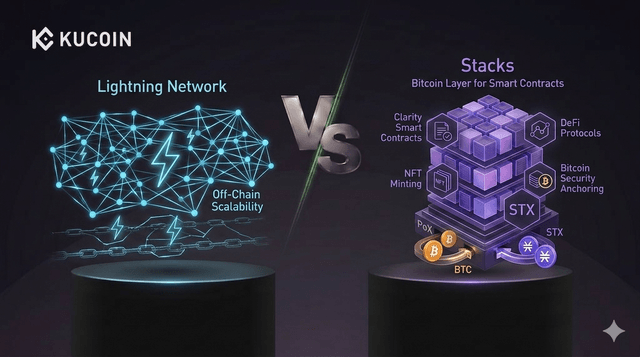
Primary Utility: The Lightning Network focuses on instant BTC payments and micro-transactions, while Stacks provides a smart contract layer for dApps, DeFi, and NFTs.
-
Consensus Architecture: Lightning operates through off-chain payment channels; Stacks uses Proof of Transfer (PoX) to anchor its state directly to the Bitcoin blockchain.
-
Token Dynamics: Lightning is a "pure" Bitcoin solution using native BTC, whereas Stacks uses the STX token for execution and governance, rewarding participants with BTC.
-
Market Fit: Lightning is the "Digital Cash" solution for global retail, while Stacks is the "Digital Finance" engine for Bitcoin-based decentralized applications.
As Bitcoin's role expands from a store of value to a functional platform, two primary scaling solutions have risen to prominence: the Lightning Network and Stacks. While both are designed to enhance the Bitcoin ecosystem, they serve distinct purposes. To understand Lightning Network vs. Stacks: Scaling Bitcoin, one must differentiate between the need for speed in payments and the need for complexity in programming.
The Lightning Network is built to handle millions of transactions per second, making Bitcoin viable for buying a cup of coffee. Stacks, on the other hand, introduces smart contracts, bringing Ethereum-like functionality to Bitcoin's secure base.
The 6W Framework of Bitcoin Scaling
To categorize these two pillars of the Bitcoin economy, we can apply the 6W principles:
-
Who: Lightning was designed for high-frequency users and merchants; Stacks is designed for developers building decentralized finance (DeFi) and NFTs.
-
What: Bitcoin Scaling Solutions one as a payment protocol and the other as a programmable blockchain layer.
-
Where: Both reside "on top" of Bitcoin, utilizing the main chain for final settlement and security.
-
When: As evergreen technologies, they provide the necessary infrastructure for Bitcoin's long-term utility.
-
Why: To solve the scalability trilemma by keeping the base layer secure while allowing innovation to happen on secondary layers.
-
How: Lightning uses state channels for off-chain transfers; Stacks uses Proof of Transfer (PoX) to link its consensus to Bitcoin’s blocks.
Lightning Network vs. Stacks: Scaling Bitcoin
The core differences lie in how these layers interact with Bitcoin and what they allow a user to do with their assets.
1. Functionality: Payments vs. Programmability
-
Lightning Network: This is a layer of speed and volume. It allows users to send BTC instantly for nearly zero cost. It does not support complex smart contracts; its only goal is to make Bitcoin an efficient medium of exchange.
-
Stacks: This is a layer of logic and utility. Stacks enables "Clarity" smart contracts, which can read the Bitcoin state. This allows for the creation of decentralized exchanges, lending protocols, and NFT marketplaces that are settled on the Bitcoin blockchain.
2. The Role of the Token
-
Lightning: There is no "Lightning token." The network uses native Bitcoin. It is a peer-to-peer network of channels where BTC flows back and forth off-chain.
-
Stacks: Stacks uses the STX token. It is required to pay for gas fees when interacting with dApps. However, STX is uniquely tied to BTC; "Stackers" (those who lock their STX) earn rewards paid in native BTC, creating a unique economic link between the two.
For retail users looking for an easy entry point into these ecosystems, the KuCoin Lite Version provides a streamlined way to acquire and manage both BTC and STX without the technical overhead of running a node.
Loading chart…
Use Cases: Micropayments vs. BTCFi
The market has divided these technologies into two specific categories of use.
Lightning: Global Remittances and Micro-tips
The Lightning Network is the backbone of the "Sats-back" economy and global remittances. Because transactions are instant and fees are negligible, it is perfect for streaming micropayments to content creators or paying for retail goods in regions with high inflation.
Stacks: The Rise of BTCFi
Stacks has pioneered the "BTCFi" (Bitcoin DeFi) movement.
-
Lending & Borrowing: Use your Bitcoin as collateral to mint stablecoins or borrow other assets.
-
NFTs and Ordinals: While Ordinals are on the main chain, Stacks provides a high-speed infrastructure for NFT marketplaces and gaming.
-
Stablecoins: Stacks allow for the issuance of stablecoins that are backed by the security of the Bitcoin network.
Strategic updates on new DeFi protocols and ecosystem growth are frequently shared via the official announcement page to keep traders informed of new opportunities.
Trading Insights: Positioning for Bitcoin's Evolution
For an investor, the Lightning Network vs. Stacks: Scaling Bitcoin comparison offers two different investment thesis:
-
The "Digital Cash" Thesis: As more merchants integrate Lightning, the velocity of Bitcoin increases, strengthening its case as a global currency. This supports the long-term value of BTC found on KuCoin Markets.
-
The "Smart Contract" Thesis: The value of STX is driven by the demand for block space on the Stacks layer. As more dApps launch and more BTC is locked in Stacks DeFi, the utility and value of the STX token typically rises.
-
Yield Generation: Stacks offers a unique way to earn "Real Yield" in BTC, which is highly attractive during periods of market consolidation.
Summary Comparison Table
| Feature | Lightning Network | Stacks Ecosystem |
| Primary Goal | Instant, Cheap Payments | Smart Contracts & dApps |
| Native Asset | BTC | STX (for Gas) |
| Security Mechanism | Payment Channels (HTLCs) | Proof of Transfer (PoX) |
| Transaction Cost | Fractions of a cent | Low (Cents) |
| Programmability | Very Low | High (Clarity Language) |
| User Reward | Transaction Fees (for nodes) | BTC Rewards (for Stackers) |
Conclusion: The Difference Between Bitcoin Layers
In the final analysis, the different between Lightning Network vs. Stacks is the difference between a high-speed highway and a thriving city. Lightning provides the infrastructure to move Bitcoin at the speed of light, ensuring it can function as a global payment rail. Stacks provides the "smart" infrastructure to build a decentralized economy on top of the world’s most secure blockchain. Together, they ensure that Bitcoin remains the most versatile and valuable asset in the crypto landscape.
FAQs
Can I send Stacks (STX) over the Lightning Network?
No. The Lightning Network is designed specifically for Bitcoin (BTC) and certain assets like stablecoins through the Taproot Assets protocol. STX moves on its own layer-2 blockchain.
Is Stacks a "Sidechain" or a "Layer 2"?
While often debated, Stacks is considered a Layer 2 because it is anchored to Bitcoin and its consensus is inextricably linked to Bitcoin's blocks. It cannot exist without the Bitcoin mainnet.
Do I need a special wallet for Lightning and Stacks?
Yes. Lightning requires a "Lightning-enabled" wallet to manage channels. Stacks requires a wallet that supports the STX token and Clarity smart contracts. Many modern wallets are now integrating support for both.
How does "Stacking" earn me Bitcoin?
Miners on the Stacks network must send Bitcoin to the network to have a chance to mine a block. That Bitcoin is then distributed to STX holders who have "Stacked" (locked) their tokens to help secure the network.
Where can I trade BTC and STX?
Both BTC and STX are available with high liquidity on KuCoin Markets. For deep-dive analysis on which Bitcoin scaling projects are currently leading the market, visit the KuCoin Blog.
Join 30 million global users on the world’s leading crypto exchange by signing up for your free account now. Register Now!
Further reading


