
What is the Difference Between Quantum-Resistant Cryptography and Current Standards?
Key Takeaways
-
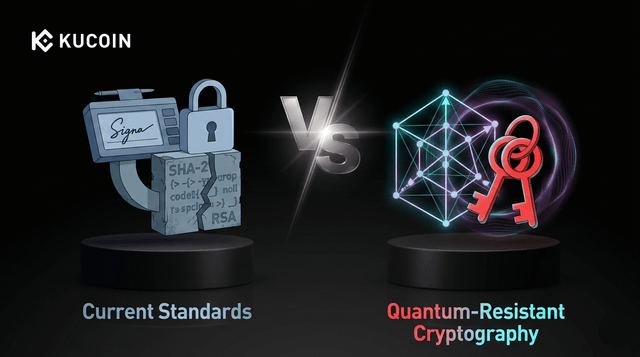
Current Standards (ECDSA/RSA) rely on the mathematical difficulty of factoring large numbers or solving discrete logarithms—tasks a quantum computer can solve in minutes.
-
Quantum-Resistant Cryptography (PQC) uses "Lattice-based" or "Hash-based" mathematics that remain computationally "hard" even for the most advanced quantum processors.
-
The "Harvest Now, Decrypt Later" threat makes the transition urgent in 2026, as malicious actors are already storing encrypted data to unlock once quantum hardware matures.
-
Crypto Agility is the defining market trend; projects that can swap algorithms without a hard fork (like Nervos) or built-in quantum layers (like QRL) are gaining institutional attention.
Market Context: The Quantum Transition
As tech leaders scale processors past the 1,000-qubit barrier and the NIST finalizes PQC standards like ML-KEM and ML-DSA, the digital asset industry is shifting toward proactive defense.
While breaking 256-bit ECDSA still requires scaling to fault-tolerant logical qubits later this decade, forward-looking allocators are beginning to evaluate "cryptographic agility" as a necessary qualitative metric for long-term protocol survival. Ensuring that Layer 1 and custody frameworks have clear, soft-forkable roadmaps to migrate legacy public keys into post-quantum address spaces is becoming a baseline requirement for generational wealth security.
Deep Dive: Quantum-Resistant Cryptography (PQC)
Core Value Proposition
Quantum-Resistant Cryptography (PQC) fundamentally upgrades the "locks" of digital assets. While current standards (ECDSA/RSA) rely on simple math doors that quantum computers can easily bypass, PQC uses multi-dimensional "lattices" or complex hash chains. Due to this geometric complexity, breaking PQC remains an exponential task even with quantum superposition, keeping wallets secure.
Technical Edge & Blockchain Impact
The technical edge lies in Lattice-Based Cryptography, such as the NIST-standardized ML-DSA (Dilithium). However, its implementation brings a critical infrastructure trade-off:
-
Signature Bloat: PQC signatures are 40x to 70x larger than legacy ones (e.g., ~3,300 bytes for ML-DSA vs. 64 bytes for ECDSA).
-
Data Availability (DA) Demand: This data expansion significantly increases blockchain bloat and gas fees, driving massive demand for high-efficiency Data Availability layers.
Deep Dive: Current Standards (ECDSA & RSA)
Strategic Advantage
Current cryptographic standards like ECDSA (utilized by Bitcoin and Ethereum) and RSA possess one massive engineering advantage: Efficiency.
-
Minimal Data Footprint: ECDSA signatures are exceptionally tiny (64 bytes), enabling the high transaction throughput and low gas fees foundational to modern Layer 2 networks.
-
Universal Infrastructure: Every hardware wallet, custody provider, exchange architecture, and smart contract library is natively built around these legacy standards, cementing deep liquidity across global crypto markets.
Ecosystem Evolution & Outlook
The transition away from legacy standards is defined by strategic Hybridization rather than abrupt deprecation:
-
The Soft Fork Path: Major Layer 1 networks are evolving. Recent proposals, such as Bitcoin's BIP 360, lay the groundwork for post-quantum security by introducing frameworks like P2MR (Pay-to-Merkle-Root) to strip out vulnerable public key paths while maintaining backward compatibility.
-
Dual-Signature Coexistence: Due to the massive operational cost of migrating billions in institutional capital, the market will widely adopt a "Dual-Signature" model over the next few years, executing both a classical and a quantum-resistant signature for each transaction.
Risk Management and Portfolio Agility
For long-term asset holders, the optimal strategy during this multi-year migration timeline is to monitor protocol-level upgrade schedules:
-
Infrastructure Readiness: Ensure your capital remains in environments or custodial frameworks that actively pledge technical readiness for upcoming network soft forks.
-
Execution Agility: As networks finalize their post-quantum address formats, users will need to maintain execution flexibility to seamlessly migrate their legacy balances into upgraded, quantum-safe wallet structures.
Comparison Analysis: The Cryptographic Divide
| Feature | Quantum-Resistant (PQC) | Current Standards (ECDSA/RSA) |
| Primary Math | Lattices, Hashes, Isogenies | Prime Factoring, Elliptic Curves |
| Shor's Algorithm | Resistant | Vulnerable |
| Signature Size | Large (Kbytes) | Small (Bytes) |
| Transaction Cost | Higher (due to data size) | Lower / Optimized |
| Adoption State | Emerging / Specialized | Dominant / Universal |
Trading Insights: Which fits your Portfolio?
-
The "Safety First" Long-Term Holder
If your time horizon is 10+ years, the quantum threat must be factored into your custody choices. Focus on networks built for cryptographic agility, such as Nervos Network (CKB). Its unique Cell Model decouples the lock script from the protocol, allowing it to upgrade to post-quantum "locks" seamlessly via script updates without requiring a network-wide hard fork.
-
The "Efficiency" Day Trader
For short-term or day traders, current standard assets (ECDSA-based) remain unparalleled. The liquidity depth and tight order book spreads for pairs like BTC/USDT or ETH/USDT on spot markets are far superior to niche protocols. The quantum threat is a multi-year macroeconomic shift, not a vector driving intraday volatility.
-
The "Crypto-Agile" Hedge
The most rational strategy during this transition is a Hybrid Portfolio. Maintain core allocations in high-liquidity market leaders (BTC/ETH), while allocating a minor risk-managed sleeve (5-10%) into structurally agile, post-quantum-ready networks. This hedges against a "Black Swan" quantum breakthrough while capturing current market upside.
Conclusion
Current standards deliver the efficiency and liquidity that power today's ecosystem, but they bear a mathematical expiration date. PQC provides the only robust architecture capable of safeguarding assets as quantum hardware scales. The defining directive for any allocator is Cryptographic Agility—ensuring your asset custody frameworks maintain a clear, technically verifiable roadmap to migrate into post-quantum address structures.
FAQs for Quantum-Resistant Cryptography
Can a quantum computer steal my Bitcoin today?
No. As of early 2026, while quantum progress is fast, "Cryptographically Relevant Quantum Computers" (CRQCs) capable of cracking 256-bit ECDSA are still projected to be 3-5 years away. However, the "Harvest Now, Decrypt Later" risk is active today.
Will I have to buy new coins when Bitcoin upgrades?
No. Most major blockchains will implement backward-compatible migration paths. If you use self-custody wallets, you will simply need to transfer your funds to a new post-quantum address format. For assets held on centralized exchanges, the platform's infrastructure team will handle the back-end transition seamlessly on your behalf.
Why are PQC transactions more expensive?
Because the mathematical proofs (signatures) required to be "Quantum-Safe" are physically larger. They take up more "block space," which leads to higher fees. This is why "Modular DA" layers are becoming so important in 2026.
How do I identify a "Quantum-Safe" project?
Look for technical terms like "Lattice-based," "NIST-compliant," or "Post-Quantum" within the project's official technical whitepapers and documentation.
Start your crypto journey in minutes by creating a secure KuCoin account with no initial deposit required. Sign Up Now!
Learn More:


