
What is the Difference Between Ordinals vs. NFTs?
Key Takeaways
-
Data Residency: Bitcoin Ordinals store all data directly on the blockchain (on-chain), whereas traditional Ethereum NFTs often use off-chain storage pointers.
-
Protocol Mechanism: Ordinals utilize "Ordinal Theory" to inscribe data on individual satoshis, while Ethereum NFTs rely on smart contract standards like ERC-721.
-
Mutability: Bitcoin Ordinals are immutable "digital artifacts" by default; Ethereum NFTs can be designed as mutable or immutable depending on the smart contract code.
-
Ecosystem Tools: Ethereum utilizes mature marketplace smart contracts for royalties and auctions, while Bitcoin Ordinals require specialized "coin control" wallets and PSBT technology.
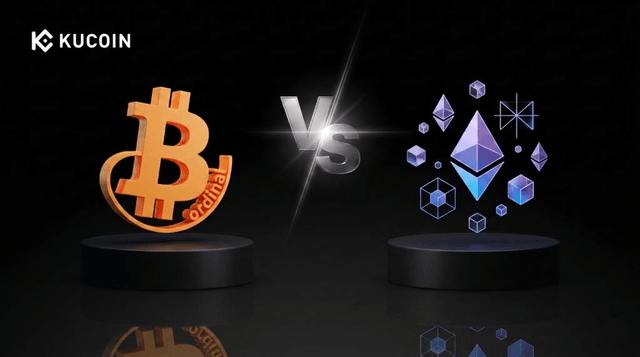
The digital asset landscape is characterized by two distinct approaches to non-fungible tokens: Bitcoin Ordinals and Ethereum NFTs. While both represent unique digital assets, their technical architectures and underlying philosophies regarding data storage and blockchain utility differ significantly.
The comparison of "Bitcoin Ordinals vs. Ethereum NFTs" highlights a technical divergence between "digital artifacts" and "programmable tokens." Bitcoin Ordinals focus on absolute permanence and on-chain residency, while Ethereum NFTs prioritize flexibility and smart contract interoperability. For participants analyzing the crypto markets, these differences impact how assets are minted, stored, and verified. Technical deep-dives into these emerging asset classes are a frequent subject within the KuCoin blog.
Technical Foundations: Inscriptions vs. Tokens
The fundamental difference between these two assets lies in their relationship with the underlying blockchain.
-
Bitcoin Ordinals: The Inscription Model
Bitcoin Ordinals function through "Ordinal Theory," a methodology for tracking individual satoshis (the smallest unit of Bitcoin). Each satoshi is assigned a number based on its mining order. "Inscribing" refers to the process of attaching data—such as an image, text, or video—directly to a specific satoshi's witness data in a Bitcoin transaction.
-
Native to Bitcoin: Ordinals do not require a separate token or a smart contract. They are part of the Bitcoin ledger itself.
-
Digital Artifacts: Because the data is inscribed directly onto the satoshi, it is considered a permanent, sovereign artifact of the Bitcoin network.
-
Ethereum NFTs: The Smart Contract Model
Ethereum NFTs are created using token standards such as ERC-721 or ERC-1155. These are separate digital tokens generated by a smart contract.
-
Programmability: The smart contract governs the behavior of the NFT, including transfer rules, minting limits, and royalty distributions to creators.
-
Metadata Pointers: Most Ethereum NFTs do not store the actual file (like a high-resolution image) on the Ethereum blockchain due to high storage costs. Instead, they store a "pointer" or a URL that links to an off-chain storage provider, such as IPFS or a centralized server.
Storage and Permanence
Storage philosophy is a critical factor in the "What is the difference between Ordinals vs NFTs" debate.
-
On-Chain vs. Off-Chain Data
Bitcoin Ordinals are 100% on-chain. This means as long as the Bitcoin network exists, the data for the Ordinal is recoverable directly from the blockchain. There is no risk of a "broken link" because the data is not hosted externally.
Ethereum NFTs generally store metadata on-chain, but the primary asset is often off-chain. While decentralized storage solutions like IPFS mitigate the risk of data loss, the asset still relies on an external layer that is not the Ethereum blockchain itself. This distinction makes Bitcoin Ordinals more storage-intensive but technically more permanent.
-
Immutability
Bitcoin Ordinals are inherently immutable. Once a transaction is confirmed and inscribed, the data cannot be altered or deleted. Ethereum NFTs are immutable if the smart contract "metadata" is frozen; however, some NFTs are designed to be dynamic, allowing the image or attributes to change based on specific triggers in the smart contract.
Comparative Analysis: Technical Trade-offs
The following table summarizes the structural differences:
| Feature | Bitcoin Ordinals | Ethereum NFTs |
| Blockchain | Bitcoin | Ethereum (and other EVM chains) |
| Creation Method | Inscription on Satoshis | Smart Contract Minting |
| Storage Type | Fully On-Chain | Primarily Off-Chain Pointers |
| Royalty Support | No Native Enforcement | Smart Contract Enforced |
| Rarity Model | Based on Satoshi Sequence | Determined by Collection Logic |
| Complexity | Simple / Static | Complex / Programmable |
For participants who manage assets via the KuCoin lite version, the primary interaction involves monitoring the value of these assets and the liquidity of the underlying networks. For broader market trends, checking official announcements regarding the support of new standards like BRC-20 or ERC-404 is essential.
Operational Infrastructure and Trading
The ecosystems for trading these assets require different technical tools.
-
Wallets and Coin Control
Trading Bitcoin Ordinals requires "coin control" functionality. Because an Ordinal is a satoshi, it could technically be "spent" as transaction fees if not handled correctly. Specialized wallets prevent this by isolating inscribed satoshis from a user's regular BTC balance.
-
Marketplaces and PSBTs
Ethereum NFTs use smart contracts for trustless trading on marketplaces. Bitcoin Ordinals utilize Partially Signed Bitcoin Transactions (PSBTs). This technology allows a seller to sign a transaction with a set price and a buyer to sign the other half, completing the trade without a centralized escrow agent.
Within the KuCoin ecosystem, infrastructure is designed to bridge the gap between these varying standards, providing users with a consolidated interface for different blockchain protocols.
Market Dynamics: Digital Art vs. Utility
Ethereum NFTs have established a significant lead in "Utility NFTs." These include gaming assets, virtual land, and identity management tokens that interact with decentralized applications (dApps).
Bitcoin Ordinals are currently more focused on "Digital Artifacts"—high-value art and historical inscriptions that leverage Bitcoin’s security and scarcity. However, the development of Layer 2 solutions on Bitcoin is beginning to introduce programmable layers for Ordinals, potentially closing the utility gap between the two ecosystems.
Conclusion
The difference between Bitcoin Ordinals and Ethereum NFTs represents two distinct blockchain philosophies. Bitcoin Ordinals prioritize the "Digital Artifact" status, leveraging on-chain storage and Bitcoin’s fundamental security to create permanent records. Ethereum NFTs prioritize the "Programmable Token" status, utilizing smart contracts to create dynamic, interconnected assets that can serve a wide variety of functions within the decentralized web.
For the cryptocurrency industry, the coexistence of these two models provides collectors and developers with a choice: the immutable, on-chain simplicity of Bitcoin or the flexible, programmable complexity of Ethereum.
FAQs
Can I turn an Ethereum NFT into a Bitcoin Ordinal?
No. They are on different blockchains with different technical standards. An asset can be "bridged" or recreated on another chain, but the original cryptographic record remains on the chain where it was minted or inscribed.
Why are Bitcoin Ordinal fees higher?
Because Ordinals store data directly on-chain, they take up more "block space" than a standard transaction. Users must pay a fee for every byte of data inscribed, making large files more expensive to create.
What are BRC-20 tokens?
BRC-20 is an experimental token standard for Bitcoin that uses Ordinal inscriptions to mint and transfer fungible tokens. It is different from an NFT, as BRC-20 tokens are designed to be interchangeable.
Are Ethereum NFTs less secure?
Ethereum NFTs are as secure as the Ethereum network itself. However, because the actual media file is often stored off-chain, the "security" of the visual asset depends on the decentralized storage provider (like IPFS) rather than the blockchain.
How can I verify the authenticity of an Ordinal?
Authenticity is verified by checking the inscription ID on a Bitcoin block explorer. This ID links the asset to a specific satoshi and a specific block height, providing a transparent, immutable record of its creation.
Create a free KuCoin account to discover the next crypto gems and trade over 1,000 global digital assets today. Create Now!
Further reading


