
What is the Difference Between Fraud Proofs and Validity Proofs?
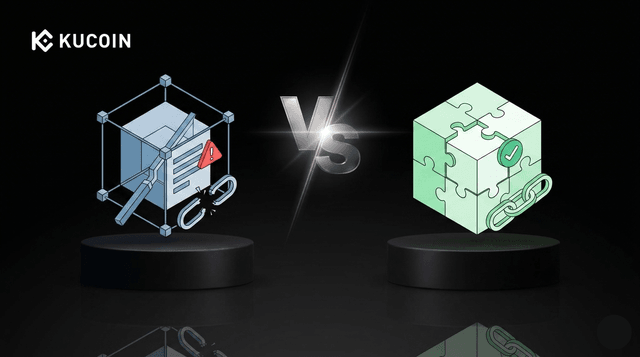
The race for blockchain scalability in 2026 has narrowed down to a fundamental battle of cryptographic methods: Fraud Proofs versus Validity Proofs. As Ethereum’s Layer-2 (L2) ecosystem matures, the distinction between these two mechanisms determines everything from withdrawal times to capital efficiency. For sophisticated traders on KuCoin, understanding the technical "under-the-hood" differences is essential for identifying which L2 tokens—Optimistic Rollups or ZK-Rollups—possess the strongest market fundamentals.
Key Takeaways
-
Verification Method: Fraud Proofs assume transactions are correct unless challenged (Optimistic), while Validity Proofs provide mathematical certainty for every transaction before it is finalized (Zero-Knowledge).
-
Finality & Latency: Validity Proofs offer near-instant settlement on the mainnet, whereas Fraud Proofs require a "challenge period" (typically 7 days) to ensure network security.
-
Capital Efficiency: Validity Proofs allow for immediate withdrawals, making them superior for high-frequency trading and liquidity management on platforms like the KuCoin Spot Market.
-
Computational Cost: Fraud Proofs are cheaper to generate in the short term, while Validity Proofs require significant computational power but offer better long-term data compression and scalability.
The 2026 Scaling Wars: Verification vs. Math
The 2026 market landscape is dominated by a modular approach to blockchain. The "monolithic" era has faded, replaced by specialized layers. Fraud Proofs power the massive liquidity of Optimistic Rollups (like Arbitrum and Optimism), which continue to host the bulk of DeFi activity due to their EVM-equivalence.
However, the surge in institutional adoption and RWA (Real-World Asset) tokenization has shifted momentum toward Validity Proofs. Institutions demand "Instant Finality," a feature that only Zero-Knowledge (ZK) technology can provide. On KuCoin, we see this reflected in the trading volumes of ZK-based assets, as investors pivot toward the cryptographic certainty of Validity Proofs to mitigate the "Seven-Day Withdrawal" friction inherent in older rollup designs.
Deep Dive: Fraud Proofs (Optimistic Rollups)
Core Value Proposition
Fraud Proofs operate on the principle of "Innocent until proven guilty." The network assumes all bundled transactions are valid. A "Challenge Period" exists where "Watchtowers" or nodes can submit a Fraud Proof if they detect a malicious transaction. If fraud is proven, the state is rolled back and the malicious actor is slashed.
Technical Edge & Economic Model (Tokenomics)
The technical edge of Fraud Proofs lies in their Simplicity and Compatibility. Because they don't require complex mathematical proofs for every block, they are easier to implement for complex smart contracts.
-
Feature: Lower computation overhead for sequencers.
-
Market Behavior: Lower initial gas costs for users, leading to higher DApp retention.
-
Investor Value: Higher TVL (Total Value Locked) in the short-to-medium term as developers flock to familiar EVM environments.
How to Trade/Stake Fraud Proof Tokens on KuCoin Lite
Assets utilizing Fraud Proofs (e.g., ARB, OP) are staples of a modern portfolio. Using KuCoin Lite, intermediate traders can acquire these tokens with one-click simplicity. Given the 7-day challenge period of these networks, many traders prefer to keep their assets on KuCoin to maintain instant liquidity, avoiding the wait times associated with native bridges.
Deep Dive: Validity Proofs (ZK-Rollups)
Strategic Advantage
Validity Proofs, powered by Zero-Knowledge (ZK-SNARKs or STARKs), use mathematical proofs to verify the correctness of a batch of transactions. The state transition is only accepted by Layer-1 (like Ethereum) if the proof is mathematically valid.
Feature -> Market Behavior: No challenge period is required.
Investor Value: Absolute security and instant bridge withdrawals.
Ecosystem Growth & 2026 Outlook
In 2026, Validity Proofs solved the "ZK-EVM" challenge, allowing them to support the same complex apps as Optimistic Rollups but with superior privacy and speed. We are seeing a massive migration of liquidity to ZK-based networks as "Prover" costs have plummeted due to hardware acceleration.
Maximizing Returns with KuCoin Earn
For long-term holders of ZK-ecosystem tokens (e.g., ZKSYNC, STRK), KuCoin Earn offers specialized staking and savings products. By utilizing these tokens in KuCoin’s professional-grade yield products, investors can capture the growth of the ZK-era.
Comparison Analysis: Fraud vs. Validity Proofs
| Feature | Fraud Proofs (Optimistic) | Validity Proofs (ZK) |
| Security Philosophy | Interactive (Game Theory) | Mathematical (Cryptography) |
| Withdrawal Delay | ~7 Days (High Friction) | Near-Instant (High Efficiency) |
| Data Compression | Lower (Requires full transaction data) | Higher (Requires only state differences) |
| Complexity | Relatively Low | High (Requires advanced math) |
| L1 Verification Gas | Higher per byte (Bulk data delivery) | Lower per transaction (Cheap to verify a math proof) |
| Capital ROI | Moderate (Liquidity is "locked") | High (Capital is always moving) |
Trading Insights: Which fits your Portfolio?
-
The Yield Farmer (Fraud Proof Lean)
If you are focused on existing DeFi ecosystems, high-yield pools, and proven liquidity, tokens utilizing Fraud Proofs are your best bet. Their long-standing presence in the market means more trading pairs on the KuCoin Spot Market and more mature integrations.
-
The Tech-Arbitrageur (Validity Proof Lean)
If you are betting on the "End-Game" of blockchain scaling—where privacy and instant settlement are non-negotiable—Validity Proof tokens are essential. These are "High-Beta" assets that often lead market rallies when new cryptographic breakthroughs are announced.
-
The Risk-Averse Institution
For those moving large volumes, Validity Proofs are the safer bet because the security is rooted in math rather than the presence of active "watchdogs" in the network. Monitor the KuCoin Spot Market for institutional-grade ZK tokens to catch this trend.
Conclusion & Strategic Guidance
In the 2026 landscape, Fraud Proofs represent the robust, battle-tested past of DeFi, while Validity Proofs represent the high-performance, cryptographically certain future. For a balanced portfolio, holding a mix of both ensures exposure to the massive TVL of Optimistic networks and the technological upside of ZK-tech.
FAQs for Fraud vs. Validity Proofs
-
Why are Fraud Proofs still used if Validity Proofs are "better"?
Fraud Proofs are currently easier to scale for general-purpose smart contracts (EVM). They have a significant "first-mover" advantage in terms of ecosystem and developer tooling.
-
Does the 7-day withdrawal delay of Fraud Proofs affect my KuCoin trading?
No. When you trade on KuCoin, you are trading within our internal liquidity pools. The 7-day delay only applies if you are manually bridging assets from an Optimistic Rollup back to the Ethereum Mainnet.
-
Are Validity Proofs more expensive to use?
Initially, yes, because generating a ZK-proof requires massive computational power. However, by 2026, many ZK-rollups have achieved "Proof Aggregation," which makes them cheaper than Optimistic rollups for high-volume users.
-
Which is more secure against hackers?
Validity Proofs are technically more secure because they prevent invalid states from ever being posted. Fraud Proofs rely on honest nodes being online to catch an attack within the 7-day window.
-
How can I identify which proof a token uses on KuCoin?
You can usually find this information in the token's whitepaper or by looking at its category (e.g., "ZK-Rollup" vs. "Optimistic Rollup") in the KuCoin News section.
Further Reading:


