
What is Pair Trading in Crypto?
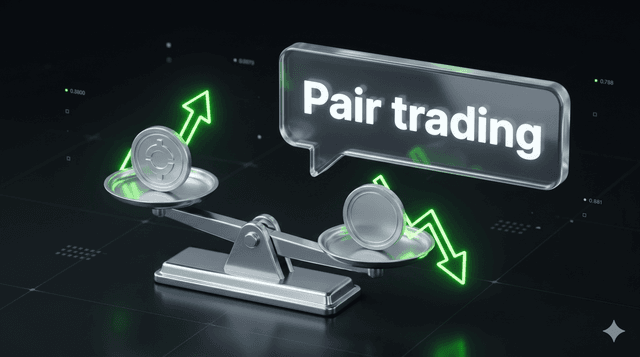
Master pair trading in crypto for 2026. Learn how this market-neutral strategy uses correlation to hedge risk. Execute advanced trades and manage volatility on KuCoin.
In the fast-moving world of 2026 digital assets, the most successful Australian investors are moving away from simple "buy and hope" tactics. Instead, they are turning to a sophisticated institutional technique: statistical arbitrage. If you have been asking "what is pair trading in crypto," you are looking at one of the most powerful tools for navigating high-volatility environments while minimizing exposure to broader market crashes.
Pair trading is a "market-neutral" strategy that involves taking two simultaneous positions: a long position in one asset and a short position in another. By 2026, this has become a preferred method for traders on KuCoin to profit from the relative performance of two coins, rather than betting on whether the entire market goes up or down.
Key Takeaways
-
Relative Value: Pair trading focuses on the price relationship between two correlated assets (like BTC and ETH) rather than their absolute price in AUD.
-
Market Neutrality: Because you are both long and short, the strategy aims to stay profitable regardless of whether the total crypto market is in a bull or bear phase.
-
Mean Reversion: Traders bet that when the price "spread" between two related assets diverges too far from its historical average, it will eventually snap back to the mean.
-
Execution on KuCoin: Using KuCoin's deep liquidity and margin trading tools is essential for executing both "legs" of the trade efficiently.
The Mechanics of Relative Performance: How Pair Trading Works
To answer "what is pair trading in crypto" effectively, we must look at the concept of correlation. In the crypto market, assets often move in clusters. Layer-1 tokens like Solana and Avalanche, or gaming tokens like those in the GameFi sector, often move together.
Identifying the Spread
A pair trader looks for two assets that historically move in lockstep. When one asset starts to "outperform" the other significantly without a clear fundamental reason, a "divergence" or spread is created.
-
The Long Leg: You buy the underperforming asset, believing it is undervalued.
-
The Short Leg: You short-sell the overperforming asset, believing it is overvalued.
By 2026, many Australian traders use the KuCoin Lite version to monitor their base holdings while using the professional spot and margin markets to execute these complex "legs." The goal is for the two assets to eventually converge back to their normal price ratio, allowing you to profit from the difference.
Comparing Directional Trading vs. Pair Trading
For many Australians, the ASIC regulatory framework has brought a new level of maturity to the market, encouraging strategies that manage risk more effectively than simple directional bets.
| Feature | Directional Trading (Long/Short) | Pair Trading (Market Neutral) |
| Market Sensitivity | High – You need the market to move in your direction. | Low – You profit from the ratio between assets. |
| Volatility Risk | High – A sudden market-wide crash can liquidate you. | Lower – A market crash often hits both assets, cancelling out some loss. |
| Complexity | Simple – Buy low, sell high. | High – Requires monitoring correlations and "hedging" positions. |
| Profit Potential | Massive in strong bull markets. | Steady, consistent returns in various market conditions. |
Risk Disclosure: Trading digital assets is high-risk. While pair trading is a hedging strategy, it is not "safe" or "risk-free." If the correlation between your two chosen assets breaks permanently—known as a "de-correlation event"—you could lose money on both sides of the trade. KuCoin is a registered Digital Currency Exchange (DCE) provider with AUSTRAC, but this does not imply government approval or a guarantee of profit. Losses can exceed your initial deposits when using leverage.
Executing Pair Trades Within the KuCoin Ecosystem
As a global leader in liquidity, KuCoin provides the infrastructure required to manage both sides of a pair trade without significant "slippage" (the difference between expected and executed price).
-
Finding Your Pair
Australian traders often pair "blue-chip" assets like BTC/ETH or sector-specific pairs like UNI/AAVE. By checking the KuCoin markets, you can see which assets have the highest correlation over the last 30 to 90 days.
-
Opening the Positions
To execute the "short" leg of the trade, you will typically need to use the KuCoin Margin Trading platform. This allows you to borrow the overvalued asset to sell it, with the intent of buying it back cheaper later. Simultaneously, you use your spot account to buy the undervalued "long" leg.
-
Automated Rebalancing
In 2026, manual tracking is often replaced by the KuCoin Trading Bot. Advanced users can set up a "Smart Rebalance" bot that automatically adjusts the weights of two assets as their prices diverge, essentially automating the pair trading process for a passive income approach.
Managing Risk for Australian Investors
The Australian Taxation Office (ATO) treats every "leg" of a pair trade as a separate taxable event. Because you are constantly opening and closing positions to capture the spread, meticulous record-keeping is mandatory.
-
Position Sizing: Never risk more than 1-2% of your total capital on a single pair trade.
-
Stop-Loss Orders: Always set stop-losses on both sides of the trade. If the underperformer continues to drop while the overperformer continues to rise, your losses can compound quickly.
-
Monitoring News: A fundamental change in one project (like a hack or a major upgrade) can break the correlation. Stay updated via the KuCoin News feed to spot these changes before they hit your PnL.
Conclusion: A Smarter Way to Trade in 2026
Answering "what is pair trading in crypto" opens the door to a more professional way of interacting with the markets. By focusing on the relationship between assets rather than just their price tags, you can find opportunities even when the broader market is moving sideways.
Success in pair trading requires discipline, the right data, and a platform that can handle complex orders. Start exploring correlation charts on KuCoin today and see if pair trading fits your 2026 investment goals. By leveraging the advanced tools in the KuCoin ecosystem, you can aim for market neutrality in an ever-changing digital landscape.
FAQs for Pair Trading
Can I do pair trading with stablecoins?
While you can trade pairs like USDT/USDC, there is very little "spread" to capture unless one stablecoin de-pegs. Most pair traders look for assets with high volatility but strong historical correlation, such as two competing Layer-1 blockchains.
Do I need a lot of money to start pair trading?
No, but because you are opening two positions simultaneously, your capital is split. To make the strategy worthwhile after accounting for trading fees on both sides, many traders start with at least $1,000 to $5,000 AUD.
Is pair trading the same as arbitrage?
Not quite. Arbitrage involves buying and selling the same asset on different exchanges to profit from price differences. Pair trading involves two different but related assets on the same exchange (like KuCoin) to profit from their relative price movement.


