
What is Maximum Drawdown in crypto?
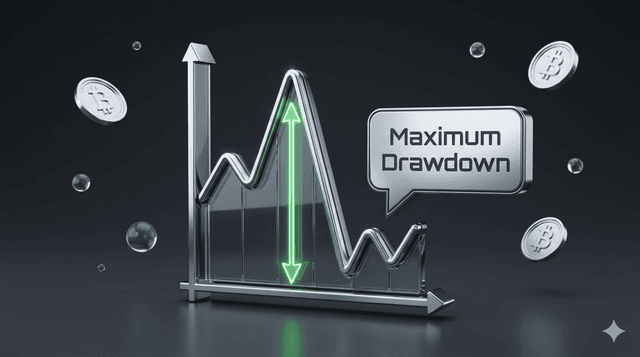
Master what is maximum drawdown in crypto to evaluate portfolio risk. Learn the MDD formula, peak-to-trough analysis, and how to manage volatility on KuCoin.
Key Takeaways
-
The "Pain" Metric: Maximum Drawdown (MDD) measures the largest percentage drop from a peak to a trough before a new peak is formed.
-
Risk Evaluation: Unlike standard volatility, MDD focuses purely on capital preservation and the "worst-case scenario" for an investor.
-
Recovery Logic: MDD highlights the mathematical reality that a 50% loss requires a 100% gain just to break even.
-
Strategic Tool: Use MDD on KuCoin to compare the safety of different trading bots and investment portfolios.
What is Maximum Drawdown in Crypto?
In the highly volatile world of digital assets, tracking gains is the easy part. However, measuring the true "pain" or risk of a strategy is where professional traders distinguish themselves from gamblers. Maximum Drawdown (MDD) is the ultimate metric for measuring this risk. It tracks the largest peak-to-trough decline in the value of an investment or portfolio before a new high is achieved.
Understanding what is the maximum drawdown in crypto is critical because, in this market, 50% to 90% corrections are historical norms for many altcoins. MDD provides the absolute "worst-case scenario" a strategy experienced during a specific period. Whether you are holding Bitcoin or exploring emerging projects on KuCoin, knowing your MDD helps you determine if your psychological risk tolerance matches your financial exposure.
-
What is Maximum Drawdown?
Maximum Drawdown (MDD) is the maximum observed loss from a historical peak to a subsequent trough of a portfolio, typically expressed as a percentage. It essentially answers the question: "If I had bought at the exact top and sold at the absolute bottom, how much would I have lost?"
Unlike standard volatility, which measures how much prices swing both up and down, MDD only focuses on the downside. It is a measure of capital preservation. A strategy with a high historical MDD suggests that a trader must be prepared for significant "Time Under Water"—the duration it takes for the portfolio to recover its previous value. To see the historical price peaks and troughs of top assets, you can utilize the professional charting tools on KuCoin Markets.
-
How to Calculate the "Pain": The MDD Formula
Calculating maximum drawdown involves three primary data points: the peak value, the trough (lowest) value, and the subsequent recovery.
The mathematical formula is:
MDD = (Trough Value - Peak Value) / Peak Value
Practical Example:
-
Peak: Your portfolio reaches a high of $10,000.
-
Trough: The market enters a correction, and your portfolio value drops to $4,000.
-
Recovery: The price eventually recovers and eventually surpasses $10,000.
In this case, the MDD is:
(4,000 - 10,000) / 10,000 = -60%
For detailed guides on how to apply these risk formulas to your own trading history or automated bot performance, the KuCoin Blog offers extensive resources on risk-adjusted returns and portfolio analytics.
-
Why MDD Matters
The reason MDD is so feared by professionals is the "Recovery Paradox." The more you lose, the exponentially harder it is to recover to your original starting point.
| Drawdown (%) | Gain Needed to Break Even (%) |
| 10% | 11.10% |
| 25% | 33.30% |
| 50% | 100% |
| 75% | 300% |
| 90% | 900% |
As the table shows, a 90% drawdown (common in many "shitcoin" cycles) requires a 900% gain—a 10x return—just to get back to zero. This is why managing what is maximum drawdown in crypto is often more important than chasing the next "moon" shot.
-
Risks and Limitations
While MDD is a vital metric, it is not a complete crystal ball. Traders must consider:
-
No Time Component: MDD tells you how much was lost, but not how long it took. A 20% drop over two days feels very different from a 20% drop that drags on for two years.
-
Historical Bias: Past performance does not guarantee future results. An asset with a historical MDD of 40% could still experience a 90% drop due to unforeseen regulatory shifts or security exploits.
-
Frequency Ignored: MDD only looks at the single biggest drop. It doesn't tell you how often smaller, frustrating 15% drops occur.
To stay updated on market conditions that might lead to systemic drawdowns, such as protocol upgrades or network changes, it is essential to monitor the official announcement feed daily.
-
Mitigation Strategies
How do successful traders keep their drawdowns manageable?
-
Diversification: By spreading capital across non-correlated assets, a crash in one sector (like DeFi) may be offset by stability in another (like Stablecoins).
-
Stop-Loss Orders: Automating your exit points ensures that a small correction doesn't turn into a catastrophic maximum drawdown.
-
Stablecoin Hedging: Moving into USDT or USDC during periods of high uncertainty protects your capital from market-wide "flush outs."
-
Position Sizing: Never over-leveraging. High leverage is the quickest way to turn a 5% market dip into a 100% maximum drawdown (liquidation).
For traders who prefer a simpler interface for monitoring their risk and P&L (Profit and Loss) without getting overwhelmed by complex indicators, the KuCoin Lite Version provides a clean, user-friendly experience.
-
FAQs for What is Maximum Drawdown in Crypto
What is considered a "good" maximum drawdown in crypto?
"Good" is relative to your returns. Generally, professional traders look for a "Calmar Ratio" (Annual Return / MDD) greater than 2.0. If you make 100% a year with a 40% MDD, that is often considered acceptable in crypto.
Does MDD apply to short selling?
Yes. For a short position, the drawdown occurs when the price rises above your entry point, eroding your margin.
How often should I calculate my portfolio's MDD?
It is best practice to review your MDD at the end of every market cycle or monthly to ensure your strategy isn't becoming too risky.
Can a trading bot help minimize MDD?
Yes, certain bots like the "Smart Rebalance" bot on KuCoin can help maintain a balanced allocation, which naturally dampens the MDD compared to holding a single volatile asset.
Why is MDD so much higher in crypto than in stocks?
Higher volatility, 24/7 trading, and lower liquidity in altcoins mean that price discoveries are often more violent, leading to deeper drawdowns.
Conclusion: Mastering the Worst-Case Scenario
Understanding what is the maximum drawdown in crypto allows you to shift your focus from purely seeking profits to achieving sustainable growth. By incorporating MDD into your regular portfolio reviews, you can build a more resilient strategy that survives even the harshest bear markets. Remember, in the world of crypto, the winner is often the one who loses the least during bad times, not the one who makes the most during good times.
Create a free KuCoin account to discover the next crypto gems and trade over 1,000 global digital assets today. Create Now!


