

What Is BEM Token? TapeOut Protocol, Proof of Design Mining, and the 16-Year-Old Founder on BNB Chain
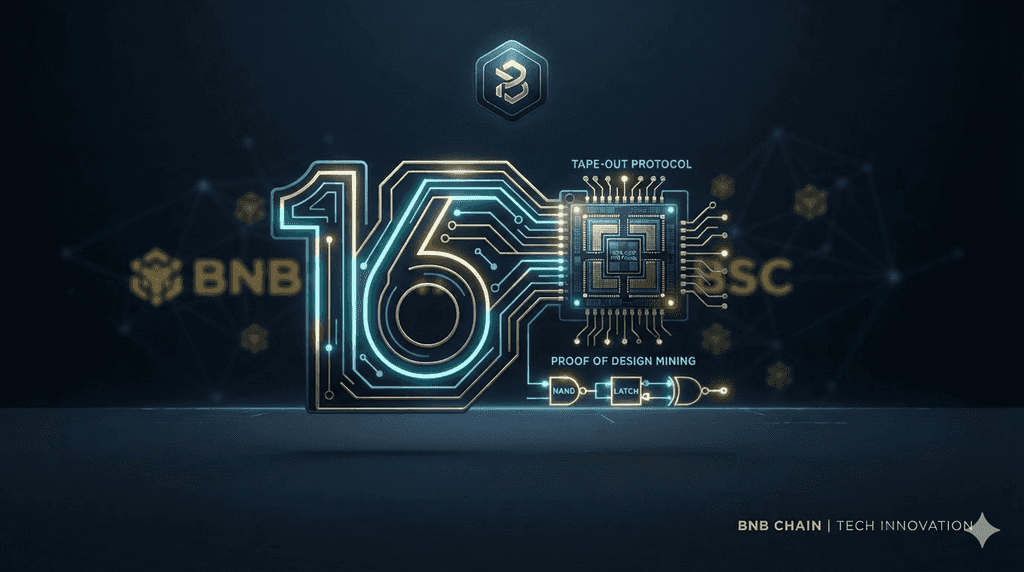
The cryptocurrency industry frequently cycles between periods of financial speculation and phases of deep technical innovation. In August and September 2026, the BNB Chain ecosystem witnessed a sharp pivot toward the latter with the emergence of the TapeOut Protocol and its native asset, the BEM token.
Created by a 16-year-old high school student operating under the pseudonym Blonskr, the project accomplished what many considered theoretically possible but practically unfeasible: constructing a working micro-CPU directly on a public blockchain. By introducing concepts from semiconductor engineering to decentralized networks, TapeOut has created a new paradigm for blockchain utility.
This article provides a comprehensive technical and economic breakdown of the TapeOut Protocol, explains the mechanics of its unique Proof of Design (PoD) mining model, and analyzes the market events that propelled the BEM token into the spotlight.
Key Takeaways
-
In August 2026, a 16-year-old developer named Blonskr successfully launched a functioning 4-bit central processing unit (CPU) directly on the BNB Smart Chain using 2,300 on-chain NAND gates.
-
The underlying framework, TapeOut, adapts the semiconductor manufacturing process for the blockchain, allowing users to design, simulate, and permanently record digital logic circuits as smart contracts.
-
BEM token introduces a novel distribution model where users earn rewards not through computational hash rate, but by submitting highly efficient digital circuit designs.
-
The project gained significant market traction following multiple public endorsements from Binance founder Changpeng Zhao (CZ) and a large token acquisition by prominent crypto trader "Bonk Guy" in September 2026.
What is the TapeOut Protocol? Bringing Silicon to the Blockchain
To understand the TapeOut Protocol, it is necessary to examine the physical engineering processes it emulates.
The Semiconductor Tape-Out Concept
In traditional semiconductor manufacturing, a "tape-out" represents the final milestone in the chip design phase. It is the exact moment when a digital circuit's layout is considered finalized and the data is sent to a foundry to be etched into physical silicon wafers. Once a design is taped out, it becomes immutable; correcting hardware errors after this stage requires expensive and time-consuming re-manufacturing.
The On-Chain Execution Environment
The TapeOut Protocol applies this exact concept to the BNB Smart Chain. Instead of using physical silicon, the protocol utilizes the blockchain's state machine as its foundational substrate.
In August 2026, Blonskr utilized the protocol to deploy 2,300 individual "NAND gate" tokens as logic units. In digital electronics, a NAND gate is a universal logic gate, meaning that any boolean function or computational logic can be constructed using only NAND gates. By wiring these smart-contract-based gates together, Blonskr assembled the world's first functioning 4-bit on-chain CPU, which he named the "Behemoth."
The architecture of TapeOut is designed for permanence and efficiency. Once a circuit is deployed, it can run indefinitely. The project's public demonstrations have since expanded far beyond basic arithmetic, showcasing a RISC-V execution environment and even simulating a micro-Linux operating system completely on-chain.
Proof of Design (PoD): A New Paradigm in Crypto Mining
The most distinctive feature of the BEM token ecosystem is its distribution mechanism. Unlike Bitcoin, which relies on Proof of Work (PoW) and raw electricity, or Ethereum, which utilizes Proof of Stake (PoS) and capital deployment, the TapeOut Protocol distributes rewards through Proof of Design (PoD).
Under PoD, the miner is not a machine computing hashes; the miner is a human engineer optimizing logic.
The Step-by-Step Mining Process
Participating in the TapeOut network requires intellectual labor and architectural planning. The workflow consists of four distinct stages:
-
Acquiring Base Components: Miners must first purchase the protocol's basic logic component tokens, primarily NAND and LATCH gates.
-
Circuit Design: TapeOut provides a free, browser-based design canvas. Users drag and drop their purchased components onto this canvas and wire them together. The interface allows users to run live simulations of their circuits locally in the browser before committing them.
-
Solving Engineering Tasks: The protocol publishes a roster of 267 real-world digital engineering challenges. These range from basic components like 4-bit and 8-bit adders to highly complex structures like 8x8 multipliers, barrel shifters, and cryptographic S-boxes.
-
The Tape-Out Event: Once a miner is satisfied that their circuit correctly solves a specific task, they commit the design to the blockchain. At this exact moment, the NAND and LATCH component tokens used in the design are permanently destroyed (burned), and the completed circuit is minted as a permanent, immutable on-chain asset.
The "H-Weight" Efficiency Scoring
Simply completing a circuit does not guarantee a high reward. The PoD mechanism evaluates every submitted design based on its architectural efficiency, calculating a specific score known as the "H-weight".
If two users submit a functional 8-bit adder, the protocol analyzes both structures. The design that achieves the required computational output using fewer logic gates, less redundancy, and more elegant routing receives a substantially higher H-weight score. Consequently, the more optimized design captures a larger share of the BEM token mining rewards. This creates a highly competitive environment where engineers constantly iterate to build leaner, faster on-chain circuits.
BEM Tokenomics
The BEM token acts as the central economic incentive for the TapeOut ecosystem. Because of its unique issuance model, its tokenomics differ drastically from typical cryptocurrency assets.
Supply and Daily Emissions
BEM tokens cannot be minted arbitrarily; they only enter circulation when a user successfully completes the Proof of Design tape-out process. The protocol enforces a rigid, fixed daily emission of approximately 7,200 BEM tokens.
Because the generation rate is tied to actual engineering output rather than automated block times, the total supply of BEM remains exceptionally low. Current metrics indicate that the total BEM supply is under 40,000 tokens. This microscopic supply denominator—combined with the active burning of underlying component tokens—creates a highly deflationary environment, explaining why individual BEM tokens trade at higher nominal dollar values rather than fractions of a cent.
Note on Contract Verification: Due to the token's popularity, several unrelated projects across different blockchains (such as the Tron network) utilize the "BEM" or "BEMT" ticker. The official TapeOut BEM token operates exclusively on the BNB Smart Chain under the contract address
0x5ce033b2bfca3af30b3e8c8457deaf776a8b695a. Users must verify this address prior to interacting with decentralized exchanges like PancakeSwap.Future Utility: Binary Neural Networks
While BEM is currently used to incentivize basic logic circuit design, TapeOut’s roadmap outlines a broader computational vision. The team has announced plans to integrate Binary Neural Networks (BNNs) into the ecosystem.
BNNs use binary values for weights and activations, making them highly efficient and ideal for resource-constrained environments like blockchains. Under the proposed system, users can train BNN models off-chain and deploy, synthesize, or execute inference directly on the BNB Chain. Interacting with or provisioning production capacity for these BNN circuits will require the continuous consumption and burning of BEM tokens, introducing a secondary utility sink that will further contract the circulating supply.
The 16-Year-Old Founder and the CZ Endorsement
The technical rigor of the TapeOut Protocol is notable on its own, but the market's attention was amplified by the identity of its creator and the high-profile endorsements the project received.
Blonskr, the primary architect behind TapeOut, is a 16-year-old high school student. The blockchain industry has a history of young prodigies delivering fundamental infrastructure, and Blonskr’s deployment of the 4-bit "Behemoth" CPU in August 2026 immediately caught the attention of Binance founder Changpeng Zhao (CZ). Recognizing the sheer engineering complexity of building a CPU out of individual smart-contract logic gates, CZ engaged with Blonskr’s initial announcement by liking, commenting, and following the young developer—an action widely noted by the crypto community.
The defining moment for the project's visibility occurred on September 15, 2026. CZ posted a conceptual thought on the X platform, musing that it would be fascinating if developers could create "immortal fruit flies" on the BNB Chain. This was a reference to digital artificial life, cellular automata, and self-sustaining computational entities.
Blonskr immediately quoted CZ’s post, connecting the concept directly to the TapeOut Protocol. Blonskr explained how TapeOut's architecture—specifically its permanent, zero-gas execution loops—could serve as the exact foundational layer needed to build life-level computing models and cellular automata on the blockchain.
Impressed by the application of the technology, CZ responded with two additional public likes. In the cryptocurrency market, consistent validation from an industry pioneer like CZ serves as a powerful signal of technical legitimacy.
Market Dynamics
The interactions between CZ and Blonskr served as a primary catalyst, but the market reaction was cemented by the involvement of significant capital.
On the same day as the "immortal fruit flies" exchange, a prominent cryptocurrency trader and influential market whale known by the moniker "Bonk Guy" publicly announced a massive acquisition of BEM tokens. The combination of CZ providing the technical endorsement and a well-known whale providing the financial momentum triggered an immediate wave of market interest.
By mid-September 2026, BEM experienced a rapid surge in trading volume and price valuation, leading to expanded trading on PancakeSwap and early centralized exchange listings, including Bitrue Alpha.
The explosive growth of the TapeOut Protocol represents a broader shift in market sentiment. After extended periods dominated by memecoin speculation and derivative financial protocols, the success of BEM highlights a renewed appreciation for "hard tech" and the "geek aesthetic."
TapeOut proves that high-performance, low-latency blockchains like the BNB Chain are capable of far more than simple asset transfers. By successfully hosting complex micro-computing logic and semiconductor-level experiments, Blonskr has expanded the boundaries of what smart contracts can natively compute.
Conclusion
The TapeOut Protocol and the BEM token represent a rare convergence of semiconductor engineering and blockchain consensus mechanisms. By replacing the brute force of Proof of Work with the intellectual rigor of Proof of Design, a 16-year-old developer has successfully gamified digital circuit architecture.
With its strictly limited tokenomics, the backing of influential industry figures, and an ambitious roadmap targeting on-chain neural networks, TapeOut has established itself as one of the most technically ambitious projects on the BNB Chain. As the protocol evolves from simple logic gates to complex computational environments, BEM stands as a unique asset rewarding genuine engineering efficiency in a decentralized landscape.
🔥 Beyond the Headlines: What KuCoin 5.0 Means for You
Market news moves fast — but where you act on it matters just as much. This October, KuCoin launches KuCoin 5.0, transforming KuCoin into a rebuilt platform. Here's what actually changes for you:
-
One account for everything. Older platforms split your money across separate "spot," "margin," and "futures" accounts and expected you to understand why. KuCoin 5.0's unified account removes that entirely — deposit once, and everything is simply there.
-
Stocks, indices, and commodities. KuCoin 5.0 expands beyond crypto into global markets. When crypto chops sideways and equities rally (or the reverse), you rotate in minutes instead of opening a brokerage account and waiting days for fiat rails.
-
Real-world assets (RWA). Tokenized exposure to traditional assets like commodities, right inside your crypto account. One of the fastest-growing segments in global finance is no longer reserved for institutions — you access it from the same balance you trade with.
-
Earn while you learn. Not ready to trade? KCUSD lets your stablecoins earn daily, auto-compounding interest. The lowest-stress way to put your idle deposit to work for 4% yield.
-
An AI assistant in plain language. Ask questions, get market context, understand what you're looking at — built into the platform, no jargon required.
-
An app that doesn't overwhelm. Faster, cleaner, and consistent — intuitive from the first tap, not after a tutorial.
-
Safety you can check, not just trust. A MiCAR-licensed EU entity, Proof of Reserves you can verify yourself, and internationally certified security (SOC 2 Type II, ISO 27001:2022).
Create your account in minutes — and start on the platform built for where crypto is going, not where it's been.
FAQs
What is the official BEM token contract address?
The official BEM token associated with the TapeOut Protocol is deployed on the BNB Smart Chain (BSC). Its verified contract address is
0x5ce033b2bfca3af30b3e8c8457deaf776a8b695a. Always verify this address before trading, as unrelated tokens use the same ticker on other networks.How does Proof of Design (PoD) mining work?
Instead of using computing hardware to solve cryptographic puzzles, PoD requires users to design functional digital logic circuits (like adders and multipliers) using on-chain NAND and LATCH tokens. When a user finalizes a design, the base components are burned, and the user is rewarded with BEM tokens based on the "H-weight" efficiency of their circuit architecture.
Who is Blonskr?
Blonskr is the pseudonym of the 16-year-old high school developer who created the TapeOut Protocol. He gained widespread recognition in August 2026 after building the first functional 4-bit CPU (the "Behemoth") directly on the BNB Chain, drawing public praise from Binance founder Changpeng Zhao (CZ).
What is the total supply of the BEM token?
The BEM token features a highly constrained linear distribution model, with a fixed daily emission of approximately 7,200 tokens mined via PoD. While the circulating supply was restricted to under 40,000 tokens during the project's initial days, it expands dynamically and linearly over time as miners deploy more circuits on the network.
Disclaimer
The information provided on this page may originate from third-party sources and does not necessarily represent the views or opinions of KuCoin. This content is intended solely for general informational purposes and should not be considered financial, investment, or professional advice. KuCoin does not guarantee the accuracy, completeness, or reliability of the information, and is not responsible for any errors, omissions, or outcomes resulting from its use. Investing in digital assets carries inherent risks. Please carefully evaluate your risk tolerance and financial situation before making any investment decisions. For further details, please consult KuCoin’s Terms of Use and Risk Disclosure.