

What is MCP vs. AI Agents? How the Model Context Protocol is Shaping Web3 Automation
2026/03/31 18:10:00
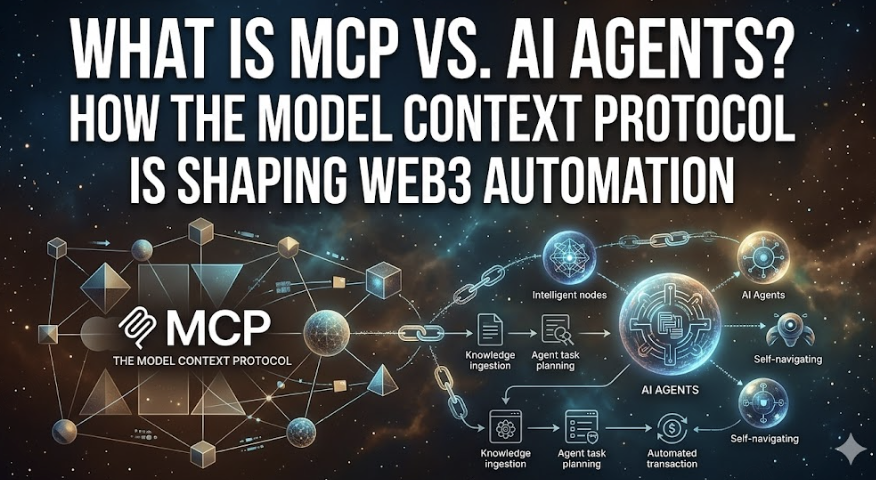
In the rapidly evolving landscape of artificial intelligence in 2026, building autonomous software requires more than just a smart language model. As developers race to create tools that can seamlessly interact with the Web3 ecosystem and traditional enterprise systems, a critical bottleneck has emerged: secure, standardized data access. This is exactly what the Model Context Protocol (MCP) was built to solve.
If you are wondering about the fundamental difference between an AI agent and MCP, it boils down to a simple analogy: one is the brain making decisions, and the other is the secure bridge delivering the reality it needs to act upon. Understanding this distinction is vital for anyone looking to navigate the future of decentralized computing.
Let's explore what MCP is, how it fundamentally differs from AI agents, and why their synergy is redefining digital automation.
Key Takeaways
-
An AI agent is the autonomous, goal-oriented decision-maker, while MCP is the standardized data pipeline that feeds the agent secure, real-time context.
-
The Model Context Protocol is an open-source standard that allows AI models to securely connect to fragmented data sources without requiring custom integration.
-
By providing direct, standardized access to verified external data, MCP drastically reduces an AI agent's tendency to hallucinate, making Web3 and enterprise automation significantly safer.
-
The Web3 ecosystem relies heavily on MCP to allow AI agents to interact securely with both private off-chain data and on-chain smart contracts without compromising user security.
-
The recent integration of native MCP support in Google Chrome 146 marks a massive leap forward for consumer adoption, enabling in-browser AI agents to securely interact with live web applications.
What is MCP (Model Context Protocol)?
To truly understand MCP, you first have to look at the biggest limitation of modern Large Language Models (LLMs). Out of the box, an AI model is essentially isolated in a vacuum; it only knows the historical data it was trained on. If you want that AI to analyze your private GitHub repository, query a live Web3 decentralized exchange, or read a local database, developers historically had to build custom, fragile API integrations for every single data source.
The Model Context Protocol (MCP) was introduced to solve this massive fragmentation problem. As an open-source standard, MCP acts as a universal, highly secure translator between AI models and external data environments.
Think of MCP like a universal USB-C cable for artificial intelligence. Before USB-C, every electronic device required a unique, proprietary charging cable. Now, one standard connects them all. Similarly, developers can build an MCP Server for a specific data source. Once that server is established, any AI model equipped with an MCP Client can instantly plug into that data stream.
Crucially, especially for Web3 and enterprise applications, MCP is designed with a security-first architecture. It does not grant an AI model free rein over a system. Instead, the protocol ensures that the AI can only access the precise data it is explicitly granted permission to see. This allows organizations and everyday users to leverage the power of advanced AI while keeping their sensitive information strictly under their own control.
What is an AI Agent?
While MCP is a standardized protocol, an AI Agent is the active software entity that actually does the work.
To understand the distinction, it helps to look at traditional artificial intelligence. If you use a standard Large Language Model (LLM) like ChatGPT, you are essentially talking to a highly advanced answering machine. It requires a human to input a prompt, and it generates text in response. An AI agent takes that LLM brain and equips it with autonomy, memory, and the ability to use external tools.
An AI agent is goal-oriented. Rather than just answering a question, you give an agent a broad objective, such as, "Analyze the liquidity pools on this decentralized exchange and rebalance my portfolio for the highest yield." The agent will autonomously break that goal down into smaller, actionable steps. It will decide which data to read, execute the trades, evaluate the outcome, and course-correct if it encounters an error, all without requiring further human input.
In the Web3 landscape, these agents have become incredibly powerful because they operate with their own digital crypto wallets. They are not just analyzing blockchain; they are actively participating in it by signing transactions, paying gas fees, and interacting directly with smart contracts.
AI Agent vs. MCP: Key Differences Explained
The easiest way to understand the relationship between these two technologies is to recognize that they solve two completely different problems. The AI agent is the decision-maker, while MCP is the data pipeline that informs those decisions.
Here is a clear breakdown of how they differ:
| Feature | AI Agent | Model Context Protocol (MCP) |
| Core Function | Executes tasks, makes autonomous decisions, and takes action. | Standardizes secure data connections so AI models can read external information. |
| Autonomy | Highly Autonomous: Reacts to environments and acts on user goals. | Passive: Not autonomous. it is a structural framework for data delivery. |
| Role in Web3 | Signs transactions, audits smart contracts, and manages crypto portfolios. | Bridges off-chain enterprise data with on-chain analytics so the agent can read it safely. |
| The Analogy | The Chef: Decides what to cook, chops the vegetables, and prepares the meal. | The Supply Chain: Securely delivers the exact, verified ingredients the chef needs. |
The Critical Distinctions
-
Execution vs. Provision: AI agents are active participants in the digital economy. They write code, send emails, and execute financial transactions. MCP is purely a provisioning tool. It does not do anything other than provide a secure, standardized pathway for the agent to access a database, a private GitHub repository, or a blockchain node.
-
Solving the Hallucination Problem: An AI agent is only as smart as the data it has access to. If an agent is asked a question but cannot securely access the relevant internal data, it is prone to "hallucinating" (inventing a false answer). MCP solves this by feeding the agent verified, real-time context exactly when it needs it, ensuring the agent's actions are grounded in factual reality.
How MCP and AI Agents Work Together in Synergy
Without MCP, an AI agent is effectively blindfolded. It might have the logical reasoning to execute a complex trading strategy, but it cannot see the current market prices or access your private portfolio balance without custom-built, fragile integrations. Conversely, without an AI agent, an MCP server is just a silent pipeline of data waiting to be read.
When combined, they create a highly secure, autonomous workflow. For example, imagine you want an AI agent to analyze a new Web3 project.
-
The AI Agent receives your prompt.
-
It uses the Model Context Protocol to securely connect to a blockchain indexer to read the project's on-chain tokenomics.
-
It uses a different MCP connection to securely read your personal risk-tolerance document stored on your local Google Drive.
-
The AI Agent then synthesizes this data and autonomously executes a trade via a decentralized exchange.
By decoupling the data pipeline (MCP) from the reasoning engine (the Agent), developers can build infinitely scalable AI tools. If a new blockchain or database emerges, the AI agent doesn't need to be entirely rewritten; a developer simply creates a new MCP server for that specific data source, and the agent can instantly connect to it.
Why the Difference Matters for Web3 and Automation
For enterprise businesses and Web3 developers in 2026, misunderstanding the difference between an AI agent and MCP can lead to severe security vulnerabilities and inefficient architecture.
In the Web3 ecosystem, data privacy and decentralized security are paramount. If developers hardcode data access directly into an AI agent, they risk exposing sensitive user data (like private wallet addresses or proprietary trading algorithms) if the agent's core model is ever compromised.
MCP provides a necessary zero-trust layer. Because the protocol strictly manages permissions, the user retains absolute control over what the AI can and cannot see. This architectural separation is exactly why major cryptocurrency exchanges and blockchain networks are heavily investing in this infrastructure. Understanding how Web3 and MCP are explaining and shaping decentralized computing is becoming a prerequisite for developers looking to build secure, agentic financial applications that bridge off-chain data with on-chain smart contracts.
Latest Milestones: Chrome 146 Launches MCP Support
The theoretical applications of MCP are rapidly becoming everyday realities. A major turning point for mainstream adoption occurred in early 2026 when it was announced that Chrome 146 launches native MCP support for AI agent integration.
Prior to this update, running local AI agents that could securely interact with your browser data required complex developer setups. By building MCP directly into the world's most popular web browser, Google has effectively standardized how in-browser AI assistants read data. This means everyday users will soon be able to deploy AI agents that can securely read their active web pages, interact with Web3 wallet extensions, and automate online tasks with unprecedented security and context awareness.
Conclusion
The difference between an AI agent and the Model Context Protocol (MCP) is the difference between the brain that makes decisions and the secure bridge that delivers its data. An AI agent is an autonomous, goal-oriented software designed to execute tasks, whereas MCP is the standardized, open-source protocol that allows that agent to securely connect to fragmented data sources without hallucinating. As we move deeper into 2026, the synergy between these two technologies, highlighted by major milestones like native Chrome integration, is paving the way for a highly secure, automated future in both enterprise computing and the decentralized Web3 economy.
FAQs
Does an AI agent need MCP to function?
No, an AI agent can function without MCP, but its capabilities will be severely limited. Without MCP, an agent must rely on its pre-trained data or require developers to build custom API integrations for every single external data source it needs to access, which is inefficient and difficult to scale.
Who created the Model Context Protocol (MCP)?
The Model Context Protocol was originally introduced by Anthropic (the creators of the Claude AI models) as an open-source standard to solve the industry-wide problem of securely connecting AI assistants to fragmented, external data sources.
Is MCP safe for enterprise and Web3 data?
Yes, MCP is designed with a security-first architecture. It operates on a permissioned basis, meaning the AI model can only access the specific data that the user or administrator explicitly allows via the MCP server, keeping sensitive corporate or Web3 data secure.
What is the difference between an API and MCP?
An API (Application Programming Interface) is a specific set of rules for two applications to talk to each other, often requiring custom coding for every new connection. MCP is a universal standard specifically designed for AI. It standardizes how AI models connect to any API or database, acting like a universal adapter for artificial intelligence.
How does Chrome 146 change AI agent integration?
By natively supporting MCP, Chrome 146 allows developers to build in-browser AI agents that can seamlessly and securely read context from web pages and local data without requiring users to install complex, custom middleware, vastly accelerating the mainstream adoption of everyday AI automation.