

Trading 101: Top Trading Strategies for Stagnating/Ranging Markets in 2026
Introduction
Crypto markets do not always move in clear bull or bear cycles. In 2025 and early 2026, traders experienced multiple periods of low volatility, sideways consolidation, and liquidity-driven fakeouts across Bitcoin, Ethereum, and altcoins. While many investors step away during these uncertain phases, experienced traders understand that stagnant and ranging markets can still create profitable opportunities when approached with the right strategy.
Ranging conditions are especially common after major macroeconomic events, ETF-driven rallies, or sudden market-wide liquidations. Instead of trending aggressively upward or downward, prices often oscillate within defined zones as traders wait for the next catalyst. These market environments can frustrate trend-following traders, but they also open the door for structured approaches such as support and resistance trading, yield-generating strategies, staking, and crypto lending.
For crypto investors, the biggest mistake during a stagnant market is assuming that “nothing is happening.” In reality, sideways markets are often accumulation phases where smart money positions itself before the next major breakout. Understanding how to navigate these conditions can help traders preserve capital, reduce emotional decision-making, and continue generating returns even when price action appears slow.
In this guide, we’ll explore some of the most practical strategies for trading and investing during stagnant and ranging crypto markets, including modern updates relevant to today’s market structure and evolving DeFi ecosystem.
Ranging Markets
Support and Resistance Trading
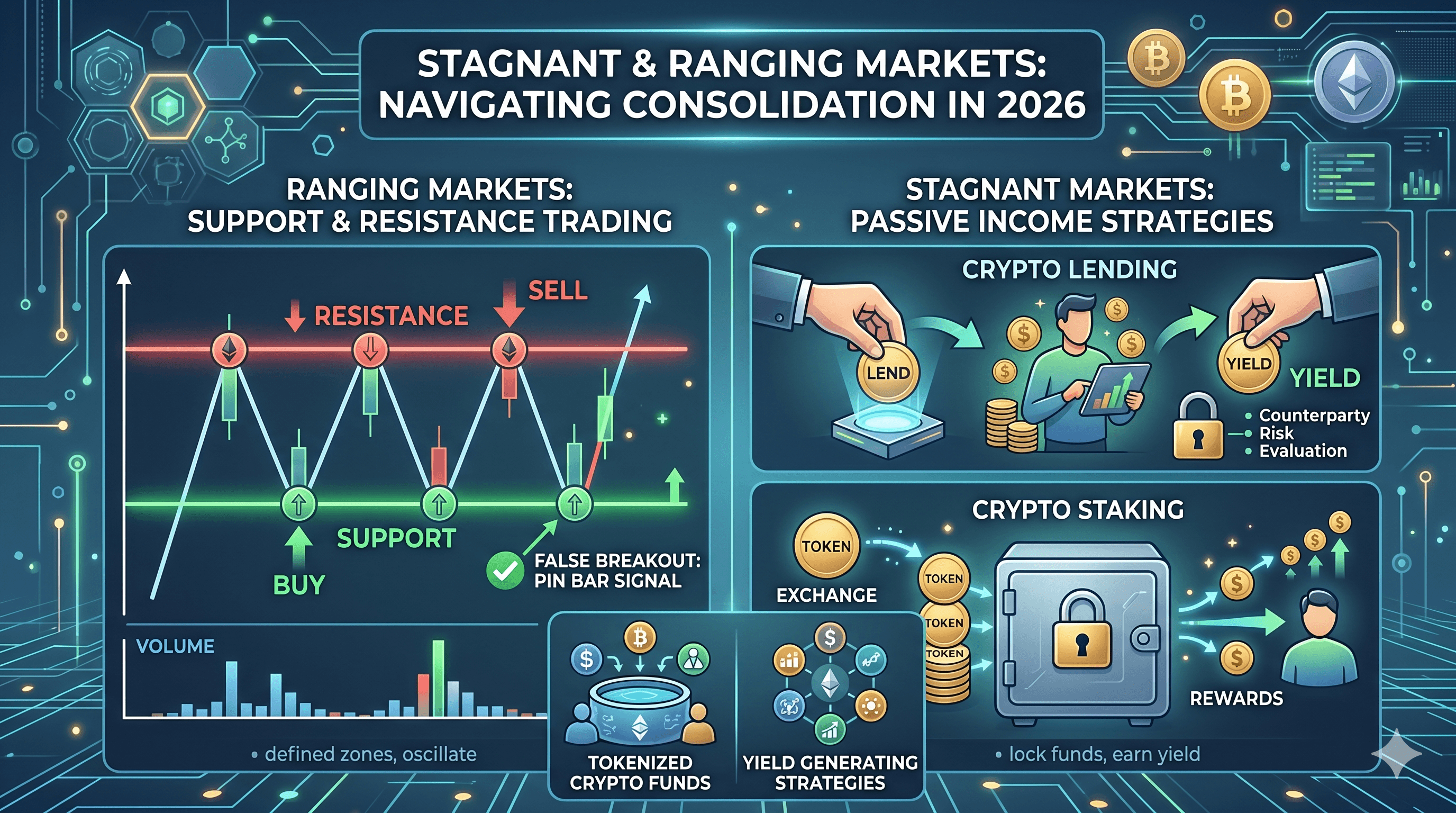
Before even attempting to trade in a ranging market, you must mark the relevant support and resistance levels. While it’s not always necessary to trade support and resistance, marking them provides you a clearer view of how the market is performing or its form of ranging.
However, suppose you now decide to trade in the ranging crypto market using support and resistance; the concept is quite straightforward. Once you’ve marked the relevant levels, anytime the price reaches the resistance mark, you should consider selling, and whenever it reaches the support mark, you should buy.
Pros
You can predict what the price does around the resistance and support level.
Reasonable risk-reward ratio.
You can enhance your trading entry with reversal candlesticks featured in this strategy.
Cons
Price may break the level, and as such, not obey them.
Sometimes, you may experience false breaks or spikes.
False Breakouts Trading
Closely monitor the market for false breakouts, also called fakeouts. A false breakout is a practical approach to trading in a ranging crypto market. Usually, it features pin bar candlesticks, sticking off resistance and support levels. In a false breakout, instead of the price breaking into a trend, it keeps ranging. While fakeouts can trap other traders, such as breakout traders, crypto traders in the ranging market see it as a blessing, which presents the perfect opportunities to sell or buy assets.
When trading in the ranging market, try not to chase the price when there is a breakout. Usually, range breakouts can be relatively strong and may carry your profits with them. Suppose you caught on the unfavorable side of this strategy; the best thing to do is to cut the loss and waiting for another entry chance. Besides, it’s not always advisable to trade back towards the range following a breakout. However, you can use the retest of boundaries as exit opportunities.
Predicting a Breakout
Volume is an effective way to know when there's about to be a breakout. Suppose there's a lot of trading volume; this may sometimes denote that a breakout is about to occur. Breakout succeeds trading volumes.
Pros
It requires no extensive knowledge. It's just price action trading with relatively straightforward rules that even beginners can understand.
The risk-reward ratio is reasonable.
Cons
You can easily miss a false breakout signal.
False breakout signals can still be false.
Stagnant Markets
Invest in Tokenized Crypto Funds
Suppose you want to profit from any strategy mentioned earlier without needing to manage a portfolio; tokenized crypto funds might be the best option for you.
You’ve probably heard of traditional investment funds. In essence, they are a pool of investor capital, managed by professional investors. These specialists adopt a range of effective strategies, including the previously discussed ones, to help you earn returns on every capital within the fund. As an investor in the pool, you get benefits by gaining access to the skills of other professional traders, while the trader benefits from your capital. Essentially, it is a win-win situation.
Pros
Access to the skills of other traders;
Generate sizable ROI;
You can make a profit from any market condition.
Cons
The tokens can be relatively expensive.
Crypto Lending
Crypto lending has evolved significantly in recent years and remains one of the most popular passive income strategies during stagnant market conditions. Instead of leaving digital assets idle in a wallet, investors can lend them through centralized or decentralized platforms to earn yield over time.
Modern lending opportunities now extend beyond simple stablecoin deposits. Many platforms support lending for major cryptocurrencies such as Bitcoin, Ethereum, and Solana, while decentralized finance (DeFi) protocols allow users to participate without relying entirely on centralized intermediaries.
However, the crypto industry has also learned hard lessons from previous lending platform collapses and liquidity crises. Investors should carefully evaluate platform transparency, proof-of-reserves systems, collateral management practices, and smart contract security before committing funds.
Using established platforms with strong risk controls and diversified reserves can help reduce counterparty risk while still generating passive income during slow market periods.
Pros
You earn irrespective of market conditions;
No experience required;
No trading skills required.
Cons
You lose control of your funds. In essence, you are sending it to someone with the hope to get it back someday with profit. However, if you fall into the hands of scammers, you may not get your assets back.
Stake your assets
Crypto staking is another straightforward strategy to earn in a stagnant market. As a user, you buy a crypto asset via an exchange or your preferred means. Then you lock it on any crypto wallet supporting staking. As the funds remain locked for some period of time, you receive rewards. It is just like a bank deposit, but decentralized and online.
Pros
Low entry and easy way to generate passive income.
Simple and easy to understand.
Cons
A drop in asset value may hurt your investment.
Relatively low profit.
Conclusion
Stagnant and ranging crypto markets are often misunderstood as periods where little opportunity exists. In reality, these conditions can provide disciplined traders and long-term investors with some of the best environments for strategic positioning, passive income generation, and risk-controlled trading.
Modern crypto markets are now heavily influenced by derivatives activity, institutional liquidity flows, algorithmic trading, and macroeconomic sentiment. As a result, traders must adapt beyond traditional strategies and combine technical analysis with tools such as funding rates, open interest data, staking yields, and on-chain insights.
Whether through support and resistance trading, identifying false breakouts, staking, crypto lending, or participating in tokenized investment products, investors today have far more ways to navigate sideways markets than in previous crypto cycles.
The key is not to fear stagnant conditions, but to recognize them as part of the natural market cycle. With proper risk management, patience, and strategic execution, ranging markets can become opportunities for accumulation and steady portfolio growth ahead of the next major trend.