

Why Ansem Says Solana DeFi Is This Cycle’s Most Undervalued Opportunity
Solana DeFi Gains Attention as Core Infrastructure Matures
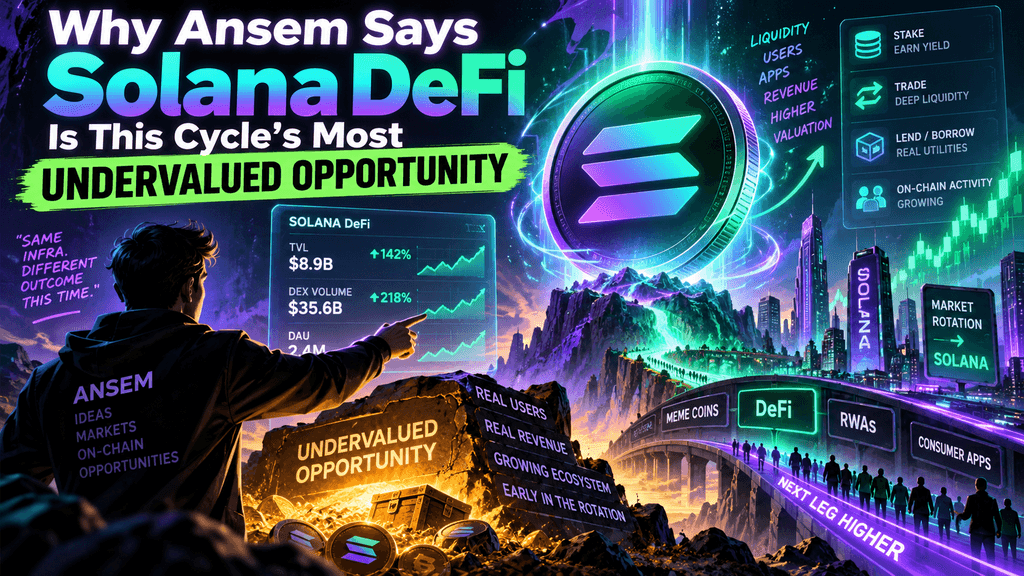
Crypto trader Ansem recently stated he is increasingly bullish on Solana DeFi, describing it as one of the more overlooked investment opportunities of the current cycle. In a post on X, he noted that meme coins captured most market attention in the prior cycle while protocols such as Jito and Jupiter remained early in their token lifecycles. He argued that the market can now more clearly identify which protocols are emerging as core infrastructure for Solana. Low fees, fast execution, and steadily growing on-chain transaction volume reinforce the thesis, he added, as retail investors, institutions, and tokenized equities continue moving on-chain. This assessment arrives as Solana’s DeFi landscape shows measurable maturation.
Total value locked sits in the range of roughly $6.5 billion to $9 billion according to recent trackers, with daily DEX volumes frequently exceeding $2 billion and stablecoin supply reaching new highs near $17 billion. These figures reflect sustained capital presence even after earlier drawdowns, positioning the ecosystem for potential expansion as activity broadens beyond speculation. Ansem’s view rests on the transition from meme-driven attention to identifiable core infrastructure protocols that benefit from Solana’s technical advantages and the ongoing migration of diverse capital onto the chain, creating asymmetric opportunity relative to the prior cycle’s focus.
Ansem’s Direct Assessment of Solana DeFi Maturity in Late September 2026
Ansem’s comments, dated around September 24-25, 2026, frame Solana DeFi as underlooked precisely because the previous cycle’s narrative was dominated by high-velocity meme trading. Protocols that now form the backbone of the ecosystem were then still establishing product-market fit and token distribution schedules. This created a lag in recognition for liquid staking, aggregation, and related services. Current clarity allows market participants to evaluate these protocols on the basis of their functional roles rather than speculative novelty alone. The shift matters because infrastructure that processes real transaction flow tends to capture value more sustainably once usage scales.
Supporting data shows Solana continuing to process high daily transaction counts and maintaining competitive fee levels that encourage frequent interaction. Active addresses and fee generation remain elevated relative to quieter periods earlier in the year. These operational metrics provide a foundation for Ansem’s claim that the setup has strengthened as capital from multiple participant types arrives on-chain. The combination of technical readiness and clearer protocol positioning distinguishes the present environment from earlier phases when attention remained fragmented.
How Prior-Cycle Meme Activity Delayed Infrastructure Recognition
During the previous market cycle, Solana’s remarkably low barriers to token creation and trading led to an intense and overwhelming focus on meme assets. This particular activity generated substantial trading volume and introduced a significant number of new users to the network, yet it also diverted much-needed capital and narrative attention away from essential protocols that deliver critical services such as liquid staking, routing, and lending. Notably, Jito and Jupiter, among others, operated in an environment where their long-term utility and value proposition were secondary to the prevailing short-term trading narratives that dominated the market. Additionally, token unlock schedules and the challenges of early-stage product development further limited immediate price discovery for these assets when compared to the more straightforward and simplistic meme tokens.
The residual effect of this phenomenon is a market that continues to underweight the compounding advantages of protocols that are now handling core network functions and responsibilities. As the cycles of meme volume begin to normalize, capital can gradually rotate toward services that generate recurring fees and support broader application growth across the ecosystem. Recent on-chain volume trends indicate that this rotation has begun to take shape in a measured and cautious form, with categories such as liquid staking and aggregators showing notable resilience in the face of changing market dynamics. Understanding the prior distractions and misallocations of attention helps explain why Ansem considers the current opportunity to be significantly underpriced relative to the operational progress that the ecosystem has made.
Clearer Identification of Core Infrastructure Protocols
Ansem has notably highlighted the enhanced capability to identify which protocols are evolving into essential infrastructure within the blockchain ecosystem. For instance, liquid staking facilitated by Jito, along with aggregation and lending services provided through Jupiter, exemplify protocols that have successfully progressed beyond the initial stages of their token lifecycle. These innovative services have now established deep integrations with a variety of other applications, thereby generating significant network effects that not only increase switching costs for users but also enhance the stickiness of their usage patterns. As a result, market participants are now able to observe critical metrics such as fee generation, total value locked (TVL) composition, and the depth of integration with much greater confidence than was possible in previous periods.
This newfound clarity effectively diminishes the uncertainty that had previously constrained both institutional investors and sophisticated retail participants in their allocation strategies. Protocols that feature transparent revenue mechanisms and boast established user bases now present risk-reward profiles that are significantly more evaluable. Data collected from recent quarters indicates that these specific categories are retaining substantial shares of Solana's total value locked, even as the overall figures have fluctuated in response to changes in the price of SOL. The resulting landscape strongly supports Ansem’s thesis, which posits that exposure to infrastructure offers a distinct and promising vector for capturing growth within the ecosystem during this current market cycle.
Solana’s Low Fees and Fast Execution as Structural Advantages
Solana’s architecture is designed to consistently deliver sub-second finality, ensuring that transactions are confirmed almost instantaneously. Additionally, the transaction costs are remarkably low, often measured in fractions of a cent under typical operating conditions. These advantageous characteristics significantly reduce the friction associated with frequent rebalancing, arbitrage opportunities, and high-frequency trading strategies, which collectively form the essential backbone of active decentralized finance (DeFi) ecosystems. In comparison to higher-cost environments, Solana’s network actively encourages continuous capital deployment, as opposed to sporadic large trades that can disrupt market dynamics.
Latest daily fee and revenue figures provide compelling evidence of sustained usage that aligns perfectly with this innovative design. The practical outcome of these features is a notably higher velocity of capital within various DeFi protocols. Liquid staking tokens, lending markets, and perpetual trading platforms all stand to benefit immensely when users can enter and exit their positions in a cost-effective manner. Ansem’s strong emphasis on these technical strengths is well-aligned with the observed leadership in trading volume on decentralized exchanges. As an increasing number of participants prioritize execution quality, the inherent advantages of Solana become self-reinforcing, further enhancing the protocols that are built on top of its robust infrastructure.
Growing On-Chain Transaction Volumes Reinforcing the Thesis
Transaction counts and DEX volumes on Solana have consistently remained elevated, with recent daily figures frequently surpassing an impressive $2 billion in decentralized exchange activity. Cumulative volume milestones, along with a consistent ranking among the leading chains for trading throughput, provide substantial quantitative support for claims of expanding activity within this vibrant ecosystem. These metrics effectively capture both speculative and functional usage, which includes stablecoin transfers and various protocol interactions that are essential for the network's operation.
The rising volume directly contributes to fee generation for core protocols and significantly enhances the economic security of the network through the implementation of higher priority fees and tips. Additionally, liquid staking and aggregation services play a crucial role in capturing portions of this substantial flow of activity. The ongoing trend of growing on-chain activity, therefore, underpins Ansem’s insightful view that DeFi protocols are strategically positioned to benefit as both the user base and capital base expand simultaneously, creating a more robust and dynamic financial space.
Retail and Institutional Capital Migration Onto Solana
Retail participation has been prominently evident for quite some time, characterized by a significant number of active addresses and notable flows associated with meme-related activities. In contrast, institutional interest has emerged more recently, manifesting through observable patterns in stablecoin issuance, growth in real-world assets (RWA), and reported initiatives exploring the potential of tokenized products. This growing ecosystem creates a more extensive and diverse capital base compared to the predominantly retail-focused composition seen in earlier market cycles. The expansion of stablecoin supply to approximately $17 billion provides a substantial amount of readily available liquidity, which can be strategically deployed into various yield-generating and trading strategies.
This dual inflow of capital not only supports deeper liquidity across decentralized finance (DeFi) markets but also diminishes the reliance on any single participant cohort, thereby enhancing overall market stability. Protocols that are designed to facilitate efficient capital deployment are well-positioned to intermediate larger volumes of transactions. Ansem’s insightful observation that retail investors, institutional players, and tokenized equities are increasingly moving on-chain reflects these parallel trends and highlights the resulting opportunities for the development of robust infrastructure layers that can support this growth.
Tokenized Equities and Real-World Asset Expansion
Real-world assets on the Solana blockchain have experienced significant growth, surpassing several billion dollars in reported value. This impressive increase has been notably influenced by public equities and related financial products, which have made meaningful contributions in recent quarters. The introduction of tokenized stocks and funds has played a crucial role in enhancing the diversity of collateral options and trading pairs that are available on-chain. This development not only enriches the ecosystem but also expands the addressable market for various financial activities, including lending, derivatives trading, and liquidity provision, extending well beyond the realm of native crypto assets.
Decentralized finance (DeFi) protocols that successfully integrate real-world asset (RWA) collateral or facilitate related swaps are positioned to gain valuable exposure to traditional finance capital that is actively seeking the efficiency and advantages offered by on-chain solutions. This emerging trend aligns closely with Ansem’s insightful mention of tokenized equities as a significant driver of growth within the sector. The continued issuance of these financial instruments, along with robust secondary market activity, would further embed Solana's DeFi ecosystem within the broader capital markets landscape, thereby amplifying the overall value of the core infrastructure that supports these innovative financial services.
Liquid Staking Protocols and Capital Efficiency Gains
Liquid staking tokens, particularly those associated with Jito, have emerged as crucial components of the total value locked (TVL) within the Solana ecosystem. These innovative financial instruments enable staked SOL to maintain liquidity, allowing it to be utilized as collateral or incorporated into various trading strategies, thereby enhancing overall capital efficiency. Recent data reflecting weekly inflows into the liquid staking categories indicates a sustained demand for these tokens, even in the face of price volatility that characterizes the cryptocurrency market. The ability to generate yield from staking rewards, along with the tips related to miner extractable value (MEV), continues to draw in depositors who are eager to capitalize on these opportunities. Moreover, the composability of these liquid staking tokens across lending platforms and perpetual trading platforms significantly multiplies their utility and effectiveness.
As an increasing amount of SOL is staked in liquid form, the foundational base of usable collateral expands, creating a more robust ecosystem. This dynamic not only supports elevated levels of activity across interconnected decentralized finance (DeFi) applications but also reinforces the infrastructure thesis that Ansem previously outlined, highlighting the importance of these developments in the broader context of the DeFi landscape. The interplay between liquid staking and the overall capital efficiency within the Solana network is a testament to the innovative potential of these financial instruments, paving the way for future growth and adoption in the DeFi sector.
Aggregators and Perpetual Platforms Capturing Trading Flow
Jupiter and other similar aggregation services play a crucial role in routing a significant portion of the spot trading volume on the Solana blockchain. Meanwhile, perpetual platforms are specifically designed to cater to the demand for leveraged trading. These innovative products effectively convert the network's throughput into revenue for the protocol by imposing fees on various swaps and trading positions. Recent figures regarding Total Value Locked (TVL) for both lending and perpetual components serve to illustrate their considerable scale and importance within the broader ecosystem.
The high number of trades occurring on these platforms, especially when compared to traditional trading venues, highlights the competitive advantage that on-chain alternatives hold in the current market space. As trading activity continues to remain at elevated levels, the protocols that facilitate and intermediate this trading activity are able to accumulate substantial economic value. Their seamless integration with various wallets and other applications creates significant distribution advantages that enhance their overall effectiveness. This particular layer of the technological stack benefits directly from the growth in trading volume and the migration of users to these platforms, a trend that Ansem has notably highlighted in his analysis.
Stablecoin Reserves as Dry Powder for DeFi Deployment
Stablecoin market capitalization on the Solana blockchain has impressively surged to record levels approaching $17 billion, significantly surpassing the current Total Value Locked (TVL) in various decentralized finance (DeFi) trackers. This notable imbalance highlights the existence of substantial capital that is currently sitting on-chain, which has the potential to be deployed into yield-bearing opportunities or trading strategies when market conditions become favorable for such deployment. The recent highs in stablecoin market capitalization have been bolstered by fresh issuance from major stablecoin providers, contributing to this upward trend.
The presence of large stablecoin balances plays a crucial role in reducing friction for new capital to enter various protocols. This influx of capital can be efficiently absorbed by lending markets, liquidity pools, and structured financial products. Ansem’s broader thesis regarding the expansion of on-chain activity finds strong support in this vast reservoir of deployable liquidity, which dwarfs the locked value present in many other categories within the DeFi ecosystem. This dynamic creates a fertile ground for innovative financial strategies and enhances the overall robustness of the Solana DeFi ecosystem.
Practical Evaluation Framework for Solana DeFi Exposure
Assessing opportunities requires examining protocol-specific revenue, integration depth, token distribution maturity, and sensitivity to network activity. Monitoring TVL composition shifts, stablecoin deployment rates, and RWA adoption provides leading indicators. Risk considerations include smart-contract exposures, liquidation cascades during volatility, and competition among similar services. Current Solana price action and broader Bitcoin market movements influence capital allocation across the ecosystem and should be tracked alongside protocol metrics.
Participants can also review how crypto futures leverage works in the context of perpetual platforms on Solana to understand amplified exposure mechanics. Combining on-chain data with Ansem’s qualitative framing of clearer infrastructure yields a structured approach to identifying potential value. The environment remains dynamic, and continuous verification of usage statistics remains essential.
🔥 Beyond the Headlines: What KuCoin 5.0 Means for You
Market news moves fast — but where you act on it matters just as much. This October, KuCoin launches KuCoin 5.0, transforming KuCoin into a rebuilt platform. Here's what actually changes for you:
-
One account for everything. Older platforms split your money across separate "spot," "margin," and "futures" accounts and expected you to understand why. KuCoin 5.0's unified account removes that entirely — deposit once, and everything is simply there (only available to VIPs for now).
-
Stocks, indices, and commodities. KuCoin 5.0 expands beyond crypto into global markets. When crypto chops sideways and equities rally (or the reverse), you rotate in minutes instead of opening a brokerage account and waiting days for fiat rails.
-
Real-world assets (RWA). Tokenized exposure to traditional assets like commodities, right inside your crypto account. One of the fastest-growing segments in global finance is no longer reserved for institutions — you access it from the same balance you trade with.
-
Earn while you learn. Not ready to trade? KCUSD lets your stablecoins earn daily, auto-compounding interest. The lowest-stress way to put your idle deposit to work for 4% yield.
-
An AI assistant in plain language. Ask questions, get market context, understand what you're looking at — built into the platform, no jargon required.
-
An app that doesn't overwhelm. Faster, cleaner, and consistent — intuitive from the first tap, not after a tutorial.
-
Safety you can check, not just trust. A MiCAR-licensed EU entity, Proof of Reserves you can verify yourself, and internationally certified security (SOC 2 Type II, ISO 27001:2022).
Create your account in minutes — and start on the platform built for where crypto is going, not where it's been.
FAQs
What specific factors did Ansem cite when describing Solana DeFi as undervalued this cycle?
Ansem pointed to the prior cycle’s heavy focus on meme coins, which left protocols such as Jito and Jupiter in earlier stages of their token lifecycles. He noted that the core infrastructure landscape has become clearer, supported by low fees, fast execution, and rising on-chain volume. The continued movement of retail, institutional, and tokenized equity capital onto the chain further strengthens the setup, according to his comments published in late September 2026.
How has Solana’s DeFi TVL evolved in recent months?
Trackers show Solana DeFi TVL fluctuating in the mid-single-digit billions, with recent readings around $6.5 billion to $9 billion depending on the exact methodology and asset price levels. Liquid staking and lending categories have shown relative resilience, while overall figures remain influenced by SOL price movements. The network has maintained a meaningful share of total crypto DeFi TVL despite broader market conditions.
Why do low fees and fast execution matter for DeFi protocols on Solana?
These characteristics reduce the cost of frequent interactions such as rebalancing, arbitrage, and liquidations. Lower friction encourages higher capital velocity, which increases fee generation for protocols and improves the usability of liquid staking tokens and lending markets. Sustained high transaction throughput provides a quantitative foundation for infrastructure value capture.
What role do stablecoins play in the Solana DeFi opportunity?
Stablecoin supply has reached records near $17 billion, creating a large pool of liquid capital available for deployment into yield strategies, trading, and liquidity provision. This excess relative to current DeFi TVL represents potential dry powder that can expand locked value and activity when market conditions encourage risk-on allocation.
How significant is the growth of tokenized equities and RWAs on Solana?
Real-world asset value has expanded into the multi-billion-dollar range, with public equities becoming a larger component in recent quarters. This diversification introduces new collateral types and trading demand that DeFi protocols can intermediate, broadening the user and capital base beyond native crypto assets.
Which protocols did Ansem highlight as examples of maturing infrastructure?
Ansem referenced Jito and Jupiter specifically as protocols that were earlier in their token lifecycles during the prior cycle. These and similar services now occupy clearer roles in liquid staking, aggregation, lending, and related functions that support the broader ecosystem.
Disclaimer: This content is for informational purposes only and does not constitute investment advice. Cryptocurrency investments carry risk. Please do your own research (DYOR).