

Are July Nonfarm Payrolls and Berkshire Q2 Earnings Two Signals of a US Stock Market Rebound?
2026/08/10 10:55:00
Introduction
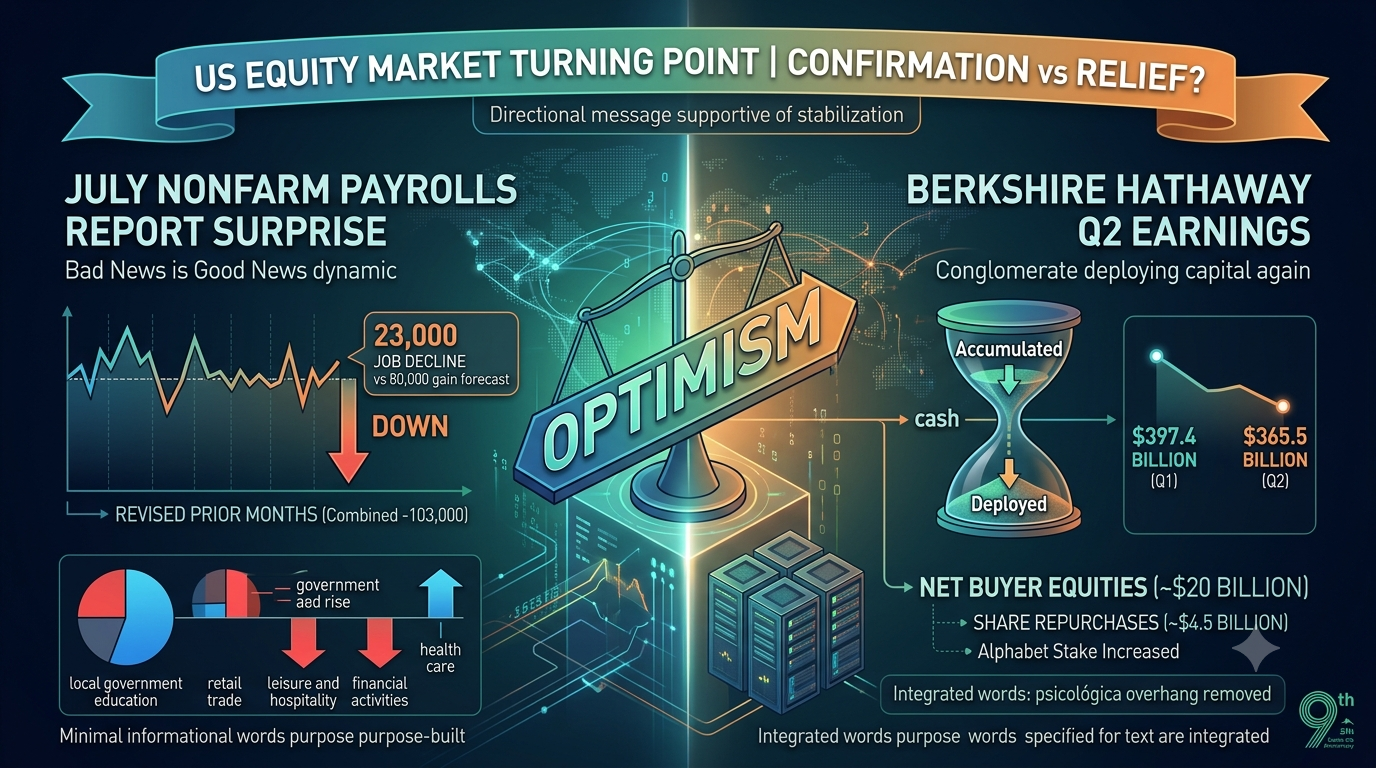
Last Friday delivered two developments that could mark a turning point for a recently soft US equity market. The first was the July nonfarm payrolls report, which showed a surprising decline of 23,000 jobs against expectations of an 80,000 gain. This marked the first drop since February and sharply raised market odds of Federal Reserve rate cuts, sending the Dow, S&P 500, and Nasdaq higher.
The second came from Berkshire Hathaway’s Q2 earnings, which revealed cash reserves falling from a record $397 billion in Q1 to $365.5 billion. The roughly $31.5 billion reduction, including significant equity purchases, signals that the conglomerate has begun deploying capital more aggressively after years of caution. Together these events provide the clearest recent evidence that both macroeconomic conditions and influential capital allocators may be shifting in favor of equity markets.
What Did the July Nonfarm Payrolls Report Reveal About the Labor Market?
The July nonfarm payrolls report showed total nonfarm employment fell by 23,000, well below the consensus forecast of an 80,000 increase and the first monthly decline since February 2026. According to the US Bureau of Labor Statistics data released on August 7, 2026, private-sector payrolls still rose by 30,000 while government employment dropped 53,000, driven largely by local government education losses. Unemployment edged down to 4.1 percent from 4.2 percent, and average hourly earnings rose only 0.1 percent month-over-month, bringing the year-over-year increase to 3.2 percent.
Prior months were also revised lower by a combined 103,000 jobs, confirming a cooling trend that had been understated. Health care continued to add positions, while retail trade, leisure and hospitality, and financial activities posted declines. The softer headline number immediately increased market expectations for Federal Reserve rate cuts. Futures markets adjusted pricing for easier policy, and major equity indexes closed higher on the day of the release.
This outcome fits a classic “bad news is good news” dynamic for stocks. Weaker labor demand reduces the risk of overheating and gives the Fed more room to ease if inflation continues to moderate. The report therefore removed one near-term headwind that had weighed on risk assets in recent weeks.
How Did Markets React to the Unexpected Jobs Data?
Equity futures jumped after the data crossed the wires, with Nasdaq 100 contracts leading gains on the prospect of lower rates. The three major indexes finished the session higher as investors recalibrated rate-cut probabilities higher. Soft payrolls combined with contained wage growth lowered the odds of further policy tightening and supported higher valuations for growth-oriented sectors.
Technology and other rate-sensitive areas outperformed because discounted future cash flows become more valuable when interest rates are expected to fall. The reaction was orderly rather than euphoric, suggesting the market viewed the data as confirmation of a gradual cooling rather than an abrupt recession signal. Downward revisions to previous months reinforced the narrative that earlier strength had been overstated, making the July print a credible turning point in labor-market momentum.
What Key Numbers Stood Out in Berkshire Hathaway’s Q2 Earnings?
Buffett's Berkshire Hathaway reported a decline in cash and short-term investments from a record $397.4 billion at the end of the first quarter to $365.5 billion at the end of June. The reduction of approximately $31.5 billion marked the first meaningful drawdown after an extended period of cash accumulation. Operating earnings rose 16 percent year-over-year to $12.98 billion, driven by strength in manufacturing, services, retailing, and energy, while insurance underwriting was softer.
The company became a net buyer of equities for the first time in 14 quarters, purchasing roughly $20 billion more stock than it sold. Share repurchases accelerated to $4.5 billion in the quarter. These moves reverse the long-standing caution that had left Berkshire holding an unusually large cash buffer—an overhang that many investors had interpreted as a lack of confidence in equity valuations.
Why Does Berkshire’s Cash Reduction Matter for Market Sentiment?
A sustained high cash position at Berkshire had been read by many as a cautionary signal that attractive investment opportunities were scarce. The Q2 reduction demonstrates that management under CEO Greg Abel is willing to put capital to work again. When one of the largest and most closely watched capital allocators shifts from accumulation to deployment, it often reassures other investors that valuations have become more reasonable or that specific opportunities justify risk-taking.
The change removes a psychological overhang. Markets had fretted that Berkshire’s record cash pile implied the legendary investor’s successors saw limited upside. Spending more than $30 billion in a single quarter, including both buybacks and equity purchases, indicates that view has evolved. Sentiment can improve when a high-profile balance sheet begins to rotate from cash into productive assets.
How Significant Was Berkshire’s Increased Stake in Alphabet?
Of the capital deployed, approximately $20 billion went into net equity purchases, with a substantial portion directed toward Alphabet. Berkshire added to its Google parent holding through both open-market activity and a private placement, making Alphabet one of its larger positions. In an environment dominated by artificial-intelligence narratives, this allocation is notable.
Investors concerned about elevated valuations in pure-play semiconductor or memory stocks often look for more diversified exposure to the same theme. Alphabet offers AI infrastructure demand through its cloud and advertising businesses while generating substantial free cash flow from existing operations. Following Berkshire’s lead into a high-quality compounder rather than chasing the most speculative AI-related names provides a relatively steadier way to participate in the theme.
Do These Two Developments Constitute Reliable Signals of Stabilization?
The combination of softer labor data and Berkshire’s capital deployment supplies two independent reasons for optimism. The payrolls surprise raises the probability of Fed easing, which historically supports equity multiples. Berkshire’s cash reduction signals that sophisticated capital is finding opportunities after a period of restraint. Neither event alone guarantees a sustained rally, yet together they address the two primary concerns that had pressured stocks: the risk of tighter policy for longer and the absence of major institutional buying interest.
History shows that inflection points in labor-market data and shifts in high-profile balance sheets often coincide with improved equity performance. The market’s immediate positive reaction to both pieces of news suggests investors are interpreting them as constructive. Risks remain—further softening in employment or unexpected inflation could reverse the rate-cut narrative—but the directional message from last Friday’s releases is supportive of stabilization and potential recovery.
Should You Trade US Equities and Related Themes on KuCoin?
KuCoin offers a convenient platform for traders seeking exposure to US market themes through crypto assets that often move in correlation with equity sentiment, AI narratives, and macroeconomic shifts. Users can access a wide range of tokens linked to technology, artificial intelligence, and broader risk-on environments while benefiting from deep liquidity and advanced trading tools.
Whether positioning for a potential rebound in growth stocks or hedging macro uncertainty, KuCoin’s competitive fees, robust security features, and intuitive interface make it straightforward to execute strategies aligned with the signals discussed above. Opening an account allows immediate participation in these opportunities as market conditions evolve.
Join KuCoin 9th Anniversary Trading Campaign
Now you can trade such trending stock assets on KuCoin, including popular stocks like GOOGL, SpaceX, NVDA, and others.
KuCoin is celebrating its 9th anniversary with a special platform campaign filled with exclusive rewards, trading activities, and limited-time offers. Don’t miss the chance to participate and enjoy the benefits as the exchange marks nine years of growth and innovation. Visit the official campaign page now:

Conclusion
July’s nonfarm payrolls surprise—a 23,000-job decline versus an expected 80,000 gain—and Berkshire Hathaway’s reduction of cash reserves from $397 billion to $365.5 billion stand as the two most significant recent signals that the US equity market may be stabilizing. Softer employment data has increased the likelihood of Federal Reserve rate cuts, while Berkshire’s renewed capital deployment, including substantial additions to Alphabet, removes a long-standing psychological barrier. Markets responded positively on the day of the releases, confirming that investors are treating both developments as constructive.
These events do not eliminate near-term volatility or guarantee an uninterrupted advance. Labor-market trends can reverse, and valuations in certain sectors remain elevated. Yet the simultaneous improvement in the macroeconomic outlook and the behavior of one of the world’s most closely followed capital allocators provides a clearer foundation for recovery than had been visible in preceding weeks. Traders and investors monitoring US equities should continue to track subsequent employment reports, Fed communication, and institutional flows for confirmation that last Friday’s signals are developing into a sustained shift.
FAQs
What was the exact July nonfarm payrolls figure compared with expectations?
Nonfarm payrolls fell by 23,000 in July 2026, against a consensus forecast of an 80,000 increase, according to the Bureau of Labor Statistics.
How much did Berkshire Hathaway’s cash reserves decline in Q2?
Cash and short-term investments dropped from a record $397.4 billion at the end of Q1 to $365.5 billion at the end of June, a reduction of roughly $31.5 billion.
Did Berkshire buy Alphabet shares in the second quarter?
Yes. Berkshire made net equity purchases of approximately $20 billion and directed a significant portion, including a large private-placement investment, into Alphabet.
Why did stocks rise after weaker jobs data?
Softer employment reduced the probability of additional Federal Reserve tightening and increased the odds of rate cuts, supporting higher valuations for equities.