

What Will XRP Be Worth in 2030? A Comprehensive 2026 Market Analysis
2026/03/25 16:12:02

The global financial landscape is undergoing a silent but profound architectural shift. As of early 2026, the era of pure speculation in the cryptocurrency market has matured into an era of structural utility. Among the thousands of digital assets, XRP stands as a uniquely positioned contender, not merely as a "coin" for retail trading, but as a foundational protocol for the Internet of Value.
Determining what XRP will be worth in 2030 requires moving beyond simple chart patterns. It necessitates an examination of the intersection between central bank digital currencies (CBDCs), institutional liquidity flows, and the definitive regulatory framework that was established following the resolution of the SEC v. Ripple litigation in 2025.
In this 2026 vantage point, we can see the "pipes" of the new financial system being laid, providing a clearer mathematical basis for XRP's valuation over the next four years.
Key Takeaways
-
The Utility Shift: XRP’s value is increasingly decoupled from Bitcoin’s volatility, driven instead by transaction volume on the XRP Ledger (XRPL) and its role in the $150 trillion cross-border payment market.
-
Institutional Infrastructure: The 2025 launch of XRP Spot ETFs and the subsequent 2026 "Clarity Act" have allowed US banks to move from experimentation to full-scale treasury integration.
-
The RLUSD Catalyst: The integration of Ripple’s USD-backed stablecoin (RLUSD) has provided the "low-volatility on-ramp" that institutions required, paradoxically increasing demand for XRP as the underlying bridge asset.
-
Projected Price Brackets: Conservative models for 2030 focus on a range of $12.00 to $15.00, while institutional "hyper-utility" models suggest a ceiling of $25.00 if the XRPL captures a significant share of tokenized Real-World Assets (RWAs).
-
Deflationary Mechanics: The burn rate of XRP, while historically low, is accelerating as the number of automated market maker (AMM) pools and tokenized assets on the ledger grows.
What Are the Key Drivers for XRP in 2030?
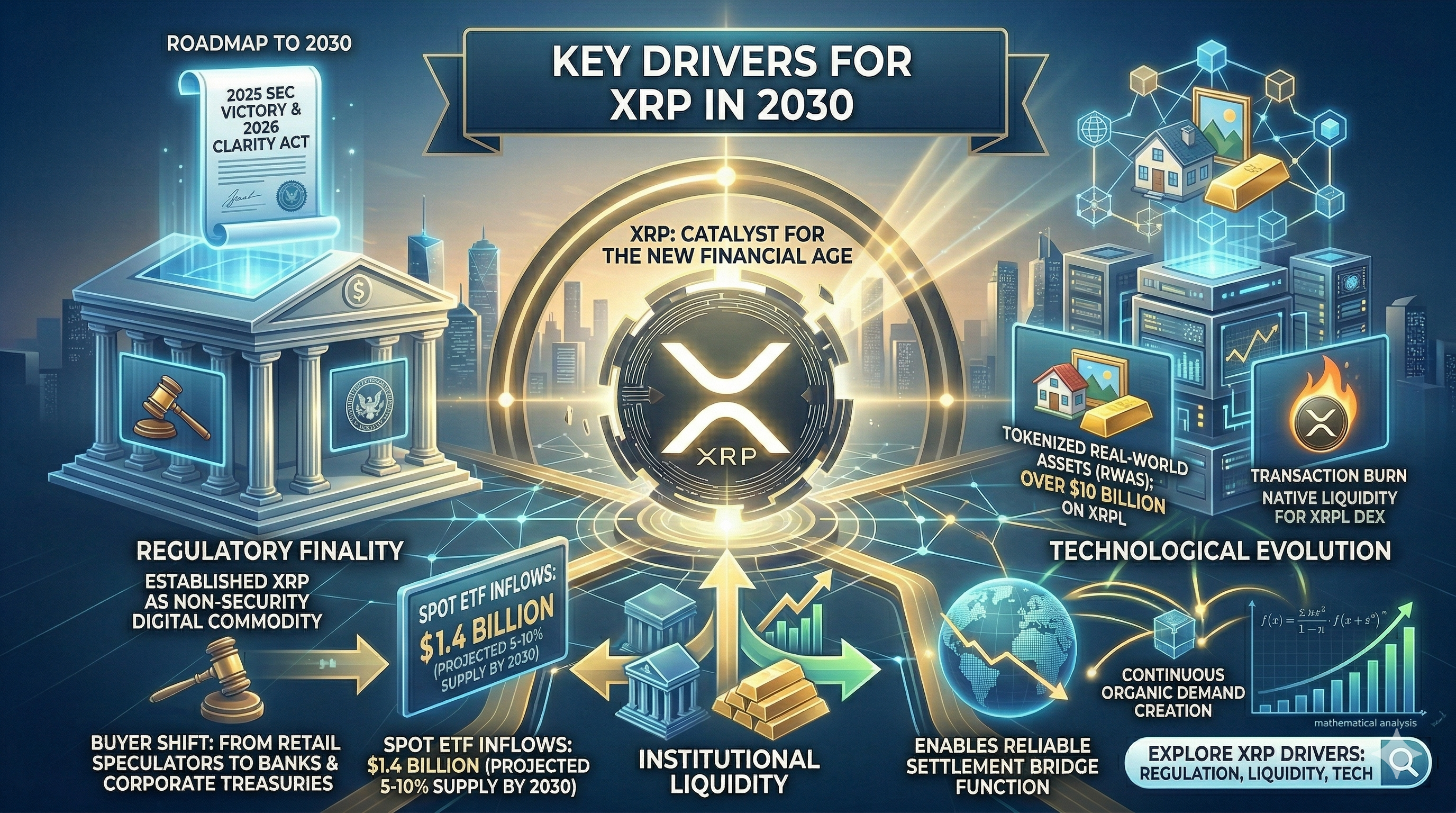
To understand the price of XRP in 2030, we must analyze the three core pillars that support its ecosystem: Regulatory Finality, Institutional Liquidity, and Technological Evolution.
Regulatory Finality and the "Clarity Act" of 2026
The single greatest weight on XRP’s price for half a decade was the uncertainty surrounding its legal status in the United States. Following the 2025 court victory and the subsequent passage of the Digital Asset Clarity Act of 2026, XRP has achieved a status that only Bitcoin and Ethereum previously shared: a non-security digital commodity with a clear federal oversight framework.
This legal certainty has fundamentally changed the "who" of XRP buyers. We are no longer seeing a market dominated by retail "diamond hands." Instead, the buyers are corporate treasuries, pension funds, and regional banks. These entities do not buy based on social media trends; they buy based on the asset's ability to reduce their capital requirements (Nostro/Vostro accounts). By 2030, the presence of XRP on a bank’s balance sheet will likely be as common as holding government bonds or foreign exchange reserves.
Institutional Liquidity: The ETF and Beyond
The approval of XRP Spot ETFs in late 2025 was a watershed moment. As of early 2026, these funds have already seen over $1.4 billion in net inflows. By 2030, these ETFs are projected to hold between 5% and 10% of the total circulating supply of XRP. This creates a "supply-side shock" that was absent in previous bull runs.
Furthermore, the introduction of XRP-based derivatives on major exchanges like the CME (Chicago Mercantile Exchange) has allowed sophisticated hedging. This reduces the "volatility tax" that previously made institutions hesitant to use XRP for large-value settlements. When an asset becomes easier to hedge, its utility as a bridge currency increases exponentially.
The Rise of Tokenized Real-World Assets (RWA)
One of the most significant developments of 2025 and 2026 has been the migration of traditional assets onto the XRP Ledger. The XRPL was designed for tokenization—specifically for the fast, low-cost transfer of any unit of value.
Recent data from March 2026 shows that the value of tokenized assets on the XRPL has surpassed $10 billion, including tokenized US Treasuries, gold, and private credit. Because every transaction on the XRPL requires a small amount of XRP to be "burned" (destroyed), and because XRP is the native liquidity provider for the ledger’s built-in Decentralized Exchange (DEX), the growth of the RWA market acts as a continuous, organic demand driver for the token.
Market Dynamics: Supply, Demand, and the Escrow
A critical part of the 2030 valuation is the management of the XRP supply. Critics have long pointed to the Ripple escrow as a source of price suppression. However, the 2026 perspective reveals a different story.
The Managed Escrow and Institutional Sales
Ripple’s practice of locking 55 billion XRP in escrow and releasing 1 billion monthly has become highly predictable. In 2025 and 2026, the majority of the XRP released from escrow has not been sold on the open market. Instead, it has been moved into "Institutional Liquidity Hubs." These are gated environments where banks and large corporations can purchase XRP directly for use in their settlement operations without impacting the retail price.
By 2030, a significant portion of the escrowed XRP will have been distributed to these long-term institutional holders. The "overhang" will have vanished, replaced by a distributed network of "utility whales" who have no incentive to sell their XRP, as it is a working component of their financial infrastructure.
The Burning Mechanism and Velocity of Money
XRP is a deflationary asset. While the burn rate per transaction is minimal (0.00001 XRP), the velocity of money on the network is the real factor to watch. In a typical retail environment, an asset might move once a month. In a global settlement environment, that same asset might move ten times a day.
If the XRPL handles just 5% of the global remittance market by 2030, the number of transactions per second (TPS) will rise from the current hundreds to thousands. This increases the total amount of XRP burned daily. While this won't lead to "scarcity" in the traditional sense, it creates a constant, upward pressure on the price as the circulating supply slowly but surely shrinks against a backdrop of rising demand.
XRP Price Projections: A Tiered Analysis for 2030
Predicting a specific price for 2030 requires a multi-scenario approach. We must account for varying levels of adoption and the state of the global economy.
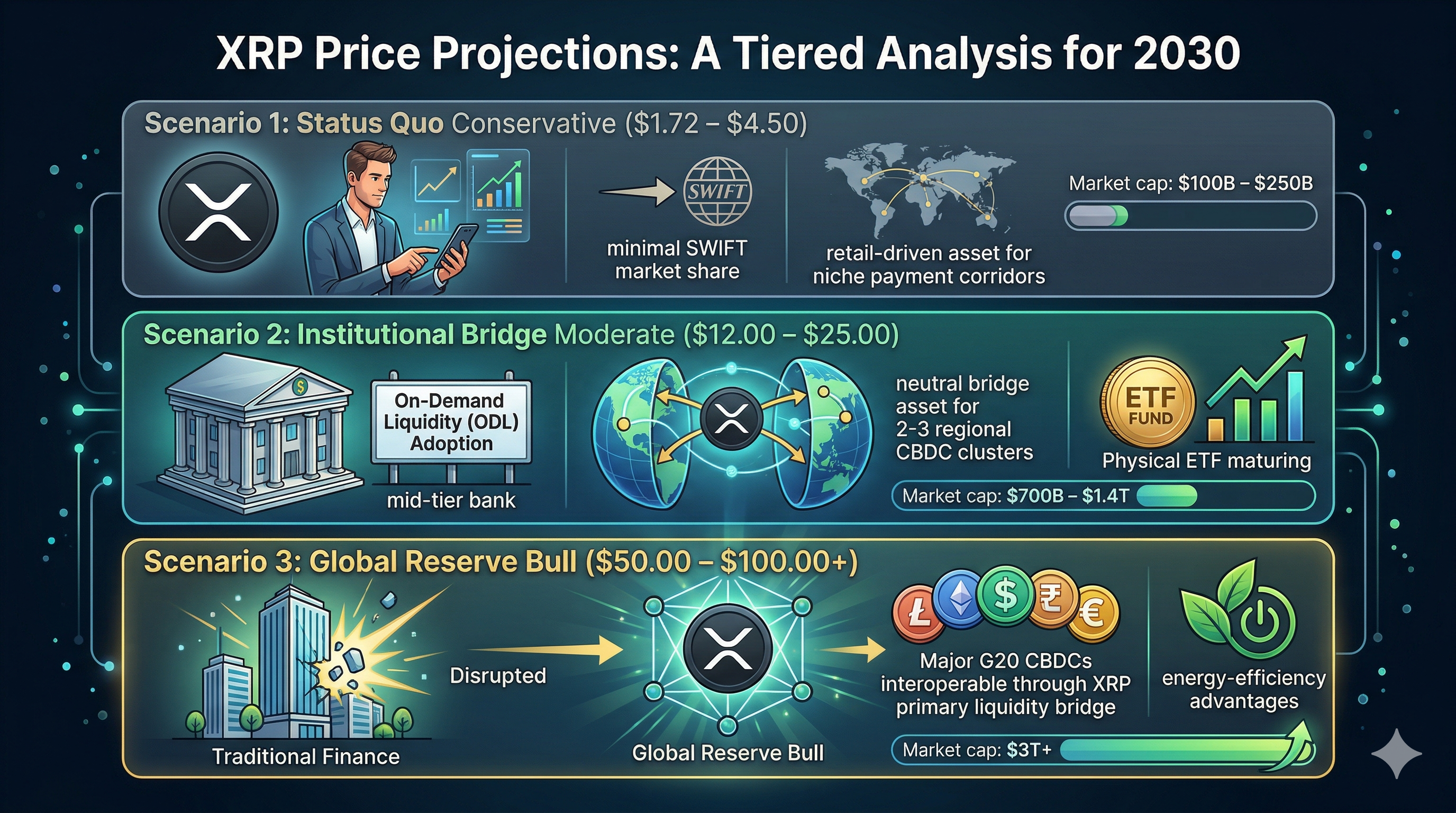
Scenario 1: The "Status Quo" Conservative Model ($1.72 – $4.50)
In this scenario, XRP maintains its current growth rate but fails to capture significant market share from the SWIFT network or new CBDC initiatives. It remains a popular asset for retail investors and a tool for niche payment corridors (e.g., Mexico-Philippines).
Drivers: Continued retail interest, modest growth in Ripple Payments, and general crypto market expansion.
Market Cap Required: Approximately $100B – $250B.
Scenario 2: The "Institutional Bridge" Moderate Model ($12.00 – $25.00)
This is the most likely scenario based on the data available in 2026. Here, XRP becomes the "neutral" bridge asset for 2-3 major regional CBDC clusters (e.g., a Southeast Asian cluster and a Middle Eastern cluster).
Drivers: Widespread use of XRP for "On-Demand Liquidity" by mid-tier banks, successful tokenization of corporate bonds on the XRPL, and the maturation of XRP ETFs.
Market Cap Required: Approximately $700B – $1.4T.
Scenario 3: The "Global Reserve Settlement" Bull Model ($50.00 – $100.00+)
This scenario assumes a "black swan" event in traditional finance—specifically a collapse or significant degradation of the correspondent banking system. In this environment, the world moves toward a decentralized, trustless settlement layer.
Drivers: Full integration into the core banking systems of the G20, XRP acting as the primary liquidity bridge for the majority of the world's CBDCs, and a massive supply squeeze as the 2030 "Net Zero" climate goals favor energy-efficient XRPL over Proof-of-Work systems.
Market Cap Required: $3T+. (Note: This would require XRP to reach a market cap similar to that of the entire 2024-2025 crypto market).
How XRP’s Technology Will Evolve by 2030
The price of XRP in 2030 will be a reflection of the network’s capabilities. In 2026, we are seeing the rollout of several "game-changing" features that will reach full maturity by the end of the decade.
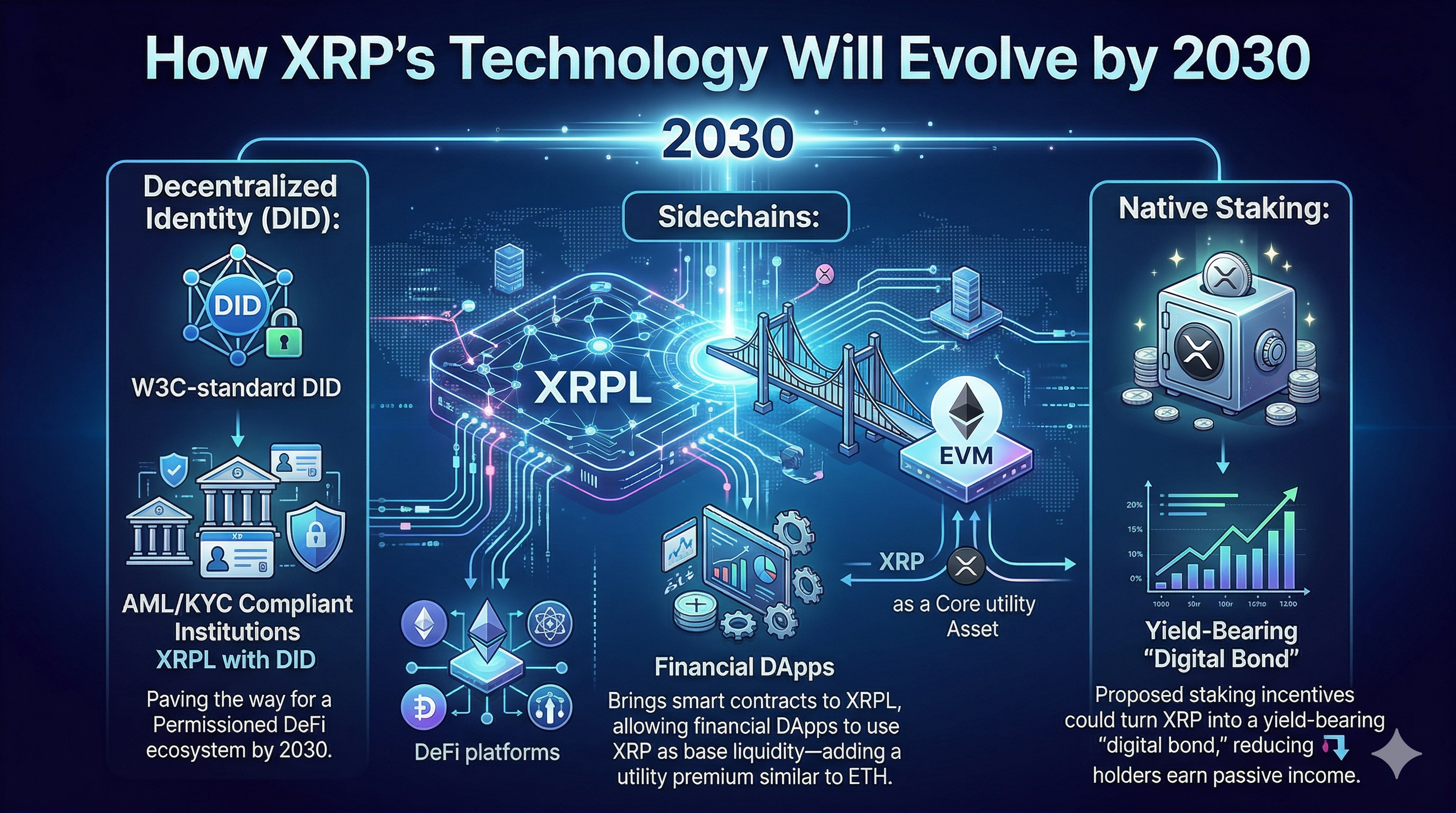
Decentralized Identity (DID) and Compliance
The 2026 integration of W3C-standard Decentralized Identifiers (DIDs) on the XRPL has solved the "compliance vs. decentralization" paradox. Institutions can now interact with the public ledger while remaining compliant with AML (Anti-Money Laundering) and KYC (Know Your Customer) regulations. By 2030, this will allow for a "Permissioned DeFi" ecosystem where regulated entities can lend, borrow, and trade assets at the same speed and cost-efficiency as retail users on Uniswap, but with the legal protections of traditional finance.
Sidechains and Programmability
While the XRPL has traditionally been "purpose-built" for payments, the 2025 launch of the EVM-compatible sidechain has allowed developers to bring complex smart contracts to the ecosystem. By 2030, we expect to see a flourishing ecosystem of "Financial DApps" (Decentralized Applications) that use XRP as their base layer of liquidity. This adds a "utility premium" to the price of XRP, similar to how the price of ETH is driven by the activity on its network.
Native Staking and Passive Income
There is significant discussion in 2026 about introducing a "native staking" or "liquidity provision" incentive for long-term XRP holders. If the community approves these amendments, the "yield" generated by holding XRP could become a major draw for institutional investors, effectively turning XRP into a "digital bond." This would significantly reduce the "sell pressure" from retail investors, as they would prefer to hold and earn yield rather than sell for short-term gains.
The Battle for 2030: Top Competitive Risks and Obstacles for XRP
It would be irresponsible to ignore the challenges that could prevent XRP from reaching these 2030 targets.
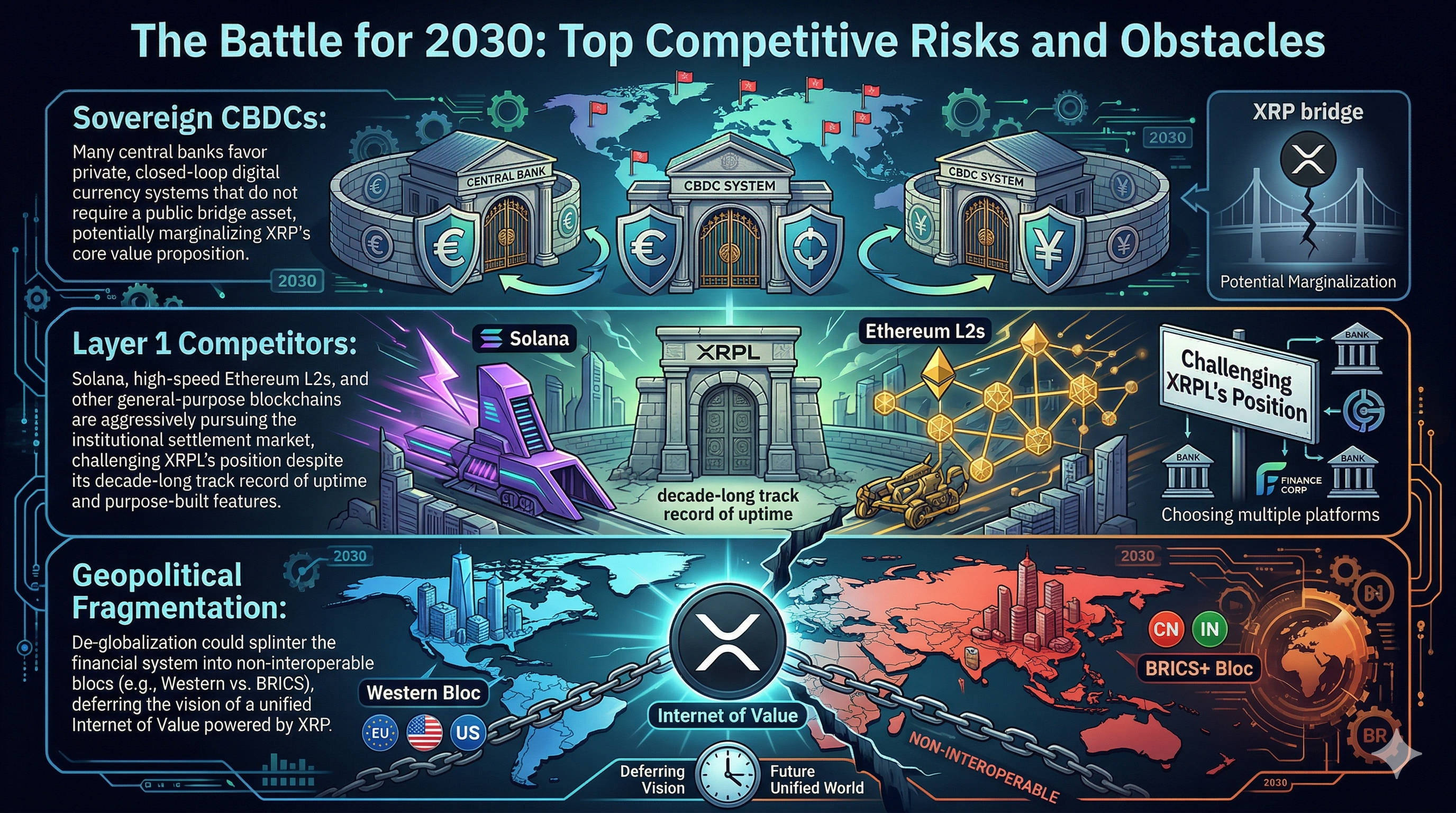
The Rise of Sovereign CBDCs
While Ripple positions XRP as a bridge for CBDCs, many central banks are exploring private, closed-loop systems that do not require a public bridge asset. If the "walled garden" approach to digital currency wins out, the need for a neutral bridge like XRP could be marginalized.
Competition from Other Layer 1s
Blockchains like Solana and high-speed Ethereum L2s (Layer 2s) are also vying for the institutional settlement market. While the XRPL has a ten-year track record of 100% uptime and purpose-built features, it must continue to innovate to stay ahead of more "flexible" general-purpose blockchains.
Geopolitical Fragmentation
The world is moving toward "de-globalization." If the global financial system splits into two or three distinct, non-interoperable blocks (e.g., a Western block and a BRICS block), the dream of a single "Internet of Value" powered by XRP may be deferred.
Conclusion
As we look toward 2030 from our current position in early 2026, the case for XRP has never been more grounded in reality. The "Wild West" days of 2017 and 2021 are over. What remains is a battle-tested digital asset that has survived intense regulatory scrutiny to emerge as a key player in the modernization of global finance.
The value of XRP in 2030 will likely not be driven by the "hype" of a single news event, but by the steady, quiet accumulation of utility. Whether it reaches $5, $15, or $50 depends on how much of the $250 trillion annual global payment volume moves onto the ledger. Given the current trajectory of institutional inflows and the rollout of the XRPL's advanced financial features, the outlook for the remainder of the decade is one of structural growth. XRP is no longer just a digital currency; it is the liquidity layer of a world in transition.
FAQs
Is XRP still considered a "bank coin" in 2026?
The term "bank coin" has become outdated. While XRP is heavily used by financial institutions for settlement, the growth of the XRPL in 2025 and 2026 has turned it into a hub for DeFi, tokenized real-world assets (RWAs), and decentralized identity. It is more accurate to call it a "financial infrastructure asset."
How does the 2025 SEC settlement affect 2030's price?
The 2025 settlement provided the legal finality of "unlocked" institutional capital. Without that settlement, US-based institutions would still be sidelined. Now, they can build on the XRPL with the same legal protections they have when using traditional financial software.
Will the 100 billion total supply limit the price?
Market capitalization is more important than total supply. While 100 billion is a large number, it is small compared to the trillions of dollars that move through global payment networks daily. To facilitate $1 trillion in daily settlement, the price of XRP must be high enough to provide the necessary liquidity without massive price slippage.
Does the Ripple National Trust Bank (RNTB) use XRP?
Yes. RNTB, Ripple's federally regulated banking arm established in late 2025, uses XRP as its primary liquidity bridge for corporate clients. This provides a direct, regulated channel for institutions to access XRP liquidity.
Can XRP be used for everyday retail payments by 2030?
Technically, yes. The XRPL is faster and cheaper than most credit card networks. However, its primary "value add" is in high-value, cross-border settlement. By 2030, you may not "buy coffee" with XRP directly, but the payment provider you use will likely use XRP in the background to settle the transaction instantly across borders.
What is the "burn rate" and why does it matter?
Every transaction on the XRPL requires the sender to destroy a tiny amount of XRP. While this is mainly to prevent spam, in a high-volume institutional environment, millions of transactions per day can lead to a significant reduction in supply over a decade, creating an organic "deflationary" floor for the price.