

What to Expect from Ethereum Hegota: 2026’s Final Roadmap Milestone
2026/04/08 15:45:02
As the Ethereum ecosystem continues its relentless march toward the "World Computer" vision, 2026 is shaping up to be its most transformative year since The Merge. Following the successful activation of the Glamsterdam upgrade in the first half of the year, all eyes are now on the year's grand finale: Hegota.
Named through the portmanteau of the Consensus Layer upgrade Heze and the Execution Layer upgrade Bogota, Hegota is not just another technical patch; it is a fundamental re-architecting of how Ethereum stores data and how users interact with their assets. Whether you are a solo staker, a DeFi power user, or an institutional investor, understanding Hegota is essential for navigating the Ethereum landscape in late 2026.
Key Takeaways
-
Target Date: Scheduled for activation in late Q3 or early Q4 of 2026.
-
The "Stateless" Shift: Introduction of Verkle Trees, drastically reducing hardware requirements for nodes.
-
User Empowerment: Implementation of Native Account Abstraction, ending the era of the "seed phrase" for mainstream users.
-
Censorship Resistance: The launch of FOCIL, ensuring the network remains neutrally accessible to everyone.
-
Economic Scalability: Paving the way for a 100M+ Gas Limit, making Layer 1 more efficient for Rollups.
The 2026 Ethereum Roadmap: From Glamsterdam to Hegota
To understand Hegota, one must look at the "biannual cadence" established by core developers in early 2025. The goal was to stop "monolithic" updates that took years to ship and instead move toward smaller, predictable forks.
Glamsterdam (H1 2026) focused on the Execution Layer efficiency and early-stage ePBS (Enshrined Proposer-Builder Separation). It set the stage for higher throughput. Hegota (H2 2026) is the cleanup and optimization phase. It addresses the "technical debt" of Ethereum’s data structures. By moving from Merkle Patricia Tries to Verkle Trees, Hegota effectively "prunes" the requirements of the network, making it leaner and faster.
Verkle Trees: The Cryptographic Engine of the Future
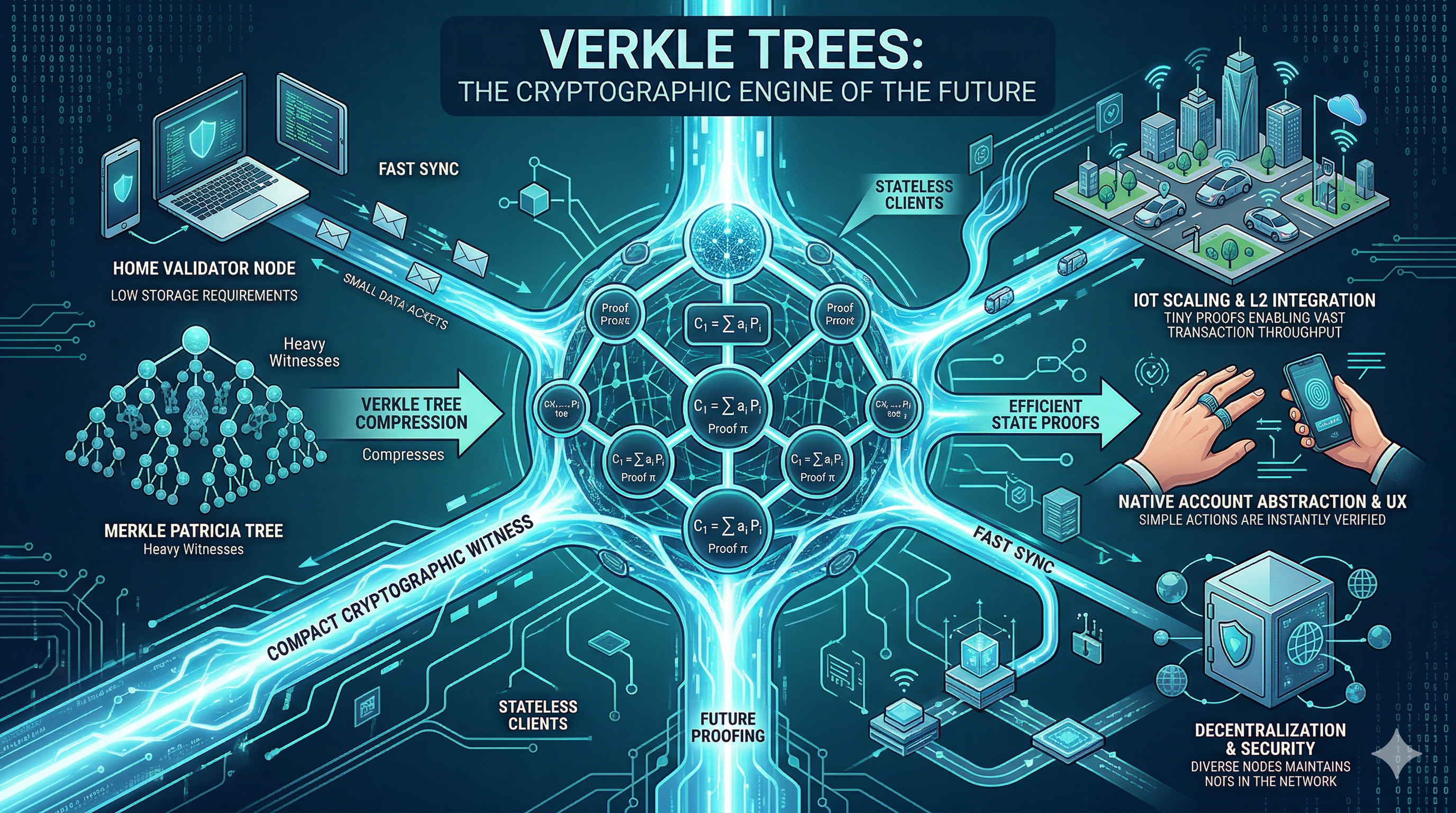
The most significant technical achievement within Hegota is the transition to Verkle Trees. For a decade, Ethereum has relied on Merkle Trees to prove the state of the network. While secure, Merkle proofs are "bulky."
The Cryptography of Efficiency
Verkle Trees use Vector Commitments to allow for much smaller "witnesses." In a Merkle Tree, a proof requires providing all the "neighboring" hashes in a branch. In a Verkle Tree, the proof size is constant regardless of the width of the tree.
Merkle Proof Size: Often several kilobytes.
Verkle Proof Size: Reduced to a few hundred bytes.
This reduction is what allows a block to be "self-describing." A node no longer needs to have a 2TB hard drive full of historical data to know if a transaction is valid; it only needs the tiny Verkle proof attached to the block.
Achieving "Statelessness": Decentralizing the Physical Layer
The ultimate goal of Verkle Trees is Statelessness. Currently, running an Ethereum node is a "hardware arms race." As the state grows (State Bloat), users must buy larger and faster SSDs.
Why Statelessness Matters
With Hegota, Ethereum moves toward a model where "Storage" and "Validation" are decoupled.
-
Block Proposers: Will still likely be high-power machines that store the state.
-
Validators/Nodes: Can be "stateless." They receive a block, check the Verkle proof, and confirm it is valid without needing to store the entire state database.
This means you could potentially run a fully verifying Ethereum node on a device as small as a Raspberry Pi or even a high-end smartphone. By lowering the cost of entry, we significantly increase the number of solo stakers, making the network much harder to attack or censor.
The Economic Impact: Scaling Throughput and Gas Limits
A common question regarding Hegota is: "Will it make gas cheaper?" The answer is nuanced. While Hegota doesn't "slash" prices directly, it enables the network to handle more demand.
The 100M Gas Limit Goal
Because Verkle Trees make block verification faster and less resource-intensive, the "bottleneck" for raising the Gas Limit is removed. Throughout 2026, we have seen a gradual increase, but Hegota is expected to safely push the limit toward 100M.
-
More Capacity: Higher gas limits mean more transactions per block.
-
L2 Synergy: For Layer 2 Rollups, the cost of "settling" on Mainnet becomes more predictable.
For active participants in the market looking to capitalize on these shifts, platforms like KuCoin provide an excellent gateway to trade the Layer 2 tokens that benefit most from Ethereum's increased base-layer efficiency. KuCoin is a leading global cryptocurrency exchange known for its extensive list of supported assets and advanced trading features, making it a preferred hub for those tracking the 2026 upgrade cycle.
Native Account Abstraction (EIP-8141): Goodbye, Seed Phrases
For the average user, Hegota’s most "visible" change is Native Account Abstraction. For years, we have dealt with the limitations of "Externally Owned Accounts" (EOAs). If you lose your seed phrase, you lose your money.
The Rise of Smart Accounts
Hegota allows every account to function as a smart contract. This introduces features that have long been standard in traditional banking:
-
Social Recovery: You can designate "guardian" wallets (friends or hardware devices) to help you recover your account if you lose your device.
-
Gasless Onboarding: dApps can pay the fees for new users, removing the "I need ETH to buy ETH" paradox.
-
Session Keys: Gamers can sign a "session" once and play for an hour without having to confirm every single on-chain action.
FOCIL: Hardening Ethereum Against Censorship
In the years leading up to 2026, the rise of "Maximum Extractable Value" (MEV) led to a centralizing trend where a few large "Builders" could decide which transactions made it into a block. This raised fears of "soft censorship."
Fork-Choice-Enforced Inclusion Lists
Hegota introduces FOCIL. This mechanism allows the validator (the proposer) to create a list of transactions that must be included in the block. If a builder ignores this list, their block is considered invalid by the network's fork-choice rule. This ensures that Ethereum remains credibly neutral. No matter who you are or what your transaction is, as long as you pay the base fee, the network must process your request. This is critical for institutional adoption, where certainty of settlement is a legal requirement.
Operational Changes for Developers and Node Operators
Hegota is a "hard fork," meaning it is not backward compatible. Developers and infrastructure providers must prepare well in advance.
Smart Contract Audits
While most Solidity code will run unchanged, the underlying "gas costs" for certain operations (especially those involving state storage) will be re-priced to reflect the move to Verkle Trees. Developers are encouraged to test their dApps on the Hegota Devnets starting in mid-2026 to ensure their economic models remain viable.
Liquid Staking and DeFi
As solo staking becomes easier, we may see a shift in the "Liquid Staking" (LST) landscape. If the risk and cost of solo staking drops, the "convenience fee" charged by large pools might decrease. Monitoring these trends on exchanges like KuCoin can help investors spot shifts in the dominance of tokens like LDO or rocket pool's rETH as the Hegota meta develops.
The Environmental and Hardware Argument
Ethereum’s transition to Proof of Stake in 2022 reduced its energy consumption by 99.9%. Hegota takes the "Green Ethereum" narrative a step further by reducing electronic waste.
By making older, less powerful hardware viable for node operation again, Ethereum extends the lifecycle of consumer electronics. This "lean" approach to blockchain architecture distinguishes Ethereum from "High-Throughput" chains that require industrial-grade server farms to keep up with the ledger.
Preparing for the Transition: A Checklist
If you are an ETH holder or participant, here is how to prepare for late 2026:
-
For Holders: No action is required. Your ETH is safe. Beware of "Hegota Token" scams; there is no new coin.
-
For Stakers: Ensure your client (Geth, Nethermind, Besu) is updated to the "Hegota-Ready" release at least two weeks before the fork.
-
For DApp Users: Look forward to "Smart Account" upgrades in your favorite wallets (Metamask, Rabby, etc.) shortly after the fork.
Conclusion: Ethereum’s Final Form?
Hegota is often called "The Great Optimization." While it isn't the end of the roadmap, it is the point where Ethereum's foundational architecture finally matches its grand ambitions. By solving State Bloat, enabling Statelessness, and enshrining Account Abstraction, Hegota transforms Ethereum from a complex tool for enthusiasts into a seamless backend for the global financial internet.
As we look toward 2027 and beyond, the "Surge" and the "Purge" will continue, but with Hegota, the hardest technical hurdles will finally be in the rearview mirror.
FAQs
Q1: Does the Hegota upgrade create a new token?
No. Like all previous Ethereum upgrades (The Merge, Shapella, Dencun), Hegota is a protocol improvement. Your existing ETH remains the same. Anyone claiming you need to "swap" your ETH for "Hegota ETH" is a scammer.
Q2: How will Hegota affect Layer 2s like Base or Arbitrum?
Hegota makes Layer 2s more efficient. By optimizing the base layer and increasing the gas limit, Layer 2s can post more data to Ethereum for less cost, which should eventually lead to even lower fees for users on those networks.
Q3: What is the difference between Glamsterdam and Hegota?
Glamsterdam (H1 2026) focused on "Parallel Execution" and making the processing of transactions faster. Hegota (H2 2026) focuses on "Storage" (Verkle Trees) and making the data structure of the blockchain smaller and more accessible.
Q4: Can I really run a node on my phone after Hegota?
In theory, yes. While a "Full Node" (storing everything) still requires significant space, a "Stateless Node" enabled by Hegota only needs to verify proofs. Mobile-friendly light clients are expected to roll out in late 2026 and 2027 following this upgrade.
Q5: Why is FOCIL important for the average user?
FOCIL ensures that nobody can "block" your transactions. It guarantees that as long as you follow the rules of the network, your transaction will be included. This maintains the "Permissionless" nature that gives crypto its value.