

Visa Accelerates AI Agent Payments: x402 Protocol Hits $15M On-Chain Volume
2026/07/17 12:00:00
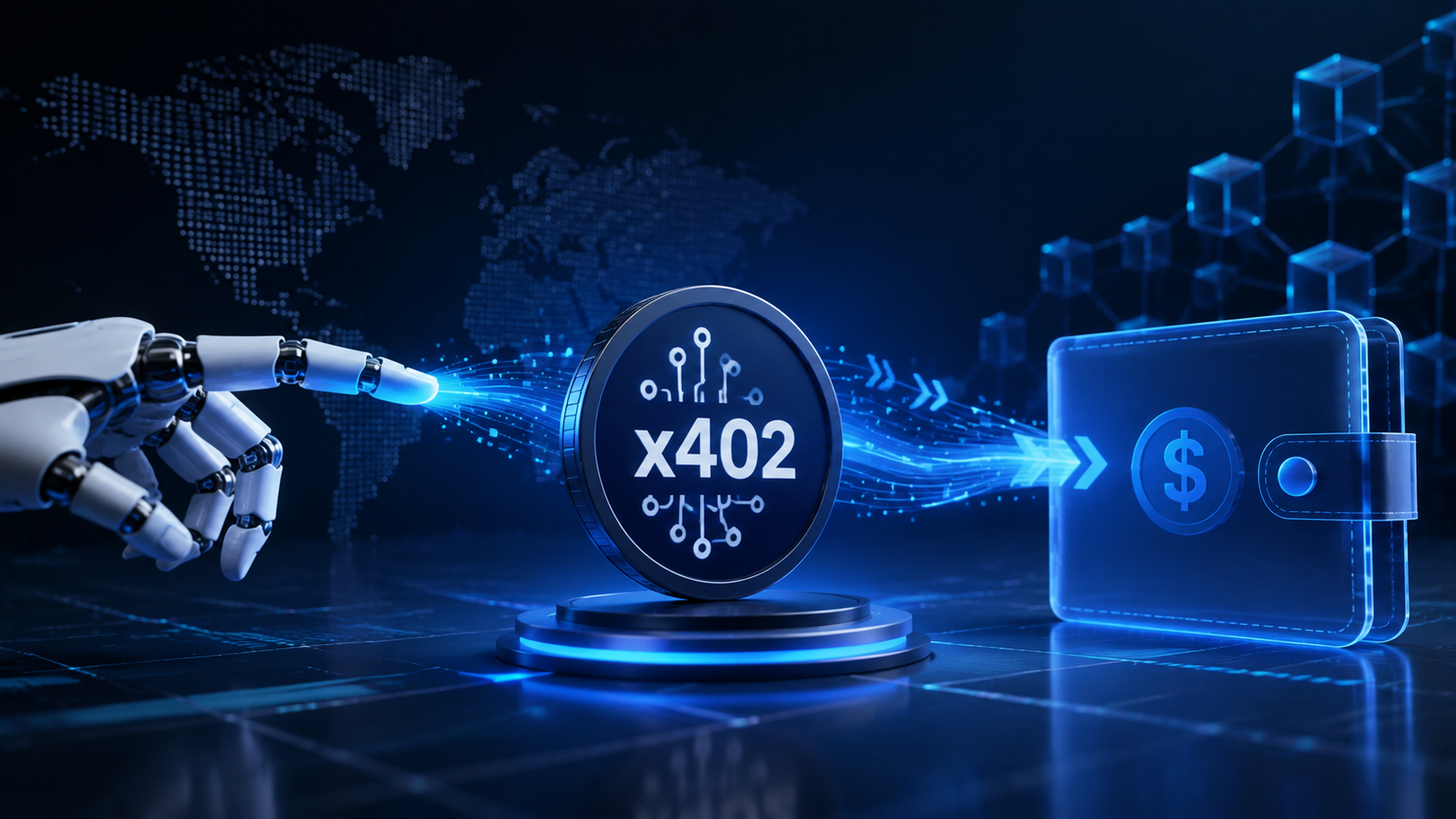
Software agents are beginning to manage micro-economies autonomously, bypassing human-centric banking rails entirely. According to a joint research report by Visa and Artemis released in July 2026, titled Agentic Payments from the Ground Up, AI-driven transaction systems are scaling rapidly.
This momentum is led by the open-source machine payment protocol x402. Since its launch in mid-2025, x402 has processed approximately $15 million in adjusted transaction volume on-chain, with the cumulative number of transactions crossing the 100 million mark. This data signals a structural paradigm shift: public blockchains are transitioning from early speculative environments into foundational financial utility layers that serve machine intelligence.
Key Takeaways
Before diving into the technical details of machine-native payments, the key findings from the July 2026 Visa-Artemis report provide a quick snapshot of this fast-evolving sector:
-
Inflection Point for Machine Commerce: AI agents are transitioning from "providing decision recommendations" to "autonomously managing and executing their own budgets."
-
x402 Protocol Emerges as a Frontrunner: Managed by the Linux Foundation, the open-source x402 protocol has processed roughly $15 million in adjusted volume across 109.6 million transactions since its launch in May 2025.
-
Micropayments Push On-Chain Infrastructure Upgrades: High-frequency transactions below $1.00 between software systems (such as API queries) require ultra-low-cost public ledgers. Traditional card networks are commercially unviable in these scenarios due to high minimum transaction fees.
-
A Hybrid, Dual-Track Future: The future of payments will not be a simple story of replacement. Instead, traditional card networks and programmable stablecoins will coexist and operate side-by-side via interoperable payment gateways.
Why Is Visa Focusing on Autonomous AI Agent Payments Now?
Visa is heavily targeting the AI payment sector because legacy financial systems fail to support the instantaneous, programmatic, and high-frequency transactions required by software agents. Traditional credit cards and bank accounts rely on human-centric verification loops—such as SMS multi-factor authentication, manual forms, and batch-settlement schedules—which prevent autonomous code bases from transacting seamlessly. For artificial intelligence to act as an independent economic agent, it must have access to frictionless, 24/7 payment networks that operate at the speed of software execution.
Legacy Financial System Friction
The existing fiat banking infrastructure introduces crippling bottlenecks for automated algorithms. Credit card networks impose high minimum transaction fees and settlement delays that make sub-penny (micro-cent) transactions completely unviable. When an AI agent needs to query an API or purchase computing power on demand, it cannot wait for card network approvals or incur a standard $0.30 fixed merchant fee for a transaction worth only a few cents.
The Shift from Human to Machine Commerce
Global commerce is entering a phase where software acts as both the buyer and the seller. Visa’s strategic focus on machine-native payments represents an effort to secure its place in this new economy before decentralized alternative rails permanently capture the market. By actively contributing to protocol development, the payments giant intends to bridge legacy card networks with public blockchain environments.
What Are the Two Primary Categories of AI Agent Payments?
The Visa and Artemis report divides the machine-native economy into two primary categories: large-scale commercial payments and machine-to-machine (M2M) micropayments. These two distinct transaction types represent different ends of the technical and financial spectrum, requiring tailored payment solutions for optimal efficiency.
The table below breaks down the structural differences between these transaction styles as analyzed in the July 2026 study:
| Operational Metric | Large-Scale Commercial Payments (AI to Human/Business) | Machine-to-Machine Micropayments (M2M) |
| Typical Transaction Value | Moderate to High ($10 to $1,000+) | Ultra-Low (Often < $1.00, or even fractions of a cent) |
| Primary Settlement Asset | Fiat-Pegged Stablecoins / Hybrid Rails | Native Gas Tokens / Multi-chain Stablecoins |
| Target Settlement Speed | Seconds to Standard Batch | Sub-second, Continuous Settlement |
| Common Use Cases | Travel booking, SaaS renewals, physical procurement | LLM token consumption, cloud computing, data indexing |
| Regulatory Requirements | Strict KYC/AML, Identity Attestation | Programmatic, Smart-Contract Enforced Compliance |
Large-Scale Commercial Payments
Large-scale commercial payments occur when an AI agent acts as a proxy for a human user to purchase traditional goods or services. For example, an autonomous travel assistant might search for flight options, negotiate prices with service providers, and finalize a booking using a virtual credit card or a corporate stablecoin wallet. These transactions are characterized by higher valuations and interface directly with conventional retail businesses.
Machine-to-Machine (M2M) Micropayments
M2M micropayments represent automated value transfers between isolated software programs, APIs, and hardware nodes. These transfers typically involve sub-dollar values—often fractions of a cent—to pay for minute increments of computational output, database reads, or artificial intelligence tokens. These interactions occur entirely on-chain, relying on high-throughput ledgers to execute payments at a scale that traditional clearinghouses cannot support.
How Has the x402 Protocol Handled $15 Million in On-Chain Volume?
The x402 protocol has achieved $15 million in adjusted volume by serving as a highly scalable open-source utility for decentralized applications. According to Visa's joint report, this volume is backed by roughly 109.6 million individual transactions executed since the protocol's release in May 2025. This volume-to-transaction ratio proves that the network is primarily utilized for authentic, high-frequency machine interactions rather than large speculative trading operations.
Origin and Governance of x402
The x402 protocol was originally conceptualized and incubated in a joint initiative by Coinbase and Cloudflare. To foster trust and encourage multi-chain adoption, the creators transitioned governance of the project to the Linux Foundation. This move established x402 as a neutral, industry-standard public utility, allowing diverse development teams to integrate the payment standard into their autonomous systems without risking vendor lock-in.
Network Distribution Across Base, Solana, and Polygon
Transaction activity within the x402 ecosystem is concentrated on Base, Solana, and Polygon due to their low fees and rapid confirmation times. The report indicates that these three networks process the overwhelming majority of machine-led activity. By utilizing highly scalable public ledgers, x402-enabled agents bypass the cost limitations of the Ethereum mainnet, allowing continuous micro-transactions to occur without eroding operational capital.
What Is the Machine Payments Protocol (MPP) and How Does It Compare?
The Machine Payments Protocol (MPP) is an enterprise-oriented payment standard designed by Stripe and Tempo, with direct engineering input from Visa. Launched in March 2026, the protocol focuses on providing a compliant gateway between legacy financial systems and smart contracts, catering specifically to institutional developers and traditional SaaS enterprises.
Stripe and Tempo's Compliance Architecture
Compared to the purely on-chain x402 protocol, MPP is designed to link traditional corporate bank accounts to web3 smart wallets. MPP integrates robust identity tracking mechanisms to ensure that all participating software agents can be traced to a legally accountable corporate entity. This approach addresses the primary compliance and anti-money laundering (AML) concerns of global enterprises seeking to adopt automated agents.
Comparative Market Adoption Rates
While x402 has generated roughly $15 million in on-chain volume due to its permissionless, developer-friendly model, MPP has taken a more conservative path, processing approximately $25,000 across 115,000 transactions since its launch in early 2026. This lower transaction volume reflects the slower, compliance-first adoption cycle characteristic of institutional finance. However, for traditional enterprises requiring strict regulatory compliance, MPP represents a vital link for entering automated commerce.
Why Are Stablecoins Essential for the Growth of AI Micropayments?
Stablecoins are essential for AI micropayments because they eliminate the price volatility of digital assets while providing the programmatic features of native blockchain tokens. An AI agent cannot operate efficiently if its transactional capital fluctuates wildly in value over the course of a day. By using stablecoins, agents can calculate operational costs, project computing budgets, and execute transactions using a reliable unit of account.
Instant Settlement vs. Multi-Day Latency
Traditional settlement systems like ACH or international wire transfers take days to clear, making them unusable for real-time machine tasks. An AI agent requiring immediate GPU compute power cannot pause its processing queue for 48 hours to wait for a bank deposit to clear. Stablecoins settle on-chain within seconds, enabling uninterrupted, real-time machine performance.
Eliminating Volatility in Algorithmic Budgets
Software budgets must remain predictable to prevent system failures caused by sudden fee spikes or asset depreciation. If an agent utilizes volatile cryptocurrencies for payment, a sudden price drop could prematurely deplete its wallet and halt its operations. Stablecoins provide a predictable, dollar-pegged monetary standard that enables accurate automated treasury management.
Will Stablecoins Completely Replace Traditional Bank Cards in the AI Era?
Stablecoins will not completely replace traditional bank cards; instead, they will coexist in a hybrid ecosystem where both systems serve specific financial functions. Visa's research indicates that the future of payment architecture relies on building bridges between decentralized protocols and traditional credit networks rather than relying on a single settlement method.
The Coexistence of Hybrid Payment Gateways
While machine-to-machine transactions will occur primarily on-chain using stablecoins, human-facing commerce will continue to rely on traditional credit card networks. Hybrid payment gateways will allow AI agents to hold stablecoins natively and instantly convert those funds into virtual credit card balances when buying services from legacy businesses. This setup enables agents to access the global retail market without forcing traditional merchants to adopt Web3 infrastructure.
Interoperability Hurdles for Autonomous Code
For AI agents to navigate between the traditional and decentralized financial systems, developers must build interoperable tools that translate legacy financial messages (such as ISO 20022) into smart contract calls. Protocols like x402 and MPP are designed to address this challenge by serving as the translating layers between traditional banks and on-chain networks.
How Do High-Throughput Blockchains Solve Infrastructure Bottlenecks for AI?
High-throughput blockchains solve infrastructure bottlenecks by offering the scale and cost efficiency required to process millions of small payments simultaneously. To support an economy populated by millions of autonomous agents, payment infrastructure must maintain transaction fees that are lower than the value of the transactions themselves.
Transaction Economics and Sub-Cent Gas Fees
On networks like Base, Solana, and Polygon, transaction fees are routinely kept under a fraction of a cent. This fee structure is essential for micro-transactions; if an AI agent is paying $0.01 to query an image database, paying a gas fee of even $0.05 makes the transaction unviable. High-throughput networks ensure that fee levels remain low enough to keep machine micropayments practical.
Scalability Demands of Continuous LLM API Calls
Large Language Models (LLMs) and autonomous agents generate thousands of API calls per second when performing complex workflows. Each of these calls can represent a distinct transaction for specialized data or processing power. High-speed networks provide the throughput and block space necessary to handle this steady stream of transactions without experiencing network congestion or price spikes.
How Can You Position Your Portfolio for the AI Agent Economy?
As machine-native protocols gain adoption and push real transaction volumes on-chain, several sectors are positioned to capture the value generated by this emerging machine-led commerce:
Layer-1 and Layer-2 Protocols
Because the x402 protocol relies heavily on Base, Solana, and Polygon, the native tokens of these networks are positioned to benefit directly. Increased network activity leads to higher transaction fee generation and greater utility for the underlying native assets required to execute smart contracts.
Decentralized Physical Infrastructure Networks (DePIN)
AI agents require continuous access to storage, bandwidth, and processing power. Decentralized physical infrastructure networks (DePIN)—such as decentralized GPU computing networks and storage platforms—are the natural suppliers of choice for on-chain AI agents, creating a closed-loop transaction flow between AI and DePIN assets.
How to Trade AI and Infrastructure Tokens on KuCoin
KuCoin provides a secure, highly liquid trading platform to help users build exposure to the foundational assets and infrastructure tokens driving the AI agent payment ecosystem. To start trading, follow this guide:
-
Access Your Account: Log in to your official KuCoin account via the desktop website or the mobile application. New users can complete the registration process and submit the required verification documents (KYC) to activate full trading privileges.
-
Deposit Funds: Fund your trading account by depositing stablecoins like USDT or USDC, or purchase assets directly using KuCoin’s fiat integration, credit card payments, or P2P trading options.
-
Locate the Trading Pair: Navigate to the "Spot Trading" market interface and use the search bar to find the specific asset you wish to trade (such as SOL, POL, or related AI and infrastructure tokens).
-
Choose Your Order Type: Select your preferred order type based on your trading strategy. You can use a Limit Order to set a specific purchase price, or a Market Order to buy the asset instantly at the current market price.
-
Execute and Secure: Input the amount you wish to purchase, verify the details of the trade, and confirm the order. Once executed, your new assets will appear in your KuCoin trading wallet.
Conclusion
The latest data from Visa and Artemis confirms that the machine-to-machine payment ecosystem is growing rapidly, led by scalable protocols like x402. By processing $15 million in adjusted volume across millions of transactions, x402 has shown that autonomous agents can manage economic activity on-chain. This structural transition points toward a future where payment systems are optimized for programmatic speed and efficiency rather than human-centric validation.
As major institutions like Stripe, Visa, and Coinbase continue to support open-source payment standards, the integration of AI agents and decentralized finance will continue to accelerate. For forward-looking market participants, tracking the development of these machine-native systems is essential. By understanding how these automated transactions flow through scalable blockchains and using platforms like KuCoin to gain exposure to key infrastructure tokens, investors can position themselves for the next major shift in digital commerce.
FAQs
What is the x402 protocol?
The x402 protocol is an open-source, machine-native payment standard managed by the Linux Foundation that allows autonomous AI agents to execute automated, low-cost on-chain transactions.
How does the Machine Payments Protocol (MPP) protect enterprise compliance?
MPP integrates identity verification standards that link digital wallets to verified corporate entities, ensuring that automated transactions comply with standard financial regulations.
Why can't AI agents use standard credit cards natively?
AI agents cannot complete the human-centric security checks required by traditional banks, such as CAPTCHAs, SMS codes, and manual sign-offs.
Which blockchains process the most AI agent transactions?
The majority of machine-led transactions are executed on Solana, Base, and Polygon due to their low transaction fees and high processing speeds.
What is an adjusted on-chain transaction volume?
Adjusted on-chain transaction volume is a refined metric that excludes wash trading, system tests, and internal wallet transfers to measure genuine economic value moving through a network.