

Best Crypto ETFs to Buy in 2026: Top Picks for Savvy Investors
The global financial landscape has fundamentally shifted. Cryptocurrency is no longer confined to technical forums or alternative asset classes; it has permanently cemented its status as a core component of modern institutional portfolios. Driving this massive transformation is the explosive expansion of exchange-traded funds (ETFs).
For investors navigating the market, choosing the right investment product can be incredibly challenging. While purchasing actual digital currencies on centralized exchanges remains highly popular for active traders, traditional brokerage accounts often favor the regulated nature of fund structures.
If you are looking to add digital currency exposure to your stock portfolio without managing private cryptographic keys, finding the top crypto ETF in 2026 requires a deep understanding of expense ratios, liquid trading volumes, custody structures, and product innovations. This comprehensive guide breaks down the best-performing and most cost-effective crypto ETFs, analyzes the latest market developments, and provides a clear framework to help you choose the ideal fund for your financial goals.
🔥 Tips: New to crypto? KuCoin's Knowledge Base has everything you need to get started.
Crypto ETF Market Overview
Before exploring individual funds, it is crucial to analyze how the leading spot Bitcoin and Ethereum funds stack up against one another. The United States continues to command the majority of the global market share for cryptocurrency exchange-traded products, turning tickers like IBIT and FBTC into household names among traditional investors.
To better understand the structural differences between holding these equity products versus holding raw digital assets, investors often study how crypto ETFs function to properly evaluate their long-term tax and custody implications.
Below is a live market overview of the premier crypto ETFs leading the industry in assets under management (AUM) and cost efficiency:
| Fund Name (Issuer) | Ticker | Primary Asset | Assets Under Management (AUM) | Expense Ratio | Key Strategic Profile |
| iShares Bitcoin Trust (BlackRock) | IBIT | Bitcoin (Spot) | ~$48.6 Billion | 0.25% | The Liquidity King: Dominates overall daily volume; preferred choice for institutional-scale execution. |
| Fidelity Wise Origin Bitcoin Fund (Fidelity) | FBTC | Bitcoin (Spot) | ~$11.1 Billion | 0.25% | In-House Custody: Bypasses generic third-party custodians by utilizing Fidelity Digital Assets. |
| iShares Ethereum Trust ETF (BlackRock) | ETHA | Ethereum (Spot) | ~$7.5 Billion | 0.25% | Top Ether Choice: The most liquid vehicle available for direct institutional exposure to the smart-contract network. |
| Grayscale Bitcoin Mini Trust (Grayscale) | BTC | Bitcoin (Spot) | ~$3.9 Billion | 0.15% | Long-Term Capital Efficiency: Designed specifically as a low-cost "buy-and-hold" tool. |
| Morgan Stanley Bitcoin Trust (Morgan Stanley) | MSBT | Bitcoin (Spot) | ~$260 Million | 0.14% | The Institutional Disrupter: Launched as the first major U.S. bank-backed spot fund. |
| Grayscale Ethereum Staking ETF (Grayscale) | ETHE | Ethereum + Staking | ~$1.59 Billion | 2.50% | Yield-Generating Product: Passively distributes actual staking rewards directly to fund shareholders. |
| Amplify Transformational Data Sharing ETF | BLOK | Blockchain Equities | ~$1.24 Billion | 0.75% | Diversified Equity Basket: Avoids direct token exposure by investing in Nvidia, Coinbase, and mining infrastructure. |
Best Bitcoin Spot ETFs
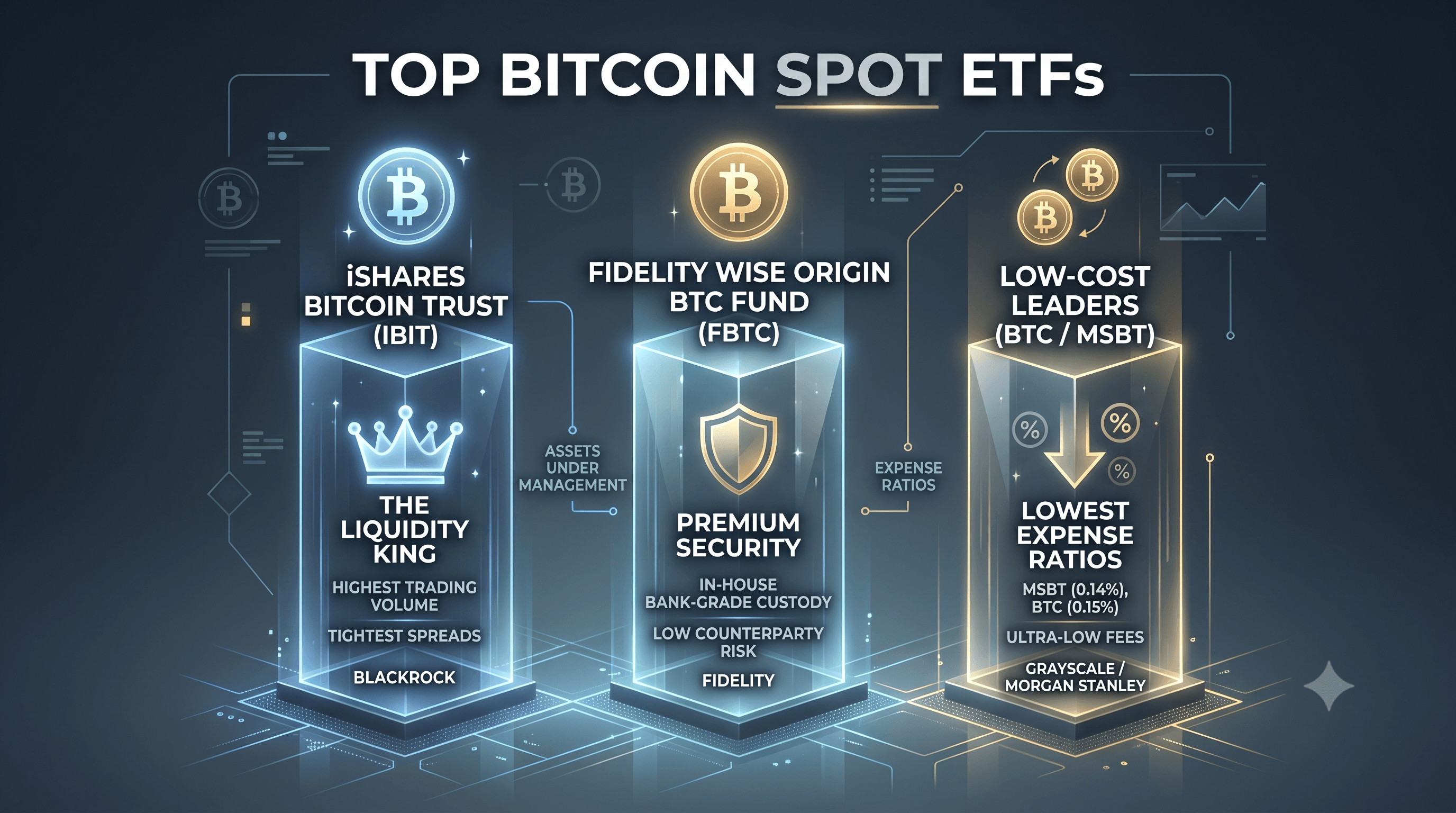
Spot Bitcoin products remain the foundation of the digital asset fund ecosystem. When you purchase a spot fund, the trust directly buys and safeguards real Bitcoins on a 1:1 basis, ensuring your shares precisely mirror the underlying spot market movements. Three clear market leaders have emerged, each serving a unique investor profile.
-
iShares Bitcoin Trust (IBIT) — The Liquidity King
Managed by BlackRock, the world's largest asset manager, the iShares Bitcoin Trust (IBIT) is the undisputed giant of the industry. Boasting nearly $49 billion in net assets, IBIT routinely accounts for the lion's share of daily trading volume across digital asset markets.
-
The Advantage: Because of its immense scale, IBIT features incredibly tight bid-ask spreads (frequently around 0.02%), making it the most cost-efficient vehicle for large-scale institutional buyers or active swing traders. Furthermore, IBIT possesses the deepest options trading liquidity in the cryptocurrency fund sector.
-
The Custody Structure: Like many of its peers, BlackRock relies on Coinbase Custody to securely manage and store its underlying digital keys.
-
Fidelity Wise Origin Bitcoin Fund (FBTC) — Premium Security
Fidelity’s FBTC competes with BlackRock by offering superior, in-house, bank-grade custody via Fidelity Digital Assets. This structure significantly reduces third-party counterparty risks for conservative, long-term investors who prioritize custody diversification.
-
Low-Cost Leaders: Grayscale (BTC) vs. Morgan Stanley (MSBT)
For maximum capital efficiency, the Grayscale Bitcoin Mini Trust (BTC) offers a competitive 0.15% expense ratio. Additionally, Morgan Stanley entered the market with its MSBT fund, establishing a new, ultra-low fee standard of 0.14% aimed squarely at wealth management clients.
Top Ethereum & Staking ETFs
The evolution of cryptocurrency funds reached a significant milestone with the maturity of spot Ethereum vehicles. For investors seeking exposure to smart contracts, decentralized finance (DeFi), and Web3 infrastructure, Ether funds provide a fundamentally different investment thesis than Bitcoin. The structural framework for these funds relied heavily on preceding regulatory battles; market analysts often study the historical evolution of crypto ETF approvals to understand the SEC's shifting definitions of commodity-based fund wrappers.
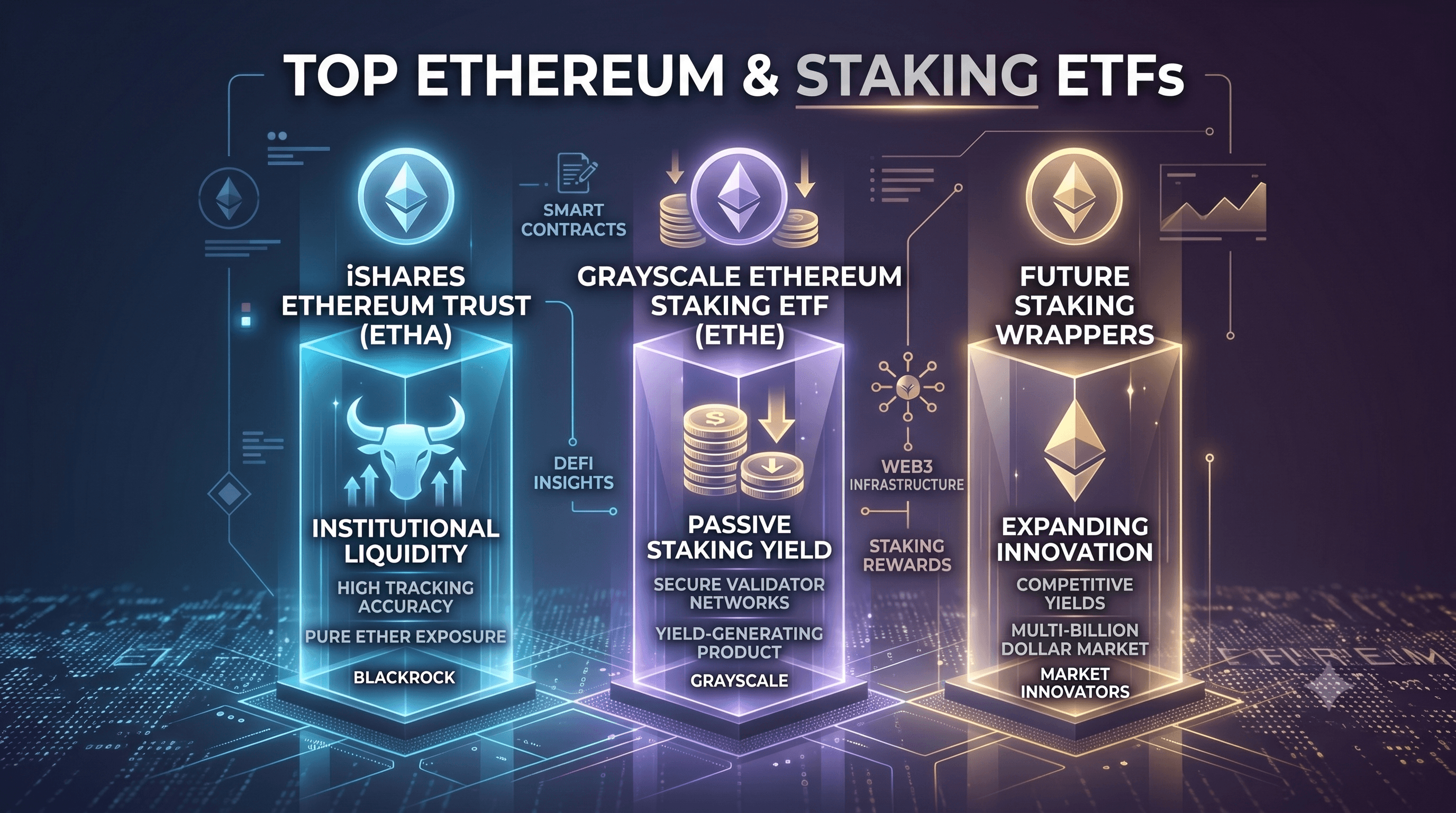
iShares Ethereum Trust ETF (ETHA)
BlackRock’s ETHA is the premier choice for pure-play, direct exposure to Ethereum. With over $7.5 billion in assets, it functions identically to its Bitcoin counterpart (IBIT), providing institutional-grade liquidity, highly competitive tracking accuracy, and seamless integration into traditional equity brokerage accounts. For investors looking to trade around Ethereum’s cyclical price swings, ETHA represents the absolute gold standard for structural reliability.
Grayscale Ethereum Staking ETF (ETHE) — Passive Income via Staking
The most revolutionary narrative driving the digital asset ecosystem is the rise of yield-generating fund products. Grayscale's ETHE has successfully pioneered the structural transition to function as a full-fledged Staking ETF. Unlike traditional spot funds that let underlying assets sit idle in cold storage, ETHE securely stakes a massive portion of its underlying Ether via institutional validation networks.
According to latest analysis from Bloomberg Intelligence, the integration of staking rewards into traditional ETF wrappers represents the next multi-billion dollar battleground for asset managers globally.
Beyond BTC and ETH: The Rise of New Crypto Asset ETFs
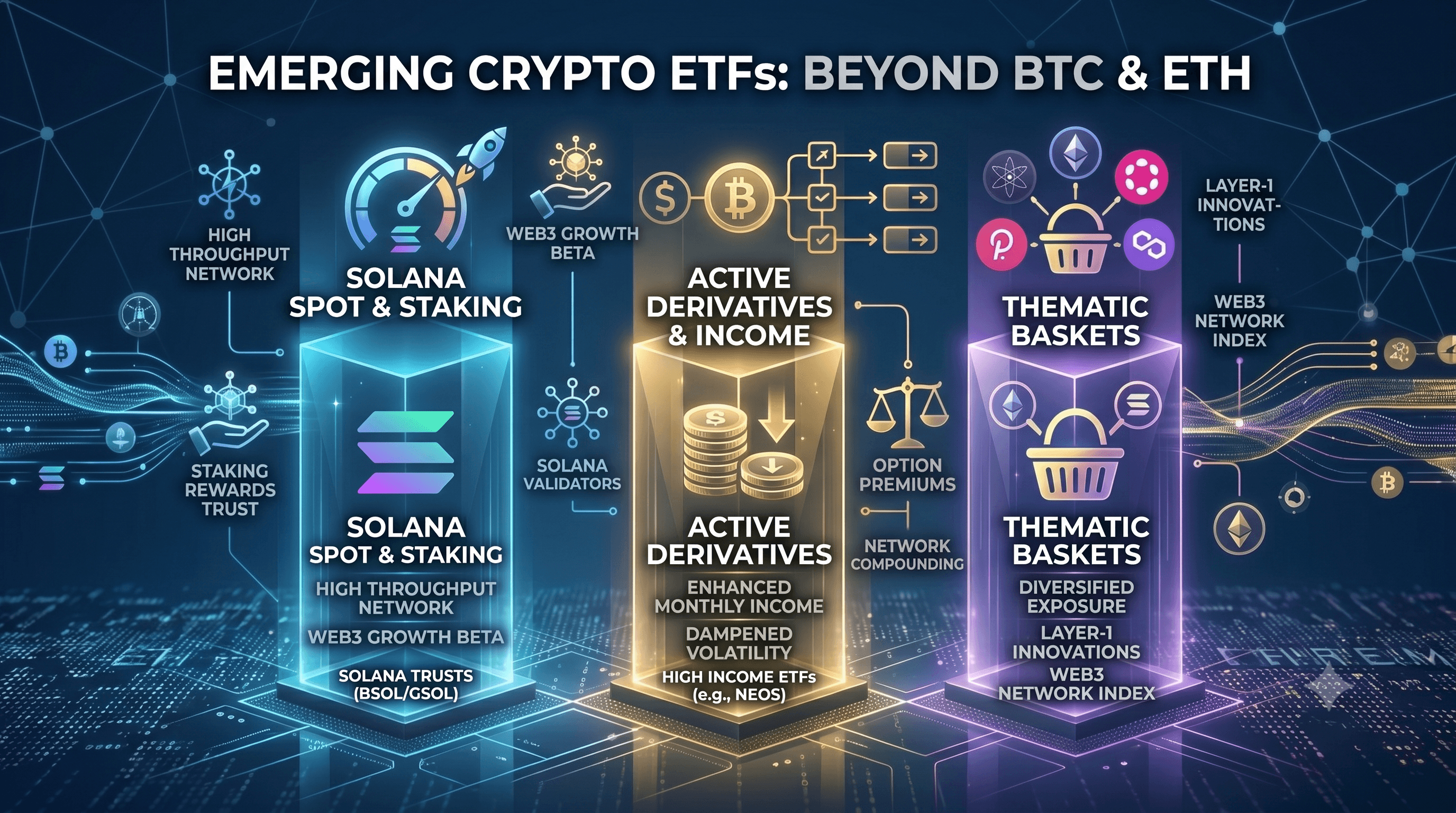
As the digital asset marketplace expands, Wall Street issuers are moving beyond the foundational duopoly of Bitcoin and Ethereum. The newest frontier centers on alternative Layer-1 networks and thematic multi-asset baskets.
Solana Spot ETFs (BSOL, GSOL) — The High-Throughput Frontier
Following the SEC’s shifting generic listing standards, Solana (SOL) exchange-traded products have entered the mainstream market. Baskets such as the Bitwise Solana Staking ETF (BSOL) and the Grayscale Solana Trust (GSOL) target investors seeking high-beta growth tied to Web3 decentralized applications and stablecoin settlement velocities.
-
The Staking Angle: Similar to Ethereum products, newer Solana trusts (like BSOL) incorporate native, on-chain staking. This structural innovation captures the inflationary rewards of the underlying network directly inside the trust, providing an additional layer of capital compounding for stock brokerage accounts.
-
The Pipeline: Wall Street’s interest continues to grow, with retail banking giants filing for customized Solana-based trust accounts, transforming high-speed blockchain network equity into standard corporate wealth packages.
Active Options & Yield-Maximizing Crypto Products
Another major trend is the development of active derivative products overlaying digital asset pools, exemplified by funds like the NEOS Bitcoin High Income ETF. Rather than relying solely on spot price performance, these vehicles utilize covered-call options strategies to generate enhanced premium income. This structure dampens the sharp downside risks of crypto volatility while delivering monthly cash distributions, appealing heavily to income-oriented retirement accounts.
Alternative Crypto ETFs: Blockchain Stocks & Crypto Indices
Direct spot exposure is not the only path to capturing digital asset returns. Many investors prefer a diversified approach that mitigates the extreme, single-token volatility of holding raw crypto assets.
Amplify Transformational Data Sharing ETF (BLOK)
If you prefer equity-based exposure over tracking volatile spot token prices, BLOK represents the ultimate actively managed corporate basket. Instead of holding Bitcoin or Ether in a digital vault, BLOK invests directly in public companies driving the infrastructure of the digital economy. Its major holdings include hardware providers like Nvidia, financial infrastructure like Coinbase, and large-scale corporate digital asset miners.
Bitwise 10 Crypto Index ETF (BITW)
For hands-off investors wanting broad, index-based market exposure, BITW tracks the Bitwise 10 Large Cap Crypto Index. This fund automatically purchases, weights, and rebalances the top 10 largest digital assets by market capitalization. It ensures you automatically own the dominant market leaders while diversifying away the risk of a single blockchain project failing.
Taxation and Regulatory Frameworks Affecting ETF Holders
Investing in digital assets through standard corporate brokerages changes how your transactions interact with fiscal and legal authorities. Understanding this regulatory wrapper is vital for calculating your ultimate net-of-fee performance.
Corporate Tax Efficiencies vs. Raw Direct Token Rules
For many retail investors, the primary driver for utilizing an ETF wrapper over a direct digital exchange is the structural integration into tax-advantaged accounts like IRAs, Roth IRAs, and 401(k) plans.
-
The IRA Umbrella: Within these structures, active rebalancing and capital appreciations are tax-deferred or tax-free. Conversely, trading raw tokens directly on a standard exchange triggers direct capital gains tax events on every single swap, adding significant operational accounting burdens.
-
IRS Treatment: Spot cryptocurrency ETFs are treated under standard grantor trust tax rules (similar to spot gold funds). This means long-term capital gains treatments apply directly based on your standard tax bracket when shares are liquidated, completely bypassing the complex, manual calculating requirements associated with calculating localized digital coin airdrops, forks, or on-chain transaction gas fees.
The Impact of New Legislation (The Clarity Act)
The legislative landscape is undergoing a massive shift with bills like the Clarity Act. This legislation aims to settle long-standing jurisdictional disputes between regulatory bodies like the SEC and the CFTC by clearly drawing lines between what constitutes an unregistered security versus a decentralized digital commodity.
How to Choose the Best Crypto ETF for Your Portfolio
Selecting the perfect fund requires balancing several critical operational and financial pillars. Before deploying capital, run every prospective fund through this strategic checklist:
-
Expense Ratio: Management fees eat directly into your compounded long-term returns. For pure buy-and-hold spot portfolios, lean heavily toward ultra-low-cost leaders like Morgan Stanley's MSBT (0.14%) or Grayscale's BTC (0.15%).
-
Liquidity & Average Daily Trading Volume: High-volume funds ensure exceptionally tight bid-ask spreads. If you plan to trade frequently or deploy large amounts of capital, giants like IBIT minimize transaction friction.
-
Asset Type & Underlying Exposure: Determine whether your financial goals are best served by direct spot asset ownership (mirroring token prices 1:1), income-producing staking vehicles, or equity-focused blockchain baskets like BLOK.
-
Regulatory Status & Security: Ensure the vehicle is fully registered with major regulatory bodies like the SEC, guaranteeing robust investor protection, standardized disclosure reporting, and institutional-grade independent auditing.
Risks of Investing in Crypto ETFs
While exchange-traded funds dramatically lower the technical barriers to entry for traditional investors, they do not eliminate the structural risks inherent to the digital asset ecosystem. Cryptocurrencies remain inherently volatile. The digital asset markets regularly undergo swift and aggressive market corrections, occasionally experiencing sharp drawbacks of 30% or more within a single calendar year. Your fund shares will experience identical fluctuations.
Structural Trade-offs
Investing via an ETF means you are paying an ongoing management fee to a third-party institutional sponsor to handle custody on your behalf. Additionally, you do not maintain possession of the actual underlying cryptographic private keys.
For investors who adhere to the core decentralized maxim of "not your keys, not your coins," utilizing traditional equity fund vehicles removes the utility of using cryptocurrency for peer-to-peer payments or direct decentralized applications. For those who prioritize asset sovereignty and direct cryptographic custody, cross-referencing standard market guidelines on how to buy Bitcoin via non-custodial or spot exchange methods remains an essential educational step.
Conclusion
The crypto ETF market has matured from a speculative experiment into an institutional financial pillar. Whether your primary investment goal is seeking the raw institutional liquidity of BlackRock’s IBIT, capturing the ultra-low-cost long-term efficiency of Morgan Stanley’s MSBT, or building an equity-focused basket via BLOK, the traditional stock market now provides institutional-grade access points for every risk tolerance. As you construct your portfolio, balance the convenience and tax advantages of these regulated structures against their ongoing expense fees, and always align your fund choices with your broader long-term financial plan.
FAQs
Which crypto ETF has the absolute lowest fees?
The fee crown goes to the Morgan Stanley Bitcoin Trust (MSBT), which features an ultra-competitive expense ratio of 0.14%. It is closely followed by the Grayscale Bitcoin Mini Trust (BTC) at 0.15%.
Is it better to buy Bitcoin directly or buy a Crypto ETF?
It depends entirely on your operational goals. A Crypto ETF is superior for tax-advantaged retirement accounts (like IRAs/401ks), simplifies tax reporting, and eliminates the technical complexity of key management. Conversely, buying directly grants you true 24/7 sovereign ownership, allows you to withdraw tokens to your private wallet, and avoids perpetual management fees.
Are there any crypto ETFs that pay regular dividends?
Yes. The emergence of Ethereum Staking ETFs, such as Grayscale's ETHE, and Solana-based options products allows funds to securely stake their underlying assets and pass the net yields directly down to shareholders as income distributions.
Disclaimer: This article is for informational purposes only and does not constitute financial or investment advice. Cryptocurrency investments carry significant risk. Always conduct your own research before trading.