

Inventory of the Top Ten Most Profitable Crypto Project Institutions
2026/04/07 10:25:27
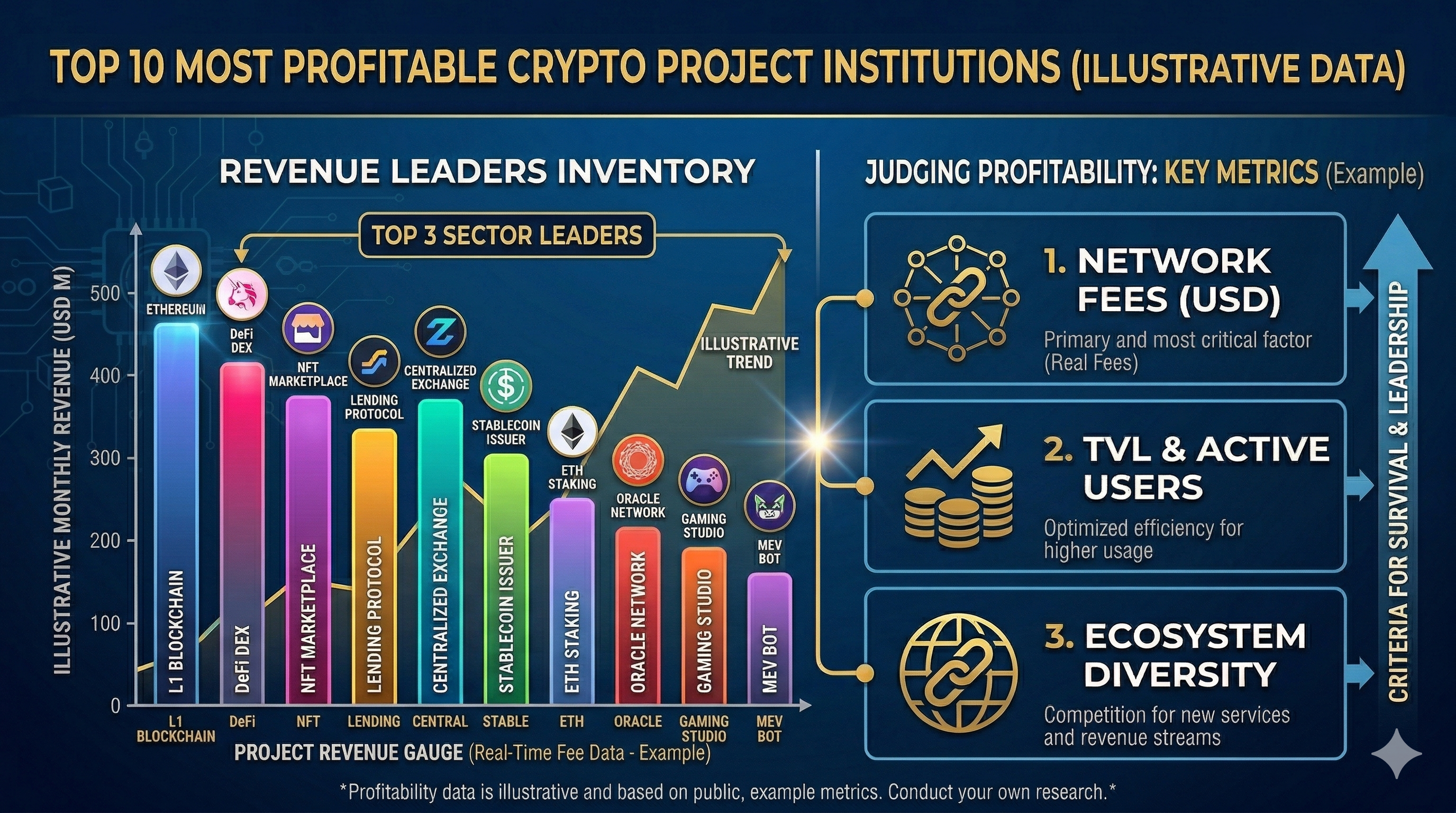
Profitability in the cryptocurrency industry has shifted from speculative token gains to measurable revenue generation, with on-chain fees and protocol income emerging as the most reliable indicators of sustainability. By analyzing verified data from DeFiLlama, this article identifies the most profitable crypto institutions and explains how they generate consistent income, offering a clearer view of long-term value in the digital asset ecosystem.
The Rise of Revenue as the True Metric in Crypto
The cryptocurrency industry has entered a phase where revenue matters more than hype. During earlier cycles, projects were valued primarily on token price appreciation and speculative demand. That dynamic has changed as investors now focus on sustainable income streams. Fee generation has become a key benchmark, providing insight into real usage and long-term viability.
Data from DeFiLlama shows that the highest-earning projects consistently generate millions in daily fees. These revenues come from transaction processing, trading activity, lending services, and network usage. This shift toward measurable income aligns crypto more closely with traditional business evaluation models.
A clear example can be seen in decentralized exchanges and blockchain networks that collect fees directly from users. These platforms are no longer theoretical innovations; they are functioning businesses with cash flow. Investors and analysts now track metrics such as daily fees, annualized revenue, and protocol income to assess performance.
This transformation marks a critical turning point. Crypto is growing from a speculative playground into a data-driven financial ecosystem. Projects that generate consistent revenue are more likely to survive market downturns and attract institutional interest. As a result, fee-based profitability has become the foundation for identifying the most successful crypto institutions today.
Ethereum: The Undisputed Revenue Giant
Ethereum stands at the top of the profitability hierarchy, consistently generating some of the highest fee revenues in the industry. As the leading smart contract platform, Ethereum processes a vast number of transactions across decentralized finance, NFTs, and token transfers.
Ethereum frequently records daily fees in the millions, driven by network demand. Every transaction requires gas fees, which users pay to validators. These fees accumulate into a substantial revenue stream, making Ethereum one of the most economically productive blockchains. The network’s dominance comes from its ecosystem. Major protocols, including decentralized exchanges and lending platforms, operate on Ethereum, generating additional activity and reinforcing its position. This creates a powerful feedback loop: more applications lead to more users, which leads to higher fees.
Ethereum’s transition to proof-of-stake has further strengthened its economic model by reducing issuance and increasing the importance of fee-based rewards. This has made its revenue more aligned with actual network usage rather than inflation. The scale of Ethereum’s profitability highlights a key trend in crypto: infrastructure layers capture significant value. As long as decentralized applications continue to rely on Ethereum, its position as a revenue leader remains secure.
Tron: Stablecoin Volume Driving Massive Fees
Tron has quietly become one of the most profitable networks in the crypto space, largely due to its dominance in stablecoin transactions. A significant portion of global USDT transfers occurs on Tron, making it a critical infrastructure layer for digital payments.
Fee data from DeFiLlama reveals that Tron consistently ranks among the top earners. Its low transaction costs and fast settlement times attract users who prioritize efficiency, especially in regions where stablecoins are widely used for remittances and trading. The network’s profitability is tied directly to transaction volume. Each transfer generates a small fee, but the sheer scale of activity results in substantial cumulative revenue. This model demonstrates how high-frequency, low-cost transactions can outperform more expensive networks in total fee generation.
Tron’s focus on stablecoins also reflects a broader trend in crypto adoption. While speculative trading remains important, practical use cases such as payments and transfers are driving sustained activity. This positions Tron as a key player in the real-world application of blockchain technology. The network’s revenue growth underscores the importance of utility. Projects that solve real problems and attract consistent usage are more likely to generate reliable income over time.
Bitcoin: Digital Gold with Fee Power
Bitcoin remains one of the most profitable networks despite its relatively simple functionality compared to smart contract platforms. Its primary role as a store of value does not prevent it from generating significant transaction fees.
During periods of high network activity, Bitcoin fees can surge dramatically. Events such as the rise of Ordinals and increased on-chain demand have driven fee spikes, contributing to substantial revenue for miners. This demonstrates that even a minimalistic blockchain can achieve high profitability through demand. Data from DeFiLlama shows that Bitcoin consistently ranks among the top fee-generating networks. Its global recognition and adoption ensure a steady flow of transactions, from retail transfers to institutional movements.
Bitcoin’s economic model relies on a combination of block rewards and transaction fees. As block rewards decrease over time, fees are expected to play an increasingly important role in sustaining the network. This transition highlights the long-term importance of user activity in maintaining profitability. The resilience of Bitcoin’s revenue generation reinforces its position as a foundational asset in the crypto ecosystem. Its ability to generate fees without complex applications speaks to the strength of its brand and utility.
Uniswap: Liquidity as a Revenue Engine
Uniswap represents the power of decentralized trading infrastructure. As one of the leading decentralized exchanges, Uniswap generates revenue through trading fees collected from users swapping tokens.
Each trade on Uniswap incurs a small fee, typically distributed to liquidity providers. A portion of these fees can also be captured by the protocol, depending on governance decisions. This model aligns incentives between users and the platform, creating a sustainable ecosystem.
According to DeFiLlama, Uniswap consistently ranks among the top fee-generating protocols. Its popularity stems from its permissionless nature, allowing anyone to trade tokens without intermediaries. The protocol’s success highlights the importance of liquidity in financial markets. By enabling seamless token swaps, Uniswap has become a cornerstone of decentralized finance. Its revenue is directly tied to trading volume, making it highly responsive to market conditions.
Uniswap’s profitability demonstrates that decentralized applications can compete with centralized exchanges in generating income. Its transparent fee structure and open access model have made it a key player in the evolving financial landscape.
Lido: Staking Dominance and Passive Yield Flows
Lido Finance has emerged as one of the most profitable protocols by enabling users to stake assets while maintaining liquidity. Its core product, liquid staking, allows users to earn rewards without locking their funds entirely. Lido generates revenue by taking a percentage of staking rewards. As more users stake their assets through the platform, its income grows proportionally. This creates a scalable and predictable revenue model.
Data from DeFiLlama shows that Lido consistently ranks among the top protocols in terms of fees and revenue. Its dominance in Ethereum staking has made it a critical component of the network’s infrastructure. The appeal of Lido lies in its simplicity and efficiency. Users can participate in staking without managing validators, lowering the barrier to entry. This has attracted a large user base and contributed to its profitability. Lido’s success highlights the growing importance of yield-generating services in crypto. As users seek passive income opportunities, protocols that facilitate staking and rewards are likely to remain highly profitable.
Aave: Lending Markets as Profit Machines
Aave generates revenue by facilitating borrowing and lending activities. Users deposit assets to earn interest, while borrowers pay fees to access liquidity.
The protocol earns a portion of these fees, creating a steady income stream. Its revenue is closely tied to the demand for leverage and liquidity in the market. During periods of high activity, Aave’s earnings can increase significantly. DeFiLlama data confirms Aave’s position as one of the top revenue-generating protocols. Its robust risk management and wide range of supported assets have made it a trusted platform for decentralized lending.
Aave’s profitability demonstrates the viability of decentralized financial services. By replicating traditional banking functions on-chain, it has created a new model for earning income in the digital economy.
MakerDAO: Stability Fees and Monetary Control
MakerDAO generates revenue through stability fees associated with its stablecoin, DAI. Users who borrow DAI must pay interest, which contributes to the protocol’s income.
This model resembles central banking mechanisms, where monetary policy influences supply and demand. MakerDAO’s ability to adjust fees allows it to maintain stability while generating revenue. DeFiLlama data shows that MakerDAO remains a consistent top earner. Its role in the DeFi ecosystem ensures continuous demand for its services.
PancakeSwap: High Volume on BNB Chain
PancakeSwap thrives on high transaction volume within the BNB Chain ecosystem, where speed and affordability create an environment optimized for frequent trading. Its low fees attract a large number of users, particularly retail participants who are sensitive to transaction costs. This constant flow of activity translates into significant cumulative revenue, even if individual transaction fees remain small. Over time, this high-frequency model has proven to be one of the most effective ways to generate consistent income in decentralized finance.
The platform’s profitability is driven by accessibility and user engagement. PancakeSwap has built a reputation for being easy to use, with a straightforward interface that allows users to swap tokens, provide liquidity, and explore new opportunities without friction. This simplicity lowers the barrier to entry and encourages repeat usage, which is critical for maintaining high transaction volumes. Its gamified features, such as yield farming, lotteries, and token staking, add an additional layer of engagement that keeps users active within the ecosystem rather than migrating elsewhere.
Beyond its core trading functionality, PancakeSwap benefits from the broader expansion of the BNB Chain. As new tokens and projects launch within the ecosystem, they often rely on PancakeSwap as a primary liquidity hub. This creates a steady pipeline of trading pairs and speculative activity, further boosting volume. The combination of low fees, strong network effects, and continuous user participation positions PancakeSwap as one of the most resilient revenue-generating platforms in the decentralized exchange ecosystem.
Jupiter: Solana’s Trading Powerhouse
Jupiter has rapidly grown into a major revenue generator within the Solana ecosystem. By aggregating liquidity across multiple decentralized exchanges, it ensures that users consistently receive the most efficient trade execution with minimal slippage. This routing efficiency has become increasingly important in a fragmented DeFi environment where liquidity is spread across numerous platforms.
Jupiter’s strength lies in its ability to scan multiple liquidity pools in real time and route trades through the most optimal paths. This creates a smoother trading experience, particularly for large-volume transactions that would otherwise suffer from price inefficiencies. As trading activity on Solana continues to expand, Jupiter benefits directly from the growing demand for fast and cost-effective swaps.
Its fee model captures value from high trading volume, making it one of the fastest-rising profitable platforms. Instead of relying on high individual fees, Jupiter scales through volume, leveraging Solana’s low-cost infrastructure to process a massive number of transactions. This approach aligns with broader trends in crypto, where efficiency and speed are becoming key drivers of user adoption.
The Data Behind the Rankings
All rankings in this article are derived from real-time fee data provided by DeFiLlama. The platform aggregates on-chain data from multiple blockchains and protocols, offering a transparent and standardized way to evaluate revenue across the industry.
DeFiLlama’s methodology focuses on actual fees paid by users rather than speculative metrics such as token valuations. This makes it a reliable source for identifying which projects are generating real economic activity. By tracking daily, weekly, and annualized fees, the platform provides a comprehensive view of profitability trends.
What makes this data particularly valuable is its objectivity. Because it is derived directly from blockchain transactions, it minimizes the risk of manipulation or misreporting. This allows analysts, investors, and researchers to make more informed decisions based on verifiable information rather than narratives.
Conclusion: Profitability Defines the Next Crypto Leaders
The cryptocurrency industry is transitioning toward a model where revenue and sustainability define success. Projects that generate consistent fees demonstrate real demand and utility, making them more resilient in volatile markets.
The institutions highlighted in this article represent the forefront of this shift. Their ability to generate income from real usage sets them apart from speculative projects.
FAQs
-
What is crypto fee revenue?
It is the income generated by blockchain networks or protocols from user activity such as transactions, trading, or lending.
-
Why is DeFiLlama important?
DeFiLlama provides transparent, real-time data on crypto protocols, making it a trusted source for analysis.
-
Which crypto project earns the most fees?
Ethereum consistently ranks among the highest earners.
-
Are high fees a good sign?
High fees often indicate strong demand, though excessively high costs can reduce usability.
-
Can investors use fee data for decisions?
Yes, it helps identify projects with real usage and sustainable revenue.
-
Are these rankings constant?
No, rankings change based on market activity and user demand.
Disclaimer
This content is for informational purposes only and does not constitute investment advice. Cryptocurrency investments carry risk. Please do your own research (DYOR).