

Tether's Gold Reserves in 2026: Inside the World's Largest Private Gold Hoard and What It Means for Crypto Markets
2026/05/13 11:36:02
Introduction
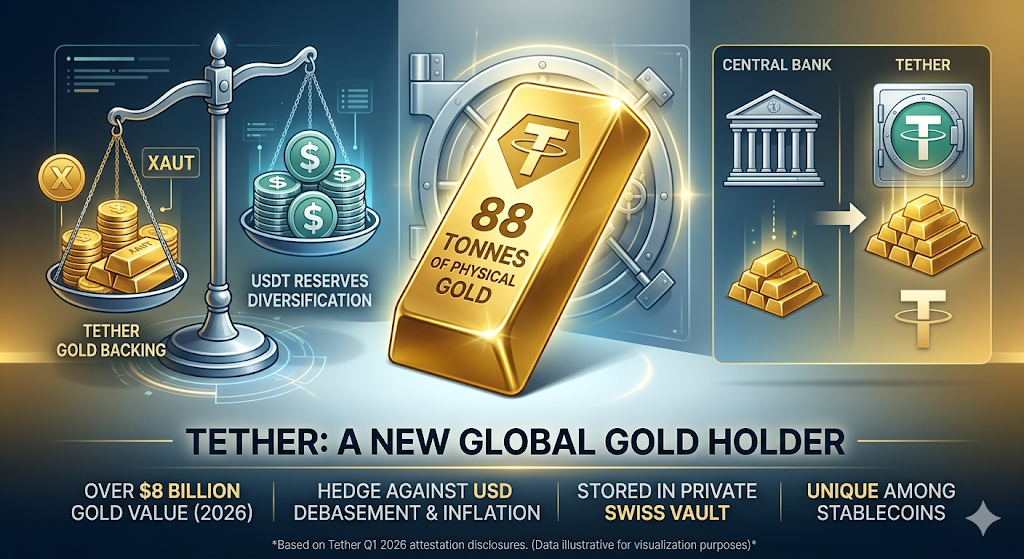
Tether now holds approximately 88 tonnes of physical gold in a private Swiss vault, making the stablecoin issuer one of the largest non-sovereign gold holders on the planet — a position that would rank it alongside mid-tier central banks if it were a country. According to Tether's Q1 2026 attestation disclosures and CEO Paolo Ardoino's public statements, the company's gold exposure now exceeds $8 billion at current spot prices near $3,300 per ounce, spanning both reserves backing USDT and the fully allocated Tether Gold (XAUT) token. This concentration of bullion inside a crypto-native balance sheet is reshaping how investors think about stablecoin solvency, inflation hedging, and the convergence of traditional safe-haven assets with on-chain finance.
To navigate this shift:
-
Gold Stablecoins explain how tokenized bullion is evolving as an asset class,
-
Digital Gold unpacks gold's strategic role amid sovereign debt stress,
-
and Tether Gold breaks down XAUT's investment thesis in rate-cut cycles.
Why Is Tether Holding So Much Gold in 2026?
Tether is accumulating gold primarily to diversify USDT's reserve composition away from pure dollar exposure and to back its XAUT token one-to-one with allocated bullion. According to Ardoino's April 2026 remarks, gold functions as Tether's hedge against US dollar debasement, currency weaponization risks, and long-term inflation — concerns that have intensified as US federal debt surpassed $37 trillion in early 2026.
The strategy serves three distinct purposes:
-
Reserve diversification for USDT — A portion of Tether's $150 billion+ stablecoin float is now backed by precious metals rather than Treasuries or cash equivalents.
-
Full backing for XAUT — Every Tether Gold token represents one troy ounce of physical gold stored in Switzerland, fully allocated and auditable.
-
Geopolitical insurance — Gold cannot be frozen, sanctioned, or remotely seized in the way custodial dollar assets can.
This dual-purpose approach is unique among stablecoin issuers. Circle, Tether's closest competitor, holds reserves almost entirely in short-dated Treasuries and overnight repos, with no precious metals exposure disclosed as of Q1 2026.
How Much Gold Does Tether Actually Hold?
Tether's gold holdings stand at roughly 88 tonnes as of the most recent quarterly attestation, valued above $8 billion. This figure combines XAUT-backing bullion with gold held inside Tether's broader reserve portfolio supporting USDT.
For context, that puts Tether's stash above the official gold reserves of nations like Finland, Bulgaria, and Peru, according to World Gold Council central bank holdings data. Among private entities, only a handful of ETF custodians and major banks exceed this level.
Where Is Tether's Gold Stored and Who Audits It?
Tether stores its physical gold in a single private vault in Switzerland, operated under custodial arrangements separate from the standard LBMA bank network. According to Ardoino's repeated statements throughout 2025 and 2026, the company chose Switzerland specifically for its neutrality, vault security infrastructure, and legal protections against asset seizure.
The custody arrangement has several notable features:
-
Allocated, not unallocated — Each bar is individually serialized and assigned to Tether rather than pooled with other clients' holdings.
-
Independent attestation — BDO Italia provides quarterly attestations covering both USDT and XAUT reserves, including the physical gold component.
-
On-chain verification for XAUT — Token holders can look up the specific bar serial numbers, refineries, and weights backing their tokens through Tether's transparency portal.
Is Tether's Gold Actually Verifiable?
XAUT's gold backing is more verifiable than most institutional gold products because each token maps to specific bar serial numbers published on Tether's website. This contrasts with traditional gold ETFs, where retail investors typically receive only aggregate vault reports rather than individual bar identification.
That said, attestations are not full audits. BDO confirms balances at a point in time but does not perform a complete forensic audit of Tether's operations. Critics — including some academic researchers — argue that a full Big Four audit remains the gold standard Tether has yet to meet.
How Does Tether's Gold Strategy Compare to Central Banks?
Tether is behaving like a small central bank by accumulating gold as a strategic reserve asset rather than a trading position. Central banks globally added a net 1,045 tonnes of gold in 2024 and continued aggressive buying through Q1 2026, according to World Gold Council data — the strongest sustained accumulation since the Bretton Woods era.
The parallels are striking:
|
Entity Type
|
Primary Reserve
|
Gold Strategy
|
Typical Holding Period
|
|
G7 Central Banks
|
Domestic currency + FX
|
Strategic, multi-decade
|
Permanent
|
|
Emerging Market CBs
|
USD reserves + gold
|
Accelerating accumulation
|
Multi-decade
|
|
Tether
|
USD-denominated assets
|
Strategic diversification
|
Indefinite
|
|
Commercial Banks
|
Client deposits
|
Trading/inventory
|
Short-term
|
Tether's behavior fits the "strategic reserve" model rather than the "trading inventory" model. Ardoino has explicitly stated the company does not intend to sell its gold holdings into rallies, instead treating bullion as a permanent component of the balance sheet.
Why Are Central Banks and Tether Buying Gold Simultaneously?
Central banks and Tether are both buying gold to hedge the same underlying risk: erosion of trust in dollar-denominated reserve assets. The 2022 freezing of Russian central bank reserves accelerated a multi-year diversification trend among non-aligned nations, and Tether's accumulation echoes this same sovereign-risk logic at the private level.
Gold's appeal in 2026 rests on several convergent factors:
-
Persistent fiscal deficits in major economies
-
Federal Reserve rate-cut cycle continuing into 2026
-
Ongoing geopolitical fragmentation
-
Declining share of USD in global FX reserves
What Is XAUT and How Does It Relate to Tether's Gold?
XAUT (Tether Gold) is a tokenized representation of physical gold where each token equals one troy ounce of LBMA-standard gold stored in Switzerland. XAUT trades on Ethereum and Tron, providing 24/7 liquidity for an asset that traditionally settles only during banking hours.
XAUT's market capitalization sits above $1 billion as of May 2026, making it the second-largest gold-backed token after PAX Gold (PAXG). The token offers several advantages over traditional gold ownership:
-
Fractional ownership — Investors can hold 0.000001 XAUT, far below the one-ounce minimum for physical bars.
-
No storage fees for holders — Unlike physical gold or some competitors, XAUT does not charge ongoing custody fees to token holders.
-
Redeemability — Verified holders can redeem XAUT for physical gold delivered in Switzerland, subject to minimum thresholds.
-
DeFi composability — XAUT can be used as collateral in lending protocols and traded against crypto pairs without leaving the blockchain.
How Does XAUT Differ from PAXG?
XAUT and PAXG both represent one ounce of physical gold but differ in regulatory framework, custody location, and fee structure. PAXG is issued by Paxos under New York Department of Financial Services oversight with London-based vault custody, while XAUT operates under Tether's Salvadoran and BVI structure with Swiss custody.
Both tokens have proven their peg integrity through multiple market cycles, including the 2024-2026 gold rally that took spot prices from $2,000 to above $3,300 per ounce.
How Does Tether's Gold Affect USDT Stability?
Tether's gold holdings provide a non-correlated reserve buffer that strengthens USDT's resilience during dollar-denominated asset stress. While USDT's peg is to the dollar — not gold — having a portion of reserves in an asset that often rises when Treasuries fall creates portfolio-level stability that pure-Treasury stablecoins lack.
The mechanics work as follows:
-
During risk-off events, Treasury prices and gold often move in opposite directions
-
A blended reserve smooths mark-to-market volatility
-
Gold provides an asset class that cannot be devalued by Fed policy alone
However, gold also introduces tradeoffs. Gold pays no yield, unlike Treasuries which generated significant interest income for Tether during 2023-2025. According to Tether's 2025 profit disclosures, the company earned over $13 billion in net profits largely from Treasury yields — income that gold reserves do not replicate.
Could Tether's Gold Be Seized or Frozen?
Tether's gold in a private Swiss vault is significantly harder to seize than custodial dollar assets, but it is not immune to legal action. Switzerland honors international sanctions in some cases, and a determined enforcement action involving Swiss courts could theoretically reach the bullion.
That said, gold offers structural advantages over digital dollar reserves:
-
No counterparty risk from a custodial bank
-
No SWIFT or correspondent banking dependency
-
No remote freezing mechanism comparable to dollar account suspension
This is precisely why central banks of geopolitically exposed nations have been repatriating gold from London and New York to domestic vaults since 2022.
What Are the Risks of Tether's Gold Strategy?
The main risks of Tether's gold strategy include concentration risk in a single vault, audit limitations, gold price volatility affecting reserve ratios, and regulatory scrutiny of unconventional stablecoin backing. Each of these warrants careful consideration by institutional users of USDT and XAUT.
Concentration risk is meaningful — 88 tonnes in one Swiss facility creates a single point of failure absent geographic diversification. Most central banks split reserves across multiple jurisdictions for exactly this reason.
Audit gaps persist. While BDO attestations are credible, the stablecoin industry continues to push for full audits, and emerging regulations like the EU's MiCA framework and US stablecoin legislation may impose stricter verification requirements.
Price volatility of gold affects the dollar value of reserves backing USDT. A 20% gold drawdown — which has occurred multiple times historically — would shrink that portion of reserves accordingly, though Tether's substantial excess reserves provide a buffer.
Regulatory uncertainty looms largest. Pending US stablecoin legislation may restrict permissible reserve assets to short-dated Treasuries and cash, potentially forcing Tether to restructure how gold sits inside its USDT reserve composition versus its separate XAUT product.
Should You Trade Tether Gold (XAUT) on KuCoin?
KuCoin offers a streamlined path to gain exposure to physical gold through XAUT without dealing with vaults, shipping, insurance, or banking-hour restrictions. The exchange lists XAUT against major pairs including USDT, giving traders direct access to tokenized gold with deep liquidity and 24/7 settlement.
Trading XAUT on KuCoin provides several practical advantages:
-
Instant settlement — No T+2 delays common in traditional gold markets
-
Low minimums — Buy fractional ounces starting from small dollar amounts
-
Portfolio integration — Hold gold alongside BTC, ETH, and stablecoins in one account
-
Active markets around the clock — Trade gold during weekends and overnight hours when COMEX is closed
New users can now register at KuCoin and Get Up to 11,000 USDT in New User Rewards.
Conclusion
Tether's gold reserves in 2026 mark a structural shift in how stablecoin issuers think about reserve composition and long-term solvency. With approximately 88 tonnes of physical gold worth over $8 billion stored in Switzerland, Tether has built one of the largest private bullion positions in the world and aligned its balance sheet philosophy more closely with central banks than with traditional financial intermediaries.
This strategy delivers genuine benefits — diversification away from dollar-denominated assets, geopolitical resilience, and a credible inflation hedge — but introduces tradeoffs including foregone Treasury yield, concentration risk in a single vault, and unresolved regulatory questions about permissible stablecoin backing. XAUT, the tokenized expression of this gold strategy, gives retail and institutional investors a transparent, redeemable, fractionally divisible claim on physical bullion that traditional gold products struggle to match.
As the convergence of digital assets and monetary metals accelerates, Tether's gold position will likely become a template that other stablecoin issuers, fintechs, and even sovereigns study closely in the years ahead.
FAQs
1. Can XAUT holders redeem their tokens for physical gold bars?
Yes, verified XAUT holders can redeem tokens for physical gold delivered in Switzerland, subject to minimum quantity thresholds (typically a full bar of approximately 430 ounces) and applicable redemption fees. Retail holders unable to meet the minimum can sell XAUT on exchanges like KuCoin for instant liquidity instead.
2. Does Tether pay interest or yield on XAUT holdings?
No, XAUT does not generate yield because physical gold itself produces no income. Holders gain exposure purely to gold's price appreciation, similar to owning a bullion ETF without the management fee, but they can deploy XAUT in DeFi protocols separately to earn yield on the token.
3. Is Tether's gold included in the USDT reserve backing or held separately?
Both — a portion of Tether's gold sits inside the reserve portfolio supporting USDT, while a separate allocation backs each XAUT token one-to-one. The two pools are distinct, and XAUT-backing gold is fully allocated and earmarked exclusively for XAUT redemptions.
4. How does Tether's gold holding compare to gold ETFs like GLD?
SPDR Gold Shares (GLD) holds roughly 900+ tonnes, dwarfing Tether's 88 tonnes, but Tether's holdings are structurally different — GLD operates as a trust with shares trading only during market hours, while XAUT trades continuously on blockchains with on-chain bar-level transparency that ETFs do not provide.
5. What happens to XAUT if Tether faces regulatory action on USDT?
XAUT is structured as a separate product with its own reserves and legal framework, so theoretical regulatory action against USDT would not automatically invalidate XAUT backing. However, reputational spillover and operational disruption at Tether's parent organization would likely affect both products, and prudent holders should monitor regulatory developments closely.