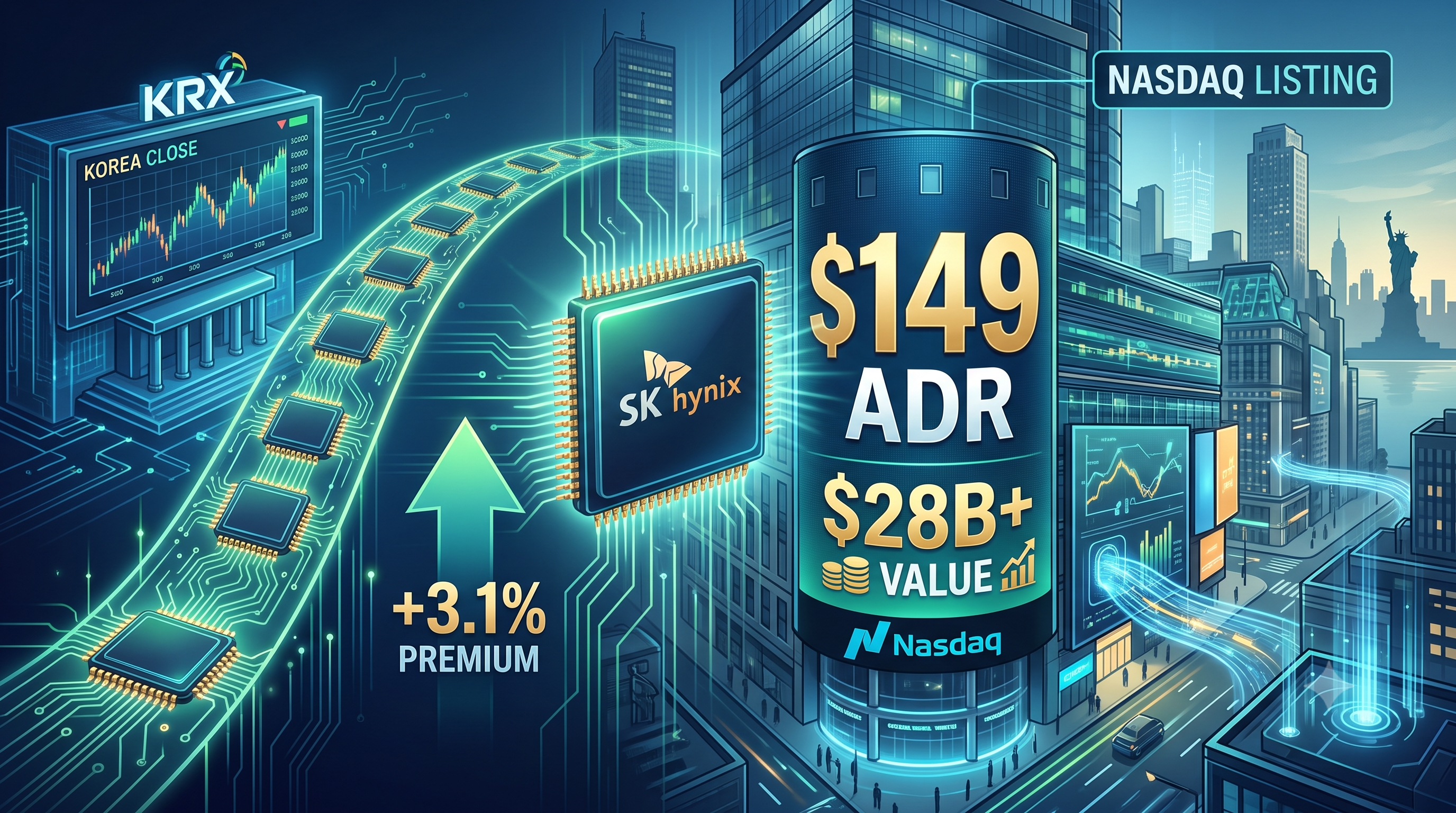
SK Hynix Sets $149 ADR Guidance Price: 3.1% Premium to Korea Close for Massive $28B+ Nasdaq Listing
SK Hynix Sets $149 ADR Guidance Price: 3.1% Premium to Korea Close for Massive $28B+ Nasdaq Listing
2026/07/13 14:31:00
The $28B Mega-Listing That Shook Wall Street and Web3
The traditional financial markets and the decentralized Web3 ecosystem rarely experience a singular event that sends shockwaves through both simultaneously. However, the monumental Nasdaq listing of South Korean semiconductor titan SK Hynix is precisely that anomaly. By setting its American Depositary Receipt (ADR) guidance price at $149, SK Hynix has successfully orchestrated a capital raise estimated between $26.5 billion and $28 billion.
This is not just another tech IPO. It officially dethrones Alibaba’s legendary 2014 New York debut to become the largest US listing by a foreign company in history. But a pressing question emerges: why should cryptocurrency investors, DeFi strategists, and Web3 developers care about a traditional hardware manufacturer going public in New York?
The answer lies in the fundamental architecture of the digital future. AI compute is the ultimate bridge between the physical world and the decentralized web. The hardware that SK Hynix produces is the lifeblood of artificial intelligence, which in turn acts as the core engine for the next generation of blockchain technology. This article will dismantle the mechanics of this historic Nasdaq listing, analyze the unprecedented 3.1% premium, and decode exactly how this massive influx of traditional liquidity will trigger a domino effect across AI tokens, Decentralized Physical Infrastructure Networks (DePIN), and the broader crypto macro environment.
Demystifying the 3.1% Premium: Why Investors Blocked the Exit for SK Hynix
In the mechanics of global finance, when a foreign company issues billions of dollars in ADRs to list on a US exchange, they typically offer a "discount" to their local share price. This discount acts as a sweet spot to attract foreign capital and mitigate the risks associated with cross-border investments. SK Hynix aggressively shattered this convention.
Priced at $149 per ADR, the valuation translates to approximately 1.49 million KRW per equivalent share, representing a highly unusual 2.9% to 3.1% premium over its Thursday closing price on the Korea Exchange (KRX). How did a $28 billion offering command a premium instead of a discount? The answer is ravenous, unmitigated institutional demand.
During the book-building phase, the order book was oversubscribed by more than 7 times the available float. Global mega-funds and tech-focused asset managers recognized that gaining exposure to SK Hynix was non-negotiable for any portfolio heavily weighted toward the AI revolution. Because the demand entirely overwhelmed the supply, underwriters possessed the leverage to push the pricing into premium territory.
For traders looking to bridge the gap between traditional tech equities and crypto market hours, understanding the ticker transition is vital.
ADR Trading Mechanics at a Glance
Feature
Details
ADR Ratio
10 ADRs = 1 KRX Ordinary Share
Pricing
$149 per ADR
When-Issued Ticker
SKHYV (Begins Friday, July 10, 2026)
Regular Ticker
SKHY (Begins Monday, July 14, 2026)
Premium to KRX
~3.1%
For the crypto demographic, this premium signals an undeniable truth: institutional appetite for foundational AI infrastructure is utterly insatiable. When smart money is willing to pay a premium for hardware, it historically precedes a massive capital rotation into software and decentralized AI layers.
The HBM Monopoly: The Golden Key to Nvidia’s Kingdom and AI Cryptos
To understand why Wall Street threw $28 billion at SK Hynix, you must understand the technology that holds the AI industry hostage: High Bandwidth Memory (HBM).
Imagine an Nvidia H100 or B200 AI chip as the most powerful V8 engine ever created. No matter how fast that engine can run, it will inevitably stall if the fuel lines cannot deliver gasoline fast enough. In the realm of artificial intelligence and deep learning, HBM is that fuel line. It is a highly specialized, stacked memory architecture that sits directly adjacent to the processing unit, allowing massive datasets to be processed at blistering speeds. Without top-tier HBM, an AI chip is functionally useless for training large language models.
SK Hynix is not just a participant in this market; it is the undisputed overlord. The company currently commands nearly 60% of the global HBM market share. Even more staggeringly, their production capacity for the most advanced HBM iterations is reportedly entirely sold out through 2026. They hold the golden key to Nvidia's kingdom.
For the crypto market, this monopoly provides a critical macro indicator. There is a documented, high-correlation relationship between the capital expenditures of traditional AI supply chains and the price action of leading AI tokens.
When Nvidia and SK Hynix secure massive funding and report blown-out earnings, the overarching narrative around artificial intelligence strengthens.
This narrative premium immediately bleeds into decentralized AI networks.
Tokens associated with AI ecosystems (such as Artificial Superintelligence Alliance or Render) often trade as high-beta proxies to these traditional hardware giants.
By securing a war chest of nearly $28 billion, SK Hynix is ensuring the AI hardware supercycle will continue uninterrupted, providing a bullish macro backdrop for Web3 AI initiatives that rely on this exact narrative to drive user adoption and token utility.
The "Korea Discount" Is Dead: Nasdaq Liquidity and the Crypto Valuation Paradigm
For decades, South Korean blue-chip companies have suffered from a chronic financial condition known as the "Korea Discount." Despite possessing world-class technology and robust balance sheets, companies listed solely in Seoul often trade at significantly lower Price-to-Book (P/B) ratios compared to their American counterparts like Micron Technology. This discount is driven by restricted local liquidity, opaque corporate governance histories, and regional geopolitical tensions.
By listing on the Nasdaq, SK Hynix is fundamentally rewriting its valuation algorithm. Financial analysts at HSBC have projected that accessing the deep, frictionless liquidity of the US markets could drive a 20%+ immediate valuation re-rating for the company. The Nasdaq listing removes the friction of cross-border capital flows, allowing Western retail and institutional money to enter seamlessly.
This dynamic is incredibly familiar to cryptocurrency investors. In fact, it perfectly mirrors the Centralized Exchange (CEX) listing effect.
Consider a promising Web3 project token that is only available on a localized or low-tier exchange. The asset might possess excellent tokenomics and a strong developer community, but its price is suppressed due to isolated liquidity. The moment that token secures a listing on a Tier-1 global exchange like Binance or Coinbase, the "liquidity floodgates" open. The asset instantly re-rates higher, not because the underlying technology changed overnight, but because the friction to acquire it was eliminated.
SK Hynix is executing the traditional finance equivalent of a Tier-1 CEX listing. By bridging from the KRX to the Nasdaq, they are capturing a massive "liquidity premium," demonstrating to crypto builders that capital conduits and accessibility are just as critical to asset pricing as technological supremacy.
How This Massive Capital Inflow Accelerates the DePIN Revolution
The $28 billion raised by SK Hynix will not sit idle in a corporate treasury. The company has explicitly outlined an aggressive capital expenditure roadmap aimed entirely at winning the global AI arms race. The funds are earmarked for two primary objectives:
The rapid expansion of the Yongin Semiconductor Cluster, a mega-hub for next-generation chip manufacturing.
The aggressive scaling of Advanced Packaging production lines, which are critical for stacking HBM chips.
This massive deployment of capital into physical infrastructure has a profound, downstream impact on the Web3 sector known as DePIN (Decentralized Physical Infrastructure Networks).
DePIN protocols, such as decentralized GPU rendering networks and distributed compute marketplaces, rely heavily on individual node operators contributing hardware to a global network. The biggest bottleneck for DePIN adoption is the prohibitive cost of top-tier hardware. By investing billions into scaling production and improving manufacturing yields, SK Hynix is actively working to push the cost-per-compute down over the long term.
As SK Hynix scales its HBM and next-generation DRAM output, the secondary market for high-performance servers and GPUs will eventually see price normalization. Cheaper, more abundant hardware means that the barrier to entry for a user to become a DePIN node operator drastically decreases.
In essence, the traditional hardware giants are footing the bill for the physical research and development. Once those economies of scale are achieved, decentralized networks can piggyback off the cheaper hardware, rapidly expanding their global footprint and driving the decentralized compute narrative forward.
Macro Readout: Will the Tech Stock Surge Drain or Fuel the Crypto Market?
Whenever a $28 billion vacuum cleaner enters the US equities market, macroeconomic analysts immediately debate the liquidity dynamics. Does a massive tech listing "drain" capital from risk-on assets like Bitcoin and altcoins, or does it "fuel" them?
In the immediate short term, a mega-listing can cause a brief liquidity reallocation. Hedge funds and asset managers might trim their high-risk decentralized holdings to ensure they have enough dry powder to secure allocations of a generational tech IPO like SK Hynix. This can lead to localized, temporary volatility in the crypto markets.
However, the long-term reality is dictated by the Wealth Effect.
When traditional tech stocks surge, the venture capitalists, family offices, and institutional funds that backed them reap extraordinary realized profits. Historically, a significant portion of these immense profits does not retreat into cash; it moves further out on the risk curve seeking higher alpha.
A booming Nasdaq, driven by the AI supercycle and fortified by giants like SK Hynix, signals a market environment hungry for technological innovation. This bullish sentiment invariably spills over into Web3. When traditional investors feel wealthy and optimistic about AI hardware, they are exponentially more likely to deploy capital into high-beta crypto assets, specifically decentralized AI and DePIN tokens.
The success of the SK Hynix ADR is a beacon. It confirms that the global appetite for next-generation compute is accelerating, ensuring that the liquidity pipeline to the broader risk-asset ecosystem remains wide open.
FAQs
Can US retail investors buy SK Hynix ADRs directly from standard brokerage accounts like Robinhood?
Absolutely. Once the regular trading ticker (SKHY) officially launches on Monday, July 14, 2026, the ADRs will function exactly like any other US-listed stock. Any retail investor utilizing platforms like Robinhood, Fidelity, or Charles Schwab can purchase them directly, completely bypassing the complex regulatory hurdles of opening a South Korean brokerage account.
How does the SK Hynix listing impact the Bitcoin (BTC) price in the medium term?
While SK Hynix does not have a direct, fundamental impact on Bitcoin's protocol, its listing is a critical barometer for macro liquidity. A highly successful, premium-priced tech listing indicates robust institutional risk appetite. A healthy, bullish Nasdaq generally correlates with a favorable macroeconomic environment for Bitcoin, acting as a tailwind for the broader digital asset market.
Are there any Web3 projects directly partnered with SK Hynix?
As of now, there are no official, direct on-chain partnerships between SK Hynix and Web3 protocols. However, the connection is infrastructural. Virtually all prominent DePIN and decentralized AI computing networks utilize server hardware and GPU clusters that are deeply reliant on SK Hynix's HBM and enterprise DRAM components to function.
What are the main regulatory risks that SK Hynix faces after listing on Nasdaq?
By entering the US markets, SK Hynix subjects itself to the long-arm jurisdiction of the US Securities and Exchange Commission (SEC). This includes stringent auditing requirements under the Sarbanes-Oxley Act. Furthermore, as a semiconductor manufacturer, they will face intense scrutiny regarding US geopolitical export controls and compliance frameworks surrounding advanced technology shipments.
Disclaimer: This content is for informational purposes only and does not constitute investment advice. Cryptocurrency investments carry risk. Please do your own research (DYOR).